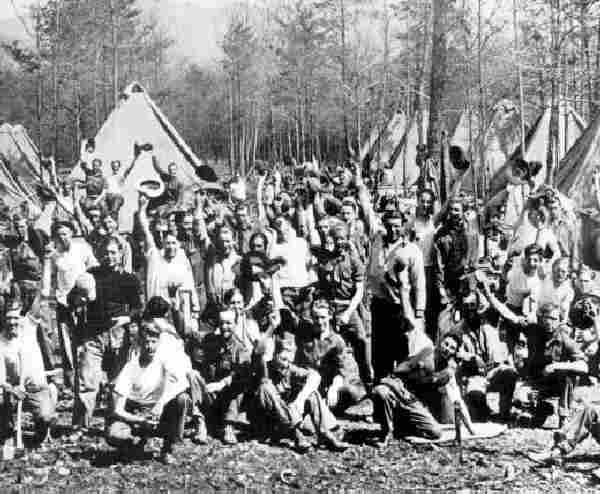
Figure 1.--These CCC youth have just arrived in their camp at Fourt Dix, Nrw Jersey. The CCC was one of the first and least controversial of all the New Deal programs. |

|
Youth benefitted from the Civilian Conservation Corps (CCC). President Franklin Roosevelt established the CCC, only a month after taking the oath of office in 1933. It was one of the first alpahbet soup agencies the President established under his New Deal. The CCC was created for boys who had finished school and couldn't find jobs. They worked in national parks and forests throughout the country, earning the nick name of the Tree Army. It is estimated that the CCC youths planted 200 million trees among their many projects. It was the largest program of reforestation and conservation in American history. This environmental program provided employment for 2.5 million youth and young unmarried men from age 17 to 25. The maintained and restored forests, beaches, and parks. The CCC built numerous forest roads,
campgrounds, ranger stations and trails, many still used by park visitors and campers today. The stipend was only $1 a day for regular enrolless, but included received free board and job training. Assistant Leaders got
$36 and leaders $45. Each month, $25 of their $30 salary was sent home to their
families, many of whom were on relief. The money not only fed the families, but put money into local economies. This was pump-priming in New Deal terms. The CCC also provided their clothes, items similar to what the army wore. Youths who joined up were issued clothes for work and dress uniforms of spruce green in the winter and khaki for summer wear. They wore stripes on their uniforms. Two stripes were Assistant Leader, three strips for the Leader. I believe they were also provided work clothes. The CCC youths were lodged in camps and provided good food and medical care. The camp facilities varied. Many were made up of barracks-like building, often of wood and tar paper. Other worked from tent camps (figure 1). There were about 1,300 camps. During World War II, some of the camps were turned into prisoner of war (POW) camps. The program operated 1934-43. There was also a similar, but much small program for young women. About 8,500 women participated. Many New Deal agencies were sharply criticised, usually by business groups with the recurring charge of socialism. The CCC was one of the most popular and least criticised of all the New Deal programs.
Youth benefitted from the Civilian Conservation Corps (CCC). President Franklin Roosevelt established the CCC, only a month after taking the oath of office in 1933. It was one of the first alpahbet soup agencies the President established under his New Deal and he took a special interest in the program. President Roosevelt explained in one of his Fire Side Chats, "In creating this Civilian Conservation Corps, we are killing two birds with one stone. We are clearly enhancing the value of our natural resources, and at the same time, we are relieving an appreciable amount of actual distress. And we are conserving not only our natural resources, but also our human resources." The program operated 1934-42. It was finally phased out after World War II begun. Because of the draft and defense work, no one had trouble finding jobs, good paying jobs anymore.
The CCC was created for boys who had finished school and couldn't find jobs. This environmental program provided employment for 2.5 million youth and young unmarried men from age 17/18 to 25. Some only stayed in a year, others worked for several. Throughout the program, the CCC rolls varied from about 0.3-0.5 million annually.
Most of the photographs I have seen of the CCC only show White Youth. We suspect that the CCC when there were official visits with photographers only visited White camps. In addition, in 1935 most of the Black camps were closed. There were, however Blacks in the CCC. From the beginning, many Southern states attempt to prevent Blacks from participating. In Georgia officials simply listed all blacks as "employed," making them ineligible to join. This was of course an outright lie. No group in America suffered more severly from the Depression than Blacks. The unemployment rate for blacks in Georgia and much of the rest of the country was twice the rate for Whites. When he learned of what Georgia was doing, the President called Governor Talmadge in May 1933, threatening to withhold CCC funds. Talmadge agreed to reconsider as long as Blacks served in separate camps. As a result, for two years Georgia and other states admitted more than 0.2 million Blacks into the program. That was just a little less than the proportional ratio of Blacks in the population. Some of the first CCC camps in northern states were occasionally integrated, but by 1934 all CCC camps were segregated. This cfreated, however, political problems for the CCC. The presence of a Black camp near a town or village was usually unsettling to the local inhabitants. The director of the program complained bitterly about the general attitude of Americans towards Blacks. As a result, the enrollment of Blacks in the CCC was curtailed in 1935, with President Roosevelt's silent assent. [Golden] We can just imagine Eleanor coming into the Oval Office and begining a conversation with, "Franklin, surely you are not ..." The President while unlike his predecesor was willing to experiment, he was also the ultimate pragmatist. He saw that the issue of Black CCC camps was unwinable. The thought of camps with thousands of healthy, well-fed uniformed young Blacks down the road was unerving enough to most Americans in the 1930s. The thought of them coming into town on the week-end with money in their pocket was just too much. It would have caused a firestorm on Capitol Hill, especially as was inevitabkle some kind of racial incident occurred. It would have not only jepodized the CCC, but other New Deal programs as well. While the president asssented in racial restrictions for the CCC, the interesting aspect of this sad story, it that he did try to open the CCC to Blacks. Despite the New Deal's many failures on Civil Rights, large numbers of Blacks benefitted from other New Deal programs and recognized that the President and especially the First Lady were concerned about their plight.
The CCC's accomplishments were asstonshing. They worked in national parks and forests throughout the country. The created many new parks. They were especially active in National Forrests, earning the nick name of the Tree Army. It is estimated that the CCC youths planted 200 million trees among their many projects. It was the largest program of reforestation and conservation in American history. They maintained and restored forests, beaches, and parks. The CCC built countless forest roads, campgrounds, ranger stations and trails, many still used by park visitors and campers today. Some Western states like Idaho were especially affected by the CCC work. They also fought forrest fires. They constructed 41,000 bridges, 44,475 buildings and 3,982,000 dams, many of them small ones designed to help erosion. They excavated historical sites and restored nearly 4,000 historic buildings. They reclaimed millions of acres of cropland damaged by drought and erosion. They built fish hatcheries, wildlife refuges, and campgrounds. CCC crews strung nearly 90,000 miles of telephone line. When floods devastated the East and Midwest, CCC boys were called in to help, providing much needed relief. Among the many projects completed, the CCC constructed the Appalachian Trail, the Pacific Crest Trail and the Blue Ridge Parkway.
The stipend was only $1 a day for regular enrolless, but included free board and job training. That doesn't sound like much now, but in Depression era America, $1 went along way. Assistant Leaders got $36 and leaders $45. Each month, $25 of their $30 salary was sent home to their families, many of whom were on relief. The money not only fed their families at home, but put money into local economies. This was pump-priming in New Deal terms.
A lot of CCC youth remember the food. One recruit recalls, "We had steaks once a week. And then the rest of the week we’d make braised beef and short ribs. And stew, we’d make once in a while. Every now and then on Sunday we’d have chicken or a special roast or something. A lot of boys come in pretty hungry, pretty thin. And the first month, 6 weeks, they’d gain 10, 11 pounds. That was not unusual." For many of the CCC youth growing up in the Depression, it was the first time they’d ever gotten three square meals a day.
The CCC also provided their clothes, items similar to what the army wore. Youths who joined up were issued clothes for work and dress uniforms of spruce green in the winter and khaki for summer wear. A lot of the gear was World War I surplus uniforms. They wore stripes on their uniforms. Two stripes were Assistant Leader, three strips for the Leader. They were also provided work clothes. One former CCC youth recalls, "In the CCC as well as the Army The standard G.I. ( Government Issue) consisted virtually of two sets or pairs of everything. 2 Sun-Tan (Chino) (Class A) Dress Uniforms for Summer, Two OD Dress uniforms for winter. Great Coat Poncho for rainy weather. 1 Black tie Two B.D work uniforms. 1 pr work shoes (1 identical pr) Dress shoes. 2 bath towels -Shaving Kit Tooth Brush in Metal tube. 2 pr socks. 2 o.d. Hankerchiefs. Turning back the pages of time 58 years can be somewhat of a struggle. However I am quite sure that the (Fatigue) Work Uniforms in the CCC were Blue Denim, the Green uniforms were introduced with the military build-up just prior to WW II."
The CCC youths were lodged in camps and provided good food and medical care. The camp facilities varied. Many were made up of barracks-like building, often of wood and tar paper. Other worked from tent camps (figure 1). There were about 1,300 camps. The camps, but not the work details were managed by the Army. During World War II, some of the camps were turned into prisoner of war (POW) camps.
The CCC was before the era of equal rights. The CCC was for men only. There was, however, a similar, but much smaller program for young women. About 8,500 women participated.
Many New Deal agencies were sharply criticised, usually by business groups with the recurring charge of socialism. The CCC was one of the most popular and least criticised of all the New Deal programs.
We note a PBS TV dicumentary, the "Civilan Conservation Corps" which did a basically good job of presenting the CCC program. We notice, however, some basic failures. Like most media presentastions, the New Deal is presented as a largely succesful period of Government efforts to protect the American people from the Depression. Documentaries broadcast by PBS almost always take this approch because of the liberal outlook of the PBS staff and the film makers. Now while we geberally agree that the CC was a usefulmand effective program, the New Deal itself is a subject of bigoirous scholsarly debate. There is no real attempt by the documentary makers to point out that the Goververnment (both the Hoover Afministration and Congress) played a major role in both turning a recession into the tragedy of the Great Depression anf The Roosevelt Afministration pursued policies that probably lengthened the Depression. Rather the film makers extol government action. One person interviewed stated that the New Deal sought to "Use the crisis to redefine what we owe each other." This utopian thought is misleading. It legitimizes the government increasing taxes to expand programs. Yet there is no appreciation of the fact that higher taxes retard economic growth and job creation. There is a generl failure to recognize the importance of the free market and the damage that misguided public policy can cause. This is unfortunate as a media copny financed by public money should seek to present awidecrange of views and not the narrow view if the film makers and PBS staff. One obvious lapse is that the film makers claim that the CCC changed the entire recreational pattern of the United States. This simply is not true. The CCC did help create or improve many state and national psarks. This was an important achievement. But what dundamentally changed Anerican recreatioinal patterns was free market capitalism. It created an economy which created the weaklth needed to finance family vacatiins and the Model-T and other moidestly priced cars that gave workers the mobility to visit the parks and other attractions.
Golden, Randy. "Civilian Conservation Corps" in About North Georgia, undated internet site.
PBS, "Civilan Conservation Corps," viewed May 31, 2010.

Navigate the Boys' Historical Clothing Web Site:
[Return to Main Depression page]
[Return to Main New Deal children/youth page]
[Introduction]
[Activities]
[Biographies]
[Chronology]
[Clothing styles]
[Countries]
[Bibliographies]
[Contributions]
[FAQs]
[Glossaries]
[Images]
[Links]
[Registration]
[Tools]
[Boys' Clothing Home]