|
Zionism continued in the early 20th century as a minority movement among European Jews. World War I (1914-18) changed the dynamic both for the Arabs and Jews. The War destroyed the Ottomon Empire, but left Psalestine now within the British Empire. The British had appealed to both the Arabs and Jews for support during the War. Britain tried to compromise and promote democratic institutions in Palestine. The Arabs resisted in part because of the secular nature of British instututions. The rise of NAZIism in Germany generated increasing support for Zionism among European Jews. The Holocaust convinced many Jews that they had to have a state that would protect them. Arab resentment of European imperialism generated considerable support for the NAZIs before and during World War II (1939-45), an intelectual commitment that still lingers in the Muslim world. After World War II, the United Nations partitioned Palestine and Arab irregulars launched attacks against Jews (1947). When the Isrealis declared independence the neigboring Arab states invaded (1948). Somehow the Isrealis without a professional military or heaby sarms managed to survive. The Arab states refused to accept Israel and financed by the Soviet Union built up large modern militaries as well as supported guerilla attacks against Israel. The Isrealis prevailed in a series of wars (1956, 1967, and 1973). In the process the Isrealis occupied the West Bank and Gaza Strip as well as the Golan Heights (Syria) and Sinani (Egypt). Egypt decided to make peace with Israel, but the other Arab states continued to refuse to recognize Israel. Egypt as part of the Camp Daid Accords retrieved the Sinai and recognized Israel (1978). Fatah guerilla terror continued attacks on Israel. Arab public opinion even in Egypt continued to be hostile to Israel. Fatah attacks resulted in an Isreali excursion into Lebanon (1982). The Palestinians finally agreed to make peace as part of the Oslo Peace Process (1993). This turned the West Bank and Gaza Strip over to the Palestinian Authority. Continuing Isrealis security concerns meant a continuing Isreali presence. The Isreli settlenents also were a continuing impediment to peace.
As pogroms raged in Russia, small numbers of European Jews came to the conclusion that Jews needed their own homeland where they could be masters of their own fate. And it was Palestine that they wanted for their homeland. It all seemed an unrealistic dream. Paestine was occupied by Arabs. Obly small numbers of Jews lived there and it was a privince of the Ottoman Empire. Small numbers of European Jews enthused with Zionism migrate to Palestine in the late 19th century. Most came from Eastern Europe where anti-Semitism was most pronounced. Jews began arriving in numbers during the 1880s. The vast majority of the Palestinian population at the time was Arab. Palestine at the time was part of the Ottoman Empire. Land registration in individual names was still a relatively recent development. Zionist purchased land in the name of the Jewish National Fund. This land was thus held in the name of the Jewish people and could never be sold back to Arabs. Like much about the conflict, there is controversy here. The Zionist claimed to have acquired arid land of little value and developed farming techniques to make the desert bloom.
Palestine until World War I was part of the Ottoman Empire. What we now refer to as Palestine is a fairly modern term which first began to be usused in the mid-19th century. European powers began to be concerned sbout the treatment of Christins in the Levnt, ibcluding Palestine. The arabs were a large minority in the Ottoman Empire. The Ottomans used both Christians and Jews to ofset the Arabs in their domains. The Ottomns granted Muslim, Christian, and Jewish communities to exercise jurisdiction over their own members through charters granted to them. This was standard Ottoman policy for centuries. Jews and Christians thus enjoyed a large degree of communal autonomy including matters like religion, personal status, taxes, and in managing schools and charitable institutions. Ottoman authorities regularized these charters as part of Tanzimat moderizatiom reforms (1856). As a result of Muslim Arab attacks on Christians and Jews, the European powers demanded better security arrangements for Chistians. Ottoman authorities were generally anxious to accomdate the Europeans to obtain diplomatic support to help fend off Russian incursions. This is often forgotten in the modern discussions of Palestine. There were very serious Muslim Arab attacks on non-Muslim communities before Zionist Jews began arriving in Palestine. The Christian Arab community was still sizeable in the Levant. Jews also benefitted from these protections. The Zionist movement in Europe organized the First Aliya in the late-19th century. The larger Second Aliyah followed in the early-20th century (1904-14). This included some 40,000 Jews, primarily from Russia and Poland (at the time mostly occupied by Russia). Tensions existed between the different comminities. This porimarily took the form of the majority Muslim Arabs attacking Christian Arabs, especially in aras like Nablus with strong Muslim majorities. The arrival of Zionist immigrants introduced larger numbers of Jews and more Muslims began to target Jews. This was, howver, mostly small-scale incidents. There was no reoccurance of the large scle attacks, primsrily because the Europeans had made it ckear that Arab Cristians were under their prorection. As Europe moved toward war, the security situation in Palestine did not change. The Ottoman Empire and Germany moved closer together against Britain and France, but Germany was one of the European powers which demanded that Ottoman authorities provide security arrangements for Chistians.
The Ottoman declaration of war opened up new fronts in the War (1915). The Ottomans thus fought two campaigns with the British in the Middle East. One was fought with Indian troops in Mesoptamia who were deployed to protect the oil refinery at Abadan in Persia. The campaign resulted in the creation of Iraq. The other was fought with British, Empire (largely Australian) trops in Egypt and Palestine. The primary British interest was in protecting the Suez Canal. Tge British buold up a substantial army in Egypt and unfer General Alenby launched a campaign which seized Palestine, Syria, and Lebanon from the Turks.
As part of the British effort, Major T.H. Lawrence was sent to aid and King Feisel's Arab Army--an irregular force. He enfused new tactics into the arab Revolt. The Middle Eastern campaigns were a side show of the War. Other than protecting the Suez Canal, they were of only minor importance in the War. They were, however, of enormous importance in the post-War history of the Middle East. The British after the War administered Palestine as a League of Nations Mandate.
The Jewish Legion was founded in 1917. It participated along with the British and the Arab Army in the liberation of Palestine. Its commander was Colonel John Henry Patterson. He was an ardent Zionist and commanded the battalion-strength Zion Mule Corps around which the Jewish Legion was built. The Zion Mule Corps served at Gallipoli (1915). The Jewish Legioin also played a role in World War II. It was used for security purposes before bveing deployed in Italy and seeing combat near the end of the campaign. They helped spirit survivirs of the Holocaust to Palestine. The Legion played an important role in the foundatiion of the Haganah which in turn was the foundatiuin of the Isreali Defense Foirce (IDF). Many JL membrs played major roles in the foundation of Israel.
The British era in Palestinr began when Sir Mark Sykes and Charles Picot during World War I negotiated the Sykes-Picot Agreement. This set out the British-French colonial spheres in the Middle East. British Foreign Secretary Arthur James Balfour committd Britain to establishing a Jewish homeland in Palestine (November 2, 1917). This is known as the Balfoyr Declaration. At the time the British offensive in Palestine was moving toward Jerusalem. Balfour's statement was included in a letter to Lionel Walter Rothschild, 2nd Baron of Rothschild, of the Jewish banking family. Rothchild was an important British Jewish leader and played a role in financing the British war effort. Two important Zionist leaders (Chaim Weizmann and Nahum Sokolow) were seeking British support for a Jewish homeland, particularly important as it became increasingly clear that the British were going to end Ottomon frule of Palestine. The British were hedging their bets as they also wanted rab support. This created a tense situation in Palestine because it meant that some Arabs might be living under some soirt of Jewish control. The Mufti Haj Amin al Husseini and his associate Aref el Aref help agitate Palestian Arabs to riot, attacking Jews in Palestine. This was in many ways an attempt at an old-fashioned pogrom.
The problem for the Grand Mufti was that he did not control the state, unlike similar such incidents in Arab history. The British and French resolved issues concerning their new Middle Eastern colonies at the Cairo Conference (1921).
The League of Nations approved the British Mandate of Palestine (July 7, 1922). The British introduced Western legal concepts to Palestine. One of the actions taken was abolishing “dhimmitude”.Under this system, non-Muslim dhimmis lived in a system of institutionalised subgegation. Political rights were denied to all but Muslims. Changing this system was a major concern of Palestianiansand other Arabs. As the number of Zionist immigrants increased and the area of land expanded, conflicts began to develop with the Arabs. One poorly persued topic is the Palestinian economy and the impact of the influx of Jewish settlers to Palestine. Anti-Jewish sentiment among the Arabs existed before the Zionist settlement. There is not doubt that the influx gave rise to increased anti-Jewish sentiment. This is a normal reaction in any country, just as the Irish immigration in America gave rise to anti-Irish sentiment. Into this volitile mix the Grand-Mufti of Palestine promoted violence against the Jews. The British tried to defuse the situation, arresting both Arabbs and Jews and confiscating weapons. Jews claimed that because of the importance of the Arabs in British colonial policy, that the British generally favored the Arabs. Here we are not sure, but it is a topic we need to pursue. Even a neutral polic, however, favored the Arabs. Palestine was suronded by Arab states or colonies to become Arab states. Thus if the Jews in Paestine had no weapons they would be defenless if the neighboring Arab states invaded. The "Arab Revolt" led by the Grand Mufti targetted both the British and the Jews (1936-39). The British Peel Commission following on the Arab riots suggested spliting Palestine into a Jewish and Arab state (1937).
The Jewish area would have about 25 percent of the land. At the time there were about 450,000 Jews in Palestine. The British believed that the much larger and more populous Arab state would not be economically self-sufficient. Thus the British saw a need for the Jewish state to support the Arab state. The Commission was important because it was the first official recognition of partition as a sollution. Most peace outlines since have adopted partition as the sollution. There have been no other possible sollution offered. Obtaining agreement from the parties involved, however, has proven elusive.
NAZI diplomacy with its anti-British and anti-Semitic approached appealed to the Arabs. Here they met considerable sympathy both because of rising anti-Semitism and opposition to British colonialism. The British attempted to counter this by issuing a White Paper before the War began withdrrawing their support for a Jewish homeland. The German position in the Middle-East was strengthen with the fall of France (June 1940). Vichy France was recognized by authorities in French North Africa, Syria, and Lebanon. Palestenians religious figures openly courted Hitler and the NAZIs. The Grand Mufti fleeing arest in Palestine sought refuge in Iraqi where a colaborator, Rashid Ali, led a pro-Nazi coup in Iraq. Saddam's uncle was also involved. It failed. The Grand Mufti tied to do the same in Iran, but was forced to again flee with the Soviets and British intervened. Both the Grand Mufti and Rashid found refuge in Berlin. The Mufti received financial support from the NAZIs and made proaganda broadcasts. He also helped recruit Muslim SS Divisions in both Bosnia and Kosovo. The the NAZIs as under the cover of the war launched the Holocaust. The Grand Mufti incouraged NAZI leaders to kill more Jews. The NAZIs of course needed little encoracment. The Grand Mufti's propaganda broadcasts to the Arab world, however, had considerable political resonance. Future Arab leaders like Nasser and Sadat were among thoses impressed. Many Arabs, especially those in Egypt, Palestine, and Iraq hope for what they saw as liberation from NAZI armies in North Africa and Russia. And for a time in 1942 it look like Rommel in the Western Desert and the Paulis in the Ukrain might just deliver such a victory. The ironic aspect of this was Grand Mufti and the NAZI supporting Arabs seem to have been oblivious to the fact that the NAZIs saw Semetic people in geneeal as inferior and not just the Jews. And thus they would have been destimed to an infrior status in a NAZI controlled world. Nor do the seem to hasve understood that Hitler did not want to demolish the British Empire. His concept was to use the British to help control the "inferior" peoples outside Europe. British resistance forced Hitler to persue the War against Britain, but it was not his desire. He wanted the British as an ally. Actually the Axis had one Arab colony during the War--Libya. The brutality of the Italians in Libya might have given the Grand Mufti and other Arabs pause about an Axis victgory in the Mikddle East, but it never seems to have done so.
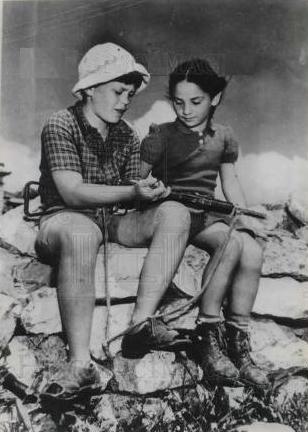
The NAZI Holocaust shatered Jewish society throughout Europe. Estimates vary, but the most commonly used estimate is that the NAZis and their colaborators murdered about 6 million Jews in Europe. Jewish communities and culture which had thrived for centuries were desimated. The Grand Mufti in Jerusalem before the War helped oraginze anti-Jewish riots and then aided a pro-NAZI coup in Iraq. When that failed he fled to Germany where he was hosted by the NAZIs. He made anti-Semetic broadcasts and urged his NAZI hosts to kill more Jews. He helped the NAZIs organize Muslim SS units in Bosnia and Kosovo. The historical basis of the Holocaust is well established. Curiously a variety of Muslim leaders have chosen to deny or claim that accounts are exagerated. The most prominant recent example is Iranian President Mahmoud Ahmadinejad who made a number of such statements in 2006. The question is why is this so common in the Muslim world. After all whether or not Hitler killed Jews has nothing to do with the valikdity of the Jewish claim on Israel. (It explains why many Jews came to Isreael, but does not justigy the Jewish claim.) The only reason that we can think of to explain why many Muslims deny the Holocaust is they resent anyrhing thing that generates sympthy for Jews. Perhaps readers can offer some onsight here. An unusual aspect of the current Isreali-Palestinian conflict is that children (Arab and Jewish) are not only the victims of the conflict, but they are also participating in the violence. We have all seen the images of rock-throwing Palestinian boys, some as little as 6 years old. Palestinian youth have carried out suicide bombing attacks killing Isrealis of all ages.
President Roosevelt met Saudi King Abdul Aziz ibn Saud in a celebrated encounter aboard an American ship as the President was returning from Yalta (1945). King Saud proclaimed to President Roosevelt that the "Jews have no right to Palestine". and that the Arabs would fight to prevent the creation of a Jewish state. The President began taling about the horors of the NAZI holocaust. Saud asked why "innocent bystanders" (the Palestinian Arabs) hd to pay for the NAZI crimes. Saud suggested that if the NAZIs murdered 3 million Jews in Poland that there now should be room for Jewish refugees. [Oren] There was some truth in what Saud told the President, but he also ignored some inconvenient facts. The chief Palestinian spokesman the Grand Mufti was a NAZI supporter and from Berlin encouraged the NAZIs to kill more Jews. There was also considerable support for the NAZIs in Muslim countries, especially Iraq and Iran. In addition, the Jewish refugees in British Palestine did not only come from Europe, but also were coming from Muslim (mostly Arab countries). The Orinental Jewish refugees (the Mizrahim) were fleeing varying levels of discrimination.
Latin America, especilly Argentina, is commonly associated with ptoviding haves to NAZI war criminals. This did happen, in part because important figures like Col. Juan Peron were impressed with Fascism and wanted noting more than their own Fscist diuctatorships. There were also German communities throughout Latin merica in which they could hide. Less well known are the Middle Eastern countries that provided havens for NAZIs. Palestine was not one of the havens, largely because the British were in control. But Egypt, Iraq, and Syria provided havens for NAZI war criminals fleeing Allied justice. They played a variety of security/military/scientific roles in the new Arab states. The Grand Muftik spent the War in Berlin majing NAZI propagnda broacasts and urging Hitler and Himmler to kill more Jews. He was wanted by Yugoslav authorities for his role with Muslim SS Divisions. He managed to escape French custody and reached Egypt. Here he was hosted by the Egyptian Government in Cairo.
Large numbers of European Jews who survived the Holocaust were unwilling or unable to return to their homes after the War. Many wanted to go to American and were able to do so as aresult of changes in emigration laws.
Many others wanted to go to Israel. This was more difficult. Palestinian Arabs strongly opposed this. British Mandate authorities out of desire to maintain order in Palestine and placate Arabs Governments strictly limited Jewish immigration. Jews attemoting to enter Palestine without authorization were arrested by the British and many interned in camps on Cyprus. Many Americans are familiar with this because of the Leon Uris novel Exodus. Uris explains that his book was fictional, but it was based on actual events. The Haganah obtained ships to get Jews to Israel. And one of them was Exodus. Yossi Harel was the ship commander.
Harel as a teenager he joined the Hagenah served under Orde Wingate, the legendary British Zionist exponent of Jewish self-defense. Harel commanded four Haganah vessels that managed to get 24,000 Europe Jews to Palestine through clandestine maritime operations. The Haganah called the operation Aliyah Bet. The British called it "illegal immigration." The Exodus was a dilapidated excursion liner crewed by mostly American volunteers and captained by Isaac "Ike" Aronowitz--a 23-year-old Palestinian Jew who had served in the British merchant marine. Aronowitz at times argued with Harel. The Exodus was designed to accomodate 400 passengers and a crew of 58. The Hagenah managed to get Exodus out of a French port without permission and headed for Palestine (July 11, 1947).. It carried more than 4,500 Jewish refugees. A Royal Navy convoy seized the over-croded Exodus at sea while it was steaming to Palesine (July 18). The Hagenah resisted and three Jews were killed and 28 hospitalized. The British attempted to find the Hagenah leaders and ship captain, but they his in prepared places. The British brought Exodus into Haifa. A Jewish work detail Jews came aboard to clean the ship which because of the overcrowding was filthy. The Hagenah members walked off with the cleaning detail. This was not the first such incident and the siuation in the Mandate was becoming increasingly difficult. British Foreign Secretary Ernest Bevin decided to "teach the Jews a lesson". The British had been intern captured Jews in detention camps on Cyprus. These camps were becoming problems in themselves. Bevin announced a new policy of returning undocumented Jews to their port of embarkation, in this case France. This policyhad the advantage that the British Government would not be respobsible for the refugees as they were on Cyprus. The refugeees refused to cooperate. There were 60 infirm and elderly Jews who went ashore when the Royal Navy returned them to France in a prison ship. The remaining Jews staged a hunger strike off the French coast and refused to leave the Royal Navy prison ships. The result was a highly publicized standoff which lastd 3 weeks which proved embarassing to the British. Finally after consideravle press coverage, the Royal Navy ordered the prison ships to Hamburg, Germany. There Royal Marines put the Jews ashore by force (Septeber 8).
Returning Jews to Germany was not the kind of image Britain's Labor Government wanted. This untenable situation in combination with the escalating violence in Palestine must have played into the British decesion to withdraw.
Harel was quite a figure. After completing his assignments with the Aliyah Bet, he worked with Israeli intelligence and then as a private businessman. In a 1988 radio interview, Harel commented, "As someone who spent many years transporting refugees, I have special feelings on the subject. It doesn't matter to me if they are Jews, Vietnamese, Palestinians or Indians. It's necessary to help refugees and people who have been exiled from their country."
The Allies at the end if World War II formaly formed the United Nations (1945). It was a term used by the Allies during the World War II even before the organization's formal creation. As the sucessor organization to the League of Nations, the UN assumed responsibility for the League mandates, imcluding Palestine. The Arabs resisted UM efforts to mediate the Palestinian issue. The UN appointed an 11-member Committee to study the issue (1947). The Jewish Agency cooperated with the UN Committee, but the Arabs boycotted it (May 1947). The Committee voted 8-3 to recommend partitioning Palestine into Jewish and Arab states. Jeruselum was to be an international zone. The UN General Assembly approved a resolution to partition Palestine (November 29, 1947). The UN Resolution was supported by France, USSR, USA, Liberia, etc. The vote in the General Assembly was very close. The Arab nations as a bloc opposed partition. The Arabs rejected the Resolution. Partition was unacceptable to either the Palestinians or the neighboring Arab states. The Arabs threaten to invade if the Jews moved to establish a Jewish state. Armed irregulars, both Palestinian and other Arabs, immediately began to attack Jewish communities. Low level attacks comtinued as the British withdrawl from Palestine approached.
Isreali terrorists after Worls War II targetted the British whonattempted to limit Jewish emigration to Palestine. Palestinian Arabs carried out attacks on Jews who retaliated. The British attempted to disarm both sides which given potential intervention by Arab armies might be considered a pro-Arab poliy. Palestinian Arabs stepped-up a campaign of violence on the eve of the UN Partition Resolution (November 1947). We do not yet have details on the violence that occurred both before and after the U.N. vote to partition Palestine. Ultimately the irregular activity within Palestine was supported by an actual invasion of Arab regular armies after Israel declared indepencence (May 1948).
The League of Nations had assummed responsiiity for Pallestine after the withdrawl of the Ottoman Empire. The United Nations assumed responsibility as the successor organization to the League of Nations assumed responsibility. Conflict between the Arabs and Jews became too intense for the British to control. Both sides began targetting the British. The most notable attack was the Irgun attack ob the King David Hotel when many British officials were living. As a result of expanding Arab and British terrorism, the British proceeded to withdraw and turn over Palestine to the United Nations. The U.N. partition plan was to take effect on the date of British withdrawal from the Mandate Territory of Palestine. The British began withdrawing their military force (early April). The British mandate over Palestine was due to expire on May 15, 1948. The Jewish Leadership led by future Prime Minister, David Ben-Gurion, declared independence on May, 14, the day before the expiration. One observer calls the British withdrawl "probably the most shamefaced British withdrawal" from any of its possessions. [Shepherd]
The decision for Israeli independence was taken by the Minhelet HaAm (מנהלת העם), the People's Administration (May 12, 1948) The Minhelet HaAm was essentially Israel's pre-independence parliament with representatives from the dufferent bpolitical parties. Tel Aviv was a largely Jewish city and thus a safe place to for officials to meet and decide the independence question. This could not be done in Jerusalem because the city was surrounded by largely Arab areas and the Jews in the city were beseiged. Three of the 13 members were missing, The Minhelet HaAm meetig convened 1:45 PM aand went on until after midnight. The issue was whether to accept: 1) a proposal for a truce and a U.N. Trusteeship to replace the League Mandate or 2) declaring independence. The members voted on the second alternative. Six of the ten members in attendance voted for it. The British Mandate originally granted by the League of Nations over Palestine expired (May 14, 1948). The British High Commissioner for Palestine, Lt. Gen. Sir Alan Cunningham, and British military forces completed their withdraw by midnight. The Jewish People's Council, the leadership of the Jewish Agency, led by Dabid Ben-Gurion, the Executive Head of the World Zionist Organization and the chairman of the Jewish Agency for Palestine, on the same day meeting at the Tel Aviv Museum approved a proclamation establishing the State of Israel. News of the announcement leaked out and people on the streets of Tel Aviv began singing Hatikvah in the streets before David Ben-Gurion even began reading the dceclaration. The actual ceremony was held at 4 p.m. before the British left to avoid making the declaration on Shabbat. It took 17 minutes to read the entire document in a 32 minute ceremony. David Ben-Gurion, chairman of the Palestine National Council, read the declration, "We hereby proclaim the establishment of the Jewish State in Palestine, to be called Israel. ....” Some Jewish officials signed the declaration later and one person even signed twice. Gunfire could be heard from fighting near Tel Aviv during the ceremony. Jewish flags soon flashed on all important Tel Aviv buildings, automobiles appeared with newly minted Jewish license plates, and Haganah officers exchanged toasts in the cafes. That night Tel Aviv was blacked out because of the danger of Egyptian bombing. Celebrations went on throughout the city, especially behind cafe doors. Just before midnight, the celevrations broke into the streets. News reached Tel Aviv that the United States had recognized the new state of Israel. of the United States recognition had just reached Tel Aviv. Four hours after the announcement, the Egyptian Air Force bombed Tel Aviv without any clear targets. Israel did not yet have an air force. An invasion by the rmies of Egypt, Jordan, Lebnon, and Syria immediately followed.
The Zionist Movement emerged from the Jewish experience in Western Europe. Great progress was made in emancipating Jews in Western Europe (throughout the 19th century). Jews became integrated into the national life, especially in Western European countries. Jews in Eastern Europe, especially the Russian Empire which included Poland were still denied extensive particiption in national life. And even pogroms contunued. It was thus in Eastern Europe that Zionism made its greatest progress. There was at the time an outlet, Jews could move to western Europe or emigrate to America. Only in America was Jewish emigration unlimited. Zionist debated the idea of a Jewish state. But even in Western Europe Jews found descrination as exemplified in the French Drefus Affair (1905). Only in America which was by no means free of decrimination did Zionism make no real headway. A call for a Jewish state thus gained support anong European Jews. It was, however, the NAZI Holocaust that created a steely determination among Jews that a Jewish state was indispensable. The NAZIs until 1939 had pursued a policy of dremigration. The NAZIs were willing to allows Jews to leave and in fact adopted policies to drive Jews out of Germany, even revoking their citizenship, confiscating property, and denying them all legal protections. In some cases they even expelled Jews. The problem was that Jews could not find countries willing to accept large numbers of Jews. Many Jews did leave Germany and more would have had they been able to find countries to accept them. American emigration policy became more restrictive after World War I. This was not directed specifically at Jews, but it did significantly limit the major haven for European Jews. And the problem of finding countries willing to accept Jews continued even at the Evian Confference (July 1938) when it was becoming increasingly clear where the NAZIs were headed. If a Jewish state had existed, millions of lives could have been saved. This was the idea that was on Jewish minds after World War II when partition and an independent Jewish state surfaced. Arab violence and the lack of a democratic tradition or the idea of minority rights only increased the determination of the Jews who had reached Palestine.
The Arab States responded to the creation of the UN-mandated Jewish State of Israel with a joint invasion (May 1948). Each of the neigboring Arab states had armies with modern weapons although the training was uneven. The neigboring Arabs states (Iraq, Lebanon, Syria, Jordan, and Egypt) invaded to destroy the new Jewish state. The invasion force included five regular Arab armies along with armed Palestinians, and armed Arab volunteers (including Moslem Brotherhood elements). One of the participants was the Cairo-born and educated engineering student, Yasser Arafat. He was 19 years old and young Leiutenant in the Egyptian Army. He fought on the Sinai front. Palestenian Arab irregulars attack Jewish settlements. Here the Arabs targeted both the Jewish fighters and non-conbatants. Few thought the Jews could prevail. The Haganah was not a modern army and the British had prevented then from acquiring weapons. The Haganah had only a small number of rifles (of a myriad of types and caliburs), few heavy weapons, and no tanks. About 4,000 foreign volunteers join the Isrealis. The Jews proved to be a more formidable force than the Arabs had anticipated. Somehow the Israelis with a hodgepoge of weapons fought off the invading Arab armies. A Jewish Kibutz, Yod Mordichai stoped the entire Egyptian army for 5 days while the Isrealis organized the defense of Telaviv. The most professional military proved to be the British-trained Jordanian army--the Arab Legion. The Isrealis and Jordanians fought each other to a srandstill in Jeruselum. A series of truces failed to sto p the fighting. Atrocities were reported on both sides. After a year of fighting, a ceasefire finally ended the war (1949). One of the countroversies resulting from the War was the Palestinian Arab refugees. Some fled Palestine because of both the fighting and Jewish attacks like that Deir Yassin village near Jerusalem. It is unclear to what extent the Arab refugees resulted from this or the fact that the Arabs called on the Arab Palestinians to evacuate Palestine. The idea was to create a "free-fire zone" in which Jews could better be targeted. This was the genisis of the Paestinian refugee problem.
In sharp conteast to the support the Palestinian Arabs received from other Arab states, especilly the Front Line states, Israel did not receive military support from any other country. British policy was to disarm both the Arabs The United states and the Soviet Union supportted partition and recognotion, but no other country was willing to commit troops to fighting the Aarbs in Palestine. Neither did the United states provide military equipment. American Jewish groups did provide private financial support. The U.S. Government did not provide any military equipment or support. The Irealis were able to obtain some weapons in Europe. Czechoslovakia was particularly important. Soviet policy toward Israel and the Arabs was still in a period of flux. American support has been vital for both the creation and continuation of Israel. The United States has not been the only country supporting Israel, but has been by far the most important. This is interesting given the substantial level of anti-Semetic feeling in America. Much of this was disapated by World War II and the NAZI Holocaust. Suddenly anti-Semitism was no longer acceptable in polite society. American Jewish groups were particularly important in the early years. They strongly supported Israel and were an important source of funds. There was considerable political support, not only among Jews, but many other groups, including liberals, blacks, and women. Presiden Truman had provided diplomatic support, but not direct economic or miliiary assistance. There was indirect American aid through the United Nations, primarily UNRAA. Most of this aid went toward the Palestinians, including some Isreali aid. The ficus on Palestinian refugees continued even when large numbers of Jewish refugees began streaming in from Arab countries. This was because of the diffeences in Isreli and Arab policies. The Israelis attempted to get refugees out of camps and assisimlate them as rapidly as possible. The Arabs on the other hand kept the refugees in camps, even with Palestine and to discourage assimilation. We are just beginning to develop details on American aid to Israel . The first direct aid we know of was a $65 million long-term loan to help Displaced Persons (DPs) (1951). By this time most of the refugees arrivig in Israel were from Arab countries. Later the United States provided guarantees for commercial loans to help a million Jewish immigrants from the Soviet Union (1990s). Israel has notably repaid these humanitarian loans in full, while many other nations have defaulted on such loans. American assistance which would reach substantial levels began later. There was no military support during the Truman Administration (1945-53). This began to change, but only slightly during the Eisenhower Administration (1953-61). A major factor was the Cold War and the decision by Egyptian Presudent Nasser to turn to the Soviets for support. Other Arab countries (SYria and Iraq) also turned to the Soviets. The United States provided Israel limited amounts of economic aid, mostly as loans for basic food stuffs. Much more important was German war reparations, which Israel were used for domestic development. France was Israel's main arms supplier (1950s). The French provided Israel advanced military equipment and technology, especially aircraft. This support was used by Israel to counter the perceived threat from Egypt under President Gamal Abdel Nasser as aesult of the Czech arms deal (September 1955.
American policy at the time was focused on preventing Nasser from joining the Soviet Bloc. The United States attempted to remain neutral and not to become too closely allied with Israel. Government assistance was limited to food aid. This finally began to change with the Kennedy Administration (early-1960s). The United States began selling advanced, defensive, weapons to Israel, Egypt and Jordan, most importantly Hawk anti aircraft missiles.
The Johnson Administration decisively shifted American policy. American policy became to substantially support Isreal militarily, but American support was not unquestioning. Until the Six-Day War, the United States attempted to deal even handely with Israel and the Arabs (1967). Support for Israel became a central feature of the American foreign aid budget.
The term refugeees when mentioned in reference to Isreael-Paestinian issue is normally used in reference to Palestinians Arabs. Large numbers of Paestinians fled from the areas where the areas over which Isrealis gained control. Historians believe that during the 1948 war that about 0.7 million Arabs fled or were expelled from the part of Palestine which became Israel. Less well known is that a similar number of Jews were expelled from Muslim countries where their ancestors had lived for centuries, in some cases predating Islam. Rather than being a one-sided refugee priblem, there was in fact an exchange of population. The essential difference is that Israel absorbed and integrated the Jewish refugees, both the European refugeees abd the so called Oriental Jewish refugees from Arab countries. The Arab countries, however, did not absorb or integrate the Palestinian refugees. As a result, decades fter the 1948 war, we are still talking about the Palestinian refugrees, who are now mostly the children and grandchildren of the 1948 refugees. One reader writes, "If 1948 was an injustice, it was not unique. Almost every existing country was built on land seized from someone else at some point in the past. If we set out to reverse every such "injustice", the result would be a global bloodbath. All that happened in 1948 and 1967 was that the Muslim world was defeated in war and lost a small amount of territory. This has happened to many societies at various times. The only unique feature of the Palestine case is that the Muslim world would rather keep fighting -- perhaps to the point of triggering a nuclear holocaust -- rather than accept reality and move on."
Gambul Ambdul Nassar, an Egyptian colonel, overthrew King Farouk. Nassar was a strong proponent of Arab nationalism. His emotional speeches and wide appeal throughout the Arab world. There was even a public realtions union with Syria. Nassar believed in no accimodation with Israel. Differences over the Awan Dam caused Nassar to move toward the Soviets who offered both enguneers and financing for the dam, but large quantities of weapons.
King Abdullah of Jordan was the son of Sharif Hussein, the Emir of Mecca, who had sparked the World War I Arab revolt. As a result of the commitments made, the British installed him as emir of Transjordan, later changed to king of Jordon. Throughout the inter-war years Abdullah had been dependent on British financial support. He also was assisted by them in the formation of an elite force, the Arab Legion, which was commanded and trained by British officers but staffed with Bedouin troops. The Arab Legion acted to maintain order and secure the allegiance of his Bedouin subjects. It became the most professional military in the Middle East. The King along with other Arab leaders participated in the 1948 invasion os Iserael. The experienced caused the King to cchange his mind about a military sollution. The King delivered a different message to the Arabs than Nassar who was determined to destroy Isrrael with military force. King Andullah became convinced that an accomodation needed to be reached with Israel. Nasser's impassioned pleas had more appeal to the Arab public than King Abdullah's quiet voice of compromise. This flexible approach was anathema to Palestinians and many other Arabs. A group of 10 conspirators plotted to assasinate the King. A young Palestinian shot the King at the al-Aqsa Mosque in Jerusalem (July 20, 1951). The leader of the group was a cousin of the Grand Mufti. King Abdullah's grandsom, Prince Hussain, was at his side when he was shot.
The 1949 ceasefire did not end the killing. The Uninted Nations helped supervise the ceasefire along the volitile Egyptian-Isreali border. This limited incidents between the regular armies on both sides. The Arab strategy beginning about 1950 with the regular armies sidelined consisted of cross-border attacks by "Fedayeen" irregulars, supported by the Arab states surrounding Israel. The Arab irregulars targeted civilian or soft targets like Jewish settlements. Homes and busses were bombed and shot up.
The UN peace keepers were unable to prevent the attacks. The Arab irregulars received varying degress of support from Arab governments. There is a long list of attacks on Isrealis from the 1950s through to the Six-Days War. All of this occurred before the occupation of the West Bank which many Arab sources often site as the cause of Palestinian terror attacks. In response, the Isrealis organized comando operations of their own. A young Isreali officer, Erirl Sharom, organized Unit 101. Armed with Isreali-built Uzzis. Unit 101 was specifically tasked with rsesponding to Faydaeen attacks.
Egyptian President Gamal Abdel Nasser emerged as the most influential Arab leader. He was determined to defeat Israel and in his view loberate Palestine. He accepted an offer from the Soviets for modern arms including planes and tanks on generous terms (1955). This permitted him to build very powerful forces to attack Israel from Egyptian bases in the Siani. He also allowed the
Fedayeen freer reain to carry out terroist attacks. He announced ithout mincing words, "Egypt has decided to dispatch her heroes, the disciples of pharaoh and the sons of Islam and they will cleanse the Land of Israel .... There will be no peace on Israel's border because we demand vengeance, and vengeance is Israel's death." [August 31, 1955] At the time, Egyptian intelligence was heavily involved in training and equipping the Fedayeen. This involved Jordan because the Fedayeen operated primarily from bases in Jordan which had seized the West Bank in the 1948 War. Egyptian Sianai was distant from Osreali population centers. The West Bank was, however, was right next to potential Isreali targets. This was the beginning of a familiar pattern. The Fedayeen attacks lwere largely on Isreali civilians. They violated the 1948 armistice agreement which prohibited provision that prohibited attacks by paramilitary forces. Even so, when Israel struck back it was censured by the U.N. Security Council for its counterattacks. The situation worsened when Nasser closed the Straits of Tiran, essentially blockading Elat at the head of the Gulf of Aqaba. Nasser further escalated the situation by nationalizing the Suez Canal (July 1956). Nassar left no doubt about his intentions.
"I am not solely fighting against Israel itself. My task is to deliver the arab world from destruction through Israel's intrigue, which has its roots abroad. Our hatred is very strong. There is no sense in talking about peace with Israel. There is not even the smallest place for negotiations." (October 14)
The Arab strategy was to launch a combined three prong invasion of Israel. Egypt, Jordan, and Syria, the front-line states, signed a tripartite agreement (October 25). Jordan and Syria agreed to give Nasser command of their armies. Israel decided to act before the three countries could launch a coordimate invasion.
The Six Days War changed the dynamic of the conflict between Israel and Palestine. The United Nations for 8 years patrolled the Isreali-Egyption border in the Siani. Nasser backed with an infusion of Soviet weapons decided to cibfront Israel militarily. Nasser otganized an alliance with Syria and Jordan. He moved 100,000 troops to the border armed with 1,000 tanks. He ordered the United Nations out. An audacious Isreali air attack destroyed the Egyptian Air force on the ground. Egyptian Air Firce commanders were at first afraid to tell Nassar wjat had happened. Nassar spoke on radio and television claiming that the Isreali Air Firce had been destroyed. The Arab public was estatic. Nassar urged the Syrians and Jordanians to joun the war with Isreal. He assured them that Egypt was winning the war in the Siamai. Israli armor desimated the Egyptians and pushed to Suez. The Isrealkis then turned on the Jordanians and Syrians that had invaded. The Isrealis managed to seize the rest of Jeruselum.
The Isreali attack on the USS Liberty during he Six Days war (1967) is still unexplained. There were 34 Americans killed and 171 wounded. The Isrealis claim it was a tragic mistake. Many in the CIA including Richard Helm believe that the Isrealis attacked the Liberty on purpose, although they are baffled as to why. [Helms]
Eight Arab heads of state met for a summit conference held in Khartoum, Sudan (August 29 - September 1, 1967). The Conference is important because it essentually stated the consensus that would become the official policy of most Arab states toward Israel for the following two decades. The essential policy was No to Peace, No to Recognition, and No to Negotiation with Israel. This was a definitive restatement of the Arab policies since the 1949 armistice.
This was a sharp rejection od Israel's "land for peace" offer. The Arab heads of state rejected the idea of a petroleum embargo on the West. This had become a major idea floated in the Arab world. Egyptian President Gamal Abdul Nasser after the disatrous defeat in the 6 Day War has to find someone to blame the defeat on least the Egyptian people begin to question his leadershipnand policies. The Arab countries had been armed to the teeth with oil money and Soviet aid. There is no doubt that the Arabs had the military forces to destroy Israel. They failed due to poor leadership. When he spoke to the Egyptian people, he blamed the Israeli victory on air-support provided by the United States. This of course was an out right lie.
He also orated, "The Sixth Fleet runs on Arab Petroleum." Other resolutions included the creation of a fund to assist the economies of Egypt and Jordan. Another agreement was reached to end the inter-Arab war in Yemen. Currently the Arab Khartoum Resolutions with the "three no's" rejecting peace with Israel are currently being laundered into an attempt at reconciliation with Israel.
Jordan annexed the West Bank after the First Isreli-Palestinian War (1948-49). Egypt seized Gaza. The economy in the West Bank and Gaza was stagnant during the era of Jordanian/Egyptian rule. Jordon joined Egypt and Syria in the Six Days War (1967). As a result of the War, Israel occupied the West Bank and Gaza . One result of Isreali occupation was a substantial growth of the West Bank and Gaza economy. The per capita income in the West Bank and Gaza was about $360 (1967). This expanded to about $2,400 by 1993, one of the highest levels in the Arab world except for the oil states. Economically the Arab population in the West Bank reached its highest level under Israeli rule. Israel as a result of the Oslo Peace Process granted the Palestinians self rule (1993). The economy, however, again stagnated falling to about $2,000 (2000). Even so, Palestinian Arabs were crossing the border illegally from Jordan in order to live in Occupied Territories because living standards were higher than in Jordon. Than the Intifada started and the Palestinian GDP and income levels plumetted. This primarily was the result of The Palestinian Authority policies to separate the economy from Israel, terrorist avtivity, and the Israeli defense measure--primaily the Security Wall.
Paleistinian groups escalted the terror attacks. after the failure of Arab arms in the Six Days War and the Israeli occupation of the West Bank began a new more intense terror campaign. The major target was civilians. These were not civilians killed inadvertedly inattacks on military targets, but the civilians themselves became the major targets. Killing Isreali civilians became the major target in a war of attrition with Israel. Aran supporters today compolain of tge Isreali Security Wall. They conveniently forget the Palestinian attacks on civilins that led to the construction of the Wall. This was primarily Isrealis, but Jews outside of Israel were also targeted. In addition, the Plestinians attacked fellow Arabs who were no seen as supporting the cause with significant vigor. This resulted in the Black September attacks in Jordsan. And a new civilian target emmerged--civilian airliners. Palestinians began targetting poorly protected Western airliners.
Paleistinian groups escalted the terror attacks. after the failure of Arab arms in the Six Days War and the Israeli occupation of the West Bank began a new more intense terror campaign. The major target was civilians. These were not civilians killed inadvertedly inattacks on military targets, but the civilians themselves became the major targets. Children were targeted as part of this effiort. The most notable attack was at a schhol in Maalot (1974). Killing Isreali civilians thus became the major target in a war of attrition with Israel. Aran supporters today compolain of tge Isreali Security Wall. They conveniently forget the Palestinian attacks on civilins that led to the construction of the Wall. This was primarily Isrealis, but Jews outside of Israel were also targeted. Here the most spectacular attack was at the 1976 Olympics Games in Munich.
The Palesinians initiated a campaign of airline hijacking in the late 1960s. They seized several planes in the 1970s. The tactic was adopted because hijackings made headlines and there was very little security at most airports. The first target was El Al, but when the Isreilis took security measures, the hijackers turned to Wester airlines which did not adopt needed security measures. Lebanese Shi'a operatives adopted similar tactics in the 1980s. The hijackings became increasingly deadly as time progressed.
Jordan suffered heavy casualties in the Six Days War (June 1967). After the Isrealis seized the Jordanian-controlled West Bank, there was a large-scale exodus of Palestinians. An estimated 0.3 millionm Palestinians chose to cross the Jordan River to the East Bank meaning Jordanian territory. This added to the Palistianians already living in Jordan, swelling the refugee total to about 0.7 million Palistinians. This added to economic disruption Jordan faced from the War itself. Palestinian groups in Jordan attempted to continue fightibg by staging terror raids into Israel from bases they established in Jordan. The King attempted to supress armed Palistinian groups which bhad been staging terror raids into Israel and thus brought about retailitory Israeli strikes. King Hussein's accepted a a cease-fire with Israel (August 1970). This enfuriated the Palistinians who wanted war not peace with Israel. Fatah moved to overthrow King Hussein who they saw as too moderate and seize control of Jordan, the country which had harbored them. The ensuing fighting is known as Black September (September 1970). The King declared mrtial law (September 1). King Hussein of Jordan moved to restore his rule over the country. The Palistiniasns then attacked the Jordanian Army in an effort to unseat the King. A bitterly fought 10-day struggle ensued. Syria attempted to intervene to support the Palestinians, but were blocked by the Israelis. Thousands of people were killed in the resulting fighting, modstly Palestinians. Fighting continued at a reduced level for months (until July 1971). The Jordanians finally suceeded in expelling the PLO and thousands oftheur fighters. Lebanon agreed to givecthem refuge. An observer in Israel tells us that he watched the Jordanian/PLO war from the Golan heights. Many nights the skies were lit up like the 4th of July. He claims that Jordan could have wiped out the PLO at that time, but allowed them to escape into Lebanon.The fighting was finally ended throught mediation by other Arab governments. The King was forced to subsequently ordered a final offensive against Palestinian fighters remining in Jordan (July 1971). Palistinian commandos assasinated Premier Wasfi al-Tal (September 1971). Further Palestinian coup attempts, believed to have been aided by Col. Qadafi in Libya, were thwarted by Jordanian security forces (November 1972 and February 1973).
The Egyptians eith modern Soviet-supplied weapons surprised Isreal with a lighting crossing of the Suez defenses on the Jewish holiday of Yom Kippur (October 6, 1973). The Isrealis relied heavily on signals intelligence which the Egyptians avoided and was a major factor in the Egyptian ability to surprise the Isreali Defense Force (IDF).
The Syrians attacked in the north. This time, however, the Jordanians did not participate in the attack on Israel. Large numbers of Isreli tanks and planes were destroyed as a result of new anti-tank missles weaponery provided by the Soviets and for which the IDF was unprepared. The Isreali air force was also hit by Soviet surface to air (SAM) missles. During the 19 days of fighting the Isrealis lost 109 planes which was 35 percent of their air force. Had the war contunued the Isreali Air Force would have been destroyed. Because the Isreali defense strategy relied heavily on air and armor forces, Isreali could have been defeated. Military historians criricicise Isrealis reliance on signals intelligence as well as lack of attention to infantry and artillery. The Egyptian Army had performed beautifully in the carefully planned Suez crossing. Once the fighting became unscripted, the Israelis began to gain the advantage. President Nixon ordered a rapid resupply of of the Isreali armor and air forces. The IDF pushed deep into Egypt and Suria. Israel counterattacks drove the Egyptians back and crossed the Suez Canal into Egypt. The IDF captured and/or of wiped out almost the entire Egyptian 3rd Army by trapping many of them in the Sinai and the rapid advance of the Israeli ground forces in Egypt. Israeli forces captured Egyptian bases including airfields even before the Egyptian commanders knew the Israelis where any where close to them. The Isrealis also counterattacked in the north, seizing the Golan Heights from the Syrians. Both Cairo and Damascus could have been under siege within another 48 hours if the United States concerned about Soviet threats had not forced Israel into accepting a cease fire agreement. The Isreali victory was not a victory of superior technology. The Arabs had high tech Soviet weaponry which to a large degree overcame Isreali superority in armor and air craft. Rather the deciding factors proved to be the superior effectiveness of IDF ledership and the training and fighting spirt of the individual soldier. About 2,500 Isrealis were killed in the War. Arab governments never released casualty figures, but they were very substantial. The War led to an Arab oil embargo. It also led American planners to reassess its air power strategy. Many of the Isreali planes shot down were American F-4 Fantoms. This gave a major boost to stealth research and the drive to reduce the radar signature of aircraft.
The move of the PLO to Lebasnon trabsformed the dynamics of Lenanese politics. Lebanon is a very complicated mixture of of Muslims (Sunni and Shi'a), Maronite Christians, Druse and others. The PLO introduced a radical, armed secular group into the Lebanese equation. The result was a devestating inter-Arab Civil War.
The Yom Kippur War (October 1973) was the last major effort by the Arabs to fight a major conventional war. This is because since that time, Egyot has been unwilling to fight another war. Abd Egypt is the kargest Arab state. Without Egypr, the Arbs do not have te capability of fighting a mahor war. Thus the conflict shifted to a peace, although the Arabs have refused to end the use of terror and thevdesire to destoy Israel and kill Jews. As a result the peae process has afiled. There have been no shortage of efforts, but the Palstinians have insisted on pursuing objectibes like the tight of retyrn which would meam the ebd of the Jewish state. Isreali diplomat Abba Eban explained, "The Palestunians never miss an opportunity to miss an opportunity.
The Arab response to Israel's declaration of independence was war. Egypt was the main front-line Arab state confronting Israel. A series of wars with Israel (1948, 1956, 1967, and 1973)) and the armament programs to support confrontation with Israel had cost Egypt dearly.
Israel during the Six-Day War (1967) occupied Egypt's Sinai Peninsula. The effort to retake the Sinai and destroy Isreal failed again in the Yom Kippur War (1973). President Sadat concluded that Egypt could not defeat Israel and the policy of military confrontation was not benefitting the country and decided to attempt a diplomatic sollution. Sadat launched his diplomatic effort with
an unprecedented visit to Jerusalem (November 19-21, 1977), shicking much of the Arab world. He aaddress the Israeli Knesset. This was the first peace effot by an Arab hed of state. Sadat ws lauded in the West. Time Magazine made him 1977 "Man of the Yea". He was widely vilified in the Arab world. Sadat's visit launched peace negotiations between Israel and Egypt (1977-78). The two sides made some progress, but then deadlocked. President Carter offered to host President Sadat and Primeminister Begin for a summit meeting in Washington to break the deadlock. Both accepted
The summit meeting was held at the Camp David Presidential Retreat (September 5-17, 1978).
What followed wer 12 days of very difficult negotiations. The two sides were both ready to accept failure, but somehow President Carter kept the two talking. It was one of the great achievements of his presidency. he negotiations were finally concluded by the signing of two agreements at the White House. President Carter witnessed the Accords which were signed by Sadat and Begin.
The agreements were founded on UN resolutions 242 and 33. The goal was both to conclude a lasting peace between Israel and Egypt. The Camp David Accords as they came to be called were meant 1) to constitute a basis for peace between Egypt and Israel and 2) to reach "a just, comprehensive, and durable settlement of the Middle East conflict" for all willing to negotiate peave with Israel.
The first agreement dealt with peace between Israel and Egypt and the return of the Sinai to Egypt and was to be concluded within 3 months. Israel agreed to withdraw from all of the Sinai within 3 years, and to dismantle its air bases near the Gulf of Aqaba and the town of Yamit. Egypt promised to recognize Israel, and to allow Israeli ships to pass through the Suez Canal, the Strait of Tiran, and the Gulf of Aqaba. The second agreement was a framework for ending thecIsreali-Palestinian conflict. The agreement provided a format for negotiations leaing to autonomy for the Palestinians in the West Bank and Gaza. The two agreements between led to a negotiated peace between Egypt and Israel (1979). It was the first between Israel and any of the surronding Arab states. Sadat and Begin were awarded the Nobel Peace Prize for this major step toward peace in the Middle East (1978).
President Saddat made a real effort to live up to the Camp David Accords (1978). It is difficult to assess how this affected his popularity with the Eguptian public. It certainly alienated the Muslim Brotherhood and other fundamentalist elements. The animosity increased when Sadat cracked down on fundamentalists (September 1981). There were mass arrests. Human rights groups in the West also criticised him. Muslim Brotherhood elements assassinated Egyptian President Anwar Sadat at a military ceremony (October 6). The Muslim Brotherhood had a long record of violence in Egyptian history. They had also murdered Egyptian Primeminister Mahmoud Nokrashy (1948) and attempted to murder his successor Ibrahim Abdel Hadi, but instead killed Supreme Couyrt Judge Moustashar Ahmad El-Kazendari. They twice attempted to kill President Gamal Abdel Nasser--in 1954 and 1965.
PLO units from securebases in Lebanon crossed the border to attack Isrealis and then retreted back to their safe havens in Lebanon. The Isrelis finally invaded Lebanon to attack the PLO.n.
PLO troops withdrew from Beirut and were transferred to neighboring countries after guarantees of safety were provided for thousands of Palestinian refugees .
The Yom Kipur War was the last major conventional war bwrween the Israekis and the Arabs. This is because President Sadat took Egypt out of the Arab linge of battle. Making a historic flight to Israel Tand and signing a Peace treaty with Israeli Prime Minister Menachem Begin. The treatly outraged many Arabs. One consequence was the saasination of Safat by the Muskem Brotherhood. Sadat's policies were nit embraced by many Eguotions and most Arans throyghout the Arab and wider Muskim world . And did not end terrorvattacks on Israel. But the simple fact is that without Egypt and the Egyptian Army. the Arabs sid not have the military power to openly cgallenge Israel. And Sadat's succesor, and his successor Hosni Mubarak naibrained Sadat's policy toward Israel. There were extensive efforts to make peace in the 1990s. They included the Madrid Conference (1991), the Oslo Accords signed on the White House lawn (1993), and the the Wye River Memorandum (1998).. Bur as Israeli diplomat Abba Eban famously said, the Palestinians never miss an opportunity to miss an opprtunity. The Palistinians over time have resisted democracy and home rule under the British. Then they allied with the NAZIs, Soviets, and pure terror. Now they the Palestinians have allied with the Iranian Mullahs and focused on firing rockets into Israel. This is actually true for the wider Arab worldas well, except for allying with the Mullahs. The best opportunity was tge Camp Dabid accird. Both sides aggreed to each other legitimacy. The Israrlis afrred to pusue their land for peace policy. The Palestinian Liberation Organization (PLO) agreed to end r=terrorism. The Camp David spirit lasted only briefly. The PLO verv quickly turned to terrorism. This dynamic tragically continued in the 21st century
The Oslo Peace Process seem to offer the possibility of peace. The official name of the Oslo accords was the "Declaration of Principles On Interim Self-Government Arrangements". It was the foundation of the Oslo Process--peace negotiations between Israel and the Palestinians between 1993 and 2000. They were signed at a Washington ceremony hosted by President Bill Clinton (September 13, 1993). Palestinian leader Yasser Arafat and Israeli Prime Minister Yitzhak Rabin famously shook hands, seemingly ending decades as sworn enemies. The foundation of the process was the idea that Israel would trade land for peace. The Oslo Process envisaged that the Israelis would proceed to transfer portions of the occupied West Bank and Gaza Strip to the control of the Palestinian Authority, a quasi-state organization. The Palestinian Authority would in exchange guarantee Israel's security by ending Palestinian Organization (PLO) terrorism and supressing armed Palestinian groups that failed to comply. After progress was made in these areas, Israel and the PA would negotiate a final agreement involving a mutual recognition of each other's territorial claims. The "land for peace" transfers were seen as building mutual trust and confidence. Finally the two sides would negotiations the 'final status' issues that were left unresolved at Oslo. These included some of the most difficult issues: Palestinian statehood, the status of Jerusalem, Jewish settlements, and the right of return. Although the Oslo Accords were signed with great optimism, there was considerable opposition to the agreement, especially among various Palestinian groups.
Clinton, Bill. My Life (Knopf: New York, 2004), 957p.
Hammer, Joshua. A Season in Bethleham: Holy War in a Sacred Place (2003).
Helms, Eichards with William Hood. A Look over My Shoulder: A Life in the Central Intelligence Agency (Random House, 2003), 478p.
Hertzberg, Arthur. The Fate of Zionism: A Secular Future for Israel and Palestine (Harper: San Francisco, 2003).
Oren, Michael B. Power, Faith, and Fantasy (2007),
Rosenthal, Donna. The Israelis: Ordinary People in an Extrodinary Land (Free Press, 2003), 466p. This is rather a popular, but insightful description of Isralei society.
Ross, Dennis. The Missing Peace. Ambassador Ross was deeply involved in the Camp David discussions. Ross includes in his book a verbatim copy of the final offer Barak made and that Arafat refused to accept.
Shepherd, Naomi. Ploughing Sand: British Rule in Palestine, 1917-1948 (New Brunswick, N.J.: Rutgers University Press, 2000), 290p.
Wasserstein, Bernard. Israelis and Palestinians: Why Do They Fight? Can They Stop? (Yale University Press, 2003).
Navigate the Children in History Website: Camp David Accords (September 1978)
Assasination of President Saddat (October 1981)
Lebanon Intervention (1982)
Peace Efforts (1990s)
Madrid Conference (1991)
Oslo Peace Process (1993)
Wye River Memorandum (1998)
Sources
CIH

[Return to Main Arab Israeli Conflict chronology page]
[Return to Main Arab Israeli Conflict page]
[Introduction]
[Biographies]
[Chronology]
[Climatology]
[Clothing]
[Disease and Health]
[Economics]
[Geography]
[History]
[Human Nature]
[Law]
[Nationalism]
[Presidents]
[Religion]
[Royalty]
[Science]
[Social Class]
[Bibliographies]
[Contributions]
[FAQs]
[Glossaries]
[Images]
[Links]
[Registration]
[Tools]
[Children in History Home]
Created: 3:20 PM 5/18/2007
Last updated: 4:29 PM 2/24/2020