
Greek-Turkish War: Refugees (1920-22)
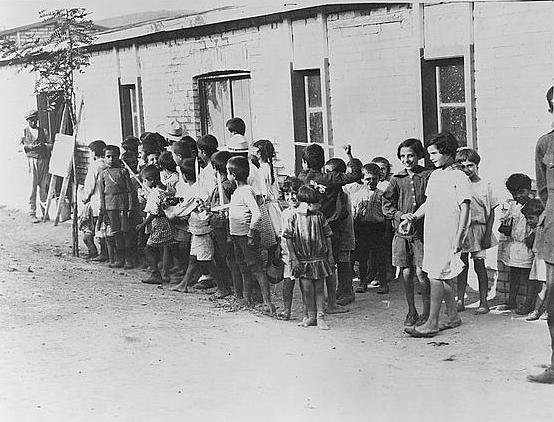
Figure 1.-- These children after the Greek-Turish War are Greek and Armenian refugee children from Anatolia being cared for in a barracks near Athens during 1923. Greece was inudated with over 1 million refugees or one for every Greek family. In fact there is no way Greece couldhave cared for these people. Again as was the case throughout World War I, it was america that prevented mass starvation. These Athens children were orphas being fed by American Near East Relief. Source: Frank and Frances Carpenter Collection (Library of Congress).
|
|
The Greek-Turkish War followed World War I. The Greeks believed that they could defeat the Turkish Army. They could not. After several defeats the Greeks agrreed to exchange populations. The Armistice of Mudanya (near Bursa) ended the fighting between Greece and Turkey (October 1922). The Greek troops withdrew beyond the Maritsa River. The Turks occupied eatern Thracee. The Turks as part of the Armistice accepted a continued Allied presence on the straits and in Istanbul until a comprehensive peace settlement could be negotiated. Large areas of western Turkey were cleated of Greeks. Much of the Greek population of Anatolia left with the retreating Greek Army or in the repressions and forced resettlements conducted by the Turks after the war. The process created a huge refugee problem, especially in Greece which received the largest number of refugees. The population exchanges created a huge refugee problem--more than a million people that had to be cared for and resettled. This would have been a problem for any country--but Greece was a very small country of less than 6 million. There are few instances in history where such a small country had to care for so many refugees. In fact there is no way Greece could have cared for these people. Greece was not self-suficent in food production, and adding a million poeople who had to be fed meant that tens of thousnds if not more would have starved. Adding to the problen, most of the military-age men had been killed or taken prisoner. This meant that the refugees were mostly women, children and elderly--meaning people who were mot capable of supporting themselves in the best of circumstances. Again as was the case throughout World War I, it was America that prevented mass starvation. Fortunately American relief workers in place, in part because of the Armenian Genocide. The British, French, and Italian Governments or private groups in those countries showed little interest in interveming. The American Government and private chritable groups in America did act. Not only did American naval personnel help feed and evacuate Greeks from Symrna, but the American Red Cross and Near East Relief provided vital food and supplies to the refugeees that reached Greece. One source estimates that hinresa of housnds of lives were saved among the refugees from Asia Minor, Pontus, and Easten Thrace. "These two organizations practically single-handedly undertook the extremely difficult task of providing aid on the spot to desperate Greek refugees who otherwise would have likely been condemned to death by diseases, malnutrition, and other hardships. The gravity of the situation demanded immediate and effective action and the United States was by far the first to respond to the Greek appeals for help." [Klapsis, p. 103.] The U.S. Goverment and private charities provided $2.6 million to the Red Cross to assist the refugees. And that was 1920s dollars, many times the value of modern dollars. Morethan 0.5million refugees were aided. American Near East Relief aid cared for thousands more including many orphans like the chilren seen here (figure 1). A Greek acadeinician reports, "It is quite obvious that,
without this assistance, the Greek government would not have been able to cope
with the extremely heavy burden of providing the means of survival to hundreds of
thousands of Greek refugees and it is easy to imagine what the fate of many of them
would have been if in the critical first months after the Asia Minor Disaster the
United States had not offered its generous help to Greece.' [Klapsis, p. 103.]
Sources
Klapsis, Antonis. Adjunct Lecturer, Department of Political Science and International Relations, University of Peloponnes. "Research Note: American Initiatives for the Relief of Greek Refugees, 1922–1923," Genocide Studies and Prevention Vol 6, No. 1 (April 2011).
CIH

Navigate the Children in History Website:
[Return to Main Grecco-Turkish War page]
[Return to Greek regions: Anatolia page]
[Return to World War I: Ottoman Empire]
[Return to World War I: Greece]
[Return to Greek History page]
[Return to Ottoman history page]
[Return to Main 20th century refugee page]
[Return to American exceptionalism: Food relief]
[About Us]
[Introduction]
[Biographies]
[Chronology]
[Climatology]
[Clothing]
[Disease and Health]
[Economics]
[Freedom]
[Geography]
[History]
[Human Nature]
[Law]
[Nationalism]
[Presidents]
[Religion]
[Royalty]
[Science]
[Social Class]
[Bibliographies]
[Contributions]
[FAQs]
[Glossaries]
[Images]
[Links]
[Registration]
[Tools]
[Children in History Home]
Created: 8:52 PM 11/25/2006
Last updated: 4:43 AM 11/1/2015