|
Inventors in Europe anf America were working on gliders in the late-19th century. Otto Lilienthal became known as the 'Glider King' flew his biplane glider (189)5. this attracted world wide coverage. Octave Chanute (1832-1910) was an American civil engineer and aviation pioneer. Some called him the 'Father of aviation'. Octave Chanute, with Augustus Moore Herring (1867 – 1926) as test pilot, conducted glider experiments at Miller Beach (1896). The Wright brothers profited from their work. German Count Ferdinand von Zeppelin invented the Zeppelins derigible (1900).
The first heavier than air flight was conducted by the Wright brothers in at Kitty Hawk, North Carolina (1903). The Wrights were Ohio bicycle mechanics without formal engineering training.
They at first flew gliders but became obsessed with the idea of powered flight. This meant designing amd building an engine. They began experimenting with powered flight with a biplane. The Wrights called their biplane flying machine "The Flyer". The Wrights achieved the first powered, sustained, and controlled flight of an airplane (December 17, 1903). Orville piloted and Wilbur rang at wingtip. The U.S. Patent Office granted a patent (1906). They began calling their 'flying machine' an aeroplane. The Wright Brothers were awarded the Congressional Medal for their achievemebt (1909). There was in popular interest, but at first not a lot of practical development in air commerce because of the limited acpabilities of the early aircradt. The Wrights after their success, dismatled their Flyer and kept their design a carefully guarded secret. This did prevent Europeans from copying their desisn. It also impaired their efforts to sell their Flyers. Europeans who were working on aviation were shocked that two American bicycle mechanics had achieved the first flight. The Wrights had managed to figure out how to conttrol a plane in flight. This put them several years ahead of other designers. Charlie Taylor (1868-1956) originally worked for the Wright Brothers at the Wright Cycle Company. He was a mechanic and bicycle machinist. Taylor is sometimes called the 'Unsung Hero of Aviation'. He played a major role in building the engine that powered the Wrights’ first Flyere. The Aero Club of America (ACA) was a social club that was formed (1905). It was organized by wealthy industrialist Charles Jasper Glidden to promote aviationa. The ACA issued the first American pilot's licenses. Future American aircraft designer and manufacturer Glenn Curtiss (1878-1930) began as a pioneer aviator. Curtiss piloted the first official public flight in the United States flying 1 mile (1908). Curtiss established theb first aircraft manufacturing company (1909). The Wright Brothers opened the first civilian flight training school in Montgomery, Alabama (1910). The first pilots they trained were Walter Brookins, James Davis, Benjamin Foulois, Archibald Hoxsey and Arthur Welsh. Allan Lockheed (1889-1969) who would become one of the most famous names in aviation with George Gates entered the field when they made the first dual-pilot controlled flight (1010). Lockhee then designed the first successful twin-engine, 10-passenger seaplane (1916). Seaplanes were very important in the early days brvause there were so few airfields, especially outside of America and Europe. Calbraith Perry Rodgers (1879-1912) was the first private citizen to buy the new Wright Brothers Model EX (1911). Orville Wright personally gave him a 90 minute lesson and off he went. More imprtant than his purchase is what he did with the palnae.
Rodgers persuaded J. Ogden Armour, a soft drink produver, the owner of the grape soft drink Vin Fiz, to sponsor a coast-to-coast fligt. Rodger's plane was christened 'The Vin Fiz Flyer'. And it vecame the first plane to achieve a coast-to-coast flight. It was not a speedy crossing. It took nearly 3 months (September 17 - November 5, 1911). Rodgers madevit, but had to survive 16 crash ups. Another major aviation figure, Glenn L. Martin (1886-1955) actually taught himself to fly. He then designed and built his own aircraft in California. Martin founded the Glenn L. Martin Company. He merged his company with the original Wright Company, forming the Wright-Martin Aircraft Company (1916). The comoany designed the MB-2 bomber which appeared at the end of World War I. Harriet Quimby (1875-1912) was the first American woman to earn a ACA pilot’s license (1911). Harriet Quimby made her name just before World War I, becoming the first woman to fly across the English Channel beating out English and French women (1912).
Another giant in American aviation, William Boeing (1881-1956), entered the field by founding the Boeing Company (1915). Like the other Amrican aviation pioneers, they had no real impact on World War I. They would, however, have a huge impact on World War II.
American military aviation began with when the U.S. Army Signal Corps created an Aeronautical Division (AD) (August 1, 1907). It was the first heavier-than-air military aviation organization in history. The AD obtained the first powered military aircraft (1909). They setup flight schools to train pilots, and created a rating system for pilot qualifications. Benjamin Foulois (1879-1967) hasvbeen called the 'Father of the United States Air Force' was the third military aviator to be trained by the Wright brothers (1910). Foulois became chief of the American Expeditionary Force (AEF) Air Service when the United States entered World War I. As a result of World War I, America fell behind Europe in the field of aviation. The Europeans spent huge amounts of money on military aviation resulting in great improvements. Actually this spending began even before the War. The U.S. military in contast got only paltry appropriatiins from Congress. The American military as a result was unable to give any significant attention to military aviation. The Army had the Signal Corps take responsibility for aviation. Europeans were involved in an arms race. Thus the Wrights turned to Europe to sell their planes. Military spending in Europe meant that after the Wrights, most early aviation advances occurred in Europe. Thus when American entered World War I (1917), the United States had few military pilots and no advanced aircradt. Wilbur Wright Field, Riverside, Ohio was established in 1917 as a military installation and airfield used to train WW1 pilots and mechanics and to conduct Air Forces flight testing. The U.S. Army Signal Corps set up Wilbur Wright Field, Riverside, Ohio to train World War I pilots and mechanics and to conduct Air Forces flight testing. Most of the trainig, however, occurred in France. Aircract as even more of a problem. The U.S. Arny Air Service did not have any American-built aircraft advanced enough for combat. American aviators had to fly French planes.
The Escadrille Americaine went into action (April 1916). This was about thetime that the critica Battle of Verdsdun began. America at the time was neutral and the American flyers attracted considerable attention, especially in the American press. Other Americans expressed a desire to fly for France and the Allied cause. A committee known as the Franco-American Flying Corps (later called the Lafayette Aviation Corps and Lafayette Flying Corps) was formed. The committee was made up of American and French business and professional men. They sought to help young Americans to enlist in the French Aviation Service. More than 200 Americans volunteered and were trained by the French. Most were assigned individually, or in small groups (twos or threes) to front-line French Aviation units. Thus the Escadrille Lafayette is a misnomer. The Americans were all members of the Lafayette Flying Corps. This was agely fictitionsl organization that never actually served as an entity on the Front. Even so, the Americans in the French Aviation Service proved to be of significant importance. This was primarily in 1918 after most of the men had transferred to the U.S. Army Air Service.
The planes and equipment of the Escadrille Lafayette along with most of its pilots, were taken over by the United States (February 1918). The French ground personnel were replaced by the 103rd Aero Squadron, Air Service, American Expeditionary Force. While serving with the French Aviation Service, the Escadrille Lafayette had fought virtually every battle front in France. They had shot down 57 enemy aircraft and had lost of their own pilots. By the time, the Escadrille pilots joined the American Air Service, quite a few Americans had received flight training and were preparing for combat. The Escadrille pilots were the only American with combat experience. They were assigned to American units. They thus were able to pass on their knowledge to the American pilots about to enter combat. The green American pilots thus benrfitted greatly from their combat experience.
The U.S. after the Germans had resumed unrestricted submarine warfare declared war on Germany (April 6, 1917). Although the War had been raging in Europe for nearly 3 years, the United States was totally unprepsared for War. The main American interest had been to stay out of the War, not prepsare to enter the War. The U.S. Army virtually did not exist and the same was true of the U.S Air Service which was part of the Army. The U.S. Army Air Service had about 1,400 officers and men. The U.S. Navy had about 300 men involved with avition. From that embryonic core, The United States Air Service deployed 45 fighter, bomber and observation squadrons. Unlike the Europeans who lavished enormous resources into airpalne development, the United States did not. As a result, the United States dud not have a high performance fighter capable of services. Thus the United States would fight the War largely with British and French aircraft.
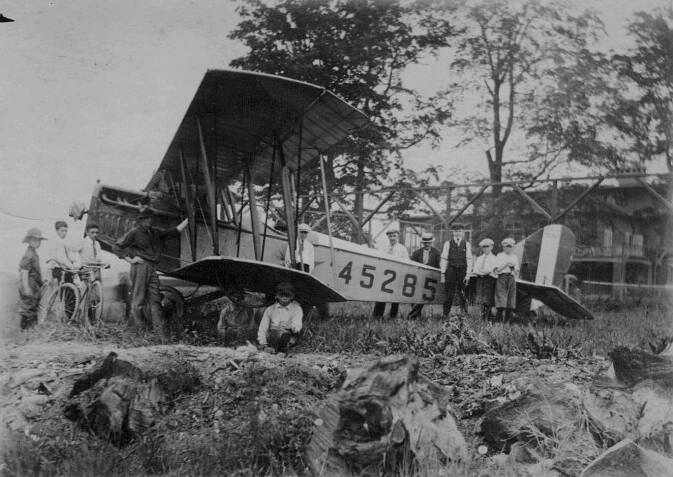
The United States had a substantial aviation industry in pre-War terms. But as it was not supporting a country at war until 1917, it had hopelessly fallen behind Europeam manufacturers in both technology and production capacity. As a result, American output was genrally used as trainers. Here the Curtis JN-4 Jenny which appeared in 1915 was particularly important. It did not have the capablilities needed for combat on the Western front, but proved to be an effective trainer. Most U.S. pilots who fought in the War trained on Jenneys. In addition, American manufacturrs also produced bombers and seaplanes, but never produced a high-prformance fighter. Anerican pilots had to use British and French fighters. Curtis also delivered Curtiss flying boats. They played an importantant role in the naval war. They also produced the standardized Liberty engine. This was imprtant in expanding Allied air power, as the engines were the primary limitation on aircraft production. The Germans who were having difficulty competung with the Allies, were toally outclassed when American aircraft engine production came on line. American companies delivered copies of the British DH4 bomber to American combat units. The companies and indivuduals involved would have a much greater impact in World War II.
The German Navy had guaranteed the Reichstag that the United States would never be able to deploy a substantial army n France. In fact, German U-boats had little success in intercepoting American troop transports. Most of the American flyers were deployed in France. A smaller force was deployed in Italy.
The first American flyers to reach Europe was a naval air detachment. They began flying seaplane escort for French coastal convoys (September 1917). The Navy eventually deployed some 900 seaplanes for convoy duties, 400 of which were stationed abroad at 27 U.S. naval air stations from Ireland to Italy. A few naval aviators flew bombers from Calais and Dunkirk.
The Army did not ship flyers to France. There were no modern aircraft types in America for training. So the Army shipped flight candidates. The first group reached France (June 1917). The leadership of the U.S. Army Air Service was not clearly defined as the different sqadroins began to form. Eventually frontline commander Col. William “Billy” Mitchell emerged as the dominant leader. Mitchell combat docus was to launch a tactical aerial offensive on the Western Front with a force made up of both newly trained pilots and veterans from the Lafayette Escadrille and Lafayette Flying Corps.
Army aviator candidates reached Italy (fall 1917). Among them was New York congressman Fiorello La Guardia. Army aviators flew bombers from Italian bases.
The first Americans flyers were given largely obsolete aircraft, such as the Nieuport 28. As American arrived in larger numbers, advanced fighters becae available. American squadeonswere equippes with the SPAD S.XIII. This Frenc-built fighter was ne of the most effective of the War.
American flyers went into action before the AEF. They got their first taste of combat in a relatively quiet sector around Toul (spring 1918).
This saw all-American squadrons patrolling the skies above the trenches for the first time. This was about the time that the Germans launched what they thought would be their war winning Spring offensive. They failed, although by a very narrow margin. American flyers got their first taste of combat. Eddie Rickenbacker managed to get his wings, despite the fact that he was not a college graduate. At the time, the Army made college a virtual prerequisite. He was assigned to one of America's air combat units--the 94th Aero Squadron which became known as the Hat-in-the-Ring Squadron because of its insignia. A historian describes Rickenbacher's flying, "Exhileration lasted only a secondas the other two enemy planes swooped from the height advantagetht his attack had conceded and broke into a 'dogfight,' a newly minted term, which, like much military slang, captured the savage immediacy and concentrated violence of the action. Seeing aramar=tic reversal, Rickenbacker jerked back hard in his stick, 'bouncing,' his mose upward in a gut-wrenching change of direction. With a loud crack, the fabric cover ovr the leading edge of his upper starboard wing peeled back from the spar and began to snap like a flag in a stiff wind." [Ross] Rickenbacker shot down his first German plane (April 29, 1918). He got his fifth German plane, making him an ace (May 28).
The AEF was deployed for the first time inforce with the fight for Chateau‐Thierry during the Aisne-Marne offensive. The USAS deployed 13 squadrons to support the ground forces (early June). When the Germans stopped, the Allied lsaunched the 100 Day Offensive thst would win the War.
The First Army with the AEF attacked the St. Mihiel salient (September 12-16). Billy Mitchell commanded 1,481 airplanes. This was the largest concentration of Allied air power during the entire War. Almost half the force was Americans. Air operations were hampered by poor weather. Even so, the massive air force seized control of the air over the battlefield. German ballos were shot down and German airfield straffed. Bombers hit targets at the front as well as rear areas. THe USAS supported ground forces in what proved to be the war-winning Meuse-Argonne Offensive (September 26 - October). Mitchell continued his tactic of massed air power.
The pitched battles and supply problems reduce the USAS to 45 squadrons with 457 serviceable aircraft. This was
almost 200 fewer planes than at the beginning of the campign. Even so, the German Army finalled asked for an Armidstice ending the War. American flyers dropped 140 tons of bombs in 150 bombing runs. They participated in seven campaigns and shot down 781 enemy planes and 73 balloons. They lost 289 planes and 48 balloons and 237 men.
The USAS was primarily used to support ground forces. It was involved in reconnaissance as well as attacks on enemy troops and supplies both at the front and in rear areas. USAS fighters was also used to protected observation and bomber craft. At the time this was not easy. There were no radios that were light enough to be installed on aircradt. Land forces faced the same problem when attacking. Headquarters could have radios, but the attacking force on an offensuce could not take radios with them. Thus command and control was a serious problm.
World War I was the first war in which air power played a significant role. Thus the term ace was coined during the War. A flying ace became defined as a military aviator credited with shooting down five or more enemy aircraft during aerial combat. Aircraft destroyed on the ground were not counted. The term was invented by French newspapers, describing Adolphe Pégoud as l'as (the ace), after he shot down five German planes. None of the belligerants, least of all the United States which did not begin to build a serious air service until after it enterd the War, has a serious pilot training program. Most pilots were thrown into combat after only a very brief and rudimentry training effort. Most of the scores run up by aces were young pilots that did not really know what they were doing. Each of the major combatants has their aces. They acquired a status rather like chivalarous medieval knights. The air war began with baloon busting and evolved into the most deadly and dangerous combat activities of the War. The various World War I air services picked up the idea of aces and developed their own definitions of precisely what an air victory was as well as verifying and assigning credit. American air service began with the French and throughout the War used French and British planes. The United States produced 71 aces durig the War. Five had more than 10 victories each. Several American aviators are well known, including Eddie Rickenbacker, Raoul Lufbery, Quentin Roosevelt, Frank Luke, Joe Werner, Carl Spaatz, Everett Cook, Billy Mitchell and others. The Battle of St. Mihiel was the beginning of the American Meuse-Argon offensive. The battle marked the meteoric ascent of balloon‐busting ace Frank Luke, who shot down 18 Germans in 17 days before meeting his death. The impetuous Luke won the Medal of Honor, as would American ace of aces Eddie Rickenbacker, who ultimately gained 26 victories and survived the war.
The United States had begun the War virtually without an airforce. By the time of the Armistice the USAS had grown to 195,024 officers and men. More than 2,000 American flight personnel had reached the front. A total of 681 aviators had died. Only about 25 percent had been killed in combat The rest had been killed in accidents.
The very limited military spending and the propensity of the WrightBrothers tosue oithers in the industry impaired the debelopment of an Americam aviation industry before World War I. The War stimulated the development of anew American industry. Technical advances during the War meant that planes were much more caoable. In addition, large numbers of Americans were involved both in flying and in mantaining aircraft. Many returning to America wanted to make a living in aviation. And at the end of the War there were llarge numbers of war-surplus planes which could be purchased at low price. This lead to barnstorming which further peacked the public interest. Government mail contracts provided support for the new industry. And with the Wrights gone, investors began to take an interest in the industry. And technical advances made air travel feasible. The Ford Tri-Motor was the first rel commercial arliner. The development of a commercially viable industry was a critical development. It would be the foundation on which the huge American World War II air forces would be built.
Hudson, James J. Hostile Skies: A Combat History of the American Air Service in World War I (1968).
Johnson, Herbert A. Wingless Eagle: U.S. Army Aviation through World War I.
Ross, John F. Enduring Courage: Ace Polot Edie Rickenbacker and the Dawn of the Age of Speed (2014), 320p.
Van Wyen, Adrian O. Naval Aviation in World War I (1969).

Navigate the CIH World War I Pages:
[Return to Main early aviation page]
[Return to Main World War I Air War page]
[Return to Main World War I conduct page]
[Aftermath]
[Alliances]
[Animals]
[Armistace]
[Biographies]
[Causes]
[Campaigns]
[Casualties]
[Children]
[Countries]
[Declaration of war]
[Deciding factors]
-------[Diplomacy]
[Economics]
-------[Geo-political crisis]
[Home front]
[Intelligence]
[Military forces]
[Neutrality]
[Pacifism]
[People]
[Peace treaties]
[Propaganda]
[POWs]
[Russian Revolution]
[Signals and intelligence]
[Terrorism]
[Trench warfare]
------[Technology]
------[Weaponry]
[Bibliographies]
[Contributions]
[FAQs]
[Images]
[Links]
[Registration]
[Tools]
[Return to Main World War I page]
[Return to Main war essay page]
[Return to CIH Home page]