|
The Poles had moved quickly in the east, engaging the Bolshevicks in Lithuanian and Beylorusia. They captured a primary objective--Vilna (April 19, 1919). The League's answer was the Curzon Line (December 8, 1919). This would have left most etnic Poles with in the boundaries of the new Republic. It did not, however, satisfy the Poles. They wanted the pre-partition boundaries even though the population beyond the Curzon Line was mixed with many non-Poles, including many Ukraines, Beyelorusians, and Lithuanians. The Poles demanded that the Bolshevicks negotiate a new border well east of the Curzon Line (March 1920). Negotiatins got nowhere. Poland declared war (April 25). The Poles with French assistance moved east, even taking Kiev in the Ukraine (May 8). The Bolsheviks launched a counter offensive (June) and drove the Poles back almost to Warsaw. At that point the Franco-Polish Army struck backmand defeated the bolshevicks in several sharp engagements. The two sides reached a cease fire (October 12, 1920). A factor here was the Civil War in Russia and the Bolshevicks need to end the war with Poland so thaey could focus in the White armies. The Treaty of Riga confirmed Polish possession of large areas in the east beyond the Curzon Line (March 18, 1921).
The Polish nation once the most powerful in Europe disappeared as a result of three partitions in the 18th century carried out by Austria, Prussia, and Russia with the major share and Warsaw going to Russia. The Poles resisted these empires and in reaction the Russians in particular set out to destroy Polish national identity and Russify the Poles. Polish nationalism was largely preserved by the nobility and the Church. The Polish peasantry was largely a political. Although there was no Polish state, Poles participated in the War as part of the armies of the three empires that had partioned the country. About 2.0 millions participated in the War. Nearly 0.5 million were killed. Polish nationalists were divided in the conflict. Many right-wing Poles led by Roman Dmowski's National Democrats promoted the Allied cause which on the Eastern Front meant the Russians. Dmowski thought that a grateful Russia might agree to autonomy for Poland, perhaps even independence in the future. Josef Pilsudski led the Polish Socialists. He also commanded the Polish Legion in the Austrian Army. He thought that Russia might be knocked out of the War. Austria which had gained Galicia in the partition had been the most willing to allow a measure of Polish autonomy. The poor performance of the Austrian Army on the Eastern Front resulted the Germans assuming command. Marshal Pilsudski refused to take an an oath of allegiance to the Kaiser. German authorities arrested him and imprisoned him in Magdenburg Castle. Russian collapse changed the political situation in the East. America had joined the war. President Wilson promoted the 14 Points wgich included national self determination. With Russia no longer in the war Britain and France came out for Polish self-determination. Although the Germans had achieved their goals in the East reverses in the West changed the political landscape. Revolts broke out in German cities. The Kaiser abdigated and fled to Holland. German authorities released Pilsudski Magdenburg (November 10, 1918). He immeditely headed for Warsaw. He arrived there on the same day the Armistice on the Western Front went into effect (November 11). The Germans had set up a Regency Council in Warsaw. Understanding that a Polish national rising was about to take place, the Regency Council turned to Marshal Pilsudski. The German garrison in Warsaw chose to evacuate by train. The Allies recognized the new Polish state set up by Pilsudski. At Versilles the Poles demanded the boundaries of Poland before the 18th century partitions. The boundaries of the new Polish nation were only established by diplomacy and military engagements (1919-21). Inter-war Poland included a German minority in the west and eastern areas where Lithuanians, White Russians, and Ukranians outnimbered Poles.
The Tsarist Empire controlled Finland, the Baltics, Beylorusia, most of Poland, and the Ukraine. The German scored major victories on Eastern Front during World War I. The Tsarist Army suffered enomorous, demoalizing losses. The Russian Revolution brought a liberal Provisional Government to power. Kerensky was willing to work with the various non-Russian provnces. Te Bolshevicks were not willing to do so, but did not have the military power to hold all f the Tsarist Empire. With German defeat in the West, the Germans withdrew back to Germany and the various Tsarist provinces began declareing independence.
President Wilson in his 14 Points had enuciated the princile of national self-determination. This principle became ensrined in the Versailles Treaty. The Treaty provided for a new independent Poland. Procedures were established for settling the brder with Germany. Soviet Russia at this time was outside the European state sustem. No attempt was made to define the country's eastern border. And after the failure of the Allies to intervene in the Russian Civil War, there was no desire to provide the military power needed to enforce an eastern Polish border, although France was willing to offer some military assistance to Poland. This meant that it was not only up to Poland to establish its eastern border, but with the Bolsheviks emerging as the winner in the Russian Civil War, Poland would have to fight the Red Army to maintain its national existence. The Poles were determined to do this, but no one fully understood the stakes. Had the Poles failed the same horrors Stalin later visited on the Ukranians would have been applied in Poland.
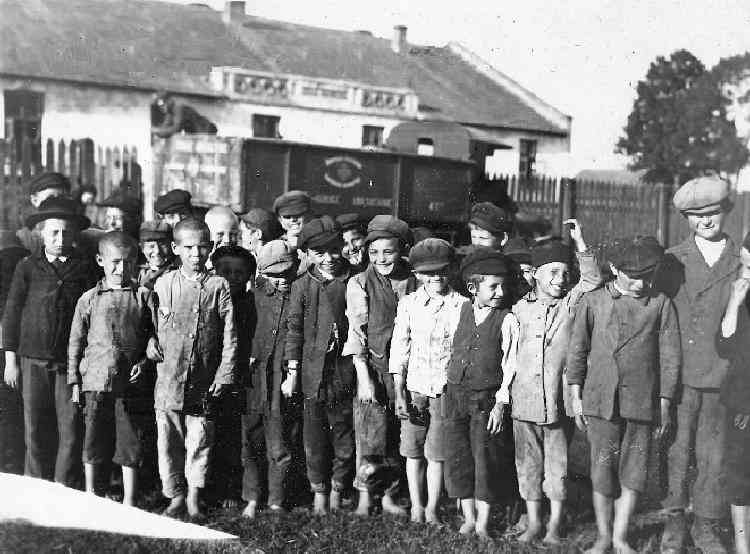
Even before Poland was officially independent, fighting broke out between Poles and Ukranians over future national borders. This began at Lw�w Lviv. At the time the city within the collapsing Austro-Hungarian Empire was known by its German name--Lemberg. It was the capital of one of the Habsburg provinces--the Kingdom of Galicia and Lodomeria. Poles were the dominasnt ethnic group in the province overall, but in some localities, namely eastern Galician Ukrainians were the majority group. In ghis area the Ukranians were the majority group (65 percent) and the Poles a much smaller minority (about 20 oercent). They did, however, along with the Jews make up a majority in the cities. Thanks to reasonably accurate Austro-Hungarian statistics, we have a good view of Lemberrg which became a flash point for the developing conflict between the Poles and Ukranians. At the time, the Ukranians were hoping to create an independent country as Poland was doing. Slightly over half of Lemberg were Polish Roman Catholics, Jews (nearly 30 percent) and Ukrainian Greek Catholics (nealy 20 percent). In language terms, most of the city's population spoke Polish (about 85 percent). [Austrian census of 1910] Fighting had ceased in the East with the Treaty of Brest-Litovsk, but borders had not been set or political arrangements confirmed. And the apparent settlment was thrown into turmoil as the Austrians and Germans prepared to sign an Armistice which would invalidate the Treaty. Ukrainian (called Ruthenians by the Austrians) soldiers from disentegrating Austro-Hungarian Armyy unannounced moved into Lemberg and occupied public buildings and military depots, raised Ukrainian flags, and proclaimed a new Socialist Ukrainian Republic (October 31/November 1, 1918). The Ukrainians in Lemberg were estatic and the Jews who were among the most loyal supporters of the Austro-Hungarian Empire were uncommitted. The majority Polish cutizends were shocked at finding themselves in a new Ukrainian nation. [Subtelny, pp. 367-68.] Poles in the city reacted violently, alythough they had few arms and no actual military units in place. The initial resistance was a group of about 200 men who organized in a school at the western outskirts. They were organized by veterans from the Polish Military Organization who collected 64 outdated rifles and asmall cache of amunition. They clashed with the well-armed Ukranians. Soon this small group was joined by hundreds of largely unarmef volunteers, mostly young people including boys. They included Boy Scouts, students, and other youngsters. Over 1,000 people joined the Polish resistance in the first day of the escalating fighting. This was the beginning of the War with the Ukraine fought in Galacia (1918-19). Ukrainian units (Sich Riflemen) fought running battles with the growing Polish resistance--the mostly poorly armed school children. Polish Army units soon arrived in Lwów to aid in the struggle. Fighting continued until the Ukranians fell back from the city (Novenber 22). Fighting had swirled around a cemetery where after the war the school children killed in the fight were honored. They became known as the Lwów Orleta (Eaglets).
Polish Independence was put in motion even before the Armistice ending World War I. Declarations were published in Lublin, New York, Paris and other places. President Wilson's 14 Points Speech laid the foundation ny making Polish independence a conditions for the Armistice. Polish and otgher ethnic Americans were striongly democratic. Ignacy Paderewski was a fervent voice for Poland in America. Poland was to become an independent nation with access to the Baltic Sea. This was later to be confirmed in Treaty of Versailles. With the Armistice about to be signed, the Gernans rekleased Pilsudski (Novemnber 10, 1018). He immediately took the train to Warsaw where he took ommand of the Army of a new Poland which had already beguin to form. The next day the Armistice ended the War (November 11).
The situation in the West was fairly easy to sort out after World War I. The Germans were required to return Alsace-Loraine to France and a small area in eastern Belgium to Belgium. The situation in the east was a very different matter. Eastern Europe had been the preserve of the three great Euroopean empires (Austria-Hungary, Germany, and Russia) as well as the Ottoman Empire. The fall of these empires had enormous consequences. The dispute between the Ples and the Bolshevicks was just one of the conflicts that erupted. The Russian Revolution occurred even before World War I ended (1917). This was followed by the Russian Civil War. The Central Powers at the end of the War as required by the Allies withdrew from the East. The Austrian Army essentially desintegrated. The Germans withdrew from Poland and the Ukraine. The Baltic Republics and Finland as well Poland. Belarus, and the Ukraine and people in the Causauses ad Central Asia declared independence. The Bolshevik Red Army attempted to hold the various territories of the old Tsarist Army. This was complicatd by the foirnation of White armies to seize power from the Bolsheviks.
The Poles moved quickly in the east, engaging the Bolshevicks in Lithuanian and Beylorusia. They captured a primary objective--Vilna (April 19, 1919).
The League's answer was the Curzon Line (December 8, 1919). British Foreign Secretary Lord Curzon of Kedleston attempted to mediate, proposing a compromise border. Curzon attempted to draw a line marking an approximate ethnic divide between Roman Catholic Poland to the west and Russian Orthodox Ukraine and Belarus to the east.
The proposed Curzon Line ran from Grodno through Brest-Litovsk to Lw�w which would have been awarded to Poland.
Rgis was essentially the border of Poland before the Partitions began (1772). The Curzon Line would have left most etnic Poles with in the boundaries of the new Republic. It did not, however, satisfy the Poles. They wanted the pre-partition boundaries even though the population beyond the Curzon Line was mixed with many non-Poles, including many Ukraines, Beyelorusians, and Lithuanians. A Polish Census in 1931 reported a population of mostly Poles (40 percent), Ukranians (35 percent), Jews (nearly 10 percent), and small numbers of other ethnic groups.
The War was fought between the new independent Polish republic and the Revolutionary Bolshevick Soviet state. The Polish Republic took an expansive definition of the new state. They claimed the territory of the Polish state that existed before the 18th century Polish partitions which mean territory deep into eastern Europe. The Soviets on the other hand sought to control the full extent of the territory of the Tsarist Empire. This meant the Baltics and most of Poland. Poland ad the Soviet Union, however, were not the only participants. The Ukraine was also involved and here there were two nascent states--the Soviet Ukraine and the Ukrainian People's Republic. Both vied for control of the Ukraine. The Soiviet Ukraine was under Bolshecick contril. The Ukranian People's Republic wanted an independent Ukraine. While France did formally enter the War, it did aid Poland.
The Ukrainian People's Republic after the German withdrawl attempted to create a Ukrainian state in the western Ukraine (1918). Both Poles and the struggling Ukranians claimed the area and both Poles and Ukranians lived in the area. Poles lived in the northern area and Ukranians dominating in the south. Within the Russian Empire there had been a degree of ethnic mixing. Polish forces emerged victorious in the Polish-Ukrainian War, managing to seize control of most of the Western Ukraine. Fighting continued until the Polish army finally pushed the Ukrainians beyond the Zbrucz River (July 1919). A factor here was that the Ukranoans were also fighging the Bolsheviks further east.
The Bolshevik Red Army began to prevail over the White armies in the Russian Civil War and advance westward toward the westerm Ukraine that Poland now held. A front line begn to form and squirmishes occurred (late-1919). A critical factor for the Ukraine was that unlike the Poles, the Ukkranioans were not united. The eastern Ukraine was heavily Russified. In addition, therewerre Ukranians which sided with the Bolsheviks. And the fighting between Poles and Ukranians made it difficult for the two people to make common cause against the Bolsheviks.
The Poles demanded that the Bolsheviks negotiate a new border well east of the Curzon Line (March 1920). The Bolsheviks rejected the Polish demands and the resulting negotiations got nowhere.
The overlapping territorial claims were exacerbated by the political calculations occurring in Warsaw and Moscow. Poland's new Chief of State, J�zef Pilsudski, decided that Poland should expand Poland's frontiers as far east as possible. He saw that it was important to act quickly before much larger and potentially more powerful Bolshevik Russia could recover from the Civil War and invade Poland. He conceived of the creation of a Polish-led federation (Miedzymorze) of several states in Eastern and Central Europe which if united could form a bulwark against any furure attempt by Germany or Russia to reconstruct an Eastern European empire. Lenin and the Bolsheviks for their part believed that their Revolution could sweep Europe and the did not want a strong indepndent Poland blocking the route of Revoluion west. They in fact were surprised that the Revolution had occurred in Russia first. Marxist doctrine presicted that the Revolution would occur in the more industrialized countries (Britain, France, and Germany), non in a largely peasant society like Russia. They assumed that the Red Army would sweep west and support the antivipated revolutions in Western Europe. Some had already occurred in Germany and Hungary. The first step was to reconstitute the Tsarist Empire, this included reestanlishing control of Finland, the Baltics, Bylorusia, the Ukraine, eastern Romania and of course Poland. Then they would be in a position to intervene in Western Europe,
The squimishes between the Red Army and Polish forces in the Ukraine gradually escalated. Poland declared war (April 25, 1920). The Poles with French assistance moved east into the Ukraine. They took Kiev (May 8). The Bolsheviks launched a successful counter offensive (June 1920) and drove the Poles back almost to Warsaw.
The prospect of the Red Army moving so far west unevered Western capitals. There were Communist parties in Western Europe and some, including the German Communist Party, had considerable support. Western Military sources were predicting the fall of Warsaw. This would have put the Red Army on the frontiers of Germany. And at the time Kadets (Communists)in Germany were attemting to seuize power. At that point, the Franco-Polish Army struck back and mauled the Red Army in the Battle of Warsaw and several other sharp engagements (August 1920). With the Polish Army driving east, the Soviets sued for peace, The war ended with a ceasefire (October 12, 1920). A factor here was the Civil War in Russia and the Bolshevik need to end the war with Poland so they could focus in the White armies.
When the Bolshevicks seized control of Russia and began to supress not only Tsarist loyalists, but democratic and other Socialists, armned resistance broke out. And the Allies assisted some of these groups. There never was one, centralize White Army. In stead severl different groups fought the Boshevicks in a series of uncoordinated actions. The Red Army prevailed, but one impact of the Civil War was it made it impossible for the Bolshevicks to focus on the Poles or the Baltic Republics which declared independence.
The two sides reached a cease fire (October 12, 1920). The Treaty of Riga confirmed Polish possession of large areas in the east beyond the Curzon Line (March 18, 1921). The Poles and Soviets largely divided the disputed territories. The Ukraine was left largely in Soviet hands, although a Ukranian minority population became part of southeastern Poland. The War and resulting treaty basically determined the Soviet-Polish border for the period between the World Wars.
The Soviets had long memories. Germany and the Soviet Union sined a Non-Aggression Pact (August 1939). A secret codicile provided for the partition of Eastern Europe. Poland was the most immediate target. The Germans invaded Poland, launching World War II (September 1, 1939). Two weeks later, the Soviets invaded from the east (September 17). The NKVD began arrests, execultiuions, and deportations. Any Poles they could find who fought against the Bolsheviks in Polish-Soviet War were arrested. Some were shot. Others were sent to labor camps.
Polish artist Wojciech Kossak was a proligic painter who specialized in historical paintings, especiall war and combat. We note large numbers of Naooleonic War battles. He ficused on battles related to Polish history and the fight for indeppedemce. Among the different battles and wars are a paintings of the Polish-Soviet War which defeated Bolshevik attempts to supptress the Polish Republic which emerged from World War I and like the Ukraine and Bylorussia ans return it to Russian control, in his case Soviet control.
Austrian census of 1910.
Davies, Norman. White Eagle, Red Star.
Subtelny, Orest. Ukraine: A History (University of Toronto Press: 2000).

Navigate the Children in Hitory Website:
[Return to Main Polish World War I page]
[About Us]
[Introduction]
[Biographies]
[Chronology]
[Climatology]
[Clothing]
[Disease and Health]
[Economics]
[Freedom]
[Geography]
[History]
[Human Nature]
[Ideology]
[Law]
[Nationalism]
[Presidents]
[Religion]
[Royalty]
[Science]
[Social Class]
[Bibliographies]
[Contributions]
[FAQs]
[Glossaries]
[Images]
[Links]
[Registration]
[Tools]
[Children in History Home]