|
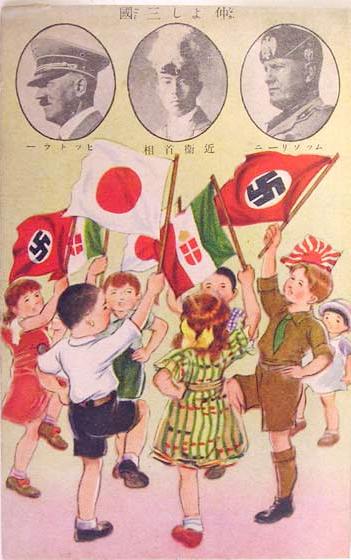
The Japanese were initially reluctant to accept Hitler's 1939 offer to formally join the German-Italian Axis alliance. The German defeat of the Netherlands and epecially France apparently caused the Japanese to reverse their position. The defeat of the French and the occupation of the Netherlands meant that the colonies of these countries in Southeast Asia were vulnerable. The Dutch East Indies (modern Indonesia) were particularly important because of their oil resources. Rubber was another important resource available in the region. Japan had been importing oil from the United States, but America was increasing pressure on Japan to end the war in China. Japan signed the Tripartite Pact, making the country a member of the Axis military alliance (September 27). The Pact allied Germany, Italy, and Japan and became known as the Berlin-Rome-Tokyo Axis, or more commonly Axis alliance.
The Allied capitulation to Hitler at Munich had vast consequences. It appears to have convinced Stalin that the Allies were unreliable and would not fight. It enabled Hitler to later seize major industrial works that would be a key part of the NAZI war effort. It affected the policies of the Balkan states. It also affected German-Japanese diplomacy. Before Munich it was the Japanese who were most interested in a defensive military alliance. Hitler was concerned that the affect would adversely affect American opinion and even drive America into a military alliance with Britain. [Ciano, p. 243.] Hitler's success at Munich caused him to consider a potential alliance with Japan more favorably. {DGFP, ch.8.]
The Axis began as the Rome-Berlin Axis between between Fascist dictators Benito Mussolini and Adolf Hitler. Hitler at an early stage pursued close relations with the Japanese. The result was the anti-Comintern Pact aimed at the Soviet Union (October 1936). Italy joined the next year. Germany and Italy concluded the Pact of Steel (May 1939).
Strong elements in the Japanese Army were promoting war to expand the Japanese Empire and to obtain the resources to pursue the war in China. The strongest element was at first the Strike North Faction desiring aar with the soviet Union. This did not at the time coinside with Hitler's thinking. Hitler, a World wat I soldier, was determnined to avoid the German strategic dilema of World War I-- a two front war. He was determined to avoid a confrontation with the Soviets as long as the Western Allies (Britain and France) threatened his western border.
The Japanese beginning in 1938 fought a series of engagements with the Soviets along the Manchurain-Mongolian border. A minor border incident (Battle of Lake Khasan) occurred at Primorye (1938). Much more significant engagements ocuured the following year. The engagements in 1939 reached very significant levels. The second series of engagements involved Zukov commanding the Red Army forces. The Japanese were badly defeated (July 1939). The fighting is known as the Battle of Halhin Gol or Nomonhan (a nearby village) Incident. The border incidents occurred because the Japanese and Soviets disagreeded about the border between Manchukuo (Japanese controlled Manchuria) and Mongolia. The Japanese insisted the border was the Halha River (Halhin or Khalkhin Gol). The Mongolians and their Soviet allies insisted the border was 16 kilometres east of the river near Nomonhan village. The incident began when some Mongolian calvalry troops grazed their horses in the disputed area (May 11, 1939). The Manchukoans had difficulkty expelling them and the Japanese Guangdong Army eventually intervened (May 14). Stalin wanted these border incidents ended and ordered the Red Army High Command (STAVKA) to take the necessary action. A young Georgy Zhukov was selected to command the action. Zukov was at the time a young officer of promise. The Red Army proceeded to destroy the small Japanese force which had occupied the desputed area (May 28-29). This involved the loss of about 100 men. The Guangdong Army at this time apparently decided that the area was not worth an expanded conflict. Continued incidents ensued. Eventually Lt. Gen. Michitaro Komatsubara, was ordered to conduct a major offensive to restabish the border at the Halha River. The Japanese commenced operations (July 1) and crossed the Halha River. The Red Army stopped the Japanese (July 3) and forced them back across the border. Hostilites ended at this point except for minor scrimishes. Zukov planned a major offensive to cross the River and seize the disputed area. A force of Russian and Mongolian troops (57th Special Corps) defend the east bank of the Halha River. With an even larger force, Zukov crossed the River (August 20). He used three infantry divisions and characteristaclly massed artillery. He also used tanks and planes in a coordinated offense. The Soviets enveloped two entire Japanese divisions. The Japanese attempted to break out, but were unsuccessful (August 27). When the surrounded Japanese refused to surender, they were obliterated with artillery and aerial bombardment. The battle was over (August 31). Red Army ground assaults drove remaining Japanese forces back into Manchukuo. The Japanese subsequently asked for a ceasfire (September 16). The Soviets won the battle, but at considerable cost, the full extent of the losses were not reported until after the disolution of the Soviet Uniom (1991). The extent of the fighting was not widely reported at the time, but many historins believe that it had a major impact on the conduct of World War II. The Japanese Imperial General Staff appears to have concluded that the "strike north" option promoted by the Army to seize Siberia was impossible to achieve or would be terribly costly. Rather the "strike south" with more Navy support to seize the resources of Southeast Asia gained backing. The result was the attack on Pearl Harbor (December 1941). The fighting is also believed to be a major reason that the Japanese declined to attack the Soviets when they were reeling from the NAZI invasion (June 1941). This allowed Stalin to move Siberian troops from the Manchurian border that played a critical role in stopping the NAZIs before Moscow (December 1941).
Hitler correctly assessed that a non-agression pact would effectively impbilize the British and French. Without a Russian ally as in World War I, the Allies would be unable to seriously engage Fermany. He appears to have even believed that they would not declare war. The Japanese were shocked at the Pact. Hitler had not consulted the Japanese before signing the Non-Agression Pact (August 23). While the Non-Agression Pact did not violate the Terns of the Anti-Comitern Pact (1936), it certainly violated the spirit of the agreement. And it came just after Japanese defeats in Manchuria at the hands of the Red Army. While to the West, the importance of the Pact was to give Hitler a free hand to invade Poland, the Japanese saw it as providing Stalin more leeway in the Far East. The shock to the Japanese was especially severe because it came at the same time that the Soviets delivered a stunning defeat to the Imperial Army along the Manchuko border.
The German defeat of the Netherlands and epecially France apparently caused the Japanese to reverse their position. The defeat of the French and the occupation of the Netherlands meant that the colonies of these countries in Southeast Asia were vulnerable. The Dutch East Indies (modern Indonesia) were particularly important because of their oil resources. Rubber was another important resource available in the region.
The Japanese invaded China proper (1937). The achieved starling success and seized most of coastal China. The Nationalists withdrew in the interior and the Japanese were unable to force Chang to surrender. Casulaties and the cost of the war mounted. We have noted some suggestion that the Japanese Army by 1940 saw themselves involved in a quaqmire in China and were looking for an horable way out. I am not aware of any real evidence of this. If so, they could have used America as an intermediary to negotiate a settlement. America had helped end the Russo-Japanese War (1905). What we do know is that the defeat of France and the Netherlands caused the Japanese to move to gain the resources Southeast Asia, resources needed to sustain the war in China.
Japan had been importing oil, steel, and other natural resources from the United States, but America was increasing pressure on Japan to end the war in China. Not only was Japan's aggressive steps ovious, but AmericAn code breakers cracked the diplomatic purple code giving them inside insights to Japanese objectives anbd olnnning. America began strenthening its forces in the Philippines. President Roosevelt ordered the Pacific Fleet moved to Pear Harbor. American pressure caused the Japanese to look for support to Germany to counter American and British pressure.
Several events in mid-1940 changed the view of the Japanese and German Governments toward an alliance. The fall of France and the Netherland created new opportunities for Japan (May-June). American pressure created a desire for allies. A new Japanese Government was formed by Prince Konoye that included General Hideki Tojo (July 17). The Japanese Goverment was already committed to obtaining oil and other natural resources in Southeast Asia. Tojo's inclusion in the government strengthen the war faction. Hitler for his part cooled on a Japanese alliance, especially as he saw benefits in using the Dutch and French colonies to entice the occupied countries into closer cooperation. This changed, however, when to his surprise, the British continued to resist. The basic agreement was that in exchange for German acquiesence to Japanese control over European colonies in Southeast Asia, the Japanese would increase pressue on the British. Both sides now had an agreement they saw beneficial. [Sommer, p. 349 ff.] The Japanese also saw benefits in countering the Soviets. The Germans for their part assumed that the British would make peace after the fall of France. When they did not, Hitler again assumed that Göring's Luftwaffe would force the British to make peace or achieve the air superiority needed for an invasion. Air battles over London showed that the Luftwaffe was failing (mid-September). Thus a new ally appeared toi make sense for the Germans.
Japan signed the Tripartite Pact, making the country a member of the Axis military alliance (September 27). The signing ceremony took place in Berlin. The Pact allied Germany, Italy, and Japan and became known as the Berlin-Rome-Tokyo Axis, or more commonly Axis Alliance. It was signed in Berlin by the foreign ministers of the three countries, Joachim von Ribbentrop, Saburō Kurusu, and Galeazzo Ciano. It was irinically a defensive military alliance that was signd by three aggressor nations. The three coutries would eventually joined by Hungary (November 20, 1940), Romania (November 23, 1940), Bulgaria (March 1, 1941) and Yugoslavia (March 15, 1941), as well as by the German puppet state of Slovakia (November 24, 1940). Yugoslavia had been an Allied country in World War I and here was wie-spread anti-German feeling. Rioting in Belgrade provoked a coup d'état. Germany and Italy, as a result, invading Yugoslavia (aided by Bulgarian, Hungarian and Romanian forces and partitioned the country. The Germans created aCroatian state which joined the Axis (June 15, 1941). The Axis Pact was directed primarily at the neutral United States which was supporting Britin and beginning to support China.
The Axis alliance was a defensive alliance. It did not require the partners to join in offesive operations. It did require them to come to each other's aid if attacked. The three Axis partners agreed to recognize German hegemony over most of Europe; Italian hegemony in the Mediterranean, and Japanese hegemony in East Asia. The alliance committed the members to come to each others assistance if attacked. It did not commit them to military assistance against countries attacked. Thus when Germany invaded the Soviet Union (June 1941), Japan remained neutral. The text of the pact made it ckear tht it as aimed at he United States, but did not mention America by name. Rge Soviet Union was mentioned, but in aay that they would not feel threatened. A orovision of the texy clled for the ceation of technical commissions to share technolohgy. This could have been a huge bebefit to Japan because of aange og Gernan high-tech. Very little came of this, largely because the Germans were not anxious to share their tchnology. Only after the War began to go against Germany did the idea of rechnolgy exchange gain ant momentum. When Japan attacked America Hitler was not obligated to declared war on America (Decenber 1941), but he did anyway. He expected the Japnese to reciprocate. They did not. The interesting aspect of the Axis alliance was that Hitler saw it as a way to weakning the British and distract America. As it worked out, the principal impact was not only to tightemn the Anglo-American relationship, but to bring America into the War, an action Hitler had been trying to delay.
The Japanese Empire and the Soviet Union were bitter enemies as the Manchurian Border War (May-September 1939) had shown. Both countries had, however, strong reasons by 1941 to avoid war. Stalin in signing the Non-Aggression Pact with Hitler had anticipated a war in the West in which the Allies (Britain and France) and Germany would fight a long debilitating war as in World War I. He thought that with these countries weakened that he would be able to expand west. The unexpected collpase of the French Army meant that instead he know faced a triumphannt NAZI Germany without allies or buffer states. Thus defusing the situation along the Siberian-Manchurian border with Japan was very important. The Japanse having decided on the Strike South option also wanted a quiet northern border so they could move south. Thus both countries had strong reason for a diplomatic accomodation. The Neutrality Pact (also called the Non-Aggression Pact) was was signed in Moscow by Foreign Minister Yosuke Matsuoka and Ambassador Yoshitsugu Tatekawa for Japan and Foreign Minister Vyacheslav Mikhailovich Molotov for the Soviet Union (April 13, 1941), Foreign Minister Matsuoka was returning from an Axis conference in Berlin. The Soviet Union committed to respecting Japanese control of Manchukuo (Manchuria). Japan made the same commitment to the Soviet dominated Mongolian People's Republic. The NAZIs did not inform the Japanese of their plan to invade the Soviet Union. And the Japanese did not inform the NAZIs of their plan to sign the Neutrality Pact with the Soviets. This was one of many instances showing the weakness of the Axis Pact. It is difficult to comprehend how Germany and Japan at this crucial moment could have failed to coordinate policy concerning the Soviet Union. The Neutrality Pact remained in force throughout most of the War. The Soviets after the NAZI surrendr in Europe (May 1945) did not automatically renew the Neutrality Pact as the Japanese wanted. The Soviets did not abrogate the Pact, but they did not renew as renewal came due. The pact still had 12 months to run, and the Soviets were not making their policies clear to the Japanese. The commitments made to the llies to join the war against Japan were secret. Soviet diplomats assured the Japanese that they would honor the pact for the next 12 months.
Both Germany and Japan thought they got an agreeement that would prove beneficial. Actually neither country benefitted from the agreement.
The Japanese were at the time bogged down in China with not end in sight. And they were intent on preventing America from aiding China. The Japanese hoped that the Pact would relieve American and British pressure. It did not. President Roosevelt steadily increased pressure on Japan in the Pacific. Actually the Pact probably assisted Roosevelt in his reelection coming as it did during the campaign. It helped make his case against the Isolationists. Their Jpsnese were intent on preventing America with a threatening alliance. The impct on America was just the opposite. America's focus was on Europe and the NAZI threat. Japanese by allying with the NAZIs actually caused the Americans to take a harder approch to the Japannese and may have increased he desire to save China as a potentially valuable ally. .
The Axis Pact had no real impact on the European campaign as Germant and Italy were already copperating in the war against Britain. The Germans hoped that the Pact would help pressure the British to make peace. Here it had no impact. As long as the prospect for American aid existed, Churchill was not going to make peace with Hitler. Nor did the Pact destract America. There was firm agreement among the Americans and British that NAZI Germany was the greatest danger. Even later after the Japanese attack on Pearl Harbor, commitment to that basic principle did not waver. In fact the case can be made that the Axis Pact adversely affected the German war effort. Hitler no matter what his public statements was very cautious about the United States, even resticting U-boat operations so as not to provide President Roosevelt a pretext for intervention. The primary Germany goal was to keep America out of the European war and to prevent any kind of Americam-Japanese reprochment. The negotionations conducted by HJapan and america during 1940-41 were of condiderable concern to the NAZIs. It is likely that President Roosevelt would have brought America into the War against Germany even if Japan had not attacked Pearl Haerbor, but it is an open question as to just when. It surely would have been several months later. In effect by signing the Axis Alliance and encouraging the Japanese, Hitler hasented the entry of America into the War. This was compounded when Hitler by declaring war on America after Pearl Harbor brought America into the European war months earlier than would have been the case otherwise. Even more importantly it was a united America than entered the War unfettered by divisive Isolationist restraints. Isolationism in America evaporated the moment the first Japanese bomb fell on Pearl Harbor.
Ciano, Galeazzo. Ed. Malcomb Muggeridge. Ciano's Diplomatic Papers (London, 1948). Count Ciano's diaries and diplomatic papers are a remarable source of information on Axis diplomacy and World War II. He was a Fascist leader who cemented his position by narrying Mussolini's daughter Edda. Her served as Foreign Minister (1936-43) and then helped engineer Mussolini's removal. He was arrested by the Germans and later shot.
DGFP. Documents on German Foreign Policy, 1918-45 (GPO: Washington, D.C., 1949). This was a collection of captured German documents published by the U.S. Government after World War II.
Sommer, Theo, Deutschland und Japan zwischen den Mächten, 1935-40 (Vom Antikominternpakt zum Dreimàchtepakt: Tübingen, 1962).
Thank you for your interest in our site. If using any of our material, partially or in full, we ask that you always provide an active hyperlink to the pages that you have consulted.

Navigate the CIH World War II Section:
[Return to Main Axis page]
[Return to Main World War II page]
[About Us]
[Biographies]
[Campaigns]
[Children]
[Countries]
[Deciding factors]
[Diplomacy]
[Geo-political crisis]
[Economics]
[Home front]
[Intelligence]
[POWs]
[Resistance]
[Race]
[Refugees]
[Technology]
[Totalitarian powers]
[Bibliographies]
[Contributions]
[FAQs]
[Images]
[Links]
[Registration]
[Tools]
[Return to Main World War II page]
[Return to Main war essay page]
[Return to CIH Home page]