
Operation Barbarossa: Luftwaffe Destruction of the Soviet Air Force (June 1941)
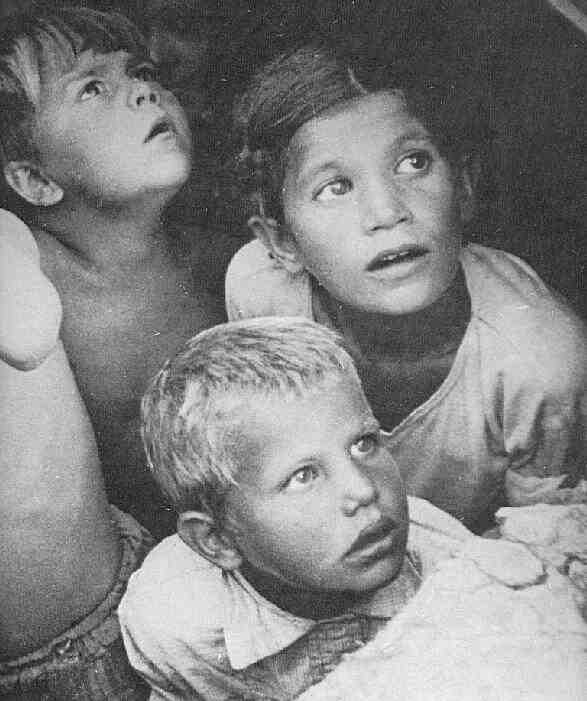
Figure 1.--The destruction of the Soviet Air Force during the opening days of Barbarossa meant that Soviet cities and civilians were exposed to Luftwaffe bombing. Stalin making common cause with Hitler through the NAZI-Soviet Non-Agression Pact unleased the Luftwaffe on Poland and the West. Now with France defeated, the Soviet people were left to face the full force of the NAZI juggernaught without a continental ally. Here children in Moscow probably during August 1941 endure a Luftwaffe bombing raid in a hastily dug slit trench. Photographer: B. Yaroslavtsev
|
|
The Luftwaffe scored a major victory in essentially destroying the Red Air Force during the first 2 days of the Operation Barbarossa. This was a enormous accomplishment by the Luftwaffe. It was one of the most important tactical strike of the War. It is what the Luftwaffe had hoped to achieve over Britain. The Soviet Air Force had been the largest in the world. Much of it was destroyed on the ground. The came about because of both surprise, Luftwaffe technical competance, and the superiority of the German aircraft. Given the fact that the Soviets had ample warning of the attack, the Luftwaffe never should have been able to achieve such a success. The reason that they did was due to the fact that Stalin refused to believe the intelligence reports and prepare for the NAZI attack. The Soviet Commander of Russian Aviation, General Rychagov, was shot for "treasonable activity". The result of the Luftwaffe victory was that for most of Barbarossa, the Germans had air superority over the battle field. Thus even lumbering Stuka dive bombers could be freely deployed to support Wehrmacht operations.
The Red Air Force/Voenno-Vozdushniye Sily (VVS)
Stalin made a huge committment to military aviation and by the time of the NAZIs came to power had built a huge air force. The Voenno-Vozdushniye Sily (VVS) was the largest and most powerful air force in the world. Only when Hitler seized power in German (1933) was an air force created which could challenge the Soviet Air Force. Hitler ordered the secret rearamament of Germany, including the construction of an air force, in flagarant violation of the Versailles Treaty. Stalin poured emense resources into his air force. Planes were built in large numbers and incoroprated a ranbge of modern features. The Soviets had both modern figters and bombers.
the Polikarpov I-16 fighter was the world's first monoplane fighter with a retractable undercarriage which improved performance. The Tupolev TB-3 bomber appeared in 1930. It was the the world's first long-range monoplane heavy bomber and had four-engines. It was the first such bomber to be put into series production. [Harvey]
Effectiveness
The Red Air Force was the world's largest air force. It had, however, serious weaknesses. Many of the aircraft types were obselere, but maintained in service. There was no modern operational doctrine. As with the Red Army, Stalin's Great Purges during the 1930s affected the conat readiness of the service. The weakness of the Red Air Fotce was on display during the Winter War. The massive Red air Fiorce did not effectively bring its weight to bear against the Finns. There seems to have been no major effort to address these problens,m pribably because to admit failure was a very dangerous matter during the Stalimist era. The Finnish Air Force did not threaten the Soviets, the Luftwaffe was a veey different matter. Failure to address the Red air Force's weaknesses proved disasterous.
While the Red Air Force was he largest air force in the World at the time of World War II., the German Luftwaffe is generally seen as the most effective. The British nd French were rapidly expanding their air forces, but the French buildup was cut short by the German invasion and occupation (May-June 1940). The Channel saved the British who at the time the Wehrmacht struck in the West were out producing the Germans. The Luftwaffe was bloodies over Britain for the first time. About 25 percent of the Luftwaffe fighter and bomber strength was lost. And unlike the planes shot down in France, the survivors were lost to the war effort. The Germans replaced the planes and air crews, but it is not clear to us just how the German losses affected Barbarossa. It certainly dd not impair the Luftwaffe effort in the opening phase, but we are less sure about the overall campaign.
Surprise German Attack: Barbarossa (June 1941)
The Luftwaffe scored a major victory in essentially destroying the Red Air Force during the first 2 days of the Operation Barbarossa. This was a enormous accomplishment by the Luftwaffe. It was one of the most important tactical strike of the War. It is what the Luftwaffe had hoped to achieve over Britain. The Soviet Air Force had been the largest in the world. Much of it was destroyed on the ground. The Luftwaffe outclassed the VVS in the air. The Luftwaffe shot down 336 Soviet aircraft, losing 59 planes. That outcome was bad enough, but it was on the groynd that the VVS was literally destroyed. The Luftwaffe within hours of launching Barbarossa destroyed about 800 Soviet aircraft by bombing Soviet forward air bases. [Harvey] The RAF had prevented this by both an advanced state of readiness and the Chain Home Radar Network. The Soviets were neithr prepared nor had an adequate warning system in place. Stalin had ordered the deployment of sunstantial Soviet army and air forces close to the border to protect newly acquired territories. This made these forces particularly vulnerable to a surprise Luftwaffe attack. In addition, it meant there was little time to recover. Rapidly advancing Panzers over ran Soviet air bases before the aircraft damaged on the ground could be repaired and returned to service, The Soviet Commander of Russian Aviation, General Rychagov, was shot for "treasonable activity".
Red Air Force Failure
How could the Luftwaffe achieved such a stunning success? Generally the superiority of the German aircraft is credited with the Luftwaffe's success. This certainly was a factor. A substantial part of the VVs air fleet was composed of obselete aircraft. The Soviets tended to add new planes, but maintain their older planes in service. The result was a massive force with large numbers of obsolete craft. Less thgan 25 percent of the VVs fighter force was made up of the newer MiG-3s and LaGG-3s. A substantial part of the force was the increasing outclassed I-16s. There were even substantial numbers of biplanes in service. [Harvey] Even so, the superiority of the Luftwaffe aircraft does not fully explain the calamedy. Several factors were involved. Some of the most important was incompetent VVS leadership, and surprise as well as superiority of the German aircraft. The surprise attack was an important factor. Given the fact that the Soviets had ample warning of the attack, the Luftwaffe never should have been able to achieve such a stunning success. And any assessment of the German camaigns in Poland (September 1939), the Low Countries and France (May 1940), and Britain (August 1940), and the Balkans (April 1941) showed that the German attempted a surprise knock out blow on opposing air forces at the onset of a campaign. Amazingly the VVS made no preparations for such an attack. We do not know to what extent VVS staff stufied the previous campaigns. But a central reason why they were not prepared was due to the fact that Stalin refused to believe the intelligence reports and prepare for the NAZI attack. The VVS Chief of General Staff Jan Alknis was targeted very early and shot. Many around were also purged. The ability of the Luftwaffe to surprise the VVS was not just a cleverly engineered attack. It relected the state of a service seriously depleted by Stalinist purges. Not only had the senior leadership of the VVS been either executed or committed to the Gulag, but large numbers of experienced officers at mid levels had suffered the same fate. One assessment suggests over 40 percent pf VVS aviation officers had served less than 6 months. Even more telling. over 90 percent of VVS formation commanders had been in that position for more than 6 months. [Harvey] The inexperience of the leadership and the fear of commanders to innovate meant that VVS tactical doctrine was out molded and ineffective against well conceived Luftwaffe tactical doctrine which had been tested and honed with a series of sucecessful campains in the West.
Impact
The result of the Luftwaffe victory was that for most of Barbarossa, the Germans had air superority over the battlefield. Air superority and close battlefield support were key components of Blitzkrieg. Without the virtual total air superority achieved in the first days of Barbarossa, the spectacular advances and encirclments achieved by the Panzers would have been much more limited. Thus even lumbering Stuka dive bombers could be freely deployed to support Wehrmacht operations. It also exposed Soviet cities and civilians to Luftwaffe bombardment. During 1941 Soviet cities were virtually unprotected by the VVS. The major Soviet cities were pummelled by the Luftwaffe. What the Luftwaffe was unable to do was to target the war industries moved beyond the Urals. The Luftwaffe was a largely tactical force and did not include a substatial starategic bombing force.
The Luftwaffe was a short-range tactical force, superbly designed to support the Heer's ground advances. Unlike the Red Air Force, there was aell developed conbat doctrine. Germany did notm however, have the infustrial capacity to also build a long-range strategic bombing force. The Luftwaffe had medium bombers which could launch raids on cities if German ground armies advanced so as to bring
them into the limited range of the two engine medium bombers. The Wehrmacht Army groups advanced so rapidly into the Soviet Union in the first phase of Barbarossa, that most cities in he western Soviet Union were not heavily bombed. The Luftwaffe was afeqquate for the relatively limited campaigns in the confined battlefields of Western Europe, but the Soviet Union was a very different matter. The Luftwaffe was not large enough to both cover the advance of German armies and bomb Soviet cities. and as the Germans anted to use the factories and other facilities in the cities, there was no real reason to heavily bomb them. Major bombing operations were mounted only when made a stand and sucessfully resisted the German advances. Thus the two most heavily bombed Soviet cities were Lenningrad and Stalingrad where the Soviets put up a major fight. Both were also hammered by German artillery. The Germans reached Lenningrad early in Barbarossa (August 1941) and pounded it for 3 years. The Germans began to bomb Moscow once the reached Smolensk (July 1941) and the raids increased when thanks to Operation Typhoon (October 1941) when the drive on Moscow narrowed the distance. The Red Army offensive before Moscow pushed the Germans back from Moscow. The distances involved and other demands on Luftwaffe resources limited the attacks on Moscow. In additions the Soviets hardenened the capital's defenses. Not only was the Luftwaffe unable to continue heavy raids on Moscow, but there was no way to bomb the arms and munitions plants the Soviets had moved east of the Urals. Stalingrad became the major target of Operation Blue the German summer 1942 offensive. The Lufttwaffe began to heavily bomb the city as the 6th Army moved toward it and provided the Luftwaffe forward bases. The Luftwaffe essrntially flatened the city before the 6th Army entered it. This time, however, the Volga made it impossible to encircle the city. And the ruble created by the Luftwaffe created enumerable places where small units coukld take cover and set up strong points. Once the 6th Army entered the city the fight was conducted at such close quaters that Luftwaffe bombing became of limited use. After Stalingrad, the Germans extensively destroyed Soviet towns and cities as they retreated, but this was largely carried out by sappers and demolition teams rather than the overstrewached Luftwaffe which had to not only support German armies in the East as well Allied armies in North Africa and the growing Allied strategic bombing campaign over the skies of the Reich where the Luftwaffe was largely desrtoyed (1944).
The primary Soviet concept of civil defense in the Soviet Union appears to have been primarily civilian support to oppose a land invasion. The Soviet Union had a voluntary civil defense organization known as Osoaviakhim.
There were women's paramilitary training and war preparations in the 1930s. The activities included shooting sports and motor racing. There were also training of female pilots, parachutists and other areas of civil defense training. This seems part of a increasing militarization of Soviet society in the 1930s. [Ilic] The Soviet Union appears to have given little attention to preparations to protect civilians from ememy aerial bombing attacks. The only major action taken was to build the Moscow sunway as especially deep depths. Nikita Khrushchev managed the Metro project. He inisted that the design should include deep tunnels for use as air raid shelters, depite the consideravle added costs. Stalin concured with the idea. After the Luftwaffe began raiding Moscow, civilians began using the subway stations as public shelters. As far as we know, these were the only significant public shelters in Soviet cities. The major air defense action taken once the War began was to attach anti-aircraft batteries to the defense factories moved from the Western Soviet Union east of the Urals. Soviets cities were after the destruction of the Red Air Fiorce, largely undefended. For more than a year, while the Red Air Force was rebuilt, air defense was largely provided by anti-aircraft batteries with little effective. Many cities in the western Soviet Union were largely unprotected when Luftwaffe raids began.
Soviet Aircraft Industry
One has to ask after the resources devoted to the VVS why Soviet aircraft proved so disappointing during Barbarossa. Soviet aircraft designers had made considerable progress and had introduced some innovative aircraft. Later in the War the VVS proved more effective. There were several reasons for inferority of VVS aircraft. Aircraft designers were also sunject to the Stalinist terror. Two of the Soviet Union's most gifted designers, V.M. Petlyakov and A.N. Tupolev, were arrested by the NKVD and not released until 1940-41. One of the weakest aspects of Soviet aviation were the engines. This reflected the weakness of the overall Soviet industrial plant. There are factors that are difficult to assess. We susprect that Stalin's terror inhibited creativity and innovation--key elements in aviation. We also suspect that the free enterprise system so dispariaged by the Soviets were a factor in more technically advanced aircraft being created in Europe and America.
Sources
Harvey, A.D. "The Soviet Air Force versus the Luftwaffe" History Today (January 2002).
Ilic, Melanie. Centre for Russian and East European Studies, University of Gloucestershire. "Soviet Women and Civil Defense Training in the 1930s," Minerva Journal of Women and War Vol. II, No. 1 (Spring 2008), pp. 100-113).
CIH -- WW II

Navigate the CIH World War II Section:
[Return to Main Barbarossa campaign page]
[Return to Main Operation Barbarossa page]
[Return to Main air war in the East page]
[Biographies]
[Campaigns]
[Children]
[Countries]
[Deciding factors]
[Diplomacy]
[Geo-political crisis]
[Economics]
[Home front]
[Intelligence]
[POWs]
[Resistance]
[Race]
[Refugees]
[Technology]
[Bibliographies]
[Contributions]
[FAQs]
[Images]
[Links]
[Registration]
[Tools]
[Return to Main World War II page]
[Return to Main war essay page]
Created: 6:00 PM 2/15/2005
Last updated: 7:14 PM 3/26/2013