
World War II Country Trends: Denmark
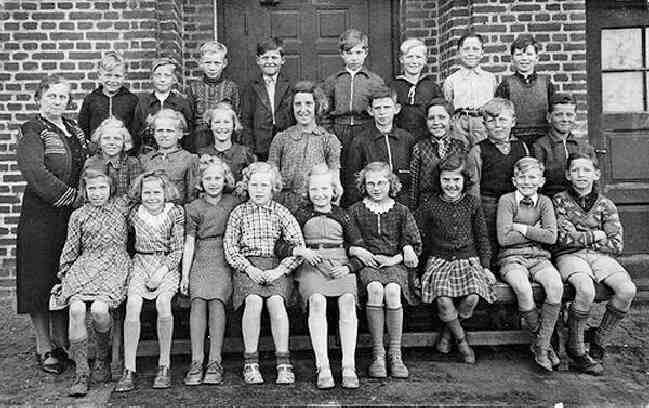
Figure 1.-- Here we see a Danish school class during 1943. The girls wear knee socks, long stockings, or anklets. The two boys in the front row wear short pants with knee socks and sweaters. The children seem happy, reflecting the relatively mild NAZI occupation of Denmark.
|
|
Denmark which had been neutral in World War I attempted to maintain the same status when the NAZIs launched World War II with its invasion of Poland. Denmark along with the other Nordic countries, officially declared their neutrality. Germany nonetheless invaded Denmark (April 9,1940). Operation Weserübung targetted both Denmark and Norway. Denmark had virtually no army. After token resistance at the border, the Danes surrendered before noon. Within hours, Denmark was in NAZI hands. King Christian X decided to remain with his countrymen. The King advised the Danish people not to resist the Germans. The NAZIs allowed the Danish Government to continue to function under close supervision. After the German invasion of the Soviet Union (June 1941), a few Danes volunteered to fight with the Germans. The Resisance movement slowly grew in strength and begin to oppose the Germans through strikes and sabatoge (Spring 1943). Finally the exasperated NAZIs seized control of the Government (August 29, 1943). The Danish Resistance managed to save almost all the country's Jews from the NAZI Holocaust. Denmark along with Norway were the last NAZI-occupied countries to be liberated. Forces commanded by General Montgomery reached Denmark just as the NAZI's surrendered (May 1945).
World War I
Denmark had been a major European power. The Danish war (1864) was the last war fought by Denmark. Danish forces were overwealmed by Prussian and Austrian forces. When Prussia later defeated France in the Franco Prussian War (1870-71) it became clear to Danish officials that Denmark could not militarily resist the Germans. Thus the only viable option was neutrality. A debate began among right-wing and left-wing Danish leads as to what form Danish neutrality should take. The conservatives wanted a strong defense, a kind of armed meutrality and fortifications were built in Copenhagen. Left-wing parties had no agreed view, but some wanted complete disarmament. Danish Goverments attempted to convince the Germans to recognize German neutrality. This was complicated by differences of opinion in Denmark and the anti-German sentiment resulting from the Danish War. Here the most antiGerman Dane was the young Princess Alexandria who married the British Prince of Wales. She would do her part in changing public opinion in Britain toward the Germans. Reports of the mistreatment of the Danish population in Schleswig further fueled anti-German sentiment. German when the World war broke out did generally recognize Danish neutrality, except that they insisted the Danes lay mines in the Great Belt (August 1914). The Danes complied being unwilling to resist a German invasion. The British did not react militarily as they understood the Danish position and were not significantly affected by the action. The kings of the three Scandinavian countries met in Malmö to make a joint declaration of absolute neutrality (December 1914). The War created export markets for the Danes although the British naval blockade and the German U-boat campaignmade it difficult for Danish companies to obtain raw materials. As a result, the Danish Government had to ration some consumer goods. The Government also had to take a range of economic steps to deal with the adverse conditions created by the War.
Egypt
Neutrality
NAZI Germany launched World War II with a devestating Blitzkrieg on Poland (September 1, 1939). Britain anf France honoring pledges to Poland declared war (September 3). Denmark which had been neutral in World War I attempted to maintain the same status. Denmark along with the other Nordic countries, officially declared their neutrality.
The one Allied offensive in the first year of the War was planned to secure Norway. The Germans responded with an offensive north on April 9, invading Denmark and Norway. It was a rapidly organized invasion to counter a planned British attempt to move into Norway to cut off iron shipments.
Operation Weserübung targetted both Denmark and Norway. Denmark had virtually no army. After token resistance at the border, the Danes surrendered before noon. Within hours, Denmark was in NAZI hands.
The German Krriegsmarine suffered severe losses, especilly of destroyers. The British fough on in northern Norway for 3 weeks, but the superiority of the Luftwaffe finally forced them to withdraw. The loss of Norway not only provided Germany access to raw material, but meant that the U-boats could not br bottled up as they were in World war I. It also mean later in the War that supplying Russia would be very difficult.
Merchant Marine
Denmark was a small nation, but had an important merchant marine. Most of the Danish merchant fleet was at se when the NAZIs invasded and subsequently sailed to Allied ports. The ships proved useful to the hard-pressed Brirish losing ships to the German U-boats in the North Atlantic. The Danish ships were especially important before America entered the War and cthe Liberty Boats began entering service. About 60 per cent of these Danish nerchant ships were sunk by German German U-boats and other units. Approximately 600 Danish merchant seamen were killed transporting supplies for the Allies
Christian X was born in 1870 at Charlottenlund. He mairred Queen Alexandrine, born Hertuginde, Duchess of Mecklenburg-Schwerin in 1898. They had two sons. Frederick the Crown Prince was born in 1898. Knud was born in 1900. Some of the major achievements of his reign were a new democratic constitution granting the vote to women and the sale of the Virgin Islands to the United States. After the German invasion in 1940 King Christian X decided to remain with his countrymen. The King advised the Danish people not to resist the Germans. The King led his people in passive resistance to attempts to bring the Danes into the NAZI order. The King's bravery was an inspiration to the Danish people, one of the few countries to have sdome success in resisting the Germans. This was in part possible because the Germans with their racially based world view were unwilling to be as brutal in Denmark as they were in other countries like Poland
The NAZIs invaded and conquered Poland and Demark within the space of a two months. While both countries were close to rach other on the Reich's northern and eastern border. The occupation regimes, however, could not be more different. The barbarity let loose on Poland was not in evidence in Demark. The difference was essentially that the Poles were Slavs and the Germans saw the Danes as fellow Teutons. General Falkenhorst gave clear orders to his men about how they should conduct themselves. The NAZIs allowed the Danish Government to continue to function under close supervision. In the case of Denmark, the German Foreign Ministry administered the occupation. The German occipation was overseen by a Reich Plenipoteniary. The first was a Foreign Ministry diplmat, CecilRenthe-Fink. He was replaced by Werner Best (November 1942). He was assisted by SS-officer Friedrich Franz of Mecklenburg-Schwerin. Best was not given control over NAZI security forces operating in the country. Denmark continued to formally a sovereign state. This status was dramatically different than the other countries occupied by the NAZI. Racial affinities were the primary factor here as well as cultural afinities. The NAZIs did not ban political parties. Denmark remained a parlimentary democracy subject to a totalitarizn dictatorship. The Germans had the right to demand that any cabinent officer be removed. And they used this authority on several occassions. Minister of Trade John Christmas Müller was found to be too pro-British. Minister of Justice Harald Petersen was found to lack resolution in dealing with Danes incolved in a brawl with German soldiers at a fooball game (Danes/Admiral Wien). The Germans demanded the military be reduced by half and placed significant contraints on the country's foreign policy. The Danes formed a four Party coalition government headed by Thorvald Stauning. Erik Scavenius was appointed foreign minister (July 1940). After the NAZI invasion of the Soviet Union (June 1941), German authorities forced the Danish government to acquiese in the formation of a Danish unit to participate, albeit a volunteer unit. A few Danes volunteered and served with the Wehrmact on the Eastern front. German authorities also demanded that authorities ban the Communist Party. Under German pressure, the Danish Government joined the Anti-Comintern Pact (November 1941). Stauning died unexpectatly (May 1942). He was replaced by Vilhelm Buhl who, however, soon proved unacceptable to the Germans. They forced him to resign (November 1942). He was replaced by Foreign Miister Scavenius.
The NAZis did not have the racial goals in Denmark that they had in Poland and the East. The intrest in Denmark was to 1) exploit the country economically to support the war effort and 2) make the Danes and Denmark part of the New Order leading to a greater Reich after the War. For the Danish people, there was a minimal German imprint. Few German soldiers werre seen on Danish streerts. Life went on much as before the invasion. The major impact was in the economic sphere. After the military occupation was secured, the German Foreign Ministry attempted to negotiate or more precisely implement an economic union with Denmark (summer 1940). Then Goering and his Four-Year Plan attempted to oversee the Danish economy. Eventually the Reich Economics Ministry took control. The Germans abandoned the idea of economic union. The German persued more limited measures. They established a ministerial Eastern Committee to expand Danish industry in the Eastern areas seized by the Barbarossa offensive (June 1941). The overall NAZI goal was to become the economic center of a self-sufficient continental Europe. Thus German could function and continue the War depite the British naval blockade. A major goal in Denmark as in other occupied areas was to obtain food for the Reich. Denmark wa a food exporter, especially dairy products. Much of that food was marketed in Britain. After the German invasion, agricultural production was redirected to the Reich. [Lund] Here the Germans were very successful. Before the War, less than 25 of Danish exports went to the Reich (1939). This rapidly shifted and the Reich was soon receiving 75 percent of Danish exports (1941). Estimates suggest that during the War, the Danes supplied 10-15 percent of the Reich's food supplies. Also important was Danish cement and naval shipyards. The shipments to Germany without any counterflow of German products caused economuic problems in Denmark. Danes experienced price inflation. The Government was forced to impose food rationing.
Birthday Snunb (November 1942)
The German occupation of Denmark was a great success economically for the NAZIs, obtaining food and other supplies with a minimal military occupation force--only about 200 Germans. Denmark was also a propaganda show case for the NAZIs. This was not enough for some Germans--namely German Führer Adolf Hitler. He also wanted obedience and a degree of obsequenous from his conquered subjects. Not to mention the fact that they were resisting on the Jewish question. It was no secret in NAZI circles how to gain the Führer's ear and plum political appointments. NAZI syncophants brought to Hitler's attention that the Danes were being codeled and allowed to thumb their nose at the Reich. This was brought to a head on King Christian's 72nd Birthday. Hitler sent the King a long, lauditory telegram (September 26, 1942). The King replied with just a few words acknowledging receipt of the telegram--'Spreche Meinen besten Dank aus. Chr. Rex' (Giving my best thanks, King Chr.). This was not the way Hitler expected to be treated by his satrapies. He was furious and considered the King's telegram an intentional insult. Hitler decided on a major shakeup in the occupation regime. Hitler dispatched Geberal Hannecken to Copehagen. He was a soldier left out of major commands an anxious to demostrate his miitary skills and political loyalty. Hitler replaced Renthe-Fink with SS-Grupenführer Werner Best whom he instructed to adopt hard-line policies for the recalcitrant Danes (early November). Danish Primeminister Bühl resigned in favor of Erik Scavenius who formed a nominally more pro-German Government. But the Government was still based on the Democratic parties in Parliament. Most importantly, the Danish Nazis were not allowed to join the Government. The changes appeared to have mollified Hitler for the time and prevented a massive German intervention. Perhaps fortunately for the Danes, Hitler's attention was diverted when the Red Army launched Operation Uranus, cutting off the 6th Army in Stalingrad (November 19). It is not clear why the Germans were faviorable toward Scavenius. But there was a big difference between April 1940 and November 1942. whatever his policies, Scavenius could read a map and beginning in October 1942, German military forces suffered a series of staggering military reverses.
Several pro-NAZI parties organized in Denmark. This was not because there was a lot of NAZI sentiment, but because there was no one individual leader who emerged to dominate the movement. The largest party was the Nationalsocialistiske Arbejderparti (DNSAP, National Socialist Workers’ Party of Denmark) was the Danish NAZI Party with no pretense of local origins. The party was organized after the dtunning NAZI success in the German Reichstag elections (1930). The DNSAP mimiked Hitler's NAZIs, using both the swastika as the Party symbol and and the German NAZI. They set up aara-military group which they called the SA. They even translated the Horst Wessel song as a Party anthemn. The DNSAP adopted the NAZIs virulent antisemitic. Cay Lembcke helped found the Party, but proved unable to gain even minimal support. Frits Clausen replaced him (1933). Clausen was a physcian from North Schleswig where he concentrated his activities. The support for the DNSAP was largely located there, in large part because of the German ethnic population located there. The party won nearly 2 oercent of the vote and three seats in the Folketing (parliament) (1939). Clausen and the DNSAP supported the German invasion (April 1940). He expected to be rewarded with control of the Danish Government. German Plenipoteniary Renthe-Fink considered the possibility, but decided that cooperation with the elected Danish government was the more prudent course, at least until Germany had won the war. The DNSAP received some financial and political support from Germany, but not political power. The DNSAP was not evem included in the wartime coalition government (1940-43). As Germany allowed the Danisg Government considerable autonomy, it did not interfere when the Government arrested 350 Danish Nazis who were demonstrating (December 1940). The DNSAP's youth movement was the National Socialistiske Ungdom (NSU). After the NAZI invasion of the Soviet Union, the Danish Government allowed a volunteer force to be recruited. The DNSAP was responsible for organizong a Waffen SS and Frikorps Danmark. The DNSAP participated in the elections permitted by the Germans (March 1943), but Clausem and the Danish NAZIs managed to garmer only 2 percent of the vote in the parliamentary election. A crestfallen Clausen decided to join the campaign against the Soviets and joined a Waffen-SS medical unit. Service in the East was a way that NAZI loyalists in the occupied countries established their credentials with NAZI officials. Clausen in a druken stupor forced himself upon nurses in a field hispital in Minsk. Himmler transferred him to an asylum in Würzburg. After the Germans seized control of the Danish Government (August 1943), the position improved slightly, but the most important collaborationist group became the Schalburg Corps, modeled on the SS with black uniforms. They numbered about 1,000 men. [Thomsen] The Danish Government dissolved the DNSAP after liberation by the British (May 1945).
Parlimentary Elections (March 1943)
A quite remarable event occurred in 1943, unique in the NAZI Empire. The NAZIs apparently thinking the Government changes made earlier as a result of the so-called Birthday Snub reflected a shift toward Germany, permitted the Danes to hold free and open parlimentary elections. (The Communists had been supressed, but the democrativ parties were allowed to particvipate along with the Danish NAZIs. It was the only free election permitted in NAZI-occupied Europe during the War. It is not altogether clear why the NAZIs allowed the election. The NAZIs believed for some reason that right-wing parties might gain strength producing a parliament more sympathetic to Germany. Why they believed this is unclear. The science of polling was just developing in America and apparently non-existencet in Germany. And it is likely many anes would have been unlikely to be too open about their politics. The Danes voted strongly to support the four major pre-War democratic parties. This was a stunning rejection of the NAZIs and their local supporters. A factor here was surely the War news with stunning German defeats in the Soviet Union and North Africa as well as the impact of deteriorating conditions resulting from NAZI plundering of the economy. The Danish NAZIs garnered a mere 2 percent of the vote and most of that was the German ethnic minority vote. The Germans were shocked at the results.
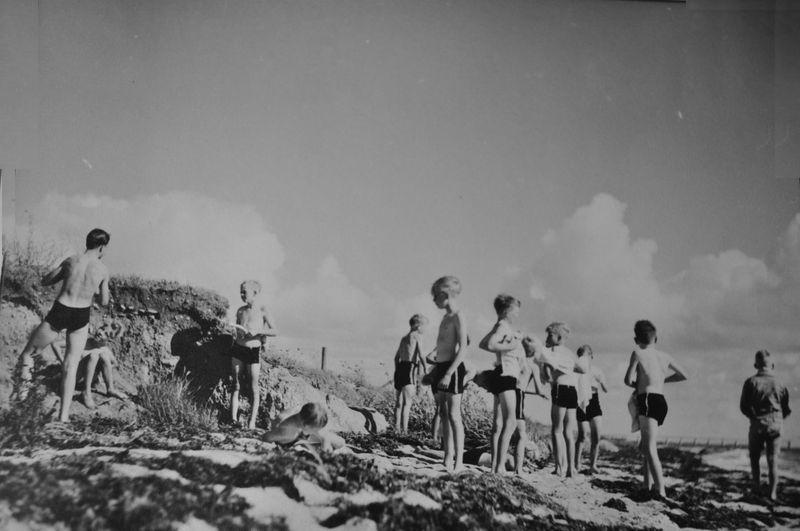
Figure 2.--Many everyday activities in Denmark were unaffected by the German occupation until late in the War. This is a snapshot from a World War II album about a 1943 summer camp. The boys enjoyed beach and swimming ctivities. They sleft in a hayloft.
|
|
Living conditions in Denmark were better than anywhere else in NAZI occupied Europe. This was in large measure because of NAZI racial policy. Denmark like the Netherlands and Norway were countries tht Hitler eventually wanted to include in a an Aryan greater-Germany after the War. With no racial concerns, Hitler allowed the occupation authorities to pursue a pragmagtic policy designed to best use the country's economy to support the German war effort. For many Danes, life went on much like it did before the German invasion. The schools continued to function. We even see Danish children going to summer camps along the country's extensive coasts. That was something that did not happen in Britain. Danish politicans, especially after the fall of France, so no alternative, but to cooperate with the Germans. And they had some success in obtaining important concessions from the occupation authorities. The Danish Government was left in tact and largely able to function until late in the War. The Danes held the only democratic election permitted in the NAZI empire. The Danes considered, but ultimtely rejected a customs union with Germany, largely because the Germans insisted on emlininating the Danish krona. [Meyer-Gohde] The Germans did not press the issue, concerned about destabilizing the political situation. The Danes had other successes, including dragging out negotiations over the return of South Jutland to the Reich, baning 'closed-rank uniformed marches' rejected includung National Socialists in the government, successfully conducting a relatively free election,
and preventing actions against Jews for 3 years.
One of the most devestating aspect of NAZI occupation in occupied countries was food policy. Occupation authorities were primarily concerned with exploiting the local economy and shipping food and other commodities back to the Reich. This was also true in Demark, but the German authorities exerciaed more restraint than in other countries. And the country's productive agricultural sector was able to keep food consumption levels higher than in other countries. We do not yet have details on rationing in Denmark. One of the mahor problems was inflation. This immediately arose with the German invasion. The German military made extensive purchases on military instalations and supplies after it moved into the country. They paid in military script which they simply printed. The National Bank of Denmark was required to convert the German currency for Danish krona. This essentially meant the Danes had to finance the German occupation as the military script had no real value and could not be spent in the Reiuch even if German products wre available for purchase. The vast sums of military script never was redemed by the Germans. Eventually the Government negotiated a more realistic exchange rate. [Giltner, p. 488.] In addition to inflation and German exploitation of the economy, Denmark's principal economic problem was that manufacturers lost access to raw materials. Denmark had a range of industries, but very few raw materials, virtually all of which had to be imported. Coal and oil were especiially difficult to obtain. The Allied naval blockade cut off the ability of imports evedn if German occupation authorities would have permitted the exports needed to pay for imports. And Denmark lost its principal trading partner--Britain. Danish economic activity becamne essentially meeting demands made by the occuoation authorities.
Here there were a variety of manufacturing operations, especually the production of munitions, but the major German demands was for food proiduced by Danish farmers.
Growing Opposition
NAZI battlefield losses in 1942 changed minds about the outcome of the War. The ressistance movement began to grow in strength. The 1943 election demonstrated that the Danish peopled rejected the NAZIs. NAZI plundering of the economy gave rise to shortages and inflation, leading to growing public disatisfaction. The Resisance movement slowly grew in strength and begin to oppose the Germans through strikes and sabatoge (Summer 1943). Here the British aware of the Danish support for the German war effort decided to to use the Special Operations Execurive (SOE) to insert teams to help the Ramish resistance. Soon sabatoge attacks were occurring at the impressive rate of 20 a week. There were also spotaneous strikes in Odense and North Jutland. This was the end of the passive Danish acceptance og German rule. The strikes centered on Danish factories supporting the German war effort.Wehrmacht commanders at first feared an Allied invasion. General Hannecken reported on the disturbances to Hitler who took a personal interest in the Danish developmemts. Hitler summoned Best to his Wolf's Lair Headquaters in Rastenburg. Best was not called for consulations, but to be informed of Hitler's decesion as to deal with the Danes. The Germans delivered an ultimatum to the Fanish Government requiring it to supress the civil disturbances. The German authorities demanded that the Danish Government approve the death penalty for sabotage, cooperate in actions against Jews, and supress strikes with force.
NAZI Seizure of Government: Putch (August 1943)
The Government refused to move against the Jews or to use violence against striking workers and thus rejected the German ultimatum (August 29). The exasperated NAZIs declared a state of emergency and seized control of the Government. General Hannecken activated Operation Safari. He disarmed and interned what remained of the the Danish Army. While the Army did not resist, the Navy did. And after a fierce fight scuttled most of their ships to make sure the Germans would be unable to use them before withdrawing to neutral Sweden. The Germans imposed a nighttine curfew. Meetings including strikes of more than five people were banned. The German Reichskommissioner assumed control of the country. The SS was now able to prepare plans to seize Danish Jews.
One of the most effective Danish acts of resistance came from the Danish military. The Danish Army was demobilized, but not totally eliminated. And Danish military officials had access to sensitive German military information which they passed to the Allies thriugh Stockholm where there was a military asttache in the Danish Embasdsy. With the Germans firmly in control of the country and prepared to brutally apply force, the only real options open to the Danes was passive resistance. This would not work in many countries because the NAZIs were prepraring genocide, not only against the Jews, but also the Slavs. The Danes were different. They were a Nordic people, infact more Nordic than the Germans. Thus race hatred and genocide was not an element of NAZI occupation policy, except for the Danish Jews. The Danish resistance movement began to form in 1941. It was realtively quiet until Danish attitudes toward the NAZIs began to change (1943). The Danish Government that ruled until 1943 essentially played a game of saying one thing to the German occupation forces and then delayed actions for as long as they could. The NAZI authorities became increasingly frustrated. There are maby accounts of ordinary folk worked as slowly as possible and if they could recalibrate a machine to make duff parts they did. It is difficult to tell just how much of this really occurred. Of course after liberation, everyone made such claims. Actually doing such things during the NAZI occupation was very dangerous. The Resiatance targeted the German military and businesses working for the NAZIs with acts of sabotage actions. There was also growing labor unrest. Massive strikes were staged in many Danish cities (1943). The Danish Government resigned and the NAZIs took over the government. Among other actions they imposed a curfew. Workers left work early on the pretext that they had to tend their gardens because the curfew provented them in the evening. In reality some went out to demonstrate, but this was dangerous. Teenagers and older students did not like passive resistance so they were the ones who carried out many of the acts of sabotague. The NAZIS as in other occupied countries targeted the Danish Jews for deportation, maning of course death. Saving the Danish Jews was the finest achievemebt of the resistance, Danes formed the Danish Freedom Council (DFC) (September 1943). By that time it was increaingly clear that the NAZIs were losing the War. They were, however, firmly in control of Denmark. The DFC was the coordinating prganization for the Resistance. Some of the major actions were clandestine newspapers, intelligence gathering for the Allies, and sabotage designed to disrupt war production. The DFC worked with Danish political figures.
The continuation of constitutional government in NAZI-occupied Denmark, meant that the Danes retained control of the police. And to the emense frustration to the Germans, the Danish Government not only refused to cooperate, but adamently refused to order actions against Jews impleted everywhere else in NAZI-occupied Europe. This was not how Hutlkerc expected conquered people to behave. The NAZIs, after seizing control of the Government (August 1943) finally were in a position to round up Danish Jews. The NAZI occupation authoritiers planned a nation-wide round up all Danish Jews and to then send them to the nearby, fully operational death camps in Poland. The Danish people courageously came to the aid of their Jews. Advanced warning of the roundup was leaked to the underground. Thousands of Danes stepped up to hide Jews and help them escape to nearby Sweden. Before World War II there were 8,000 Jews in Denmark. They could have been dispatched in 1-2 days at Auschwitz-Birnenau if the SS could just get their hands on them. Miraculously 7,500 of them successfully managed to get to Sweden with the assistance of their non-Jewish countrymen (October 1943). The NAZIs only manage to capture a few. It was one of the few successful efforts to save Jews in NAZI-occupied Europe. It was only possiblle, however, because Sweden was so near and by this point in the War, the Swedes no longer had to fear a German invasion. The Danes not only got the Jews to Sweden, but looked after their homes and other property until liberation and they were able to return.
NAZI Terror
Reports of NAZI terror reached the Allies. One wire service press reports reads, "A German wave of terror aimed at smashing the Danish underground was reported today to be sweeoing through Denmrk. The Nazis in two weeks of intensive raids were said to have bagged number of prominent resistance leaders, including professor Mogens Fog, leader of the Danish Fredom Council, who is believed to have been slain. Danish circles in Stockholm said it us common to see the Gestapoherding scores od Danes into tucks in Copenhagen for transportation to concentration camps. Refugees reaching Sweden despite the almost irnclad Nazu precautions against escapes tell lurid tales of conditions in Denmark. They said the the German dismissal of the entire 14,000Danish police force on September 19 plunged the country into aave of disorders. Free Danish sources said theGerman presumably decided to take over the policing to break down the underground. ['Nazi terror']
Denmark is amall country with limited capabilities and virtually no military. The country did its best to remain neutral, as it had in World War I. After the Soviet Union invaded Finland (November 1939), Denmark took in a number of Finnish child evacuees. Most went to Sweden, but the Danish and Norwegians took in a few as well. This could be done without compromising the neutral status adopted by the Scandinavians. The situation in Denmark change radiclly with the NAZI invasion and ensuing occupation. Caring for Finnish evacuee children was still possible although the Finns primarily focused on the Sweeds. We note a Danish businessmen who set up a smll summer camp for a group of Funnish children, many malnourished some sick. This could occur because when the Germans invaded the Soviet Union (June 194), Finlabd became a co-beligerant, thus there was no German opposition to aiding Finish evacuee children. In addition to aiding Finnish evacuees, the Danes carried out one of the great coups of the war. The Germans after killing bmuch of the Jewish population of Poland and the western Soviet Union, finlly turne to Denmrk's smll Jewish community which had been left largely untouchd. Right under the noses of the Germans, the Danes at great personal danger to the many rescuers saved almost their entire Jewish population, getting them safely to Sweden. It was an action without prescedent in the tragic history of the Holocaust.
Denmark along with Norway were the last NAZI-occupied countries to be liberated. Danes followed war developments on the radio. They knew that the and of the War was near. They did not know, however, if the British or Soviets would reach them first. Or how the Allies would regard them. Unlike the Norwegians there had been considerable collaboration with the Germans. The German forces in the Netherlands, northern Germany, and Denmark surrendered effective (May 5, 1945). The surrender to Field Marshal Montgomery took place at Lüneberg Heath in Germany (6:30 pm, May 4). It did not go into effect until the following day--8:00 AM May 5. The Danes, however, learned as a reslt of a report on the BBC Danish broacast (8:30 PM). “This is London … I
“At this moment, it is announced that Montgomery has stated that the German troops in the Netherlands, Northwest Germany and Denmark have surrendered.” The annoubncer was Johannes G Sørensen. He was the Danish annoubcer that informed the Danes that their country had been occupied on (April 9, 1940). He later fled to Britain in 1944. The Danes called it their declaration of freedom. The British, however, had not yet reached them. People coud not wait until the next day when the surrender went into effect. They flooded into the streets, waving the Danish flag 'Dannebro' and burning their blackout curtains. Many people also spontaneously placed lit candles in their windows. This became the symbol of liberation and a custom that is still kept up by many Danes. Fortunately for the Danes the British on the northern flank of the allied advance into Germany arrived at the base of the Jutland Pemonsula just days before the Red Army advancing from the East. British forces arrived just as the NAZIs surrendered (May 7-8, 1945). he next day The Red Army occupied the island of Bornholm after intense fighting with the Germans (May 8). It was not retirned to the Danes until a year later (April 1946). British parachute troops arrived to suprvise the German surrender (May 8). Many Danes were out for revenge. Quite a number of men were shot before civil order was established. Newspapers reported numerous unexlained shootings. Women who were mostly gulty of affairs with German soldiers had their hair cut off and paraded in the street. A few were striped naked and painted with swastikas. Eventually 40,000 people were arrested on charges of collaboration. Over half were found guilty, some 13,500 were fond guilty. There were 78 received death sentences, of which 46 were actually carried out. Most of the others received prison sentences of less than 4 years. The first British troops led by General Richard Dewing arrived in Copenhagen (4:32 May 5). This became Liberation Day--Befrielse Dag. Field Marshall Montgomery made a triuphant entry a week later.
A new government was formed with both representatives of the DFC and major political parties. The Danes voted (Fall 1945), electing a left-of-center government led by Knud Kristensen.
Sources
Giltner, Phil. "The Success of Collaboration: Denmark's Self-Assessment of its Economic Position after Five Years of Nazi Occupation," Journal of Contemporary History Vol. 36, No. 3 (2001), pp. 483–506.
Lund, Joachim, Denmark and the ‘European New Order’, 1940–1942 (Cambridge University Press, 2004).
Meyer-Gohde, Ruth. "Dänemarks wirtschaftspolitische Reaktion auf die Besetzung des Landes 1940/41" NORDEUROPAforum No. 2, (2006), pp. 51-70
Thomsen, E. Deutsche Besatzungspolitik in Dänemark, 1940-1945 (Düsseldorf, 1971).
"Nazi terror," Sarasota Herald Tribune (October 26, 1944), p.7.
CIH -- WW II

Navigate the CIH World War II Section:
[Return to Main World War II country page ]
[Return to Main World War II displaced children page]
[About Us]
[Aftermath]
[Biographies]
[Campaigns]
[Children]
[Countries]
[Deciding factors]
[Diplomacy]
[Geo-political crisis]
[Economics]
[Home front]
[Intelligence]
[POWs]
[Resistance]
[Race]
[Refugees]
[Technology]
[Totalitarian powers]
[Bibliographies]
[Contributions]
[FAQs]
[Images]
[Links]
[Registration]
[Tools]
[Return to Main World War II page]
[Return to Main war essay page]
[Return to CIH Home page]
Created: 6:55 AM 7/10/2006
Last updated: 3:58 AM 6/23/2019