
World War II Country Trends: Estonia
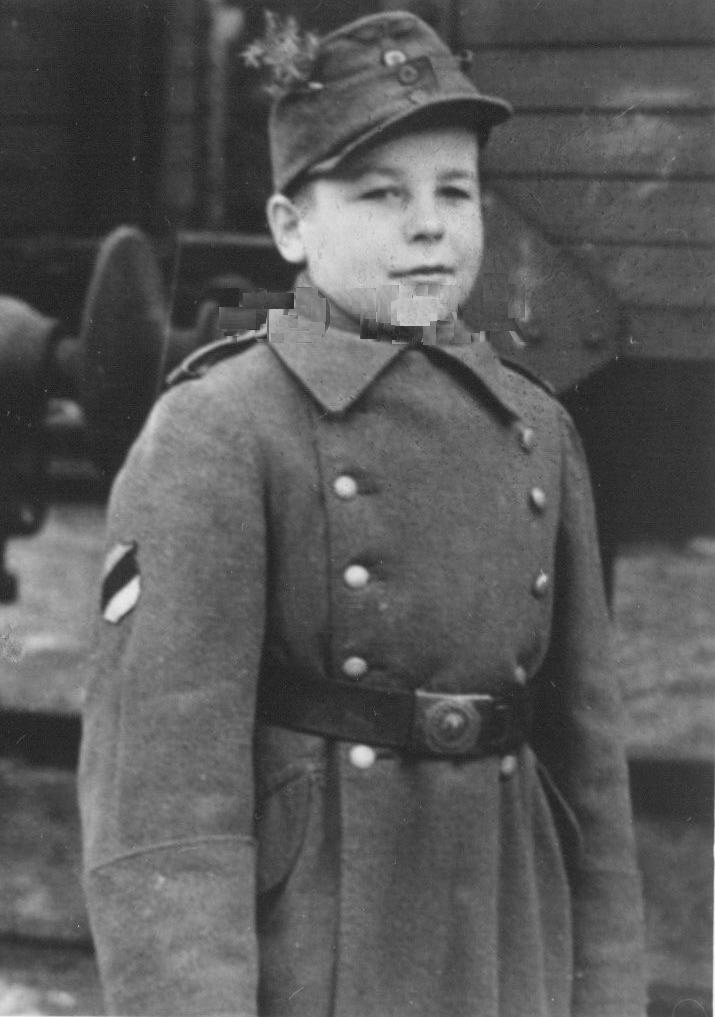
Figure 1.--Estonia like the other Bltics was caught between two evil titalitaroian powers, NAZI Grmany and the Soviet Union. This Estonian boy has joined the Whermacht, presumably to oppose the Red Army reqonquest of his country. He would no have been conscrioted, but volunteered. Notice the Estonian shoulder patch and the sprig in his cap. The Germans called these units Freiwilligen Legions, volunyeer lefions. One wonders why he would join the Germans at this stage of the War, perhsp he witnessed the NKVD drag away his fathervor grandfather in 1940-41. Unbeknowst to him and other Estonians was the NAZI Generalplan Ost hich called gor the murder of half the population, the same plan for the Latvians, but less than the 85 percent of the Lithuanins to be destroyed.
|
|
Estonia was part of the Tsarist Empire, but achieved independence after World War I through a war with the Bolshevicks (1918–1920). Estonia became one of the three small independent Baltic reoublic along with Latvia and Lithuania. Hitler and Stalin divided Eastern Europe with the NAZI-Soviet Non-Agression Pact (August 1939). After the start of World War II, the Soviet Union occupied Estonia and annexed it (1940). Large numbers of Estonians who opposed to Communism and Soviet intervention were arrested, executed, and deported. About 60,000 Estoniansd were involved. The Soviets were especially harsh in the NARVA region where Russian "colonists" to a substabntial degree ethnic Estonians. Estonia was occupied by the NAZIs in the opening phase of Operation Barbarossa (1941). The NAZIs quickly hunted down and killed Estonia's small Jewish population. The resurgent Red Army drove the NAZIs out (1944). Estonians fought a guerilla war for independence after the War, but faced overwealming forces.
Tsarist Empire
Tsarist Russia seized Estonia from Sweeden under the Peace of Nystad (1721). The landlords remained the Balts (Baltic Germans) under the political control of the Tsar.
Independence (1918)
Estonia was part of the Tsarist Empire, but achieved independence after World War I through a war with the Bolshevicks (1918–1920). Estonia became one of the three small independent Baltic republic along with Latvia and Lithuania. Russia weakened by World War I, the Revolution, and Civil War, could not hold the new Baltic republics.
Hitler and Stalin divided Eastern Europe with the NAZI-Soviet Non-Agression Pact (August 23, 1939). This provided Hitler the opportunity to invade Poland without the far of Soviet interference. A secret memorandum attached to the pact divided Eastern Europe. Estonia was located in the Soviet spehere of influence.
The Soviet Union after the start of World War II began the process of seizing the Baltic Republics. Hitler called the ethnic German populastion (about 21,000) home to the Reich. There was some disagreement between the NAZIs and Soviets as into whose zone of influence Lithuania fell. There was no doubt about Estonia.
The Polish submarine ORP Orzeł when thevGermans seized Danzig, sought refuge in Tallinn. This lead to the Orzeł incident. The Soivet Union had also invaded Poland (September 17). The Siviets accussed the Estonians of harboring an ememy war ship. The Soivet Union threatened to invade if Estonia did not accept a Pact of Defense and Mutual Assistance. Similar demands wee made on Lithuania and Ltvia. The pacts required allowing the Soviet Union to build Military Bases into Estonia. Estonia officials realized that military resstance was futile and agreed to the pact (September 28, 1939). This allowed the Soviets to station Soviet troops and maintain bases in Estonia, Latvia and Lithuania.
The NAZI victory in the West with the fall of France fundamentally changed the European ballance of power (June 1940). The Soviets proceeded to absorbed the Baltic Republics. The Red Army compleleted the occupation of Estonia. Soviet officials claimed that Estonia had violated the Pact of Mutual Assistance. The Soviets than oversaw the establishment of a new government with Communists who quickly seized power. A sham election was held after all political parties were outlawed except the Communists. The Communist government then proclaimed the Estonian Socialist Republic (ESR) (July 21). The ESR "requested" admission to the Soviet Union as one of the Soviet republics and was admitted to the Soviet Union (August 6). Large numbers of Estonians who opposed to Communism and Soviet intervention were arrested, executed, and deported. About 60,000 Estoniansd were involved. The Soviets were especially harsh in the NARVA region where Russian "colonists" to a substantial degree replaced ethnic Estonians.
Barbarossa (June 1941)
NAZI Germany launched Operation Barbarossa, the massive invasion of the Soviet Union (June 1941). The Red Air Force was qickly destroyed. Whole Soviet armies were engulfed by powerful Panzer pincers. Estonia was occupied by the NAZIs in the opening phase of Barbarossa. After furious figting around Lenningrad, the front stabilized. The NAZIs fauled to take the city by storm and then set out to pound and starve the city into submission.
A key facor here is that the NAZIs allies, the Finns, refused to moved significantly beyond pre-War Finnish territory.
NAZI Occupation
Many Estonians saw the Germans as liberators from brutal Soviet occupation. Some Estonians inlisted in the German military and security forces. The NAZIs at first were not sure how to administer the occupied east. Estonia was incorporated into the NAZI Ostland. This included the Baltics and the northwestern Soviet Union. Ostland was administered by military officials.
The NAZI occupation regime had a racial component. The Russians were Slavs and seen as subhumans. The NAZI goal was to substatially reduce the Slavic population and to use those who were not killed or deported for slave labor. The ethnic Baltic population includung the Estonians were accorded a higher status.
The Holocaust
Estonia had the smallest Jewish population of the three Baltic republics. There were about 6,000 Jews in Estonia before the NAZI invasion of the Soviet Union--Opperation Barbarosa (June 22, 1941). Estonia is the most easterly of the three Baltic Republics. As a result, the Estonian Jews had more of a chance to escape east. About 5,000 Estonian Jews fled to Russia before the Wehrmacht reached Estonia. Only about 1,000 Jews remained. They were quickly rounded up by the NAZI security forces. Of those who fell into NAZI hands, only seven persons are known to have survived. I'm not sure where they were killed. One report indicated that they were deported to Auschwitz. I am not sure about that. The NAZIs also killed 7,000 other people, including 6,000 ethnic Estonians, mostly Comminists or others known to be critical of the NAZIs. Some Estonians worked with the NAZIs in the Holocaust. Some Estonians participated in actions against Jews and as concentration camp guards.
The Simon Wiesenthal Center has provided the Estonian Security Police Board with the names of 16 Estonians it claimed helped murder Jews in Belarus in August 1942.
Ethnic Cleansing
Both Hitler and Stalin in launching World War II had similar intentions, the only major difference was Hitler's obsession with the Jews. Their plans for the Baltics is a poorly reported aspect of the War. Stalin after seizing Estonia and the other Baltics (June 1940) ordered the NKVD to arrest not only known indiviual anti-Communist, but groups known to be generally anti-Communists such as politicans, public servants, army officers, and many others. Some were shot. Others including their families were deported to Central Asia under circumstances in which many died. Stalin also began moving ethnic Russians into the Baltics, all in an effort to make the area more securely Soviet. These actions horrified the Baltic people and explained why with Barbarossa (June 1941) many Balts receivd the advancing Wehrmacht as liberators. Unknown to the Balts was Generaplan Ost which was an even more horrific ethnic cleansing plan. The Germans planned to kill some 50 percent of Estonian and Latts and 85 percent of Lithunians. They were to be replaced with German colonists. Unlike the Soviets, however, the Germans did not begin executing Generalplan Ost in the Baltics except for some preliminary steps. Generalplan Ost had to be put on hold when the Red Army launched a Winter Offensive before Moscow (December 1941). The Wehrmacht found itself locked in a life and death struggle and instead of executing Generalplan Ost, turned to the Balts for support, something that they did not do in Ukraine. .
We are unsure about the minority groups in Estonia at the time of World War II. Data exists on the current minorities. We are less sure about World War II. We believe that the major minority group was Russian as well as other Soviet groups (Ukranian and Belarusian), but there were also Finns, Swedes, Balts, Jews, and others. Estonians are related ethnically and lingustically to the Finns. There was an important German minority, but they were evacuated just before the War on Hitler's 'Home to the Reich' order. We do not have much information on these groups and their experience during the War. The relatively small Jewish population either fled east or were murdered by the Germans. We have found information on the ethnic Swedes in Estonia. The Soviet Union demanded Estonia sign a treaty allowing them to establish military bases on Estonian territory (1939). The Soviets made similar demands on Finland, Latvia, and Lithuania. The Finns fought leading to the Winter War (1939-40), the Balts acquiessed. The ethnic Swedes in Estonia mostly lived along the coast and offshore islands. Estonia was once part of the Swedish Kingdon. Gaining contol of these islands was an important Soviet goal meaning that the Swedes in Estonia were especially affected. Note that they were people of Swedish ancestry, but Estonian citizens. The Soviet military occupied many of these islands and built military instalations of various types. The inhabitats were forced out of their homes and off the islands. After the Soviets invaded Poland (September 1939), they moved against Estonia and the other two Baltic Republics annexing them to the Soviet Union. As far as we know, reltively few Estonian Swedes were able to flee to Sweden at this time. The Soviets began conscripting Estonian men, including the Swedish-Estonians, into the Red Army. After the Germans invaded (June 1941), the Germans conscripted men into the Wehrmacht. The Germansvery rapidly swept through the Baltics as part of Operation Barbarossa. With the German reverses in the East, the Red Army began to move toward the Baltics (1944). Most of the Estonian Swedes fled to Sweden at this time. The Germans do not appear to have prevented this nd began evacuating German civilins and wounded soldiers. At the end of the War, there were some 6,600 Estonian Swedes and 21,800 ethnic Estonian refugees in Sweden. [Zerterberg]
Soviet Re-Conquest (1944)
The resurgent Red Army drove the NAZIs out. The Red Army reached Estonia (September 1944). Many Estonians having experienced one Soviet invasion, wanted no pat of the Soviet Union. An estimated 70,000 Estonians left Estonia, many to neutral Sweden. Many of thesecrefugees eventually emmigrated to Canada and the United states. Estonia with the entry of the Red Army was restored as a Soviet Republic. The Western Allies had protested Soviet actions in the Baltics during 1940 and did not recognized Soviet annexation. The Allies had no military capability to contest the Soviet annexation.
Guerilla War (1944-53)
Estonians fought a guerilla war for independence after the War. The Amemericans with the outbreak of the Cold war did attempt clandestine aid to the Baltic republics. The Estonians, however, faced overwealming forces. An estimated 15,000 Estonians wre killed in the fighting.
Personal Experiences
Sigrid von Bremen-Thomas
"My mother, grandmother, her companion, the estate secretary and I were riding a horse-drawn coach and a farm wagon, fleeing the advancing Soviet army in western Poland in late January 1945. Our family, Estonian nobles, had been displaced to Poland by the Soviets at the start of World War II. We were now escaping a second time. Refugee wagons filled one lane of the icy road. German trucks and tanks filled the other. Everyone was going in the same direction. Artillery rumbled to our rear. I sat on the coach box, dazed by sleeplessness and subzero temperatures. Then came the planes. The noise! I saw mother leap from the driver's seat screaming, "Into the ditch!" I don't remember how I jumped, but I do remember lying in the snow, amazed to see that grandmother had made it as quickly as I.
The single-engine biplanes, called Red Ivans, flew so slowly they seemed to almost float over the highway. From the rear cockpit of each a machine gun sprayed bullets onto the crowded road. One plane flew so low I saw the red star on the pilot's collar tabs. In three minutes they disappeared, leaving panic behind. Horses had gone wild, tipping their wagons into the snowy ditch. Soldiers rushed about with stretchers. When I got up, I saw the first dead in my life.
We started moving again. As darkness fell, I imagined that the hooves of Bibi and Lola, pulling the coach, were slowing down. Look, they're staggering," my mother gripped my hand.
The next instant, the horses stopped. Mother sprang from the box, rushed to Bibi, and began stroking her neck, trying to coax the horse. "Come on woman, move!" came angry voices from behind.
Mother took Bibi by the bridle and tugged her forward. Powerless to resist, Lola came along. Both horses let themselves be dragged a few yards, then stumbled.
"Sigrid, come down!" mother shouted to me. "I need your help."
I jumped down and leaned into Lola's trembling side with all my might, pleading with her to take more steps. Mother pushed and cajoled Bibi. I reached exhaustion beyond tiredness-emptiness. The deep soft snow on the roadside tempted me to lie down. I heard my voice repeating, "go, move, go, move." I am sure I wasn't supporting Lola anymore. She was dragging me. Around midnight, we saw a large, fully lit building ahead of us on the road." [von Bremen-Thomas]
Sources
Zerterberg, Seppo. Viro, Historia, kansa, kulttuuri. (Helsinki: Suomalaisen kirjallisuuden seura, 1995).
Von Bremen-Thomas, Sigrid. "A push, a pull in the dark, The Washington Post (May 28, 2004), p. W11.
CIH -- WW II

Navigate the CIH World War II Section:
[Return to Main World War II country page ]
[Return to Main World War II displaced children page]
[Return to Main Estonian page]
[Biographies]
[Campaigns]
[Children]
[Countries]
[Deciding factors]
[Diplomacy]
[Geo-political crisis]
[Economics]
[Home front]
[Intelligence]
[POWs]
[Resistance]
[Race]
[Refugees]
[Technology]
[Bibliographies]
[Contributions]
[FAQs]
[Images]
[Links]
[Registration]
[Tools]
[Return to Main World War II page]
[Return to Main war essay page]
Created: 4:27 AM 12/10/2005
Last updated: 6:58 PM 2/14/2018