*
World War II: displaced children refugees Norway
World War II: Displaced Norwegian Children (1939-45)
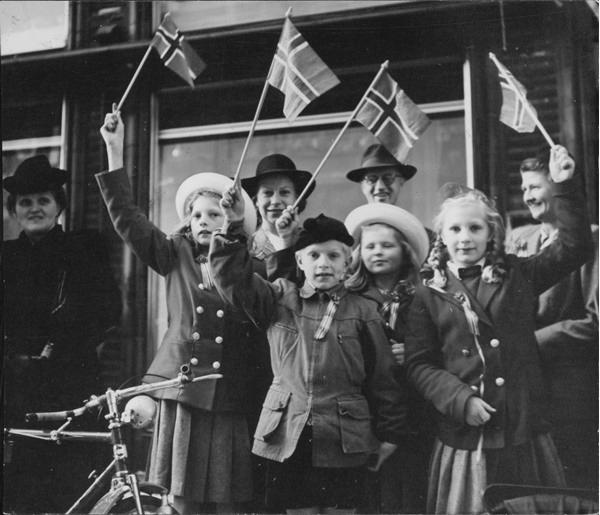
Figure 1.--The population of most countries invaded and occupied by the Germans during World war II were trapped with very limited opportunities to escape. Here the Norwgians were one of the most fortunate occupied countries. Norway had aong border with Sweden. And while not easy to cross, it was possible with a little planning. The crossing was often done as family groups out of fear that the Germans would arrest family members. Here Norwegian refugee children in Stockholm wave their Norwegin flags to celebrate V-E Day.
The Germans occupied Norway early in the War (April 1940). And like other counties invaded and occupied by the NAZIs, children were affected. Norway was a little different thn most of the NAZI-occupied countries. The NAZIs much admired Norway as a rich source of Nordic Aryan breeding stock. In fact Norway w more Nordic/Ayan than Germany itself. A aesult, Himmler's Lebensborn ptogram functioned in Norway. We do not yet have details, however, on the extent to which the Lebensborn program operated in Norway. There does not seem to have been any organized kidnapping program as was the case in Poland and the East. The Resistance was active in Norway and numerous Norwegians were arrested and executed by the occupation authorities. We do not have details on their children. Most seem to have been taken in by family. The Germans maintained a substantial army of occupation, per capita, the largest of any occupied country. Later in the War, the Allies tried to convince the Germans that they were planning an invasion, to discouraging the Germans from drawing down the occupation force. They could have been used to strengthen the Atlantic wall in northern France. Thus over the 5 year occupation of Norways, there were many liasons between German soldiers and Norwegian women. After the War, these women were shunned. Over 10,000 children were fathered by German soldiers. Had the Germans won the war, these children would probably have begun part of the Lebensborn program. With the Allied victory contact was lost with the fathers. These children were like their mothers shunned and harassed. They were bullied at school and descriminated against when they began working. The Norwegian parliment finally offered a small cash payment as retribution (March 2005). There were also Norwegian refugees. Most sought safety in Sweden, but some made it to Britain. Unlike the Finnish evacuee children taken in by the Swedes, the Norwegin refugee children mostly came with their families.
The Germans occupied Norway early in the War (April 1940). Norway ptoved useful to the NAZIs as naval and air bases made it difficult for the Royal Navy to bottle up the U-boats in the North Sea. Norway was also an important source of raw materials. Later after the invasion of the Soviet Union, the Germans were able to launch devestating raids on Allied convoys delivering war materials to Murmansk and Archangel.
Most people in NAZI-occupied Europe had no where to go to escape the Germans because most of the continent was occupied. Thus the refugee problem did not become a major problem until after the War. Norway was an outlier. Norway was across the Baltic from NAZI Europe. There was a long difficult to close border with neutral Sweden. In the north was a border with Finland, but most of the population was in the south. To the west was the North Sea and Britain. A sea escape was possible, but required a fairly substantial craft to cross the tempetuous North Sea. As a result, escsaping from occupied Norway was possible, especially reaching Sweden. The German occupation, largely for racial reasons was relatively light. So unless, except for the small Jewish population, the Norwegian people were not targeted by the NAZIs. There was labor conscription. Most refugees went to Sweden. There were also small numbers in Britain. At the beginning of the German invasion anf Throughout the War, Norwegians were able to cross the border into Sweden. These included Jews, political figures, resistance fighters, labor conscripteesd, and others who feared the Germans. The Germans establishef border patrols, but this was a virtually impossible task given the length of the border and Sweden refusal to return the refugees. Norewgian living along the border helped the refugees evade the German pstrols and became known as 'border pilots'. The Swedish authorities harbored the refugees, but did not encourage flight from Norway. They confined the refugees in camps. An estimsted 50,000 Norwegians escaped to Sweden. We are not sure about the number of children, but among the refugees were family groups. Some of the male refuf\gees wanted to join the Norwegian armed forces abroad otganized by the Londin government-in-exile. Some managed to travel through the Soviet Union and get to Britain. This became more complicated after the German invasion of the Soviet Union (June 1941). A few individiduals including officsers and pilots managed to get permissiion to exist Sweden on Swedish-flag vessels. The Norwegian government in exile after considerable effort got Swedish permisddion to form military formations among the refugees in Sweden (1944). They were called 'Police troops' so Sweden coukld retain its neutral stance. A number of Norwegians managed to make their way to Britain during the War. A few more were brought to Britain as a result of several British raids.
NAZI authorities considered Norway to be a rich source of Nordic breeding stock. There were no organized kidnappings that we know of, but some sources say that Norway was not imune to occasional NAZI kidnappings. More importantly, there were extensive liasons between German soldiers and Norwegian girls. More than 0.5 million German soldiers were stationed in Norway during the War. Virtually all the off-spring would be racially acceptable. Himmler regarded as direct descendants of the Wikinger, and therefore German soldiers were incouraged to have affairs with Norwegian womem. Lenensborn homes were established throughout Norway. One source suggests that there were nine homes set up, almost as many as in Germany. The homes were very attractive. The women got excellent care and good food. Conditions were very difficult during the occupation and the community would have been very hostile to women having the children of the German soldiers.
Resistance
The Resistance was active in Norway and numerous Norwegians were arrested and executed by the occupation authorities. We do not have details on their children. Most seem to have been taken in by family.
Occupation Babies
The Germans maintained a substantial army of occupation. Later in the War, the Allies tried to convince the Germans that they were planning an invasion, to discouraging the Germans from drawing down the occupation force to strengthen the Atlantic wall in northern France. Thus over th 5 year occupation of Norways, there were many liasons between German soldiers and Norwegian women. After the War, these women were shunned. Over 10,000 children were born with German fathers. These children were also shunned and harassed. They were bullied at school and descriminated against when they began working. The Norwegian parliment finally offered a small cash payment as retribution (March 2005).
Individual Reports
A radio broadcast described the experiences of a Norwegian girl with a German father during the World war II occupation. "The woman was born in 1942, daughter of a German soldier and Norwegian woman who had had a consensualaffair in 1941. She did not remember her father as he was moved away whilst she was a baby. The parents did try to marry but it was not permitted, the girl was
raised by her mother in a very small village and there were no problems until she was age seven. Then she had to go to school where the teachers and children abused her, because of her father. For the rest of her childhood she suffered. At age 19 she went to Germany and met her father, it was not a happy meeting. He had married a german woman and raised a new family. He had not told his wife about the norwegian child from his past. They did not meet again. This woman, now aged 65, is taking a case against the Norwegian government for abuse, because the government failed to protect her. She was the spokesperson for many similar people, who had been abused in 1950's.
Their lives were wasted, school was torture, employment was difficult, society shunned them."