**
NAZI plans for the occupied East World War II -- Poland borders
World War II: NAZI-Soviet Partition of Poland (1939)
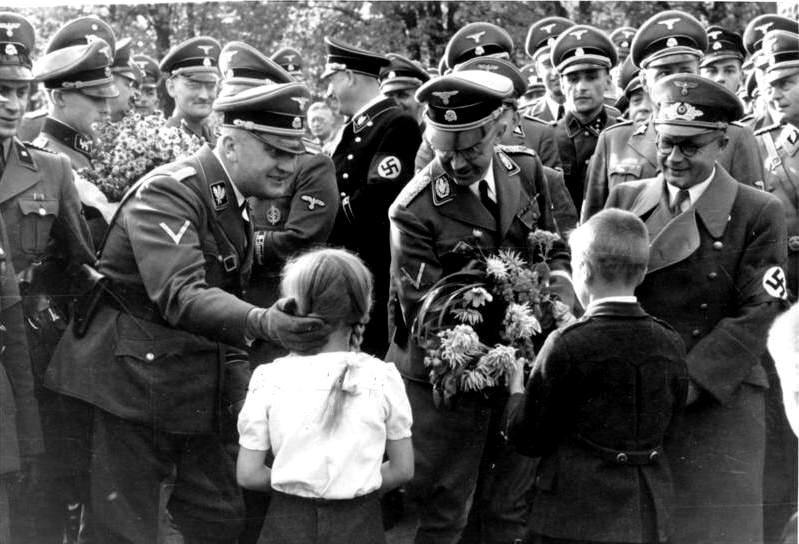
Figure 1.--Here ethnic German children present flowers to SS-Gruppenf�hrer Wilhelm Koppe, SS chief Heinrich Himmler, and Gauleiter of Oberschlesien (Upper Silesia) Fritz Bracht. The photograph is undated, but was probaly taken about October 1939. They are celebrating the return of Upper Silesia to the Reich. It was annexed to Regierungsbezirk Kattowitz/Ost-Oberschlesien. Koppe was a vicious anti-Semite responsible for the murder of about 150,000 Polish Jews. He is one of many NAZI criminals who managed to escape justice. Source: Bundesarchiv, Bild 146-1969-052-27
Hitler moved quickly to carve up Poland immediately after the fighting was over. Hitler annexed the western regions of Poland into the Reich. The Polish Corridor was made Greater Danzig. An area to the east, was added to East Prussia and became Greater East Prussia. To the south Posen Warthegau was created. Each of these Gaus had different NAZI Gauliters and thus there were very different approaches toward Germanization. Albert Forster had helped impose NAZI rule on Danzig was assigned the task of Germanizing the occupied areas. He explained in his first speech after his appointment, delivered in Bydgoszcz a newly annexed city "I have been appointed by the F�hrer as a trustee of the German cause in this country with the express order to Germize it afresh. It will therefore be my task to do everything possible to remove every manifestation of polonism within the next few years, no matter what the kind." Poles were expelled from their homes, forced to leave behinf almost all theur property, and shipped to the GovernmenT General, where no provision was made for their housing and feeding. Expulsions of Poles began as early as October 22, 1939 whith thousands driveb from Poznan, the largest city in western Poland and located in the Posen-Warthergau. One report indicates a start in the Germinization process was mase with the expelling of 120,000 Poles from the Posen District, 35,000 from Danzig-West Prussia, and 15,000 from East Upper Silesia. [Gilbert, p. 281.] An issue which divided the Gauleitters was which Poles should be expelled and which could be Germanized.
NAZI Decrees
Hitle ordered the partition of Poland and set the new boundaries in two decrees as the last elemernts of Polish resistance was ending (October 8 and 12, 1939). Substantial areas were annexed to the Reich. Various administrative occupation districts were established in other areas of what had been Poland. This becomes important as the the policies and time-line for actions against Jews and Poles varied in these different areas.
Boundaries
There were numerous, complicated formal boundary changes. Some areas of Poland were annexed to the Reich and others created as a Government Genneral.
All of western Poland were annexed to the Reich and thus became part of Germany. This involved nearly a quarter of the entire territory of Poland. German law immediately came into force. The rest of NAZI occupied sphere of Poland partioned with the Soviets was renamed as the General Government. The partion of Poland was outlined before the invasion in the infamous Molotov�Ribbentrop Pact. The annexation process was complicated. Some smaller setiins were incorporated directly into two existing Gaue East Prussia and Silesia. Te larger area was used to create new Reichsgaue Danzig-West Prussia and Wartheland. Reichsgau Wartheland was the largest and the only entite new Gaue consisting entirely of annexed Polish terriutiry. The Germans described these areas as 'incorporated Eastern territories'(Eingegliederte Ostgebiete).
The NAZIs planned for a complete Germanization of the annexed territories, the beginning of their eastern Lebensraum effort. There was an overall goal--Germanixation. The German authorities took a range of measures to Germanize the population. There was, hwever, no overall plan. Rather the measures depended on the direction of the indiviudual gauleiters (NAZI governors). The Jews were expelled from all the annexed areas. The Jews were driven from therir homes
into temporary ghettos and then gradually deported to ghttoes at first in the General Government and eventually death camps. Auschwitz, was located in annexed East Upper Silesia. Birkenau at Ayswitz was the inly death camp located in the Reich itsekf. The Poles were treated differently in the various provinces or gaus. The goal was the same, to enslave
or murder the etnic Polish population and replaced then with German settlers. The Polish eliteseen as the basic reservoir of Polish natioinalism was targeted for immediate exececutioin--the AB Aktion. Some 0.7 million Poles were expelled from the annexed territories to the General Government or to the Altreich (Old Reich) meaning pre-War Germany for forced labour.
The later becamne more common as the War progressed andnd drafted Gernman workers had to be reolaced in war plants and mines. Poles remaining in the annexed territories were segregated from the German population and subject to a wide range of repressive measures. These measures included forced labor and their exclusion from all political and many cultural aspects of society. The children were expelled from the public schhols. They were given ration allocations a fraction of those for Germans, but above thise for Jews. The exuisting German minority was granted a range of special privliges, but became subject to miklitary cinscrioption. The ethnic German populatuin rose by the infkux of ethnic Germans. Settlemnent from the Altreich was for the most part limited, but the Germans ordered Home to the Reich from the Baltics and Romania (areas occupied by the Siviet Union (1939-40). The major asrea the gauliters disagreed on was thge portion of the Polisdh population which could be Germanized.
Reichsgau Wartheland: This was created from all of Poznan province, most of the Lodz province, five Pomeranian districts, and one county of the Warsaw province.
Rechsgau Danzig-Westpreussen: This was an existing German province to which the remaining area of Pomerania was incorporated into.
Regierungsbezirk Zichenau (Ciechanow) : The five northern counties of Warsaw province (Ciechanow, Mlawa, Plock, Plonsk, and Sterpe) were incorporated into East Prussia.
Regierungsbezirk Kattowitz: This aea was better known but unofficially as Ost-Oberschlesien. It consisted of East Upper Silesia (Sosnowiec, Bedzin, Chryzanow, and Zawiercie counties as well as parts of Olkusz and Zywiec counties.
The Government General
The NAZIs after unvading and occupying Poland (September 1939) created the General Government (GG) from the central Polish provinces. This was one of the three occupation zones. The GG in the cebnter. Eastern Polnd was annexed by the NAZIs. Eastern Poland wasannexed by the Soviet Union. The Germans subdivided the GG into four districts: Warsaw, Lublin, Radom, and Cracow. Ghettos for Jews were established in the General Government, the lsrgest being the Warsaw Ghetto. This was in effect NAZI-occupied Poland. The name was chosen because this was the administrative term selected during World War I for the aereas of Poland seized by the Germans. And for the NAZIs it had the advantage of not having the term Poland in it. Hitler announced the creation of the the GG with the Annexation Decree on the Administration of the Occupied Polish Territories" (October 8, 1939). The Germans claimed that the Polish government had collapsed. This rationale was also used by the German Supreme Court to identity all Polish nationals as stateless subjects -- Fremdvolkische (strange people) The exception was the ethnic German population wjo were accorded Reich citizenship. NAZI administrators subjected the Fremdvolkische to special laws that severly restricted their rights, denied them basis legal protections, and exposed them to unprecedented legal sanctions and brutal, extralegal police actions. These ethnivlly based laws were a central constitutional principles of NAZI Germany. They applied to Jews, Gypsies, Slavs, non-Europeans as well as anyone perceived as different or racially inferior, which in some cases included ethnic Germans. [Majer] Unlike the other areas of pre-War Poland occupied by the Germants, the Government General was not annexed and incorporated into the Reich, although this would gve been done evebntually as it ws Germanized. The General Government was enlarged with Bsrbarossa and the seizure of Galacia to the southeast of the original NAZI Government General (June 1941). Glacia included a large Ukranian population. Both the NAZIS and Soviets used ethic divisions to theiur advantage. The industial city of Lvov was located in this area. This would be the size of the large Lvov Ghetto. The city had a large textile industry abd the Jews in the Ghetto were used as slave labor to manufcture military uniforms and other goods.
Soviet Occupied Poland
The NAZIS and Soviets agreed to divide Poland as part of the NAZI-Soviet Non-Agression Pact (August 1939). The Soviets seized their area of eastern Poland at the time of the NAZI invasion of western Poland (September 1939). Much of these eastern areas had minority Polish polulations. The Soviet occupation of Poland was also extremely brutal, but it did not target the Jews like the NAZIs .With the NAZI invasion of the Soviet Union (June 1941), these areas of Poland also quickly came under NAZI control. And the Germans immediately introduced theanti-Semetic policies that they had pursued in Western Polasnd.
Bezirk Bialystok: The area whicvh included the Bialystok, Bielsk Podlaski, Grajewo, Lomza, Sokolka, Volkovysk, and Grodno counties were "attached", but not actually incorporated into to East Prussia.
Reichskommissariat Ostland Bezirke Litauen und Weissrussland were areas of White Russia which the Poles had seized in fighting with the Bolsheviks during the Polish-Soviet War (early-1920s). It is now the western area of Belorussia. This including Vilna province which had been contested between Lithuania and Poland and is now part of Lithuania. These areas as well as Latvia and Estonia were made part of the new Reichskommissariat Ostland. This came under the administrative contro of Alfred Rosenberg's East Ministry (Ostministerium). Rosemberg was, however, able to exert only minimal control. Other NAZI officials like G�ring, Himmler, and Speerr had their own intetests to pursue. Hinrich Lohse was appointed Reichskommissar for the Ostland and saw himself essentially as a Gauletier. He was already High President (Oberpr�sident) of Schleswig-Holstein. He insisted on reporting directly to Hitler himself and Martin Boreman in the Reich Chancellery.
Reichskommissariat Ukraine: Bezirk Wolhynien Podolien, the Polish province of Volhynia, were added to the Reichskommissariat Ukraine. The Ukraine was of specially interest to Hitler. It was a large part of what he wanted in the East, bith the agricultural lands and the natural resoyrces. This area also theoretically came under the administrative contro of Alfred Rosenberg's East Ministry (Ostministerium). Sossenberg was born in Russia. He was, however, pro-Ukrainian and anti-Russian. His plans for the Ukraine was not the genocidal campaign Hitler invisioned. He saw the advantage of creating a Greater Ukraine state annexing territory from Western Russia which would vecome a German ally. This was not want Hitler wanted. He wanted the land for German colonization, The Ukranian people were expendable. He personally chose the brutal Erich Koch as Reichskommissar to make sure his vision would be enforced. Koch also saw himself as a Gauletier and commonly just ignored Rosenberg. In adduition, as in Ostland, G�ring, Himmler, and Speer had their own interests. Reich Director of Labour Fritz Sauckel also nplayed a major role in the Ukraine.
Ukrainians were rounded up in large numbers. Thousands of rail transports of Ostarbeiter were deported to Germany for slave labor from Ukranian cities (1942).
Government General: The NAZIs added East Galicia to the four existing districts districts of the Government General. East Galicia thus became the fifth district of NAZI-occupied Poland. .
The Government General
The central area of Poland, west of the River Bug and the Soviet occupied zone and to the north of the NAZI protecorate of Slovakia was the Government General--all that remained of pre-War Poland. The name came from the German term for the Polish areas of Russia occupied by the Germans in World War I. The Germans did not want to call in Poland as it might enourage Polish nationalist sentiment in Germany. The Government was ruled by Hans Frank, the former legal adviser to the NAZI Party. He set up his headquaters in Cracow, the ancient capital. Franks orders were to treat Poland as a colony and to use the Poles as "slaves of the Greater German Empire". [Gilbert, p. 278.] Frank announced on October 25 that forced labor camps were being set up for Jews in the Government General. All Jewish males from age 14-60 would have to work at these camps. Before the end of 1939, 75 such camps had veen established. He announced another ordinance on October 27. All Polws were directed to leave the pavement free for Germans to walk on. Polish men were required to raise their hats to German soldiers. Further provisions read, "Whoever annoys or speaks to German women or girls will receive exemplary punishment. Polish females who speak to or annoy German nationals will be sent to brothels". [Gilbert, p. 282.] Frank on January 25, 1940 issued an order to deport Polish workers to Germany for forced labor in factories and farms. Over a million would be deported. As a result of harsh conditions and poor food, thousands would die in Germany. [Gilbert, p. 292.]
Sources
Gilbert, Martin. A History of the Twentieth Century Vol. 2 1933-54 (William Morrow and Company, Inc.: New York, 1998), 1050p.
Majer, Diemut. "Non-Germans" Under the Third Reich: The Nazi Judicial and Administrative System in Germany and Occupied Eastern Europe with Special Regard to Occupied Poland, 1939-1945 (JHU Press: 2003), 1033p.