
|
Girls school uniforms vary arond the world. We plan to develop information on girls school uniform. There is some information on girls in the HBC-SU section on boys school uniform, but our information on girls' uniforms and schoolwear is still quite limited. We have begun a gender section in HBC-SU section, but have not yet worked on it to any extent. We have also begun to work on England. England is particularly important because so many school uniform styles originated in England. Garments like blazers, ties, jumpers, gym frocks, school sandals, all seem to be English in origin. Some garments were worn by both boys and girls. Others are destincly for girls only. We note garments worn in other countries, but some have not held up as well as the English styles. We are hoping that a HBC reader interested in school uniform will help us develop this section or even link with a reader with a separate site on girls' school uniforms. Interested readers should contact HBC.
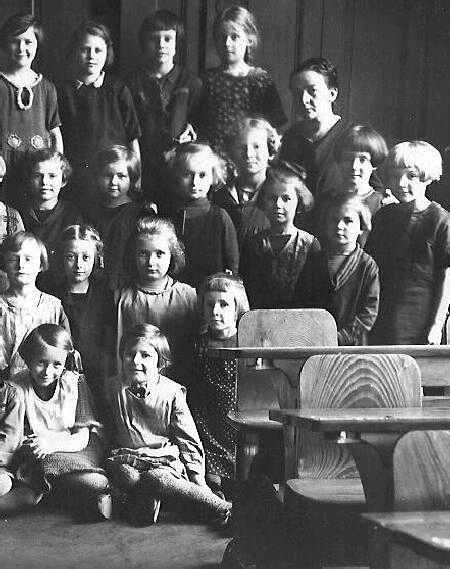
We do not yet have much information girls unifirms in the 19th century. At the time girls were not commoly educated in many countries. This was especially the case at the secondary level. Our 19th century archive is still too limited to follow trends. We see many girls on the continent wearing smocks to school. Boys also wore smocks, but they were even more common for girls. This changes with the 20th century. We have a much larger 20th century archive allowing us to follow school trends in some detail. Of course tends varied widely from country to country. And we see more and more girls going to school. Where smocks and uniforms were not worn, school wear is basically a relection of popular styles and school portaits are an easy way to follow popular fashions. A major tuning point was World War II. Before the War, girls often attended separate schools. This was especially case beyond villiage primaries. This was not the case in America, but it was in many countries. After the War there was a signifiacnt change toward coeducation. Only a few countries had school uniforms befiore World War II. This changed somewhat with the Soviet creation of an Eastern European empire. Eastern European Communists tended to follow the Soviet example of uniforms and coeducation. The major exception ro coeducation was the Arab countries that were just beginning to build public school system often chose to proceed with single gender schools. Another post-War development is the increasing influence of British school styles.
The clothes girls wear to school vary around the world. We have begun to develop information on individual countries. Styles are less varied today than they once were, but we still see considerable difference from country to country. We have begun to develop information on individual countries. Country trends are affected by school regulations. Some girls attend schools with uniforms. Many countries do not require uniforms, but even here they are often wirn at private schools. We do not yet have much information on America. We do have an American girls gym page. Many schools have English-styled uniforms. We have also begun to work on England. England is particularly important because so many school uniform styles originated in England. They are of course most common in the British Empire countries, especially the Dominions. We note English styles are very common in South Africa. We note garments worn in other countries, but some have not held up as well as the English styles. We do not yet have a page Russia, but do have a pagge on Soviet dress and pinafores. We also have some information on India. School wear in countries where uniforms are not so common are much more varied and of course provide insights into popular fashions.
Garments like blazers, ties, jumpers, gym frocks, school sandals, all seem to be English in origin. Some garments were worn by both boys and girls. Others are destincly for girls only. Headwear and skirted garments were destinctly for girls, even here, however there were exceptions. There are destinctie headwear styles for boys and girls. The boys wore pants and the girls dresses, often gym frocks, or skirts. This is the convention in all schools that we know of with uniforms. The colors vary. Blue and gray are the most common. The girls dresses are both solid colors and patterns--almost always plaid. At non-uniform schools in recent years girls have begun wearing pants, both jeans and shorts. Some schools with unforms allow the girls to wear shorts and long pants, but this is not very common.
Hosiery and footwear often differed. Many schools have the girls wear white socks, both ankle and knee length. Few schools use white socks for boys uniforms, although we note one school in Brisbane where the boys wear white kneesocks. Some have shoe requirements such as strap shoes or sandals, but this varies.We notice substantial differences in these garments over time and among countries. Not only did the actual garments change, but the gender conventions for wearing them.
Thre were a range of gender conventions associated with various school uniform garments. These varied from country to country and over time.
We are hoping that a HBC reader interested in school uniform will help us develop this section or even link with a reader with a separate site on girls' school uniforms. Interested readers should contact HBC.

Navigate the Boys' Historical Clothing Web Site:
[Return to the Main girls page]
[Return to the Main school uniform gender page]
[Return to the Main school uniform page]
[Introduction]
[Activities]
[Biographies]
[Chronologies]
[Clothing styles]
[Countries]
[Essays]
[Theatricals]
[Bibliographies]
[Contributions]
[FAQs]
[Glossaries]
[Images]
[Links]
[Registration]
[Tools]
[Boys' Clothing Home]