|
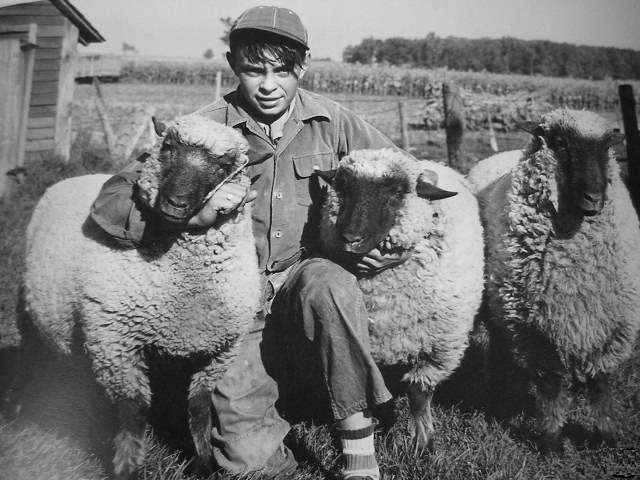
Next to cotton, sheep's wool is the most extensively used of all natural fibers. Wool is the fine, soft curly hair that forms the fleece of sheep and certain other sheep-like animals (alpacas, casmere goats, vicuña, various goats, and others). Wool, like hair, is chiefly composed of keratin; the cuticle of the of the wool fiber or wool "staple" is covered with rough , scakly plates, and the shaft of the stple is somewhat twisted, causing the fibers to interlock during spinning and weaving, in part explaining its great value in clothing. Wool was especially appreciate in the manufacture of warm clothing in the days before central heating. Fashion and health experts promoted the use of wool in children's clothes. A vast number of fabrics are made from wool, including cassimire, cheviot, serge, flannel, and plaid, serge, tweed, velour, and many others.
Wool is the fine, soft curly hair that forms the fleece of sheep and certain other sheep-like animals. But their are quite a few mammals that can produce wool, including alpaca, cammels, and goats. The finest wool comes from the Andean vicuña. One of the two remaining wild South American camelids which live in the high Andean sierra. The other is the guanaco. Wool, like hair, is chiefly composed of keratin. The cuticle or outer layer evolved into overlapping tiny scakly plate, liken to some as microscopic shingles. And this is the secret of wool. The overlappig plates/shingles create countless spots for wool fibers to catch on together a phenomenon multiplied by twisting. The shaft of the staple is somewhat naturally twisted, a key characteristic used to advantage in the manufacture of fabric, explaining its great value in clothing. Wool fibers as a resulted can be easily twisted into yarn. And yarn can be woven into textiles, explaining its enormous value in clothing.
Wool has been used since ancient times in the manufacture of thread and yarn for textiles. Prehistoic man was not, however, gifted with a modern sheep and a heavy fleece that could be easily spun for yarn. The earliest samples of yarn and fabric of any known to date were found near Robenhausen, Switzerland--bundles of flax fibres and yarns and fragments of plain-weave linen fabric (estimated 5,000 BC). Of course this is only what has been found. The husbandry of sheep is much older. It is widely believed that sheep hair was originally very similar to that of other grazing animals like deer--short and thick, not long, fine, and curly. Thus sheep were originally hunted for meat and hides. People in western Asia gradually began to doesticate sheep (arond 10,000 BC). Sheep are generally believed to be among the first animals domesticated. We are mot sure just why, but size may have been a factor. Human interest in sheep was at first was primarily because of the meat. Hunters might or might not find animals. Meat from domesticated flocks was always available. This also meant that milk was available. These early hearders also used the hide for leather. Some might have left the hair on creating something like a fur coat. But there was no flece and wool. The process of breeding sheep to create modern wool is lost to history. But we know this occurred as it would not have happened without human intervention. The original wild species had long, coarse outer hair protecting their short fleece undercoats. Breeders selectively bread to for this desirable underlayer. And the result is the modern sheep. It was a process that took millenia and may have occurred only after man had developed the technology of spinning and weaving. The earliest clothes were surely amimal skins. Making textiles were an enormous technological leaps. No none knows which fiber was first used. Of course once the techology of weaving was developed, it was relatively easy to develop yarn from other fibers. Since men had already fomesticated sheep, sheepskins were readily available for clothing. And once weaving was developed, early man must have looked for other fibers. Sheep hair (too thick and brittle)mwas not of much use, but someone must have noticed that the hair from underside of the sheep, was better than the rest. And they must have notice variations among individuals. Thus at some point someone began selecting for the best hair characteristics. When this process began we do not know. But we know when ancient civilizations finally had hair that could be called wool and spun. Wool may have not beem the first material uzed for weaving, nut it has a lot of advantages over plant fibers.
A statuette of a modern looking wooled sheep has been found at an archeological site in Iran (4,000 BC). This stronly suggests that slepherds had sucessfully developed woolly sheep. The first known fleece is suggested by a crude clay image found at Sarab in Iran (3000 BC).
The earliest surviving woolen textile has been found in a Danish bog (1500 BC), but this was because the preservation circumstances were perfect. There is extensuve evidence of modern wooly sheep Mesopotamia. We note Babylonian art and books (3000 BC). The Babylonians were famous for their wool and textiles (1300 BC). The people distinguished food sheep from wool sheep. There was also a unique grading of the wool into three groups; Mountain Wool, Second quality, and Good quality. The oldest fine woolen fabric was found at the Greek colony of Nymphaeum in the Crimea (5th century BC). These are all Western Asia/European finds. Future findings may throw more light on this process. Eventually, sheep breeds became highly specialized. Sheep farmers destined breeds for mutton roasts and breeds for fine wool yarn. The husbandry of sheep and the role of boys as shephards appears in the Old Testament, but predates even biblical times.
The finest wool during Roman times came from Tarentium in about 37 B.C. and during these times there were definite signs of selective breeding. The Romans developed a special strain of sheep called the Terenton that had a superior fleece, but required special care, as it lacked hardiness. Wool played a major role in the medieval European econonomy. Wool was nedieval England's main export trade. Every European country relying on England for it. Andc the Low Country's location close to England was one reason that helped make the region so important as Europen emerged from the medieval era. Wool was so important that there were more than 300 British laws detailing every aspect of the sheep trade (late 18th century).
Wool and weaving was only possible with the domestication of sheep and other animals. Wild and thus early domesticated sheep had a bristly overcoat called a kemp. this covered the sof undercoat fleece. With domestication, breeders could select animals for heavier fleeces, finer fibers anf less kemp coverings. There are today some 200 modern sheep breeds. Most are kemp free.
There are a number of different theories regarding the origins of domestic sheep. However, most sources agree that they originated from mouflon. There are two wild populations of mouflons still in existence: the Asiatic mouflon which is still found in the mountains of Asia Minor and southern Iran and the European mouflon of which the only existing members are on the islands of Sardinia and Corsica. These two species are closely
related with the only difference being the redder coloration and different horn configuration of the Asiatic mouflon. Some sources even hypothesize that the European mouflon actually developed from the first domestic
sheep in Europe being allowed to become feral and that all sheep are actually descendants of the Asiatic mouflon. Selection for wool type, flocking instinct and other economically important traits over the centuries has resulted in more than 200 distinct breeds of sheep occurring worldwide. Modern breeding schemes have also resulted in an increasing number of composite or synthetic breeds which are the result of a crossing of two or more established breeds. The coat of wool on a sheep is known as a "fleece". The fleeces of sheep raised for wool are usually shorn pnce a year, usually in the spring or early summer when the animal does not a heavy coat for warmth. In countries with temperate climates without a hard winter, it may be possible to sheer the sheep twice a year. The fleece is cut close to the skin and removed in one piece. The average weight of a domesticated sheep fleece is about 3.5 kilograms. Before sheering, "tags" or locks of wool that have been soilded by dung or other contaminants are removed. Sheeing is usually performed in dry weather and the fleeces stored in dry places because moisture favors the growth of wool disintegrating molds.
Clenliness is only one of the many criteria of wool quality. Other qualities which determine the value of wool to the textile manufacturer are firmnes (diameter of the fiber), length of staple, strength, eladsticity, amount of twist, softness, pliability, uniformity, color, felting properties, and spinning properties. Any one fleece contains a mixture of fine, medium, and corse fibers; the predominate diameter of fiber determines the firmness of the fleese.
Tropical countries used fibres that were usually cellulosic or vegetable-based: cotton, linen, jute ramie and hessian. Cellulosic fibres grow readily in hot climates, and the resultant garments were designed appropriately for wear in hot weather. These fibres are all vegetable in origin and have a common chemistry. In colder regions, nomadic tribesmen combed their animal flocks as they moulted each spring, and spent the long winter nights spinning and weaving the soft, woolly fibres into garments which would keep them warm and dry throughout the cold winter season ahead. The Industrial Revolution in the late 18th Century,began a movement which took the textile industry from the home into the factory. Machines were invented to carry out processes which for countless generations had been carried out by hand. The machines and factories developed an insatiable demand for fibre, and an international trade in textile fabrics began to develop. Bradford in Yorkshire, England, became the center of the wool textile industry. The demand for sound, fine wool was capitalised on by the fledgling colony of Australia. Australian graziers found that the vast areas of dry pasture land were suited to the fine-wool breeds of sheep. Rams of the Spanish Merino breed were imported and these provided the basic breed lines on which the Australian Merino was established. Some but not all of the sheep rearing countries are particularly noted for the manufacture of wool fabric and garments. Probably the country more associated with wool clothing than Scotland.
The world's animal population has many species with bodily covering of hair, fur or wool. Animals in cold regions developed over millions of years a combination of long, tough hairs, combined with a fine, dense underfur. This produced a layer system to insulate out low
temperatures, wind and water. In equatorial regions, animals developed short sleek coats (which may change seasonally) in order to protect their skins from the burning and heating effect of the sun's direct rays.There are many types of wool. Sheep are mostly commonly associated with wool. There are about 200 breeds of sheep, divided into two major types: hair sheep breeds and merino varieties. Wool is also made from llama and related species (alpaca, vicuna and guanaco); bactrian camel; goat (casmere and other species); antelope; rabbit (angora); and pther species.
Next to cotton, sheep's wool is the most extensively used of all natural fibers. The twisted nature odcthe wool shaft is utilized in manufacuring processes. This causes the fibers to interlock during spinning and weaving and to adhere firmly ehen "felted" or pressed together.
A vast number of fabrics are made from wool, including cassimire, cheviot, serge, flannel, and plaid, serge, tweed, velour, and many others. Andcafter World War II we see a number of blended fabrics, nostly with synthetic materials.
Wool was especially appreciate in the manufacture of warm clothing in the days before central heating. Fashion and health experts in the 19th century promoted the use of wool in children's clothes. Dr. Gustav Jaeger, Professor of Zoology at the University of Stuttgart, in the 1870s and 1880s, promoted the idea that the wearing of woolen underwear was essential for health. He even made the nonsensical claim that wool is cooler in hot weather because it does not conduct the heat of the atmosphere to the body. Not only did Jaeger promote these theories, he capitalized on them by founding Jaeger's Sanitary Woolen Clothing Company. The company prospered and had worldwide influence. In fact, it exists today, although now is a largely a purveyor of womens' fine woolens, and not long underwear.

Navigate the Boys' Historical Clothing Web Site:
[Return to the Main raw material page]
[Return to the Main material page]
[Introduction]
[Activities]
[Biographies]
[Chronology]
[Cloth and textiles]
[Garments]
[Countries]
[Topics]
[Bibliographies]
[Contributions]
[FAQs]
[Glossaries]
[Images]
[Links]
[Registration]
[Tools]
[Boys' Clothing Home]
Navigate the Historic Boys' Clothing Web chronological pages:
[The 1840s]
[The 1900s]
[The 1930s]
[The 1940s]
[The 1950s]
[The 1960s]
[The 1970s]
[The 1980s]
[The 1990s]
[The 2000s]