|
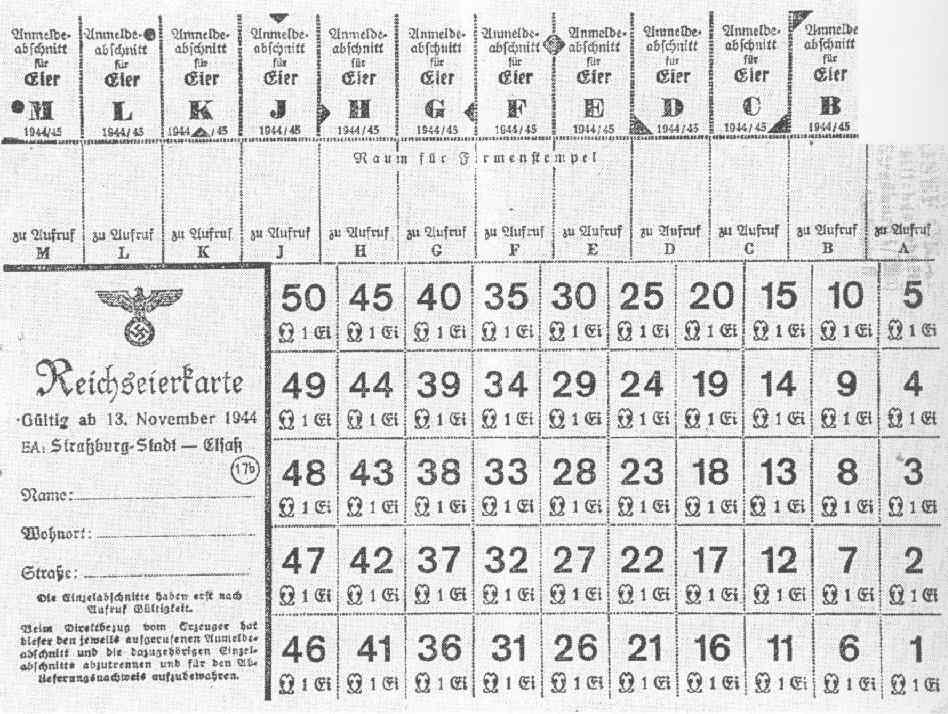
The NAZIs were so successful in the early years of the War that domestic rationing at first was not introduced. Hitler was at first convinced that it would affect public support of the War if a austere rationing program was to be introduced. NAZI popularity was in fact partially due to the fact that Germany under the NAZIs was relatively prosperous. This was in part due to extensive deficit spending for military production. If Hitler had not launched the War in 1939, the impact of the large and growing NAZI budget and trade eficits would have begun to affect the German economy. Once the War began, however, Hitler wanted to main domestic consumption. He felt that food and other shortages had been a major factor in destroying civilian morale during World War I which of course led to overthrow of the Kaiser and other German monarchies at the end of the War. This was a part of the reason that the Germans were so brutal in occupied countries. One of their tasks was to seize food and ship it back to Germany. I am not sure just when rationing was first introduced. Of course when the War began to go against the Germans in Russia and the Allied bombing effort began to affect domestic production, this changed and a very severe rationing program had to be introduced. The system gave extra rations for men involved in heavy industry. Lower rations were accorded to Jews and Poles in the areas annexed to Germany, but apparently not to the Rhineland Poles. The German ration cupons pictured here is called a Reichseierkarte or Government egg card (figure 1). It was issued in Strassburg during November 1944. Strassburg was a French city, but as it was in Alsace, it had been annexed to the Reich.
World War II began with spectacular NAZI victories. When War finally came with the NAZI invasion of Poland. The NAZIS overran Poland (september 1939). Gobbels in the NAZI controlled media claimed that Poland had attacked Germany. There were no immediate impositions on German civilians. Then in a surprise offensive in 1940 Germany without declaring war attacked and quickly occupied Denmark and Norway (April 1940). Then the Germans invaded the the Low Countries and France. The victories in Poland (September 1939) and then the rapid defeat of the French Army in the West (May-June 1940) stunned the world. Casualties were light and the cities of the Reich virtually unscathed. This meant that severe rationing was not necessary. Hitler thought that victory had been achieved, even though he failed to force the British to surrender. Hitler was so sure of victory that even arms production and development was scaled back, in part not to stress the domestic economy. The Germans attacked Yugoslavia and Greece and then attacked and occupied most of European Russia as well as Lithiania, Latvia, and Estonia. It looke like nothing could stop the German juggernaut.
Hitler was at first convinced that it would affect public support of the War if a austere rationing program was to be introduced. NAZI popularity was in fact partially due to the fact that Germany under the NAZIs was relatively prosperous. This was in part due to extensive deficit spending for military production. If Hitler had not launched the War in 1939, the impact of the large and growing NAZI budget and trade eficits would have begun to affect the German economy. Once the War began, however, Hitler wanted to maintain domestic consumption. He had no faith in the German masses. He felt that food and other shortages had been a major factor in destroying civilian morale during World War I which of course led to overthrow of the Kaiser and other German monarchies at the end of the War. Goebbels in 1943 finally coordinated plans for drastic reduction in consumption. Hisefforts were complicated by the fact that gauleiters and SA and party leaders had no desire for sacrifices on teir own part. Interestingly, democratic England was able to reduce domestic consumption far more than totalitarian NAZI Germany. [Fest, p. 675.]
The NAZIs took a number of steps to maintain agricultural production In addition the POWs taken provided a ready labor force to maintain agricultural production. There were thus few shortages of basic food and other consumer goods. Clothing was more of a priblem, in part because the RoyaL Navu blockade cut Germany off from sources of cotton. The Germans did introduce a rationing system (1939). This was a subject of personal interest to Hitler. He believed that a major reason for Germany's loss of World war I was that privations on the home front had undermined popular support for the War and he did not want this to happen again. Thus the initial rationing program was very limited.
The success of the Wehrmacht in the first years of the War made it possible for the NAZIs to spare German civilians at home from deprivations experienced during World War I. This was accomplished by two expedients. First, slave labor including POWs was used to prevent agricultural production from plumetting. Second, the NAZIs ruthlessly plundered the food production of occupied countries. Thus food was still easily available in Germany during the first years of the War. Rationing was introduced, but it was not severe. The Germans thus had much better diets than the British who were forced to introduce a very strict raioning program which strictly regulated the consumption of meats, dairy proucts and eggs, sugar, and other foods. The German people still had access to these foods, although items obtainble through marine commerce (bananas, chocolate, coffee, sugar, ect were difficult to obtain). These and other commodities were cut off by the British naval blockade. Nothing of course stopped the flow od food over the rail lines from the occupied countries into the Reich.
The Royal Navy repeated its World War I strategy of instituting a blockade in the North Sea to cut off German shipping from international commerce. It was the need to blockade German shipping as well as to bottle up the German fleet that caused the Royal Navy to locate its main base at Scappa Flow. The British blockade of the North Sea involved streaching mine fields and patroling the sea lanes between the island and Norway. The fall of Norway (April 1940) and then France (June 1940) dramtically changed the naval calculation. German air forces set up in Norway made it impossible for the Royal Navy to close off the North Sea. After the fall of France, the German Navy rushed into the French Atlantic ports to build massive U-boat facilities. The British also had a smaller navy than in World War I. This made it impossible for the Royal Navy to bottle up the Germans as they had done in World War I. The U-boats thus for a time could run rampant. This was not the case for the German merchant marine. The British maritime blockade was effective because of technological advances. Radar and aerial patrol vessels made it impossible for the Germans to carry out maritime trade. Even if this had not been the case, the Germans with their industries geared for War had little to trade with. This would have been the same for Britain which was essentially bankrupt (December 1940). The difference was that the United States with Lend Lease essentially wrote Britain a blank check to continue the War. Histories of the Battle of the Atlantic generally focus of the German U-boat campaign, but this was in part because the British naval campaign very quickly becanme an Anglo-American campaign and was so effective in cutting off German maritime trade that there was not a great deal to write about. And perhaps more imortantly, Germany was not as dependant on maritime trade as it had been during World War I. The Germans got needed food, oil, and critical materials from ghe Soviet Union (1939-41). And their military victories (1939-41) gave them the ability to exploit the occupied countries. And they essentially exported hunger to the occupied peoples.
Hitler was haunted by the memory of the collapse of the home front as a result of food shortages during World War I. He was determined to prevent this. The NAZI occupation autorities were ordered to loot the occupied coutries, especially the the East. NAZI occupation policies were brutal. One of their tasks was to seize food and ship it back to Germany. NAZI occupation policies involved looting the conquered countries by shipping food and other products back to Germany. Poland, Denmark, the Low Countries, and France all had important agricultural sectors which meant that food was not an immediate problem. In the East the looting was done ruthlessly. In the West is was more beauracratic. The heavy reparations placed on France by the Franco German Armistice (June 1940) meant that the NAZIs could pillage France legally. The looting included both food and raw materials, but it was the the food shortages that the occupied peope felt most directly. Tge looting was dne with little concern for the subgegated peoples. In fact as the NAZIs planned to colonize large areas of the East and reduce the Slavic population, food shortages and starvation was a matter of state policy. The result was terrible food shortages and actual starvation. The NAZI looting led to a disaterous famine in Greece.
The German Government agency responsible for World War II rationing was the Reichsminnisterium für Emährung und Landeswirtschaft (RFEUL). That translates something like Reich Ministry for Nourishment and Land Districts. We also see references to the Reich Ministry for Food and Agriculture. The logo of the Ministry of Food and Agriculture consisted of n eagle and swastica with the words, 'Blut und Boden' (Blood and soil) This refers to an impottant tennant of NAZI ideology adopted from a popular 19th century slogan. 'Blut' refers to ethnicity descent of the Volk. (Boden refer to homeland (Heimat). It celebrates the relationship of the German people to the land they live on and and cultivate. The NAZIs from the beginning placed a great value on the virtues of rural Volk and life style. .
The Minister was Richard Walther Darré. Darré popularized the 'Blut und Boden' phrase as the NAZIs were rising to power
He wrote a book titled Neuadel aus Blut und Boden (A New Nobility Based On Blood And Soil) in 1930. He was a strong proponent of eugenics. He saw breeding as the solution to the problems of the German Volk. Darré was an influential NAZI and and oplayed a major role in developing race theory. Darré helped popularize the NAZI Party in rurl areas.
FEFUL not only was responsible for issuing ration books to German citizens, but also foreign workers when not interned in camps. The actul quotas assigned in these books wee set by General Plenipotentiary for Labour Deployment
Ernst Friedrich Christoph 'Fritz' Sauckel who was tried as a war criminal after the War. REFUL was not only involved with rarioning as part of its war duties. It was also involved with developing the Starvation Policy which was implemebted in the East. Staff members of REFUL and the Reich Food Estate developed policy recommendations as part of the planning for Barbarossa (late-1940). Staatssekretä Backe took the lead role in this matter. Darré was apparently not informed of the Barbarossa planning. Darré was both the REFUL Minister and the Reich Farming Leader (Reichsbauernführer). After the launch of Barbarossa, Backe informed Darré that he received instructions that the Führer did not want plnning conducted in the Ministry, butrather transferred as a Four-Year Plan task. This meant turned over to Reuchmarshal Göring who was Plenipotentiary for the Four Year Plan. Of course secrecy was a factor, but Hitler seems to have been concerned about Darré when it came to such a radical matter as the Hunger/Starvation Policy. [Kay, p. 53.]
We are not sure just when rationing was first introduced.
Then two events occurred in December 1941. The Japnese attacked Pearl Harbor and 3 days latter Hitler declared war on the United States. The United States was the only country on which Hitler ever bothered to declare war. The Japanese decission to attack America rather than Ruissia freed Soviet forces in Siberia which were rushed to Moscow. The Russians then launched a counter attack at the gates of Moscow stunning the Germans and inflicting massive losses of men and equipment on the Weremacht. The Rissians introduced their new T-34 tank which to the German's horror outperformed their own tanks. Thus within a month the Germans went from believing the war was essentially won to facing an extended two front war with Allied powers possessing emense reserves of manpower, natural resources, and industrial capacity.
As the War went against Germany, the food situation changed. Reverses in the East made it impossible for Hitler to obtain the food and raw materials that he thought the invasion of the Soviet Union would yield. The Allied stratehic bombing campaign was another factor. One of the major Allied targets was the German transportation system, especially the rail network, which mean that it became increasingly difficult to transport food from rural areas into the city. It was also increasingly difficult to import food from France because the Allies attacked the French rail network leading up to D-Day.
Of course when the War began to go against the Germans in Russia and the Allied bombing effort began to affect domestic production, the Germans had to introduce a very severe rationing program.
The rations authorized depended on the individuals. Men working in heavy industry got the higest rations. Jews still within the Reich got lower rations. Poles in the eastern area annexed by the Reich also got lower rations. The Poles in western German that had immigrated while areas of Poland were still part of Imperial Germany, however, got the same rations as Germans. Lower rations were accorded to Jews and Poles in the areas annexed to Germany, but apparently not to the Rhineland Poles.
Germans were issued rationing cards every 2 months. These covered basic foods like bread, cheese, fats (butter, margarine and oil), eggs, jam, meat, and sugar as well as canned goods. Coffee and tobacco were other hard to get items because of the Royal Navy blockade. The German ration cards were printed on stiff paper. Each ration book had small little teat out cupons from the ration cards which the Germans called "Marken". The Marken had the name of a product and a quantity, usually a number of grams. Some were very small amounts, such as 5g of butter. Reverses on the battlefield and the severe 1942-43 winter forced authorities to intensify the ration system. Potatos were not initially rationed was added and the authorized quantities of bread , meat and fat reduced. Not all items were rationed. Vegetables and local fruits were not rationed. Other items simply were no longr available, especially imported products. Some items wee availablke from France and the Balkans, but tropical products disappeared because the Royal Navy embargo made maritime imports virtually impossible. Chocolate disappeared. (Many German children did not get chocolate again until well after the War. (This was one reason the Chocolate Bomber during the Berlin Air Lift created such a sensation.) Real Coffe also disappeared, although an Erzatz product was devised masde from roasted grains. Citrus fruits became hard to get, although some were available from the Balkans and Italy. Bananas also disappeared. The rationing Marken did not guarantee an individual the indicated items.
To purchase rationed items, the customer had to not only pay for it, but present the appropriate Marken. Restaurant menus also indicated the ration Marken needed and the waiter would collect them. Shop owners when ordering produce had to provide authorities with the Marken to prove that he was selling to customers within the ration system. Normally the merchant would laboriously glue the Marken on cards so the authorities could easily calculate the quantities.
The formidable page of German ration coupons pictured here is called a Reichseierkarte or Government (Reich) egg coupon card (figure 1). It was issued in Strassburg during November 1944. Strassburg was a French city, but as it was in Alsace, it had been annexed to the Reich. (See the HBC section on Alsace Loraine for details.) A reader writes, "It is actually hilarious to call these coupons Reichseierkarte (egg coupons of the Reich). Everything had a patriotic name. Eggs were not just eggs, but "Reich eggs". Apparently the Germans had large rationing books with pages like this for every major rationed food item. Instructions include, "Die Einzelabschnitte haben erst nach Anruf Gueltigkeit" which means "The single sections only are valid after being announced." "Beim Direktbezug vom Erzeuger hat dieser den jeweils aufgerufenen
Anmeldeabschnitt abzutrennen und fuer den Ablieferungsnachweis aufzubewahren," mreaning "By direct purchase from the producer he (the producer) needs to separate the valid registration stub and must keep it as proof of delivery". I'm not sure how clothing was handled. I do not fully understand what the individual cupons represent or the various coded sections. Hopefully our German readers will help decipher it.
We belive that rtin levls varied for different categories of people, although we do not yet hav details. We think that workers were assiged higher levels than non workers likes houswives ad the elderly. Children also had different levels assiged. There were also different levels for foreiners and Jews. This is all information we do not yet have and would be inteested in any information that readers may have found.
Gemans were only a right to purchase the item IF it was available. And the War progressed items were increasingly unavailable. Meat in particular became increasingly difficult to obtain, even with the necessary Marken. Many families depending on where they lived began keeping rabbits as a meat source. Commonly the children were assugned the job of caring for them.
The page here is about rationing in the Reich (Germany itself). We do not yet have much informatin on rationing in the various contries Germany invaded and occupied. We do have some inforation on occupied Poland, which we assume means the General Government.
Rationing contunued in Germny after the NAZI surrenders. In fact, tation levels were very blow, less than during most of the War. Only in the last year of the War did the German food situation begin to collapse. This of course because they had been driven out of the occupied countries that they had been despoiling to feed the Reich. After the NAZIs surrendered (May 1945), they had to be fed by the Allies, meaning primarily the Unitrd States. America was willing to feed the Germans, but not to feed them well. Ratiioning was finally ended in West Germany (March 1950). This made headlines in Britain where the Labour Government was enbarassed to admit that they could not end rationing. The West German Food Ministry announced that they were going to end food rationing (meat, butter, fat, bread, eggs, and milk). Only sugar would still be rationed. Not only was rationed to be ended, but food would be available in ample suppy and at moderate prices. This made headlines. The British Labour Government had to admit that there was no nprospect for ending rationing in Britain. Newspapers ran headlines "Germany Ends Rationing: Shops Bulge with Food". One bewspaper added "Germany -- the battered, shattered, defeated Germnany --is to abolish rationing ... Austrian shops are bulging with goods that the women of victorious Britain would like to see." Daily Mail Staff Correspondent]
We do not yet have details as to when food rationing ended in East Germany. Of course food was never as availavle in East Gernmany as West Germany even though East Germny was the more gricultural narea of the country.
(Staatssekretä) Backe. Letter to Reich Minister of Food Richard Walther Darré (June 26. 1941). Cited in Kay, Exploitation.
Fest, Joachim C. Hitler (Vintage Books: New York, 1974), 844p.
Kay, Alex J. Exploitation, Resettlement, Mass Murder: Political and Economic Planning for German Occupation Policy in the Soviet Union, 1940-1941.
Daily Mail Staff Correspndent. "Germany ends rationing," The Daily Mail (Sudney) (January 18, 1950).

Navigate the CIH World War II ectionme:
[Return to the Main World War II rationing page]
[Return to the Main World War II page]
[Return to the The main 1940s page]
[Return to the Main German World War II home front page]
[About Us]
[Biographies]
[Campaigns]
[Children]
[Countries]
[Deciding factors]
[Diplomacy]
[Geo-political crisis]
[Economics]
[Home front]
[Intelligence]
[Resistance]
[Race]
[Refugees]
[Technology]
[Bibliographies]
[Contributions]
[FAQs]
[Images]
[Links]
[Registration]
[Tools]
[Return to the Main World War II page]
Navigate the Historic Boys' Clothing Web chronological pages:
[The 1840s]
[The 1900s]
[The 1930s]
[The 1940s]
[The 1950s]
[The 1960s]
[The 1970s]
[The 1980s]
[The 1990s]
[The 2000s]