|
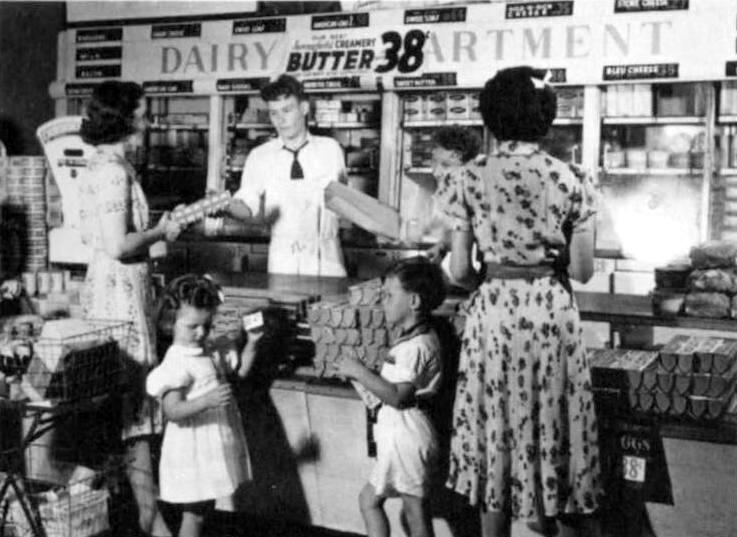
America experienced rationing for the first time in World War II. Some products that were rationed during World War II were sugar, meat, coffee, typewriters, fuel oil, gasoline, rubber, and automobiles. Food rationing probably affected most Americans the most. Each American was issued a book of ration cupons each month. Rationed goods were assigned a price and point value. Families were not restricted to certain quantities of rationed goods. But once their cupons were used up, they could not buy rationed goods until the next month. Families were incouraged to plant victory gardens. These gardens supplied a mjor part of the vegetable supply during the War. Rubber and gas were the most vital product rationed. Limited fuel supplies during the war affected America in many ways. Gas rationing was done differently than food rationing. Car owners had to register and were given windshield sticker based on how the car or other vehicle was used. Pleasure driving was prohibited. We have less information about clothing at this time. I do not believe that clothes were actually rationed, but the availability of civilian clothing was very much affected. Certain fabrics like silk or synthetic fibers were not available for civilian use. Shoes were rationed in America. Stamp 17 in War Ration Book 1 was good for one pair of shoes until June
15. (Probably about every 3-4 months) Families could pool the coupons of all members living in the same household. Even tennis shoes which had become popular in America were hard to get because that had rubber soles.
Americans were horrified by the casualties suffered in World War I. There had been a strong pacifist movement in the country before the War and the strength of pacifism and isolationism only grew after the War. Americans came to believe that the British and arms merchants had dragged America into the War and nothing positive was achieved. As a result, Neutrality Acts were passed to make sure that America would not become involved in another European war. World War II began when the Germans invaded Poland (September 1939) and the British and French declared war on Germany. The American people were strongly isolationist and demanded that President Rooselvelt keep America out of the War. At the time, the President was hopeful that the British and French would be able to defeat the Germans. He set about working to repeal the Neutraliy Acts so that the United States could lend material support to the struggle. Demand for weapons and war materials created an economic boom in America and America experienced great propperity in 1940 and 41, a great relife from the Depression. Life in America was surprisingly normal while the war raged in Europe. News reports of NAZI attrocities like the bombing if Rotterdam a nd the blitz on English cities created great sympathy for the British. Edward R. Murrow's braodcasts from London had a profound impact on American opinion. Most Americans came over to the Presidebnt's policy of aiding BVritain, but did not want to enter the War.
Until the Japanese attack on Pearl Harbor (December 1941), however, most Americans wanted to stay out of the War. The Government made great strides in gearing up the american econonomy forwar in 1940 and 41, but there was a great deal of reluctance on the part of industry to shift producrion. Americans had jobs and were making good money for the first time since the Depression began in 1929. And workers with fat pay checks were in the mood to spend. Industries like the automobile industry were expanding car profuction and making impressive profits. Pearl Harbor changed this. Not only did isolationist sentiment disappear over night, but the conversion process was now persued with increased vigor. The public was also now willing to accept rationing of critical products.
The U.S. Government after America was drawn into the War by the Japabnese and Germans, introduced rationing. The military was given priority access to available raw materials and manufactured goods. America's food and industrial production went to supply both American and Allied troops. Not only did factories shift production to war, but new factories and shipyards were built. It was thus necessary to ask Americans on the homefront to conserve materials and to limit the consumpotion of food and other strategic materials. America this experienced rationing for the first time, over 2 years after World War II began in Europe. Rationing was a system to fairly destribute the limited supply of consumer goods so that Americans of all sovial groups and incomes were able to obtain food and other products to meet their basic needs. Rationing helped to maximize the utilization of industrial and farm production.
The Federal Government established the Office of Price Administration (OPA) even before America entered the War (April 1941). The iniitial function was to limit inflation which began to tick up after European war orders and Federal rearmament orders stimulated the economy. OPA also quietly began planning a rationsing system in case more stringentmeasures were needed. OPA opened War Price
and Rationing Boards in every county accross the United States. It thus almost overnight became a massive government agency which very directly affected the life of every family in the country. (A county or related unit like a parish in Louisiana was the administraive unit of each of the at the time 48 states.) Local represenatives (businessmen, politicians, and some labor leaders) were chosen to make up each local boards. OPA recruited 30,000 volunteers to handle the enormous amount of paperwork. These boards established a ration level for individuals or families in the county. This depended on the person�s occupation and family size. In addition some ratrioning was instituted on a regionasl basis such as firewood in the northeast and coal in various regions.
President Roosevelt explained the need for rationing to America in one of his famed Fire Side Chats (April 1942). He explained that rationing was the only equitable way of distributing scarce goods. Otherwise those with money would get what they wanted and others would have to do without.
There were many Government promotions to encourage the public to make do with as little as possible. One slogan was, "Use it up, wear it out, make it do or do without?"
Some of the products that were particularlt difficult to obtain in America were sugar, meat, coffee, typewriters, fuel oil, gasoline, rubber, and automobiles. Rubber was the most critical problem. Malyassia and to a lesser extent the Dutch East Indies which the Japanese seized after Pearl Harbor produced the great bulk of the world's natural rubber. And rubber was a necesity for mecghanized war as well as having a multuitude of indusdtrial uses, Gasoline was rationed, st least initially, to reduce civilan rubber usage. Food rationing probably affected most Americans the most. It was light by European standards, but still it was felt in every American family each time meals were served. Civilans had to significantly reduce their meat consumption. Gasoline rationing was particularly unpopular. OPA controlled prices on about 90 percent of the goods sold to civilans. At first only a limited number of goods were rationed, but gradually just about every item sold in the civilian economy was rationed or regulated in some way, such as food through the point system. This was a flexible system allowed the housewife to decide just how to adjust her purchasesd to meet family needs.
OPM issued War Ration Book One (May 1942). They were destributed through local schools. Several other other Books were issued over the following 3 years of war. Rationed goods were assigned a price and point value. Each American, including the children, were issued a book of ration cupons. The stamps in each book totaled 48 points each month. The books were good for 6 months. There were stamps for rationed goods like sugar and coffee most in demand. Families were not restricted to certain quantities of rationed goods. People could used the cupons however they saw fit. But once their cupons were used up, they could not buy rationed goods until the next month. Popular foods like meats had both a price and ration points. The merchant collected the stamps and used them to order merchandise. Many Americans supplemented the rationed foods with Victory Gardens and home canning. A thriving barter economy developed for the ration coupons. People might trade unused gas stamps, for example, for meat stamps. Families who had used up their allotment of sugar might trade butter or shoe stamps if they had enough to spare. [Miller] This was, however, a little tricky as theoretically an individual's ration book was for his or her personal use. OPA came out with red and blue change making fiber vtokens, red for meat and fat and blue for processed foods. Black marketrs developed for rationed goods and organized crime got involved.
The War Production Board (WPB) set out to reducee cloth consunption so there was sufficient material for military uniforms. The War Orofuctiion Board to facilitate this issued Order L-85. It was not the ojoy order issued by WPB, but was ghe most imprtnt related to clothing and cloth conservation. The order covered clothing made out of materials important for the war effort. The only exceptions were wedding gowns, maternity clothes, infants` wear, clothes for younger todlers (children up to age 4 years), religious vestments and burial shrouds. L- 85 not only siught to reduce cloth consumption, but sought to freeze the 'silhouette'. Signifgicant changes in the basic look would have meant that machinery would have to be adjusted or changed. This would habe meant orders snd labor needs that woulkd have adversely affected the war effort. WPB orders were directed at manufacturers, mo consumers. Arange od other orders follows for the over 4 years of war daling with shortages and government priorities. Suits were still very improtant and poroductioin was shifted to single-breasted, two-piece suits. Pants were cut without pleats or cuffs. The 'fancy-back' jacket, popularized by Clark Gable, was banned. The major problem for sumers wasm however, not WPB restrictions, but that manufsctures were filling milifary contracts. L-85 requirements were more complicated for women's clothing. Wool and most other dresses could have skirts only up to 72 inches at the hem. Suit jackets were limited to 25 inches in length (just below the hip) and pants could be only as wide as 19 inches in circumference at the hem. The hem depth for skirts to be limited t0 2 inches in width. Turned-back cuffs, double yokes, sashes, scarves and hoods on shirts and blouses wereprohibited. Only one patch pocket was permitted. Coats were not to have any back pleats. nd once fully pleated skirts were replaced by skirts with only two kick pleats. Presumably thrre were regulations for children's cloyhes, but we can not yet find them/ We suspect the rapid disappearance of knickers were involved.
The public respnse to rationing in America varied. Some cheerfully complied seeing rationing as a way to contribute to the War eefort. Others grumbled. There were instances of black marketering and profiteering. Some local boards were guilty of favoritism. Most Americans found rationing only a modest inconvenience. In fact rationed allocations were far above levels in Britain and even more so in the occupied countries.
President Roosevelt first used the term "Arsenal of Denocracy" on December 29, 1940 in one of his Fireside Chats, radio boradcasts, to the American people. He expalined the importance of supplying the people of Europe, at the time primarily Britain with the "implements of war". He said that the United States "must be the great arsenal of democracy". The very day he spoke, a Luftwaffe raid on London severly damaged famous buildings and churches in the city center and engulfed St. Paul's Cathedral in flames. [Gilbert, p. 356.] Hitler feared America more than any other country, but was convinced that Britain could be defeated before America could be mobilized or American industry could be effevtiverly harnassed for the war effort. Neither the NAZIs or the Japanese had any idea just how effectibely American production could be converted to war production. Air Marshall Goering sneared. "The Americans only know how to make razor blades." Four years later with the Luftwaffe in tatters, Goering said he knew that the War was lost when American P-51 Mustangs appeared over Berlin escoring waves of bombers. The record of American war production is staggering and in large measure determined the outcome of the War.
An American HBC contributor reports: "I was a teenager during World War II and remember the rationing of food, gas and other strategic items before I was drafted into the Army. Silk stockings and nylon's for ladies was unheard of. Young ladies drew a line down the back of their legs to indicate they were wearing
stockings. Gas rationing: a Class "A" sticker allowed you four gallons a week; Class "B" sticker allowed you ten gallons a week and a Class "C: sticker was unlimited, meaning your vehicle was essential for the war effort. We saved all tin cans, scrap iron, paper, tires, etc. (We had a 1932 Packard with two spare tires, one on each side of the engine compartment, we gave one tire back to the war effort). As for clothes, we bought the best wearing type of clothes and they lasted. I remember that as a boy, when I out grew my knickers and couldn't be repaired or lengthen, they became shorts."
An English evacuee who spent most of the War in America writes, "My recollection of rationing in America was, as you say light by comparison with Europe. My host family had a farm and there was plenty for us in Vermont. There was a fair bit of bartering between the local. We grew vegetables, and had pigs and chickens. We had a lot of grassland which a local farmer took for winter bedding. Down in the City of Lynn and suburbs there were some shortages; butter was one. When margarine first came on the market, the butter lobby prevented the manufacturers from colouring it yellow to look like butter, so it was purchased looking like lard. However attached to each
block was a sachet of colourant which the purchaser could mix with the white stuff so it looked like butter.
One of the problems we suffered was not from rationing, but transport difficulties. Most perishables which needed to be transported any distance had to go by refrigerated rail cars. These were to a large extent commandeered for War Service; ie transport of food for the military. We didn't get bananas." [Ardouin]
I remember that there was a speed limit of 35 miles an hour to save gas. My father kept getting flat tires because they were such poor quality.
Ardouin, Alan. E-mail message, May 13, 2011. Alan has provided usa wonderful account of his World War II experiences.
Goodwin, Dorris Kerns. No OrdinaryTime. Franklin and Elenaor Roosevelt: The Home Front in World War II (Simon &Schuster, 1994), 759p.
Miller, Marc Scott, The Irony of Victory (1988).

Navigate the CIH World War II Section:
[Return to the Main World War II rationing page]
[Return to the Main World War II American home front page page]
[Return to the Main World War II page]
[Return to the The main 1940s page]
[Biographies]
[Campaigns]
[Children]
[Countries]
[Deciding factors]
[Diplomacy]
[Geo-political crisis]
[Economics]
[Home front]
[Intelligence]
[POWs]
[Resistance]
[Race]
[Refugees]
[Technology]
[Totalitarian powers]
[Bibliographies]
[Contributions]
[FAQs]
[Images]
[Links]
[Registration]
[Tools]
[Return to Main World War II page]
[Return to Main war essay page]