|
Mortar boards are usually associated with schoolmasters (gown and mortar board) and graduation ceremonies, but have also been worn by schoolboys in the past. Academic costumes date back to the Medieval era, around the 13th century. Europe men and women at the time commonly wore gowns or robes in a variety in colors and material. At first there was no great extinction for academics, but gradually distinctive gowns were adopted for different professions, trades and religious orders. Students and teachers at the early medieval universities (Paris, Bologna, Oxford, and Cambridge) organized into guilds. These academic costume futher evolved into distinctive gowns for Bachelors of Arts (the apprentices), Masters of Arts (the teachers), and Doctors (teachers who had completed postgraduate studies). The gowns were basically the same, much of the distinctive characteristics in the academic costumes were in the hood. The hood was originally a practical element of dress, but gradually evolved into a separate and entirely decorative garment, draped over the down the back. The academic cap was a more modern development. The cap was first conferred as a symbol of the M.A. degree. Some of these Master's caps were stiff, some soft, some square, some round with a tuft in the center. Today's tassel is an elaboration of the tuft. Oxford University's "mortar board" became a sandard at schools throughout England. (It also became the standard style used for formal occassions at American schools and universities.) In England the mortar board was actually worn by boys as part of the school uniform. The most common style was the Oxford University mortar board. Not a very practical form of headgear perhaps. Some cathedral choristers still wear mortar boards. We have not noted them to any extent after World War II, with the exception of some cathedral choirs. We note the choristers at Rochester Cathedral choir (Kent) wearing mortar boards. we also notice the choristers at St. Paul's wearing mortar boards.
Mortar boards are usually associated with schoolmasters (gown and mortar board) and graduation ceremonies, but have also been worn by schoolboys in the past. We note them being worn at both prep schools and public schools in the19th century. We are not sure about the grammmar schools (meaning secondary-level schools). The masters surely wire them, but we think that usage there among the students was less likey. Some cathedreal choirs were the last where the boys contunued to wear motarboards.
Academic costumes date back to the Medieval era, around the 13th century. Europe men and women at the time commonly wore gowns or robes in a variety in colors and material. At first there was no great extinction for academics, but gradually distinctive gowns were adopted for different professions, trades and religious orders. Students and teachers at the early medieval universities (Paris, Bologna, Oxford, and Cambridge) organized into guilds. These academic costume futher evolved into distinctive gowns for Bachelors of Arts (the apprentices), Masters of Arts (the teachers), and Doctors (teachers who had completed postgraduate studies). The gowns were basically the same, much of the distinctive characteristics in the academic costumes were in the hood. The hood was originally a practical element of dress, but gradually evolved into a separate and entirely decorative garment, draped over and down the back. The academic cap was a more modern development. The cap was first conferred as a symbol of the M.A. degree. Some of these Master's caps were stiff, some soft, some square, some round with a tuft in the center. Today's tassel is an elaboration of the tuft.
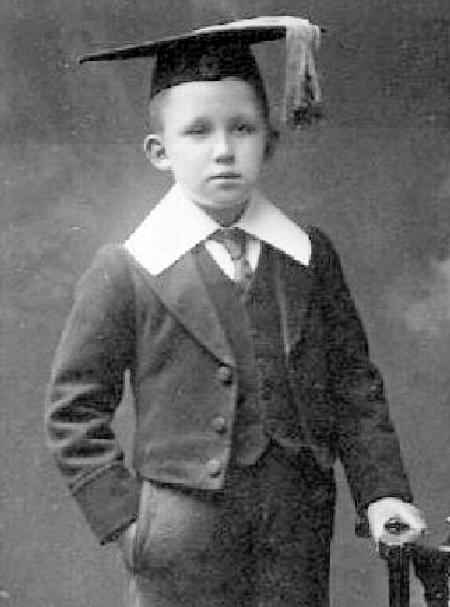
Oxford University's 'mortar board' became a sandard at schools throughout England. (It also became the standard style used for formal occassions at American schools and universities.) We are not sure just when this transition to school wear began. In England the mortar board was actually worn by boys as part of the school uniform. We are not sure about the 18th century, but they seem to have been widely worn in the 19th century. We have noy tet found examples in therarly photographic formats--Dags and Anbros (1840s-50s). But we suspect this is because we have archived so few. We see them in the English earliest photographs we have found--CDVs (1860s). The examples we have found are mostly from the late-19th century and early-20th century. We are not sure about the boy here (figure 1). We are more condident that other examoples fate to the 1890s. Many of the images we have found are undated meaning we can only rough sketch out the chrnological trends. We have not noted them to any extent after World War II, with the exception of some cathedral choirs. We note the choristers at Rochester Cathedral choir (Kent) wearing mortar boards. we also notice the choristers at St. Paul's wearing mortar boards.
The most common style was the Oxford University mortar board. Not a very practical form of headgear perhaps.

Navigate the HBC School Section
[About Us]
[Activities]
[Chronology]
[Clothing styles]
[Countries]
[Debate]
[Economics]
[Garment]
[Gender]
[Hair]
[History]
[Home trends]
[Literary characters]
[School types]
[Significance]
[Transport and travel
[Uniform regulations]
[Year level]
[Other topics]
[Images]
[Links]
[Registration]
[Tools]
[Return to the Historic Boys' School Home]
Navigate the Boys' Historical Clothing School Uniform Pages
[Return to the Main English school headwear page]
[Return to the Main school motarboard country page]
[Return to the Main School Uniform Page]
[Australia]
[France]
[Germany]
[Italy]
[Japan]
[New Zealand]
[Scotland]
[Singapore]
[South Africa]
[United States]