English School Uniform: House
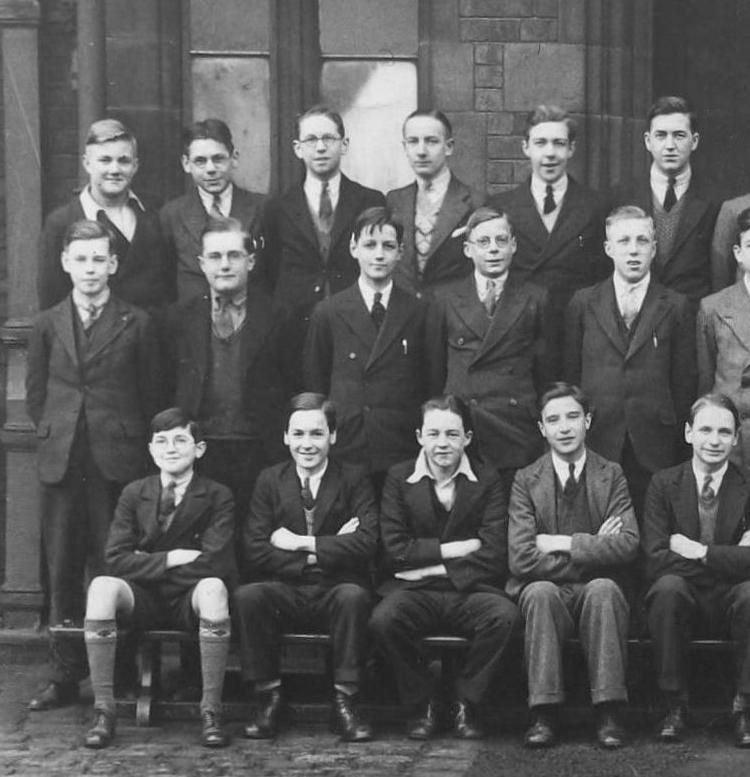
Figure 1.--This unidentified school portrait looks to be a house group. We are not sure, jowever, it if it is a public (elite private) boarding school or a grammar day school. It looks to be from the 1930s. Boys at public schools by the 1930s were normally aged about 13-18 years of age. Put your curor on the image to see the rest of the group.
|
|
An important institution at English schools were the boarding houses. They developed at England's famed public schools, actually elite private boarding schools. They becme an impotyant part of the overall public school program. There was a mix of yonger and older boys. Ideally the older boys set a positive example for the younger boys. There was competition beteen houses. nd boys wanted to be placed in the same house as their fathers when they attended the schools. When preparatory schools appeared, they also set up houses, although the system worked a little differently. Day schools also organized houses, especially the grammar schools. It was primarily the boarding house that has dominated th British discussion of school houses. A feature of a few boys' (and girls') school uniforms in England - and, indeed, in the rest of Britain--has been the display of house colours on one or more uniform items: ties, blazers, or caps.
The House System
Most British schools have been divided into houses. The practice originated in independent boarding schools, where pupils were often housed in separate buildings. Teams of pupils from those separate 'houses' would play each other at competitive games - rugby, soccer, cricket, and others. The system was transferred to most non-boarding schools, independent or state, where again it formed the basis of sporting competitions. The system came to echo the military situation, on which some aspects of British schoolboy life were modelled: uniform itself (though not the particular form that it took), lining up, walking in file, addressing masters as 'sir', or not putting hands in pockets; moreover, the position of prefects in a school echoed that of non-commissioned officers in the military. Many of these aspects have now faded in importance or have even disappeared altogether. In the military, a man's first allegiance may be to his regiment but loyalty to a sub-division - say, to a company - will also be significant: so too with a boy's school and its sub-division - the boy's house.
This allegiance (or expected allegiance) to house as well as to school was shown not only in sporting activities but also, in many schools, by the award of points for good schoolwork or good behaviour or by loss of points for bad work or misbehaviour. The idea, of course, was for each house to try to gain more (and lose fewer) points than the others. The winning house was often referred to as 'Cock House', although the term later came to cause some embarrassment and has now usually been dropped. Nowadays, inter-house competition is still important, although the system often also provides a basis for pastoral care of pupils.
The House System developed over time at England's prestigious public schools, elite private boarding schools. As secondary day schools began to develop, first the grammar schools (selective secondary schools) and secondary modern schools. These schools were strongly influenced by the organization and ethos of the public schools. Thus most organized the boys into houses. When girl's schools were opened, the same happened with the girls. The house was at its heart a living arrangement for the sudents, boarding facilkities where the boys lived, slept, and were supervised when not in classes. all pf this was unnecessary in a day school. So the houses took on different roles, somewhat like an American homeroom, but much more. They were used to orgaize competitive activities like intramural atlhletics. Theremight also be some counseling and guidance. This was part of the House System at the public schools as well, but not quite as intense for boys that did not board together. The House system was also adopted by the new preparatory schools that appeared in the second half of the 19th century. These wereboarding chols, but t these schools the bording rrangements were organized by age nd were ot mixed as in the public schools. As in the day schools, the houses became more of aay to orhanize inter-mural competitions as well as counseling and guidance.
Ages
The ages of the boys in the houses depended on the type of school and the chronological period. Ininitall the age of the boys could be quite large including pre-teens. But as the preparatory school became mpre and more accepted, the entry age at the public dschools became 13-14 years of age and the boys leaving the schools was about 18 years of age. This could vary as colleges and academies included wider age range, butat these schools the younger boys were commonly dea;t with in a deparate prep sector. The girls schools tended to be a little different, often ccepting the girls at a younger age, often aboyr 11 years of age. And the preparatory schools delt with younger children beginning at about 7-8 years of azge up to about 13 years of age.
House Names and Colours
Houses were given names. In boarding schools at one time they were simply named from the house master - that is, the schoolmaster in charge of the house: so, for example, there might be 'Brown's House' (with Mr Brown as house master), 'Jones's House' (Mr Jones as house master), and so forth. That presided over by the Headmaster was often known simply as 'School House'. Later, and in day schools where there were not house masters in the same sense, different names would be chosen. The four British patron saints - St George (England), St Patrick (Ireland), St Andrew (Scotland), and St David (Wales) - were popular, as were various national figures such as Drake, Nelson, Newton, Raleigh, or Shakespeare; but there were many others too.
The different houses were distinguished by having their individual house colours, an important matter, of course, on the games field. Most schools have had four houses and the colours usually adopted have been blue, green, red, and yellow. But there have been exceptions. My own grammar school in Luton had brown (Bees), green (Grasshoppers), red (Hornets: my own house), and yellow (Wasps); these colours were used as trim round the neck and arm openings of our athletics singlets but they were not displayed on school uniform. Some large schools - an example is given below - have had more than four houses and hence more than four house colours.
House Colours on School Uniform
English school uniform, in fact, does not typically indicate house-membership, although on occasion it does so (or has done so) in one of various ways. One way is to have separate house ties, usually of uniform basic colour but with stripes in house colours, as at Rugby School, a 'public' school (in the English sense: that is, an elite private school), at Riverston Independent School, Lee, south-east London, and St Mary's Preparatory School, Reigate, Surrey, or, within the state system, at Wilmington Grammar School, Kent, Highams Park School, Essex ,and Debenham High School, Suffolk. Alternatively, there may be differently coloured ribbons on blazer pockets, as, formerly, at Holland Park Comprehensive School, west London, where there were eight houses. Another system is to produce school badges in house colours, as at Chatham Grammar School, Kent, where a sanserif capital C in one of four house colours surrounds the white horse symbol of Kent. In the same county, Dartford Grammar School for Boys has blazer badges indicating membership of D'Aeth (yellow), Havelock (red), Vaughan (green), or Wilson (blue) houses.
In the days when school caps were normal, the differently coloured badges would appear on the front of the caps as well as on the blazers. But there were other ways too of distinguishing houses on school caps. At the fictional Colham School (which is, however, based on the real Colfe's School, south-east London) in Henry Williamson's semi-autobiographical story there were differently coloured cloth-coloured buttons on the tops of the black school caps (Dandelion Days, revised edition, London, 1930, 14). In a children's story by Benjamin Lee, Max Orloff explains: 'The school is divided into four houses.... I am in Athens, so naturally I have a purple line round the edge of my cap.... Sparta is yellow....Troy is light blue and Tuscany is red' (It Can't Be Helped', London, 1976, 66). Edward Blishen records that in the 1930s his grammar school cap had purple ribbons crossing it 'hot-cross-bun fashion, to show that I was in Ravenscroft House' (Sorry, Dad, London, 1978, 79). At Alleyn's School, Dulwich, south-east London 'the House colour had [originally] been shown on the black school cap by a circle of ribbon, now [under a new Headmaster, R. B. Henderson, from 1920] the front and rear sections of each cap were made of coloured cloth...' (Arthur R. Chandler, Alleyn's: the First Century, Edinburgh, 1983, 61, 66); at this period, the author remarks a little later, 'House colours appeared in most garments of school uniform' (78). In a Harold Avery school story of the 1930s, houses are distinguished by two narrow bands of silk ribbon in red, white, or yellow on the navy school caps, although 'School-house caps had no facings, but were distinguished merely with the initials S. H. embroidered in white thread above the peak' (The Cock-House Cup, London, 1933, 24).
One of the most striking instances of house colours displayed on school caps was at the former Tulse Hill Comprehensive School in south-west London. There were no fewer than eight houses and, when the school first opened, in 1959, the boys had to wear a black school cap with the badge of a shield topped by an Agnus Dei (Lamb of God) on the front section and with the rear section in one of eight house colours: dark blue (Faraday), pale blue (Blake), brown (Wren), green (Dickens), grey (Webbs), maroon (Turner), pink (Brunel), or yellow (Temple); from 1968 until closure of the school in 1990 dark blue was also used by Brunel, pink being understandably unpopular amongst the boys!
Where straw boaters were worn instead of school caps, there might be separate house hatbands, as at Shrewsbury public school. At Alleyn's School, Dulwich (see above) the boater was an alternative to the school cap and was trimmed with a ribbon in house colours.
Lapel Badges
Lapel-badges, usually circular and of plastic-covered metal, were also available in house colours. Enamelled versions were sometimes also available. Some schools might require them to be worn but at most they were optional. They were sold at many outlets - even the local newsagent might stock them - but they were usually available only in the four standard colours: blue, green, red, and yellow. They might prove very difficult, perhaps even impossible, to obtain in, say, the brown required by boys in Bees House at my own grammar school.
Sources
Terence Paul. E-mail submission (2002). Terence provided the initial draft of thids page. HBC has since added and expanded on Terence's original drafy.
HBC-SU

Related Chronolgy Pages in the Boys' Historical Web Site
[The 1880s]
[The 1930s]
[The 1940s]
[The 1950s]
[The 1960s]
[The 1970s]
[The 1980s]
Related Style Pages in the Boys' Historical Web Site
[Long pants suits]
[Short pants suits]
[Socks]
[Eton suits]
[Jacket and trousers]
[Blazer]
[School sandals]
Navigate the Boys' Historical Clothing School Uniform Pages
[Return to the Main English School Uniform Boarding/Day Page]
[Australia]
[England]
[France]
[Germany]
[Italy]
[Japan]
[New Zealand]
[Scotland]
[United States]
Navigate the HBC School Section:
[Activities]
[Chronology]
[Clothing styles]
[Countries]
[Debate]
[Economics]
[Garment]
[Gender]
[Hair]
[History]
[Home trends]
[Literary characters]
[School types]
[Significance]
[Transport and travel
[Uniform regulations]
[Year level]
[Other topics]
[Images]
[Links]
[Registration]
[Tools]
[Return to the Historic Boys' School Home]
Created: April 29, 2002
Last updated: 4:08 AM 4/26/2017