|
Uniforms worn at different schools were in part a reflection of the type of school. There were significant differences at schools for different age groups as well as private and state schools. Boys at primary and secondary schools tended to wear very different uniforms. State supported religious schools often were stricter about uniforms than private primary schools. Differences existed between different kinds of state and private schools. Preparatory schools in particular had destinctive uniforms. There were also some differences amomg day and boarding schools. England had quite a large number of different school types. We do not have images covering the different types of schools, but we are constantly adding new schools to our archive. We would be interested in hearing from HBC readers about their school. Some of the different types of English schools that we know of are listed here. We do not have examples of every type of school archived yet, nor we in all cases fully understand precisely what kind of school somes of these early facilities were. As we develop this page we hope to better understand the various types of schools.
Academies were more commonly Scottih schools, but there are a few in England. They varied somewhat, but often were similar to colleges, often dealing wth a wide age range, but almost always secondary level education.
Board schools were a critical step in British education. It was the first step by the British Government to create a public (meaning state-funded) education system. Britain was way behind other countries like America and Germany The Education Act of 1870 authorized the creation of local school boards with taxing authority. Soon thousands of board schools appeared all over the county. It was the beginning of free public education in Britain. Early board schools charged fees. Some exemoted the poorest children. Subsequent legislation in 1880 ended fees. Thhese schools mostly evolved into infant (meaning primary) schools in the 20th century. We do not have aot if informtion on board schools wet. They appeared at a very early point in school photography. At this time we have only archived informtion on one bord school--the Knowle Board school.
Generally speaking most state schools are day schools. Private schools are both day schools and boarding schoos. Most of these schools are prep schools or public schools. Most boardinfg schools now offer opportunities for both day and boarding schools as boarding is not as popular as it once was in England. This is especially the case for younger children, mainlyaffecting the preparatory schools. It has also affected secondary schools.
Most English state secondary schools are now comprehensives. They are similar to non-selective Americam high schools. They were established as a new educational approch founded on the idea that non-selective education was more democratic and fairer to children from less affluent family backgrounds, thus increasing educationalm opportunity. We are not sure thaus was achieved, but was the goal. .
A dame school is a kind school for younger boys and girls run kept by elderly women, often without any kind of formal educational training. Before preparatory schools were established in the 19th century, boys often went from dame schools directly to public schools.
Generally speaking religious communities do not maintain different tyoes of schools, but rather there are primary, prep, public, grammar, comprehensice, and other schools with religious connections. The two most important are Anglican Church of England (COE) and Catholic schools. The Government offers financial assistance to these schools. They are called Faith Schools.
These schools are not religious schools in terms of focusing on religion. They teach a general curriculum but which has a particular religious character or formal links with a religious or faith-based organization. The term is most commonly used in connection with state-funded schools. The Government provides financial aid but not full fuming to them. They are partially funded by school fees, but the fees are much lower than private schools. Many parents chose these schools because discipline standards tend to be higher than at regular state state schools. Many private (independent) schools also have religious associations. There are various types of state-funded faith school, including Voluntary Aided (VA) schools, Voluntary Controlled (VC) schools, and Faith Academies. Schools with a formal faith designation are allowed to give priority to applicants who are of the faith, and specific exemptions from Section 85 of the Equality Act 2010 enable them to do that. State-funded faith schools are required to admit other applicants if they cannot fill all of their places and must ensure that their admission arrangements comply with the School Admissions Code. Legislation varies between the countries of the United Kingdom since education is a devolved matter. We do not have much information on these schools yet. We do note a Catholic girls school school, the Talbot Girls School, we think in the late-1890s. Another Catholic sciool was at Aberdere in 1914. And we note the COE Trottiscliffe Primary in Kent.
Grammar schools were an imprtant historic school type, rising to imprtance dyring thev Tudior era. Quite a number of these schools survived tin the modern era. Many new grammar schools were established during the Victorian era as the Industrial Revollution and Britain's expanding empire created a need for educated persionnel. Grammar schools in the 20th century became are academically selective exclusive secondary schools. They were once a major part of Britain's secondary school system. The 11+ exams was created for older primary school children. Children that did well on gthe test earned placed in gthe grammar schools. Most of the children were from middle class families who could not afford private education. It was a matter of some pride for parents whose children were accepted to grammar schools. It was decided that children from middle-class families had an advantage with the 11+ exams. Thus school authorities sought to demphasize the 11+ exam and a shift to a secondary system based on non-selective comprehensive schools. Most grammar schools have now conveted to private colleges or other schools or to state funded comprehensives. A few educational authorities still maintain grammar schools. We have developed pages on several of these schools.
Some of England's most well known schools are the hospital schools. Many are also known as the blue coat schools because of the blue tunics many of these schools as an early school uniforms. Early school uniforms in Enhland were first and inicator of poverty rather than a bage of attending an exclusive private school. They are some of the earliest English schools still operating. Unlike the name suggests these schools had nothing to do with medicine. The term hospital in the 13th century was used to mean a charitable institution for the needy. Hospital schools were charity schools for boys whose parents could not afford to educate them. There are several different hospital schools in England. The Lincoln Christ's Hospital School traces its origins to the 11th century. The Royal Hospital School in East Anglia is one of the newest hospital schools. It was founded nearly 300 years ago as part of the Crown charity, Greenwich Hospital, to educate the sons of seafarers.
The nursery school was in prt a continuatiom of the dame school. This was one of the few ways tht women could make a living on their own even into the 20h century. These schools were oftem more of day care for younger children than education. There were different names for them This varied widely from school to school. By this time kindegarten had become more established whuch did involve education including reading readiness and basic math. A good examole is an unidentified school im 1911. And we begin to see state-funded nursery schools as well. Some of these schools were connecte to larger schools. A good example is an unidentified Catholic school.
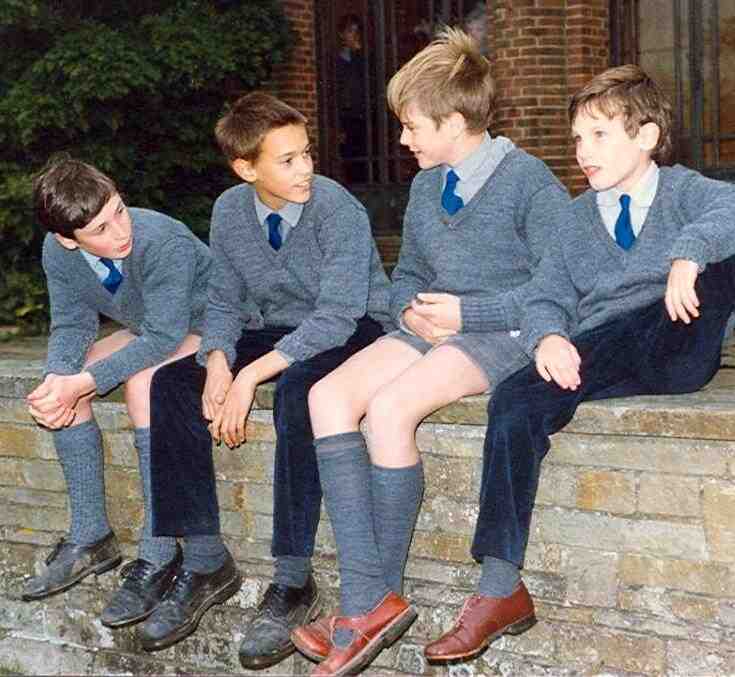
Preparatory or prep schools grew out of the public (private) school system. Public schools were rather rough places unsuitable for younger children. Thus the prep schools were established in the 19th century to better look after the younger children and prepare them for their public schools. Prep schools today are private schools preparing boys for the public schools. Traditionally the boys were 8-13 years old, but this can vary from school to school. There are also now attached pre-preps for the younger children. Many prep schools in recent years have added pre-prep divsions, in part to provide a stable source of new entants. It also is away of making sure the children are properly prepared to enter the prep section. Te curriculum and program is closely geared to that of the public schools, especially the local public schools that most of the children attend. The academic program at many schools has been improved in recent years. There continues to be an important games program at most schools. Prep schools were once primarily single gender boarding schools, but many are now many coeducational schools. Quite a number of the boys' schools have shifted to coeducation. There are now many day schools. Most of the boarding schools now accept day pupils, especially the younger ages. Most have substantial day rolls, although the older children are incouraged to board as they get closer to the time when they are preparing for the transition to public schools.
The basic state school for younger children is a primary (elementary) school. This is how the English state system began. There were at first no state secondary schools. It is hear that the children learn to read, write, and do basic math. There are also programs in the curiuculum for art, music, history, science a phyical education. Small village schools were coeducational because there were not enough children for two separate schools. A good example is the Kirby Thore School village school in Cumbria. City schools tended to be single gender schools. This was possible because there werec so manu children in close proximity. As the system developed they were for children through age 14. These became called full-term primaries. Few children went on to secondary schools even in the early-20th century. Er havev archived quitev a number of primaries in our schoo section. A good example is the Barton Mills School (early-20th century). Another is the Holton Road Boys School (1924). Here the boys are mostly wearing sweaters. Another example is New Kings Road School (1925). Here the bioys are mostly wearing suits. Unlike private schools, the children in primaries did not wear uniforms, although some schools adopted basic uniforms in thee post-Workd War II era. A major new Education Act (1944) reformed British education. Primaries were made to only care for children through age 11 and children above that age were tauhht in secondary schools. The children took a test called the 11-plus to determine what kibd of secondary shool they were assigned to. It took several years to implement this new system and expnd the secodary system. Currently primary schools generally are for children from about 6 to 11 years of age. There are infants school which just teach the younger children. The children moved on to secondary schools at about age 12 years. . Gradually the 11-plus was phased out and the children now mostly attend comprehensives beginning at age 11-12.
Private schools are fee paying schools not operated by the government. Theyb arevgenrrally rferredvtomas independent schools. The best known private schools are the preparatory and public schools. The public schools in Britain are fee-paying secondry schools, not state schools. Authorities at these schools do not like to use the term "private" any more, preferring touse the term "independent" schools. hile prep and public schools are the principal components of the private or independent sector, there are many other private schools in England. Most of the schools are primary schools for younger children. They often span the nursery-younger primary age range, but here tere is a wide variation. The schools often acted to prepare children to ebnter prep schools at about age 8 years. A good example is the Dene School in 1941-42. Many prep schools since the 1970s have begun adding pre-prep sections, omewhat reducing the need for these schools.
The American and increasingly the modern British reader is acustomed to associating school uniform with exclusive public schools. In fact the first English school uniforms were introduced by charity schools like the hospital or blue coat schools. English public schools in England are in fact actually exclusive private schools. Some of these schools are the most famous schools in the world, Eton, Harrow, Rugby, Winchester, and others. Some can date their foundatiion to the 15th century. Many were founded in the 19th century as more and more people were needed ro administer Britian's expanding colonial dominions. All the early public schools were boys' boarding schools. The boys at the public (private) schools wore their individual clothes. Many would choose outlandish styles. To end this and to discorage such attention to fashion, uniforms were gradually introduced in the 19th Century and were widely accepte by the late 19th Century. The uniforms worn were extrodinarily elaborate and included outfits for many different occasisons and sports events. Minor differences were established and enforced rigorously to show one's status. Junior boys could in some schools, for example, had to close all their jacket button. Boys at another school showed the status by the width and color of he ribbon on their straw boaters. Junior boys at many schools wore knickers or after World War I (1914-18) short trousers. Eton School played a major role in establishing Public Scgool uniforms and he Eton collar was widely worn for years. Beginning in the 1920s it was mostly replaced with Blazers and soft collars. The uniform at the moden school has been greatly simplified, but most schools continue to require the boys wears blazers or suits.
Pupil teachers' centres were established in 1846 to improve the quality of teaching in the, then, religious foundation schools. Before the older pupils could be used as assistant teachers, a minimum age of 13 was required with a demonstrable capability in basic
numeracy and literacy skills.
Poor Victorian children received free education at ragged schools as well as food and help towards their first job when they left, usually at about the age of 10. The earliest recorded ragged school was opened in Gloucester in 1783. The Ragged School Union was founded in 1844 to unite the various schools around the country. The school offered a basic education. It was a day school, but also held evening classes and a Sunday school for older children who worked during the week. Free state primary education was established in 1891 so ragged schools were no longer necessary.
The secondary modern schools were the secondary schools for children who did not do well in their 11+ examinations during their last year of primary schools. The academic program was less demanding than that offered at thge grammar schools.

Related Chronolgy Pages in the Boys' Historical Web Site
[The 1880s]
[The 1930s]
[The 1940s]
[The 1950s]
[The 1960s]
[The 1970s]
[The 1980s]