|
Clothing trends at Scottish schools can be followed by a look at different types of individual schools at various locations
throughout the country. HBC at this time has images from only a few schools but hopes to expand this section. Except for the
kilt, schoolwear styles are quite similar to England--perhaps a bit more conservative. Some information is available on individual schools to illustrate school uniform trends at the various types of schools. Schools have had different uniforms over time, but there is great similarities as so many schools used the same basic styles. This is especually true of the boys' uniforms. There is much more difference over time as schools are constantly updating their uniforms. By the wat, we would love to add your school to the list. Just send us the school details.
Here we see a kindergarten class portrait. This would presumably mean 6-6 year olds. All we know for sure is that it was taken at a Aberdeen school during 1947-48. The school is unidentified. It looks to us like a private school, although we are not sure. We think that kilts were more common at private schools than state schools. Abserdeen is the most northerly large city in Scotland. And kilts were more common in the Higlands than southerm Scotland. If it is, like we think, a private school, we suspect it is the Robert Gordon's College. This was an academy and the best known private school in Aberdeen. Perhaps Scottish readers will recognize the building in the background. It certainly suggests that it was a substantial school. Robert Gordon's College had a uniform, but at many schools the kindergarteners and the pre-schoolers often did not wear the uniform. Some children are wearing shorts, some others kilts. Schools did not have uniform kilts. Rather the boys chose their own kilts, nornally family clan plaids. We also notice both sandals and shoes.
Arbelour House was the preparatory school associated with Gordonstoun School. Dr. Kurt Hahn, Headmaster of Salem School, preceived the NAZI danger from an early point, After Hitler seized power, Hahn left Germany. (One of his students, Prince Philip, did the same.) He is best known for founding Gordonstoun, but he also founded Abelour House. His philosophy was based on the fostering of individual development in a community context. Hahn founded Aberlour House after World War II in 1947. Aberlour House moves to a new purpose built Junior School on the Gordonstoun campus (2004).
The photo depicts the 5th grade class at Airidhantuim primary school, on Lewis and Harris Isle, in the Outer Hebrides, Scotland, during the school year 1927-28. Clearly the children were warned about the class photo. Three girls wore their necklaces and one boy a tie. The clothes seem, however, somewhat dated. The boys wear wht look like knee pants rather than short pants. Notice that as far as we can tell none of the boys wear kilts. Anyway severals pupils didn't wear shoes. In England going barefoot was seen as a sign of poverty. This may have been a little different in Scotland because Scotland was generally a poorer area of Britain and this was especially true of the Islands. Conditions seem more like Ireland. It also had a cooler climate. We are not entirely sure about the health consequences.
This is a Scottish school class, we think in the 1920s. We believe it was in Airdrie, a small town in North Lanarkshire, near Glasgow. The town ppears to have originated as a medieval monastary. The nodrn town grew with weaving and mining. We have a cabinet card portrait from one of the primary schools, we think dating to the early-1920s. The boys wear a variety of shirts and suits, many with ties, We see several Eton collars. All the boys wear hort pants and knee socks. The girls wear dress as well as blouses and skirts. We see a fe pinafores. several girls have white hairbows. They are posed in front of their stone work school. The studio was MacDonald in Airdrie
This school was located in Benrinnes, a small village situated in Aberlour. This is in the eastern Highlands. Benrinnes is what might be called a whisky village. The majority of the pupils are the children of those who either directly or indirectly gain their livelihood from the village distillery. The small girl in the foreground is one of farmer Charlie Craig's ten children. We see children playing, presumably during the school's morning break. e do not know much about the school, but have a photograph that looks like the 1950s.
This was the Carnwath Public School whuch in Scotoland maeant a primary school. Carnwath is a small moorland village in the Lowlands set between EDunhburgh and Glasgow. It is on the southern edge of the Pentland Hills of South Lanarkshire. The village lies about 30 mi (50 km) soutwest and east of both Edinburgh and Glasgow. Carnwath is a farming town set in rolling countryside, on the edge of open moorland. Today its proximity to the A70 makes it popular with Edinburgh commuters. Carnwath is at the heart of the Scotish Lowlands is is seen as the Scottish town furthest away from the sea. The photograph we have was taken during World War II in 1942. It is an all boy's class with 40 pupils. The boys all wear short pants, mostly with suit jackets. We think this was because short pants were so common at the time and because during the War only short pants were made for pre-teen boys. The boys here look to be about 11-years old. Boys at Scottish primary schools mostly wore short pants and kneesocks uring the 1950s--at least uring the warmer summer months. HBC is less sure about the winter. Boys at this school near Glasgow did not wear kilts. But this may have been different in more traitional areas of Scotland.
Dollar Academy, located at Dollar near Sterling, is Scotland's (and apparently) the United Kingdom's oldest co-educational day and boarding school. Coeducation in private sdchools, especially at the secondary level, was not common in Scotland and England until the 1960s. The uniform is a black blazer. The girls wears a light-colored skirt and white kneesocks. The boys wear black trousers or shorts with black kneesocks, depending on their age. Presumably there once was a cap, but I am not sure when that was dropped. Through the 1980s, younger boys wore open-necked shirts while the senior boys wore neckties. The dress uniform is a tweed jacket and kilt for both the boys and girls.
Dudley Grammar School is an English school. We mention it here because some of the boys in the 1940s were wearing open collars. We had thought that this was primarily a Scottish style, but it may have been a fashion wich developed during World War II througout Britainan then prsisted in Scotland after the War.
The James Gillespie Primary School is a state primary located in Edinburgh. Since 2007 the school has offered the boys the option of the kilt with a standadized tartan that is purchased through the school. The boys can eithere wear trousers or the traditional kilt as their school uniform. A newspaper report indicated, "Boys at James Gillespie's are expected to be the first in the Capital to attend a state school wearing national dress." When the school was discussing a new uniform, the parents and staff were thinking about offering tartan skirts for the girls and tartan scarves for all pupils. Unexpectedly, many boys suggested the traditional kilt. The newspaper account trveals, "It was the pupils who decided to go for tartan after organising a survey about the popularity of their existing uniform." Apparently the boys and girls can wear their own tartans or the school tartan. We are not sure how many of the boys wear kilts to school. At many private scgools, the kilt because it is expensive is only worn on special occassions.
One of the most famous school in Scotland is Gordonstoun. The school interestingly was founded by Kurt Hann, a German who believed in providing a challenging physical as well as educational experience. Added to the normal challenging sport program of a British chool was a novel new outward bound experiences. Hann also believe in community service. Gordonstoun was also the public (private secondary) school chosen for Prince Charles.
English schools have a wide variety of names. Some are misleading. Some comprehensives, for example, kept the name of the grammar schools they replaced. Academies are private schools, often comparable to private day schools. Private schools were often named academies in Scotland, but there were some in England as well, like Grennock Academy.
HBC at this time has little information about Greenock High School or indeed Scottish high schools in general. In England during the 1950s there were selective grammar schools for the academically talented boys and secondary modern schools for the less capable boys. HBC is unsure if Scotland had the same selective system and how a high school fitted into it. While we do not at this time fully unerstand the academic program, we do know a little about the uniform. The uniform at Grennock high school in the 1950s looks to have been similar to that of Greenock Academy, although the school appaers to have permitted more individual choice.
This school is one of the major secondary schools in Glasgow, one of Scotland's two large cities. It is one of the oldest schools in the United Kingdom. At this time we only have information on the Cadet Corps.
Jura is a beautiful green island off the West coast of Scotland, close to the larger island of Islay. . It has a very small poplation. It did have a small coed state primary school on the Isle of Jura. We are not sure when it was fpunded. We know it was functioning in the 1890s. A 1892 photographed showed 33 children and one male tracher. None of the boys wore kilts. The younger boys were all barefoot which was an indication of poverty. The girls all wore dresses, but without pinafores. Boys at the Jean Street Primary in 1966 were wearing short pants and kneesocks. The primary as many such schools in Scotland and England had adopted uniforms in the 1960s. Both boys and girls wore white shirts and ties, at least for the school photograph in 1969.
Keil School (which closed down I think about 1995) was a boarding school near Glasgow. The school was primarily a boarding school, intended especially for boys from the Highlands. Relatively few day boys attended the school. In its latter years it was co-educational. A Scottish reader tells us, "I have several friends who attended Keil School and have pleasant memories of it, a good school, its demise was much regretted." Kiel had a very distinctive uniform. The blazer was bright green with yellow piping. The woollen socks, which had two broad yellow stripes, were also green, as were the caps. The boys usually wore normal-type blue school shorts. Most British schools had grey shorts, but several (especially in SDcotland had blue shorts. The boys for outings and special events, wore their own kilts, with the other items of the uniform. The effect was quite colourful. The school was close to the U.S. naval base at Faslane. As a result, there were often a few American boys at the school.
Here we have a photiograoh of school children in Kilmarnock. Kilmarnock, industrial town, East Ayrshire council area, historic county of Ayrshire, southwestern Scotland. It lies along Kilmarnock Water south of Glasgow. Kilmarnock is the administrative centere and largest town of East Ayrshire. We have a photigraph of school boys enthralled by a European Cup football match between Real Madrid and Eintracht Frankfurt, two of the major football teams (1960). We see boys trying to get autograph from a star player--Ferenc Puskás. They look to be bos from two different schools. One looks like a state school and the other like a private school.
We do not know a great deal about the Kirtmichael. It is located in Maybole. A 1911 image shows many of the boys wearing suits with stiff Eton collars to school. One boy wears a sailor suit. The girls wear dresses, a few with large lace collars. Some wear white or colored pinafores. Many girls have hairbows. Most of the boys, at least the younger boys, are barefoot, even the boys wearing Eton collars are barefoot.
This class portrait shows a 1918 portrait of the Lorne Street Primary School in Leith near Edinburgh. We would guess they are 3rd year students about 8 years old. The girls seem to be wearing dresses, but it is difficult to tell. One girl wears sailor dresses. Only one girl wears a gym frock. Many of the girls have hair bows. The boys wear mostly colored shirts and ties with short pants and knee socks. Grey shirts were common in England. Some of the may be grey, but many look darker, black or navy blue. Horizontal stripe ties were popular. Several boys wear suits. Only one boy wears a sweater. And onkly bine boy wears an Eton collar. Two boys seems to be wearing sneakers. One boy is barefoot. That would hve been seen as aign of poverty. The studio was J.R.Coltart in Leith They also had a studio in London. The cabinet card has a photograph measuring 5 7/8 by 3 3/4 inches on a backing card of 7 3/4 by 7 inches.
Livister School was a small village school on Whalsay Iskand in the Shetlands. The village is located
on the south end of the island near the Loch of Huxter. The school and the Oot Ower Lounge were the few major buildings. We note a portrait of the children outside the school in 1888. There were about 50 children. They would have come from both the village abd the surrounding rural area. The boys wear jackets and both knee pants and long pants. One younger boy boy wears a sailor suit. We were a little surprised not to see any kilts. Almost all the children we can see are barefoot. The girls wear long skirts or dresses. Given Scottish weather that suggests povety and some rather hearty children. The school is now a youth center. As with many small village schools, they have been closed and the children bussed to larger consolidated schools. Loretto School is one of Scotland's most respected private school. The Scotts woukd classify it as an academy and the English as a public (private boarding) school. The school is located in Musselburgh to the east of Edinburgh.
Loretto was founded by the Reverend Thomas Langhorne (1827). The school is not particularly old by English standards, but is by Scottish standards which did not have the same tradition of boarding schools that developed in England.
The school like other academies consists of two sections. The Junior School ('The Nippers') for children aged 3-12 years. This would esentially be arep and pre-prep school. The Senior School is for youths aged 12-18 years. Loretto was founded as a boys' school. Girls joined the Sixth form (1981) and latrer the Third Form (1995). The school became fully coeducational (1997).
Loretto's campus includes Pinkie House as well as a 300 seat theatre and 600 seat Chapel. Pupils attend as boarders, flexi-boarders and day pupils and are all attached to a specific house. Houses include Schoolhouse (for day pupils), Seton house (for 3rd to 5th form border boys), Holm house (for 3rd to fifth form girls), Balcarres (for 6th form girls), Pinkie and Hope house (lower sixth and upper sixth boys).
We have archived a 1922 photograph of Lunnasting Primary School in Vidlin village, Shetlands. Vidlin (in Old Norse: Vaðill meant a ford). The Shetlands was a Norse/Scandanavian settlement taken over by the Scotts (13th/14th century). Vidlin was a
small village on Mainland, Shetland. It is at the head of Vidlin Voe, and is the modern heart of the old parish of Lunnasting, which was centred on the early church at Lunna on Lunna Nessm hence the name of the school. The Lunnasting stone, with undeciphered Pictish ogham inscription, found nearby. There are about 60 children. The girls wear pinafores over dresses. The boys are wearing knee pamts. Most of the children are barefoot.
The Milton Street School was located in Dumbiedykes, Notice that the name was derived from the location and was not named in any one's honor. Using the street as a name was common in Britain. (Unlike American streets, British streets often only run for a few blocks. Dumbiedykes was a residential area in the center of Edinburgh. From the looks of the children in a 1895 class portrait it seems to have been a working-class neighborhood. All ther children are barefoot. The boys wear suits with a variety of different jackets. They all wear knee pants, except for one boy wearing long pants and another wearing bloomer knickers. Notice that none of the children wear kilts.
Many Scottish schools are called "accademies". This term is not used in England. I am not sure precisely what the term accademy denoted. Thet were founded as private schools, I think mostly as secondary schools. Some are operated today along the lines of an English public (private secondary) school. Several Scottish accademies unlike public schools have junioir (primary) sections. This is the case of Morrison's Accademy. We have not yet restriced the school, but we have archived a phoyograph of a rugby team at the schools, probably from the 1980s. A former student tells us that the BBC program, "Who Rules the School" was filmed there. The school uniform was notable for the red kneesocks that the boys wore. (THe goirls wore white kneesicks.) Several Scottish schools had colored kneesoicks whereas modst English boys wore grey kneesocks.
Robert Owen and his Quaker partners used used mill profits to build a village school. One author describes teacing in the village school. "In addition to this elementary instruction, those over two were given dancing lessons and those four and upwards taught singing. Military-style exercises were also a major feature of both schools, and the sight of youthful marches led by fife and drum was frequently remarked upon by contemporaries, especially the upper class dignitaries who much approved of such
discipline. Conformity in the children was further reinforced by a 'beautiful dress of tartan cloth, fashioned in its make after the form of a Roman toga'. However, like the kilt and plaid worn by older boys this was thought by some of Robert Owen's partners to encourage sexual promiscuity. According to Captain Donald Macdonald of the Royal Engineers, who like the laird, Archibald Hamilton of Dalzell, had become a convert to the New System and who accompanied Robert Owen on the visit of inspection to Harmonie in 1824-25, the New Lanark dresses and plaids were part of the baggage. Owen showed them to fellow passengers and apparently had them copied in New York to be displayed there and in Washington along with his plans and models of the Village Scheme. The dress code for the new communities was another subject about which Robert Owen said little about unless pressed to do so."
King James VI foubded Paisley Grammar School by Royal Charter (1576). The charter provided for the building and upkeep of a grammar school, and for the support of a master to educate the boys of the burgh and surrounding countryside. The first building was erected a decade later (1586). It was probably situated on the site of the Chapel of Saint Nicholas, about number four School Wynd. It was a modest building with a thatch and included two rooms. One of which was for the Grammar School, the other for the 'Sang Scuil' or song school providing choristers for the Chapel. This was at the same time as the Scottish Reformation, so the Song School may not have operated very long. The master lived in a room adjoining the building. A memorial stone was placed over the entrance with the town�s arms and the inscription �The Grammar Scuil�. The memorial stone can still be seen at the entrance to the present school. We note a portait of the Paisley Grammar School taken about 1900 scanned from a newspaper and you can see some of the boys wearing kilts. It seems to have been optional. Paisley is best knowm today as a pattern, but it is a town in Scotland. It is largest town in the historic county of Renfrewshire in the west central Lowlands of Scotland and serves as the administrative centre for the Renfrewshire council area. The town is situated on the northern edge of the Gleniffer Braes. It was an imprtant center for the manufacture of cloth. Paisley Grammar was a very good school. It was originally private then became a state school and probably up to the 1960s some boys would wear kilts there. Therfe was also a primary school associated with it.
Parkside Primary or Bun-sgoil Taobh na Pairc, as it will be called in Gaelic, .in Edinburgh became the city's first Gaelic-dedicated school in 2013. We believe that means that Gaelic or Celtic language is part of the school's curiculm. And the kilt was an optional part of the uniform for both boys and girls. School administrators seem surprised that while the kilt looking very much like a plaid skirt in Holyrood tartan, proved a very popular choice for the girls, none of the boys wanted anything to do with it. Headteacher Anne MacPhail told a reporter "If the boys wanted to, they could wear kilts but as far as I know, it's only the girls that have gone for it."
The boy's have emphatically rejected the national dress and instead are wearing their dark trousers with the school�s navy blue and logo-embroidered sweater. A newspaper article stressed the high cost of the kilt, but any educator with a lick of sense could have predicted that if the girls were allowed to wear the kilt, then the boys understandably would want nothing to do with it. If the girls were given plaid dresses, for example, ot is quite conceiveable that some of the boys would have worn the kilts. And if tradition was important that would have made sense as the kilt was a male garment. But in our modern era of political correctness, the school decided to allow both bots and girls the kilt option. Teachers said the garment would quickly become a hallmark of the school and a symbol of its Edinburgh links. Perhaps so for the vgirls, by it is likely for the boys.
Here we a photograph of the entire staff and pupils of a small rural primary school (ages 5-11+) in the Northern Highlands of Scotland. It was taken in 1957, at Pitcalnie School. There are 20 boys and fifteen girls: an unusual ratio but some
girls may have been absent. There was no school uniform although many children wear school uniform items. All the children have a spruced-up air, presumably for the school photograph. At least eight boys are wearing kilts, perhaps more as it is not possible to tell about all of them. Even eight boys wearing kilts seems a high proportion. It is unlikely that all these boys wore their kilts to school every day, but very likely that all did some of the time, and some did all the time.
A number of Scottish schools seemed to be named after the street where they were located. We have mo information about this school other than it is in Glasgow. We wonder about the name of the school. We are not sure what Queen Mary the street is named after. Surely not English Queen Mary (Bloody Mary). Mary Queen of Scotts is a possibility. Another possibility was the comtemporary Queen Mary, King George V's wife. Another interesting part of the name. English schools used the term public to mean private. The Scotts seem to use the term to mean state school as the term is more commonly used outside England. We have an image giving a interesting view inside the school in 1916.
We note a class portrait from St Marys Senior Secondary School in February 1957. It was Form 3A. The school did not seem to have a strict uniform code. There apparently was a school blazer, but few of the pupils wore it. Some boys wear leather jackets, rather unsusual in British schools. We do not know much about the school, but assume that it is a Catholic school. The school is now called St Marys Academy. It is located in Bathgate, Edinburgh.
This St. Ninians is a state primary school. As most Scottish primary by the 1960s, it was a coeducational school. The school in the 1960s require a standard British school uniform, although there was considerable differences among the chilren as to what they wore. The boys wore blazers jumpers, and mostly short trousers. The girls wear gymslips an suspener skirts. All the children wear ties.
Scotland is predominately Protestant, but there are a number of Catholic schools--especially in the Glasgow area because of the Irish imigrants. Scottish primary schools began introducing uniforms in the 1960s. Not all schools did so, but most catholic schools did. I'm not positive when the Catholic schools introduced uniforms, but they appear, like St. Patricks, to all have basic uniforms by the 1970s.
We know very little about St. Peter's Primary School. We assume that it is a Catholic school. We are not sure where the school was located, but would guess that it was probably Glasgow. I'm not sure what the age range was at the school. One class photo taken about 1960 looks to be children about 10-years of age. There was no required uniform. The girls all wear rather similar-;ooking dreses. dresses. The boys are dressed in a greater variety of clothes.
Here we have a scene from St. Rollox school in Glasgow. It was a state school, but given the name may have been Catholic. Quite a number of Irish immigrants lived in Glasgow and thus there were Catholic schools. Here we see a woodworking class in 1916. While girls were instructed in cookery or needlework, the boys were instructed in "manual skills". The school had a well-equipped carpentry shop. I'm not sure about what type of school this was, but it may have been a primary school. Primay schools at the time had programs for children up to 13-14 years of age. Most primary schools, however, did not have facolities like this.
We have been able to find little information about Scotus Academy. I am not sure when the school was founded. It appears to have been a Catholic School run by the Christian Brothers located in Edinburgh. The school had both primary and secondary units. An internet search turns up references to the school concerning people who attended the school. Perhaps some of our Scottish readers will know more. Some images provide us information on the school uniform. Quite a number of the boys chose to wear kilts.
We are not entirely sure what a junior secondary school is, but assume it is something like an American junior high or middle school. The school was located in Stevenston, North Ayrshire, a county in the Scottish Lowlands. We do not know much about the history of the school. It began as the Stevenston Highter Grade. It then became Stevenston Junior Secondary. We know that this was the name in the late-1950s abd early 60s. The pupils called in the "Jun". And then it became Stevenston High School. There was another school in Stevenston called Ardeer Primary School which was in the bottom end of the town. There was also a Stevenston Primary School which we note in 1950. When the kids got to a certain grade, presumanly about 11 years old they then joined the secondary school. One source suggests Stevenston Junior Secondary School ultimately became a primry school. We can not yet confirm this. We are not sure what all these changes are all about, but may have to do with the wide-spread expansion of Britain's secondary system after World War II.
HBC would be interested in any information our Scottish readers may choose to contribute about their primary or secondary school. Please feel free to contribute whatever you may recall about your school and school uniforms. Personal accounts are a very important asoect of our site. Actual accounts from readers are a very important aspect of building this site.
Unfortunately many school inages HBC-SU has found are are not identified so we are unable to our alphaberical section listing schools. We have found some images from Scotland or we believe to be from Scotland that we can not identify. It is usually possible to estimate the dates of school portraits. Identifying the specific schools is much more difficult. Hopefully our Scottish readers will help identify the schools. It is of course useful to have the names of the schools so we can add the history of the schools into our assessment.
HBC incourages old boys and girls of these and other Scottish schools to contribute information about the school uniforms they wore and school regulations concening those uniforms. HBC is also interested what students thought about their school uniforms.
Additional information on individual schools is available in the personal experiences section.
Rose, Gareth. "Article: Pleats sir, could we wear kilts to school?" Evening News (SScotland) (January 24, 2007).
Related Chronolgy Pages in the Boys' Historical Web Site
Navigate the Boys' Historical Clothing School Uniform Pages Navigate the Boys' Historical Clothing Web Page Craigknowes Primary
D
Dollar Academy
Dudley Grammar School
G
James Gillespie Primary School
Gordonstoun School
Greenock Academy
Greenock High School
H
High School of Glasgow
I
Isle of Jura
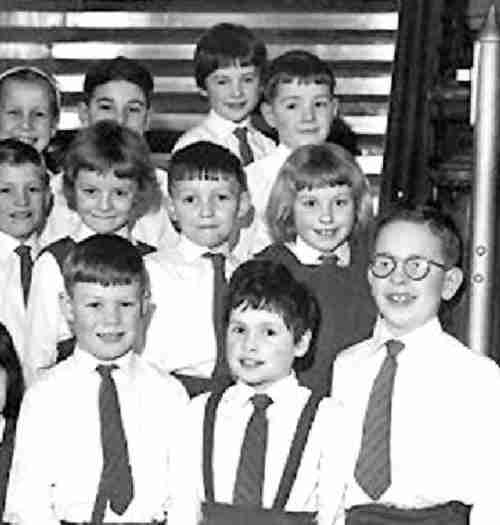
Figure 2.--Many primary schools in Scotland, as in England, adopted simple school uniforms in the 1960s. The children here at the Jean Street school wear white shirts an ties.
J
Jean Street Primary
K
Kiel School
Kilmarnock schools
Kirkmichael School
L
Lorne Street Primary School
Livister School
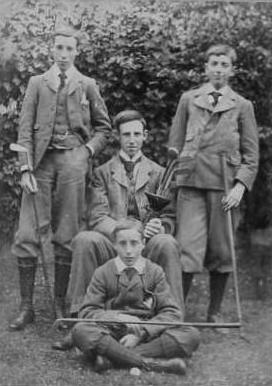
Figure 3.--Here we see some golfers at the Loretto School about 1890. Most private schools in Britain had uniforms. Knickers uniforms were common in the late-19th century. The school adopted a short pants uniforn in the 20th century.
Loretto School
Lunnasting Primary School
M
Milton Street School
Morrison's Accademy
N
New Lanark School
P
Paisley Grammar School
Parkside Primary
Pitcalnie School
Q
Queen Mary Street Public School
S
St Mary's Academy
St. Ninians Primary
St. Patricks Primary
St. Peter's Primary
St Rollox
Scotus Academy
Stevenston Junior Secondary School
Other Schools
Unidentified Schools
Old Boys
Personal Experiences
Sources
HBC-SU

[The 1880s]
[The 1930s]
[The 1940s]
[The 1950s]
[The 1960s]
[The 1970s]
[The 1980s]
[Long pants suits]
[Short pants suits]
[Socks]
[Eton suits]
[Jacket and trousers]
[Blazer
[School sandals
[Return to the Main Scottish individual school page]
[Australia]
[England]
[France]
[Germany]
[Italy]
[Japan]
[New Zealand]
[Scotland]
[United States]
[About Us]
[Activities]
[Chronology]
[Clothing styles]
[Countries]
[Debate]
[Economics]
[Garment]
[Gender]
[Hair]
[History]
[Home trends]
[Literary characters]
[School types]
[Significance]
[Transport and travel
[Uniform regulations]
[Year level]
[Other topics]
[Images]
[Links]
[Registration]
[Tools]
[Return to the Historic Boys' School Home]
Created: December 17, 2000
Last updated: 5:48 AM 6/7/2020