|
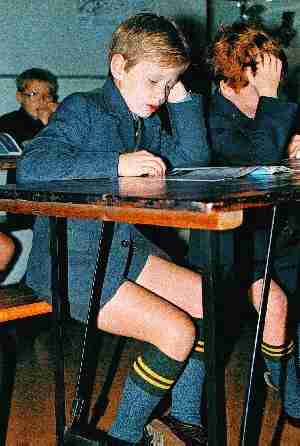
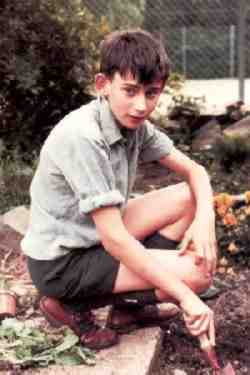
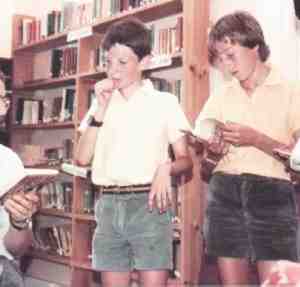
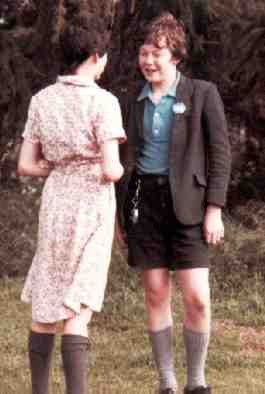
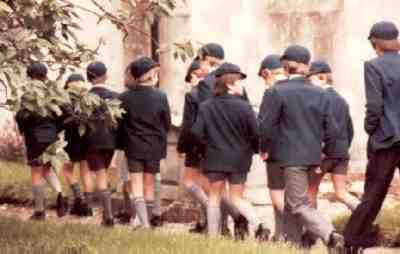
British school boys after the First World War began to commonly wear short pants, or short trousers as the British call them. I think that before the First World War that boys more commonly worn knickers or knickerbockers as the British call them. The shorts worn by British boys were generally worn at knee length and were often baggy. This continued until the 1960s when shorter, better tailored shorts became more common. However,because of the cold winters, the shortness became a hindrance and this is possibly another reason why they lost popularity with both parents and pupils. It is noticeable that the trend has now reversed with short trousers nearly at 1950s length. Almost all school shorts were grey, both at private and state schools, except for a few Scottish schools where boys wore blue shorts. Materials varied, but flannel shorts were initially most common. A few schools adopted corduroy shorts in the 1930s. After World War II, synthetic fabric, especially terylene became more common. The shorts were generally worn with kneesocks. Schools had a variety of policies and regulations about the school uniform and wearing shorts. Beginning in the 1960s older boys stopped wearing short pants and slowly British schools began to lower the age at which boys had to wear shorts and gradually most schools dropped the requirement alltogether.
|
The requirements of English schools concerning uniform including short pants varied by the type of school as well as variations at different schools. The various types of English schools seems enornously complex to the Americam reader. Schools have included: academies, Anglican, Catholic, dame, grammar, hospital, national, normal, preparatory, public, ragged, secondary modern, grant maintained, and many others. In addition to this complexity, the names are misleading. Public schools are exclusive private schools. The term Independant schools is also used for private schools. Many Independant schools were grant maintained which meant that many pupils were fee paying whilst the state paid for 10 percent (e.g. Norwich School). Grammar schools are for secondary-age children and preparatory schools are for elementary age chldren. The uniform regulations or lack of such regulations at these schools would be a very complex study, requiring a separate book. We will how however provide a short summary to assist the reader. One key law creating the modern structure of English Education was the 1944 Education Act. It reflected the growing political clout of the Labor Party and the aim was to expand educational opportunity. The law had some features that would be now viewed as elitist, especially the 11 plus exams to gain access to the best secondary schools. The school leaving age was raised to age 15 in 1944 and the Conservatives later raised it to age 16.
There seem to have been some regional differences. Short pants seem to have continued in the north of England longer than in the south. In the north the change to long trousers was not happening as early as the 1950s; many older teenage boys always had worn long trousers but most of those under 13 or 14 certainly did not until well into the 1960s.
School short pants have varied over time. Short pabts were a relatively modern inovation for boys. We see shortened lebngth pants in the 18th century. Boys and men at the time commonly wore knee breeches in the 18th century. As we approach the 19th century, this began to change and we begin yo see long pants. And boys tended to be the first to wear long pants. Adult men gradually followed suit. This was primarily the result of the skeleton suit which began to appear with long pants. At first we see skeletin suiys with knee breeches, but by the turn-of-the 19th bcentury we begin to se skeleton suits done wuith mostly long pants. Skeleton suits were a popular style in the early-19th century. They begin to go out of style, but boys contuinued to wear king apnts (1830s). After mid-century we begin to see younger boys wearing shortened-length pants, but we do not immediately see them at schools. Gradually shoietened-length pantxs begin to show up at the schools, but not short pants. We see knickers at many private schools where unifirms were worn. This was fir the younger boys. Preparatoty chools in tyhe late-19th century became part of the private school system for the younger boys. Knee pants seem more common at the state schools which were mostly younger boys as the state system consisted largely ofprimary schools. They were commonly wirn with long stockings. The Government beggan to significzangly expabnd the state system (1870s). The grammar schools which were scondary schools supported by the state tended to follow trends in the privatre schools, especially public (elite private boarding) schools. Only after the turn-of the 20th century do we begin to see short pants at school. They seem to hve been an evolutionsry step from the knee oabnts commonmly wprn in thatre late-19th abearly-20th century. After World War I in the 1820s short pants becane standard for English boys, a trend that occurred in most European countries. Unlike America, knickers were not very common. And like general fashion trends, short psbnts became standard schoolwear, commonly wiorn with knee socks, often called kling sicks or turn-over-top socks. This rended to be required wear in the schools with unifiorms, especially the prepararory schools and firv the younger boys at pubkic and grammar schools. In the state primary schools there were no uniforms, but most bioys akso wire shorts. As the Governmnt expbded the state seondary system, the different kinds of schiools (seciondary moderns and grammar schiiools) had i=unifirms abnd tended to require shirts for the younger boys.
|
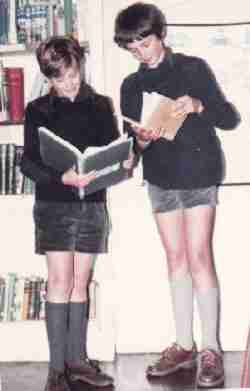
The shorts worn by British boys have varied in length. The length at first was quite long, at times touching the knee cap, rather like knee pants, but without the three buttons at the hem. Shorts Gradually the commonly accepted length was shortened to just above the knee, which was the common length by the 1930s. They were often quite baggy. This continued until the 1960s when shorter, more trim tailored shorts, showing a continental influence became more common. British schoolboys in the 1970s and 1980s often wore quite short shorts. There seems to have been little in the way of school regulations about the length of the shorts, only the fashions of the day dictating what was available. Some of the low-priced treylene shorts available through the main-line retailers like Marks and Spencers were particularly affected by the continental style of short shorts. These were the unlined shorts commonly purchased by mothers for boys at state primary schools. Boys at private schools tended to wear slightly longer, better made shorts sold through local retailers. Actually some of the shorter shorts worn at the private schools were the older boys. Many mothers knowing that their sons were about to graduate to long trousers, put off buying a new pair of shorts that they knew would only be worn for a few months. Longer styled shorts began to appear in the late 1980s, but by that time many schools had dropped the short pants requirement, especially for older boys. Many English school shorts for some reason did not have back pockets. I'm not sure why this was, but presumably there was no real need felt for back pockets at the time. Apparently schoolboys at the time did not normally carry wallets. British contributors tell me that even in the 1950s and 60s, boys did not carry wallets. This is quite different from America where boys' pants, except for play shorts, commonly had back pockets. English and New Zealand school shorts even to this day often do not have back pockets. The New Zealand unlined summer shorts, however, do have back pockets. Scottish school shorts (Doody) do have back pockets. American schools generally do. Proper school shorts made for private school uniforms almost always were lined. The linings were either white or light blue. Less expensive shorts available through the mass-retailers were less commonly lined. Many school shorts in the 1950s had double seats for longer wear. These double-seated shorts were mostly unlined and the double seat was normally sewn into the inside, though sometimes on to the outside. English short trousers as late as the 1940s and 50s still had very high waists compared to the cut of later shorts though it is noted that current Trutex shorts have reversed this trend. This is possibly a reflection of the change from knickers to short trousers during the early 20th Century. Breeches were cut with higher waists. Breeches also had brace (suspender) buttons and this style was utilized for early shorts as well. Boys at the time did not normally wear belts. Brace buttons were eventually replaced by belt loops in the 1940s and 50s and this gave rise to the common snake belt which every English schoolboy is familiar. The snake belts were produced in the school colors and became a mandatory part of the uniform. Snake belts are still worn at a few traditional prep schools. During the mid-1970s when short trousers started to be cut shorter, elastic waists were introduced for the younger boys. This was normally confined to the back of the waist band of the shorts and replaced the need for a belt and thus there were no belt loops on this style of shorts. This style has now become more prevalent with shorts for all age ranges and can in the 1990s be obtained up to and around 32 inches for the older boy. Some firms like Trutex have now put belt loops on to such shorts so the boy has the option of wearing a belt. Styles have varied over the last 50 years with regards to waists. Some short trousers have had no belt loops, but instead side adjusters. Others have a button to close the trouser top whilst others have a connection clasp. Some shorts had a second conection clasp on a 1 inch tab over lapping the first clasp. None of these variations are period link, but rather were available since the 1950s from various manufacturers. One signifivant variation has been period linked. Before World War II all school shorts and trousers were made with button flys. Zipper flys were not commonly available until the late 1950s and were not adopted at most schools until the 1960s. Some traditonal schools still had button flys as late as the 1970s. No shorts since the 1980s have been made with button flys, unless made to order.
|
Materials varied, but flannel shorts were initially most common. Some schools adopted corduroy shorts in the 1930s. After World War II, synthetic fabric, especially terylene worsted.
Cotton: A few schools adopted cotton shorts for the summer. But this was a relatively small number of mostly prep schools.
Corduroy: Corduroy is a corruption of the French corde du roi, corde or material of the king. It was a material used as livery for the king's attendants on the hunt. I am not precisely sure when it crossed the channel or became used for boys' trousers. It appears by the 1930s, however, that boys were wearing cord shorts for play. A few schools adopted them for the school uniform because of their lon wearing characteristics. Many of the school with cord shorts would use them for every day and the boys would have a dress uniform with proper grey shorts.
Flannel: Flannel was the most common material for boys trousers and short pants during the 1920-40s.
Terylene: Synthetic fibers became increasingly common in the 1950s. By the 1960s, Terylene worsted fabrics became increasingly common and was the primary material used for short pants by the 1970s. The term Terylene will be unfamiliar to Americans. It is a trade mark for polyester in thevUnited Kingdom. It was very poular because of the easy if care and the way in which the material held a crease. Terylene shorts were usually a blended fabric with 40-60 percent wool.
Herringbone: Several prep and public schools had herringbone jackets for the boys to wear during the school day. A few prep schools had uniforms of herringbone jackets and matching shorts.
Cavalry twill: A very small number of Public Schools after World War II introduced fawn-colored cavalry twill suits. These were all short pants, never in long pants. I'm noy sure what the actual material was, but probably wool. One of these schools (Dauntseys) later in the 1980s did switch to cavalry twill long pants suits.
|
Almost all school shorts were grey. Some Scottish schools adopted blue shorts, but in England virtually all schools had grey shorts of varying material and shades. There were a few exceptions. A few schools had fawn coloured shorts. Also in the period after the war many boys in non-uniform schools wore khaki drill shorts for school in the summer. These were like the shorts worn by British servicemen during the war and many boys wore these for holiday or weekend wear in the 1950s. The schools with cord shorts showed more variety. Cord shorts were mostly grey, but a few schools had blue or rust colored shorts. Grey was by far, however, still the color worn at the vast majority of schools. I'm not sure why grey was so universally adopted as the color for school shorts. It is a neutral color and thus went with whatever blazer color a boy might wear, but its not entirely clear to me why grey was so common. Interestingly, the last few English Public schools that required boys to wear short trousers throughout, were not in grey. Sedburgh and St Bees wore navy shorts in flannel (serge) whilst Dauntseys and Abbotsholme wore fawn colored shorts. Dauntseys' boys wire calvary twill suits. I think Abbotsholme boys wore suits of the same material.
The shorts were generally worn with kneesocks. Some schools let the boys wear ankle socks during the summer term, but kneesocks were very commonly worn. Almost all the kneesocks were grey. Boys at private schools often wore kneesocks with bands at the top in the school colors. I'm not sure when this fashion began, probably in the 1930s, but it was very common by the 1950s. Knee socks with colored bands were most commonly worn at private schools. This was because the private schools were more concerned with school uniform and because the socks with colored bands cost more. Many state schools, however, also requited the socks with colored bands. One HBC contributor reports that his grammar school (academically selective secondary school) in Yorkshire during the 1960s required knee socks with colored bands for the junior boys wearing shorts. Ankle socks also often had the school colors banded onto them and were normally worn with sandals. This fashion was primarily at prep schools because Public schools requiring shorts almost required knee socks, even during the summer.
|
Schools had a variety of policies and regulations about the school uniform and wearing shorts. Beginning in the 1960s older English boys stopped wearing short pants as commonly as they once did, even for casual dress. Slowly British schools began to lower the age at which boys had to wear shorts and gradually most schools dropped the requirement alltogether. Many of the traditional preparatory schools continued to require boys to wear short pants, but only a few schools in the 1990s continue to insist on shorts--mostly for the younger boys. Some primary schools still require short panrs be worn, but usually only during the warmer spring term.
Schoolwear trends in England were influential in many other countries.
The attitude of English boys toward short pants has changed over time. Boys in the 1920s-50s mostly wore short pants. Thus most did not give a second thought to wearing them at school. By the 1960s most older
boys wanted to wear long pants. Some traditional state and private schools insisted on shorts. Some private schools even required the older boys to wear shorts, despite the fact that some of the boys were embarassed. By the 1980s with only a few exceptions it was moistly the primary schools and traditional preparatory schools which insisted on short pants as part of the school uniform.

Navigate the HBC School Section:
[Return to the Main school short pants country page]
[Return to the Main school garment page]
[Return to the Main school garment page]
[Return to the Main English short pants type page]
[About Us]
[Activities]
[Chronology]
[Clothing styles]
[Countries]
[Debate]
[Economics]
[Garment]
[Gender]
[Hair]
[History]
[Home trends]
[Literary characters]
[School types]
[Significance]
[Transport and travel
[Uniform regulations]
[Year level]
[Other topics]
[Images]
[Links]
[Registration]
[Tools]
[Return to the Historic Boys' School Home]