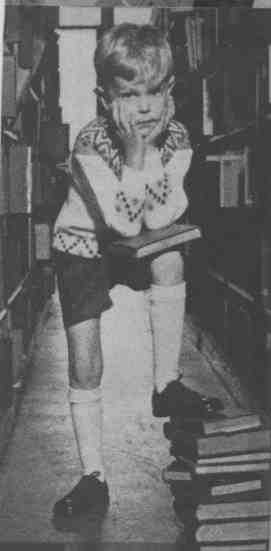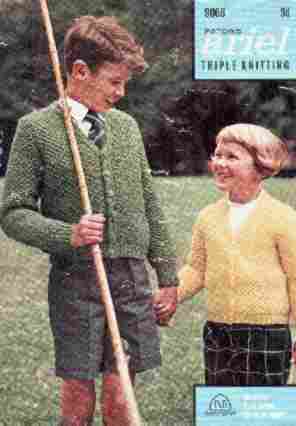
Figure 1.--Cardigan sweaters were popular for boys in Britain and to a lesser extent America during the 1950s and 60s. They were by the 1990s, however, little worn. |

|
A sweater is a knitted jacket or jersey worn by adults and children. The term derives from a garment originally worn by adults during erercising to induce sweating and reduce weight or for warmth. Sweaters appeared in the 19th century, but did not become an important garment for cool ot cold weather. They have commonly been worn by European and American boys since the 20th century. They are generally made in pullover or cardigan style, with or without sleves. Sweaters were initialy knitted from wool, but now synthetic fibers are also commonly worn.
I am not sure just when sweaters first appeared. I do not remember seeing then in paintings or photographs until the late-19th Century and even then not very commonly. This may reflect, however, the greater availability of photographic images in the late 19th Century. Some historical references suggest that knitted garments were being manufctured well before this time which evolved into the modern sweater. Warm wool garments were being knitted in the Channel Island during the 17th Century which seafarers found these grments to be of great utility, These garments may have been the origins of the modern sweater. Only with the 20th century does the sweater become an important garment for wear on cool or cold days. Only in the 20th century did the sweater become both a fashionable garment and garment commonly worn by children and adults, especially after World War I. We suspect that sweaters were widely wirn by men during the War, in the trenches and battlefields in the East. And then after the War, the soldiers wanted these practical garments. Use for sports may have helped increase the popularity with boys. And the sweater fit in nicely with the increasing trend toward casual wear in clothing.
The term 'sweater' derives from a garment originally worn by adults during work (such as fishing) or erercising (biking, cricket, skiing, and other sports) tht might induce sweating and reduce weight or for warmth. This of course tells us precisely how the sweater was viewed in the 19tyh century. They are also referred to as jumpers in the UK and former British colonies. We are not sure just how this usage came about.
Knitwear is extremelu popular in the modern fashion scene. In both women's and childrens fashions there has been a revolution in knitted clothes. No where is that more apparent then for sweaters. Modern design has had a major impact on the knitted sweater. Modern knitsd are an exciting area of modern fashion trends. The range of styles that can be purchased or hand made is constantly expanding. Children have always worn knitted comments more commonly than adults. Past styles had children dressed from head to toe in knitted garments. Woolen sweaters would be matches with knitted trousers, shorts, or skirts. Knitted caps, gloves, and socks might complete the outfit. British royals have influenced modern knit wear as they have influenced other styles. Prince Charles as a child commonly wore knitted outfits, such as patterned sweaters with matching plain trousers or short pants. This wasa a popular look in the 1950s and the prince's outfits may have been some of the first to be knitted on a machine. The advaning technology of modern knittng machiner has been the primary factor in the virtual explosion in availability of high-quality knitwear. Both modern and classic designs are available in a wide range of colors. Fashion experts report a trend toward a rougher and chunkier look in knitwear. This is in esence a return to the handmade look as opposed to the plainer sweaters of a few years ago. The classic British styles, however, remain the most popular styles--the fairisles, guernseys, and arans. The British royals continue to wear these styles and they continue popular for British and American children. Children commonly wear a variety of sweater styles, from ski-style cardigans to cable knit pullovers. An increasingly common modern trend is the picture sweaters or motif knits.
|
Sweaters come in a wide variety of different styles. We are aware of some of the styles, others we are less sure about. This is complicated by the fact that some sweaters are a mixture of diffeent styles. Some of the sweater types are overlapping. for instance many types of sweaters have been used for schools. The names varied. Some relate to thevplace where they originated. Others were a discription of some phusical feature of the sweater.
Aran:
Cable knit: Cable knit sweaters have a rope or cable design.
I have no information yet on the origins of this style, but cable knits have proven to be a popular enduring fashion.
Fairisle:
Cardigans: The cardigan is a close fitting knitted woolen jacket which buttoned up the front like a jacket. Cardiganshire is a county in west Wales. The sweater style is named after the seventh earl of Cardigan (1797-1868) who served in the Crimean War. Cardigan sweaters were popular for boys in Britain and to a lesser extent America during the 1950s and 60s. They were by the 1990s, however, little worn.
Crew neck: A crew neck sweater is one where the neck opening is tight against the neck. I'm not sure what the derivation of the term was. Perhaps it was worn by boat or rowing crews.
Turtle neck: A turtle neck sweater is one with extra material at the neck
extending the sweater to cover the entire neck area.
Guernseys: The authentic Guernsey sweater is still going strong after 400 years. The craft of knitting has been a continuous tradition on Guernsey in the British Channel Islands since the time of the first Queen Elizabeth, when intrepid seafarers began to venture as far as the New World and needed warm, practical and weather proof
clothing to survive.
Jersey: A jersey is a close-fitted knitted woolen jacket, shirt, or sweater worn by seamen, athletes, or others.
Letter:
Picture: Picture sweaters or motif knits are generally children's sweaters knitted with pictures of animals, trains, cars, boats and other images that appeal to children. Mothers often like tomlicen up a plain sweater with these images.
Pullover: A sweater that is put on by pulling it over one's head. There
are no button or other opening.
Raglan: I am not positive just what a raglan sweater is. It is named, however, after the Earl of Raglan who like the Earl of Cardigan served in the Crimean War where the men had need of warm woolen garments to keep warm.
Set: Sweaters were often chosen to go with pants of a similar or contrasting color. Although not very common, we have noted knotting magazines offering patterns for sweater sets with matching sweaters and pants. The sweaters for these sets varied, but the pants were often, but not always shorts. The knit was always the same. The color was commomly the same, but not always. The sweaters often had a patter, the pants were normally solid colors.
School: The sweater or jumper is a particularly popular garment for school, in part because much of the fall and winter is the school season in the northern hemisphere. We notice a wide range of sweater types used for school. Many colors are also worn, although grey and blue are especially popular.
Ski-style:
Sleave and sleeveless: Sweaters are made both with and without sleeves. The sleeveless style is worn like an informal vest.
V-neck: Some pullover sweaters are made with a "V" front. These are generally
designed to be worn with ties, the "V" allowing the ties to be seen. Most school sweaters are "V" neck.
Sweaters were initialy woven or knitted almost exclusively from wool. A wool sweater is now a relatively expensive garment. Sweaters with synthetic fibers are also commonly worn.
Sweaters have been popular garments for boys around the world. They are most popular of course in the more northerly countries with severe winter weather. Here we are just beginning to collect information and have not yet developed any detailed information on national trends.
These are knit garments and, as a result, until after World War II many sweaters were hand knitted by mothers or grandmothers. Sweater knitting patterns were some of the most popular items in knitting patterns. I'm not sure when the first knitting patterns appeared. I think in h late 19th century, but am not sure about this. Sweaters are still hand knitted, but most are brought ready made.
Some smocks came with belts of the same material as the smock. In the early 20th century smocks were often worn with a leather belt. The belt had no real purpose than as a stylistic element. Wearing belts over smocks became less common in France after the 1920s. HBC has also noticed boys wearing belts over their sweaters, but was most common with smocks. This style has also been noted in Germany, but rarely in America or Britain. This is a style that HBC does not fully understand, but has begun to assess. A French HBC contributor has offered some interesting insights.
There was once a major difference between sweatshirts and sweaters. Sweatshirts were athleticwear for boys. Sweaters were garments for both casual and schoolwear during the fall and winter. The sweatshirt since the 1950s has, however, developed as a casual garment that is now worn rather like sweaters by both boys and girls. Some modern schools have adopted sweatshirts rather than sweaters fior their school uniforms.

Navigate related Boys' Historical Clothing Web Site ciold weather pages pages:
[Return to the Main cold weather page]
[Return to the Main inclement weather page]
[Coats]
[Knits]
[Leggings]
[]
Navigate the Boys' Historical Clothing Web Site:
[Introduction]
[Activities]
[Biographies]
[Chronology]
[Clothing styles]
[Countries]
[Bibliographies]
[Contributions]
[FAQs]
[Glossary]
[Images]
[Links]
[Registration]
[Tools]
[Boys' Clothing Home]