
American Sailor Outfits: Suit Types
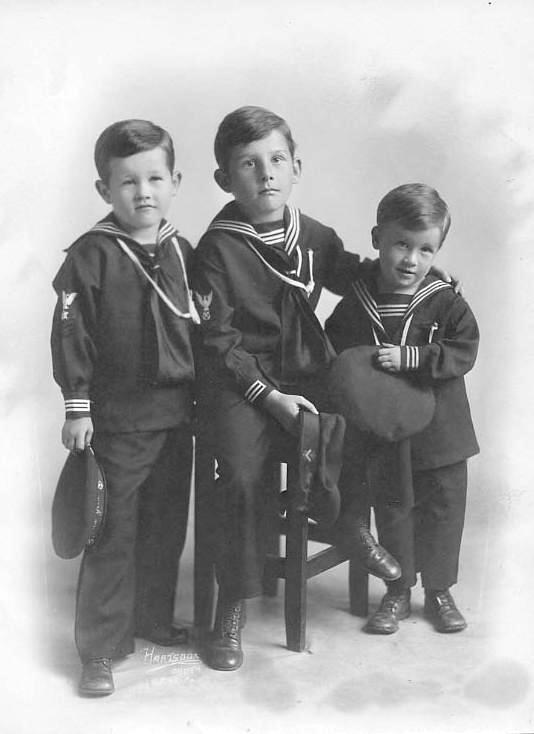
Figure 1.--hese American boys, probably in the 1920s, wear classic sailor suits with middy blouses abd trousers. The traditional pull-over middy blouses were fairly standard. The trousers varied. We have seen sailor suits with short pants, knee pants, bloomer knickers, and long pants--some times bell-bottoms. Caps also varied.
|
|
The sailor suit is one of the most popular styles for boys over a very long period of time. American boys have worn several different types of sailor suits. There are a vast variation in styling, but the actual number of different suit types are more limited. Sailor suits consisted of blouses or jackets worn with different types of pants, or skirted garments for younger boys. The most common was probably the standard middy (pull-over) blouse. We also note blouses that buttoned up. Much less common were open-front sailor jackets. I am not entirely sure what the proper names are for these various types of sailor suits.
The standard sailor suit was a three piece outfit of pull-over middy blouse pants of various length, and a scarfe. This was the case for both blue and white suits as well as suits made in other colors. Sailor suits were made in many different styles over several decades, thus the actual suits varied considerably. The standard, however, was three-piece outfits. Matching caps and hats of different styles were often purchased separately. During the winter a reefer jacket might be worn. While the styling of the various garments varied over time the basic suit continued to be the standard three pieces.
Many sailor suits in the 19th century were made with button fronts. The styling of these suits varied widely as they were the ones that often diverged from actual uniform designs the greatest. Detailaing was often elaborate and frequently diverged from the traditional three stripes. Many were also often worn with the colorful large bows that were popular at the time, rather than modest black sailor scarves. They were most commonly worn with knee pants. Unfortunately we often do not know what tyoe of hat was worn with these suits. They were often worn with dickies or stripped undershirt.
Jacket Suits
In addition to the popular blouse suits there were also jacket suits. This was a shidt from the basis simple sailor suit of vlouse and pants which first appated in the 1840s. It appears an attempt to retasin the stule, but introduce a greater formality in keeping ith trends during the late-19th century. Formality was a strong convention even for children's clothes. We see both closed- and open-front suits. The closed-front suits were the most common. We see numerous examples in both the the photographic record and mail order catalogs, mostly the closed-front jackets. We see these suits in all kinds of different styles, colors, material, and detailing. They seem especially prevalent in the 1880s-1900s, but we are still working on the chronology.
Closed-front jackets
The open-front jacket was a rather fancy, formal style. This is not a sailor suit style that we see bing worn as a play suit. We primarily note in the 1890s and 1900s. The boy here had his portrait taken in 1898 (figure 1). Because of the chronology, these suits werevusually done with knee pants. We are still working on the precise chronology. These were not jckets just not buttoed, but mean not to be buttoned. The sailor suit was a very versitile outfit. They could be worn for dressing up, formal occassions, school, and play. This suit was, however, a rather formal style. They were not a real common tyle, but we notice some portraits of boys wearing them. I'm not sure to what extent this style was worn in other countries. So far we have only found them in America. we are not sure yet about the age conventions.
We see many boys wearing button-on sailor suits. This was a style for younger boys and a way of hilding up the pants. They were mostly done with knee pants, shirt pants and knickers. This was not an exclusively American style, but the style seems more popular in American than any other country. The buttons were commonly used in the styling, but even if large white front buttons are noy used, the styling is obvious because the blouses do not blouse out. We believe that these primarily appeared during the 1910s. We are, however, still working on the precise chronology. Button-on styling itself did nor originate in the 1910s. We see button on suits in the 1860s, but on a lot of button-on sailor suits. Sailor blouses which bloused out using waist draw cords seem particularly popular for sailor suits. We are just befinning to collect information on them. The imahe here isa good example (figure 1). These outfits were very common for younger boys. We see large numbers of these button-on suits. Sailor siuits were just one of these styles done with button-on styling. Buster Brown suits were also dobe with button-styling. We see the suits donr for pre-school boys up to about 10-years of age. Generally speaking, the sailor suits were done in sizes to about 8-years of age. There were both summer and winter suits.
The sailor style was the most popular style of tunic in the United States. Some tunics like the one seen here does not seem to fit into any specific style, but is in fact a fancy sailor tunic. Sailor collars had the prominent "V" front and back flap and were very popular. Many had other features of sailor styling. Other sailor tunics only had the basic "V" feature. There were substantial variations in the styling of the sailor tunics. Some were done with traditional styling or some resemlance to it. We also note sailor tunics done with elaborate lace and ruffle trim. These tunics were of course dressy garments reserved for special occassions. They wee often made in larger sizes than the other tunic styles. Russian blouse tunic did no have collars. Buster Brown tunics had a wide white collar. Many tunics had prominent belts. They were oramental without any real purpose. Sailor tunics were widely worn in America during the early 20th century.
Not all boys wore actual sailor suits. We see some boys wearing suits with sailorfeaturs, but not actual sailor suits. This could be because the sailor was just beginning to become popular. By the 1880s, however, the sailor suit was readily available in stores. We note some outfits that were not standard sailor suits. They proably resulted from a mother's afinity for the popularity of the sailor suit, or perhaps the boy's desire to wear a sailor suit. Perhaps the mother could not afford a proper sailor suit. or perhaps the boy had a saior suit and was for one reason or another mixing outfits.
HBC

Sailor Suit Country Related HBC Pages:
[Return to theMain U.S. sailor suit garment page]
[American]
[English]
[French]
[German]
[Italian]
Other Related HBC Pages:
[Sailor suits]
[Kilts]
[Smocks]
[Pinafores]
[Sailor Hats]
[Blouses]
[Ring Bearers]
[Long hair]
[Ringlet curls]
[Hair bows]
[Bangs]
[Collars]
[Bows]
Navigate the Boys' Historical Clothing Web Site:
[Introduction]
[Activities]
[Biographies]
[Chronology]
[Clothing styles]
[Countries]
[Bibliographies]
[Contributions]
[FAQs]
[Glossaries]
[Images]
[Links]
[Registration]
[Tools]
[Boys' Clothing Home]
Created: 7:14 AM 1/13/2008
Last updated: 11:22 AM 10/11/2016