|
None of the border or southern states moved to end slavery. Even in the slave states, however, there were free blacks. Some blacks had obtained their freedom during the Revolutionary War. Others had been freed by their masers after years of faithful service. There was many other circumstances. Freed blacks were a small minority, but certainly not a negligible group. Some southern states passed laws requiring freed slaves to leave the state, but here enforcement was often uneven. We are not sure just how many free blacks there were in the South. One study of Virginia, estimates that nearly 10 percent of the state's black population was free. 【Ely】 This proportion of the population rather surprised me. I'm not sure about the proportion in other slave states. What is interesting about the free blacks in the South before the Civil War is that they had the right to own property. They also had access to the courts. This is not to say there was equal justice. Court records show that blacks did bring civil actions and at least in property matters did receive some judicial relief. 【Ely】 Another interesting aspect of free blacks in the South before the Civil War is that there were shared institutions. Free blacks for example attended churches with whites. Of course the churches were run by the whites. It is also true that men that attended church together also did business with each other. 【Ely】 Many of these interactions and shared institutions disappeared after the War.
The history of black Americans before the Civil War primarily focuses on slavery. While most blacks lived in the South as slaves, there were free blacks in both the northern and southern states. The numbers were relatively small, the result of slave owners freeing their slaves, often in their wills. The colonial period ended before the Christian abolition movement was only beginning to impact public opinion. Of course unlike the rest of the early United States the Louisiana Purchase brought areas colonized by France into the United States (1803). The Canadians decided not to join the Americans and most of the rest of French North America was minimally populated by French colonists. The exception of course was New Orleans where attitudes on race were somewhat more moderate than in British North America. And New Orleans in in the early history of the United States was one of the most important cities. This issue, however, is complicated. France's most important colony Saint-Domingue (modern Haiti) was the most valuable colony held by any European colony. The British held tiny islands like Barbados and Trinidad. Jamaica was a little larger. Saint-Domingue had a growing area comparable to all the British sugar islands combined. The value of the resulting sugar shipments was enormous. Europeans simply could not get enough sugar. The Caribbean slave/sugar system was brutal beyond belief. The Caribbean sugar plantations were essentially death camps. Survival rates were much higher for slaves in North America the Caribbean and Brazil. And Saint-Domingue was brutal even by Caribbean standards. The value of the sugar, however, probably explains why the French Abolitionist Movement was so much weaker than the movement in Britain and America.
Blacks were involved in the Revolutionary War from the very beginning. There was a black killed in the Boston Massacre. Blacks served on both sides of the War. Quite a number of blacks, mostly in the North gained their freedom as a result of military service in the War. Questions of freedom and liberty were raised during the Revolution. Many Americans fighting for their freedom found it difficult to countenance slavery for others. The issue in the North was not complicated by economic factors and larger populations as was the case in the South. Many understood the role that black soldiers had played in the fighting.
None of the border or southern states moved to end slavery. Even in the slave states, however, there were free blacks. Some blacks had obtained their freedom during the Revolutionary War. Others had been freed by their masers after years of faithful service. There was many other circumstances. Freed blacks were a small minority, but certainly not a negligible group. Some southern states passed laws requiring freed slaves to leave the state, but here enforcement was often uneven. We are not sure just how many free blacks there were in the South. One study of Virginia, estimates that nearly 10 percent of the state's black population was free. 【Ely】 This proportion of the population rather surprised us. I'm not sure about the proportion in other slave states. What is interesting about the free blacks in the South before the Civil War is that they had the right to own property. They also had access to the courts. This is not to say there was equal justice. Court records show that blacks did bring civil actions and at least in property matters did receive some judicial relief. [Ely] Another interesting aspect of free blacks in the South before the Civil War is that there were shared institutions. Free blacks for example attended churches with whites. Of course the churches were run by the whites. It is also true that men that attended church together also did business with each other. 【Ely】 Many of these interactions and shared institutions disappeared after the War.
Some of the original Blacks sold in to the English North American colonies were treated more like indentured servants. 【Frazier, p. 1】 Thus some were able to obtained their freedom. Some blacks had obtained their freedom during the Revolutionary War. 【Horton】 There were mixed race children born o free Native American mothers. 【Seybert】 Some slaves managed to buy their freedom. Others had been freed by their masters after years of faithful service. The most common group appears to be the children of slave owners and their female slaves. 【Heinegg】 There was many other circumstances. Freed blacks were a small minority, but certainly not a negligible group. And most of the free blacks were mixed race. The Founding Fathers were essentially correct. Slavery was a dying system and would disappear on its own. Northern states began abolishing slavery. And in the glow of the Revolution, slave owners began granting freedom to heir slaves at unprecedented rates. 【Zilversmit】 Some sources report the proportion of free Blacks may have reached as high of 13 percent, but this is primarily because of changes in the North. Then the situation changed. Eli Witney's cotton gin took hold and Southern planters began growing highly profitable cotton. Planters expanded production and needed more workers. And as a result the percentage of free Blacks began to decline.
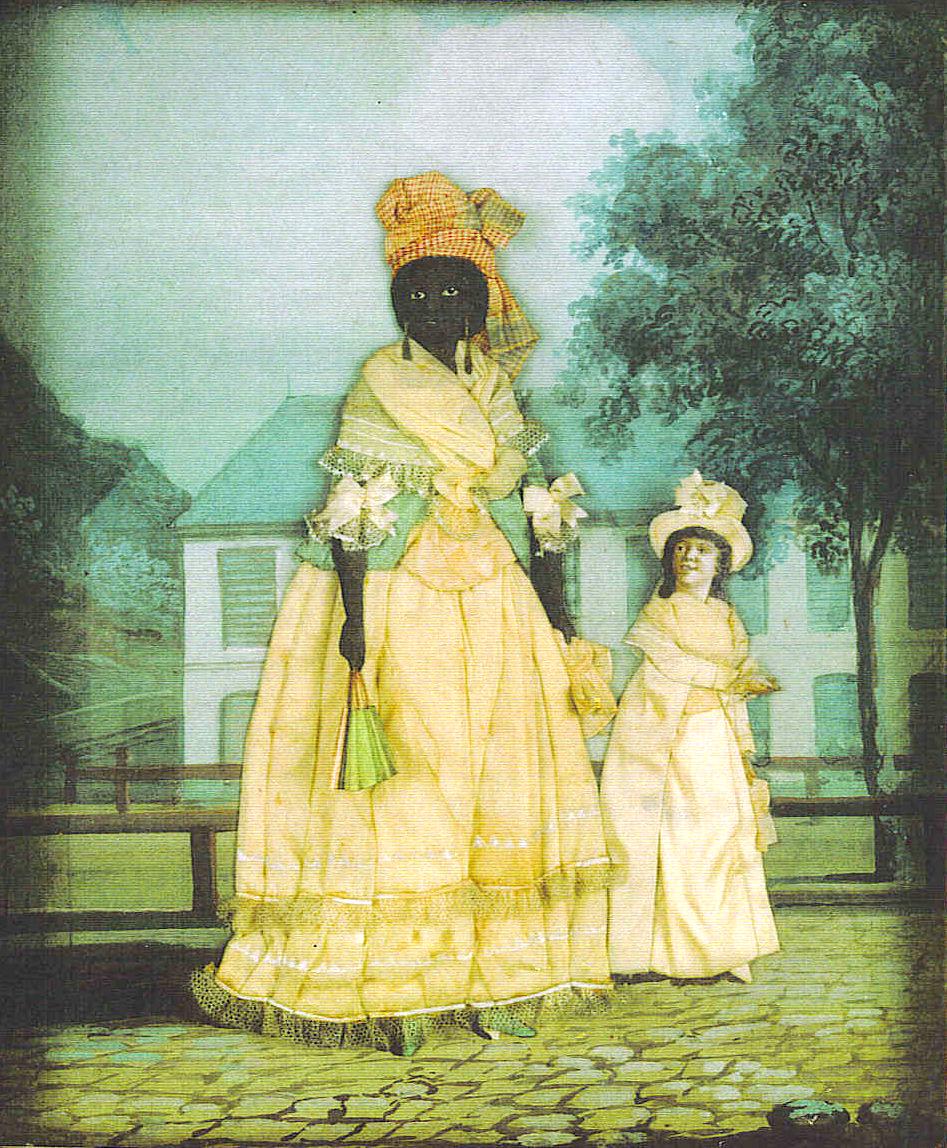
We have some data on free persons of color. There were a small but mot insignificant numer of free Blacks in America. Somewhat surprisingly, there were more free blacks in the South than in the North; roughly 261,000 lived in slave states, while 226,000 lived in northern free states. This was because so many more slaves existed in the slave states. One study of Virginia, estimates that nearly 10 percent of the state's black population was free. 【Ely】 Most free blacks did not live in Deep South (the states of Alabama, Arkansas, Florida, Georgia, Mississippi, South Carolina, and Texas). The freed slaves ere in th upper southern states, especially the border states ( Delaware, Maryland, Virginia, North Carolina, and later Kentucky, Missouri, Tennessee, and the District of Columbia). An excretion to this pattern was Louisiana, especially in New Orleans. There were free Blacks in New Orleans at the time the Louisiana Purchase was negotiated (1803). There were more free Blacks and living at a higher social standard than in any other Southern city. .
Southern blacks were a largely rural population, primarily involved in plantation agriculture. The small number of emancipated Blacks generally moved into cities. A substantial majority of free blacks in the South were lighter-skinned women. This obviously reflected the trend of white slave owners to free their children born from enslaved mothers. The boys were often sent North. The girls were more likely to remain. There were terms for the different levels of parentage. Mulattoes are those with one black and one white parent), quadroons (those with one black grandparent), and octoroons (those with one black great-grandparent). Lighter-skinned blacks commonly adopted the same racial attitudes toward darker skinned blacks as white society.
Despite the open racism in the United States, interesting there seems to have been relatively little interest among free blacks to return to Africa, even after the American Colonization Society set up a settlement which would become Liberia.
Free blacks in the North played an important role in the abolitionist movement. Most blacks in America were slaves and lived in the southern States. There were much smaller numbers of free blacks, mostly in the northern states as well as run-aways. African American in the north joined the anti-slavery movement and the struggle against racial discrimination in the North. his was not the case in the South. They would have been arrested as well as become the target of extra-judicial violence.
Even when emancipated, blacks in the north were not afforded full civil rights such as the franchise, jury service, and other rights. There was also resistance in allowing black children to attend public schools. In the South as far as we know, freed Blacks were not entitled to few basic civil liberties. What is interesting about the free blacks in the South before the Civil War is that they had the right to own property. They also had access to the courts. This is not to say there was equal justice. Court records show that blacks did bring civil actions and at least in property matters did receive some judicial relief. 【Ely】 This included the right to purchase their own slaves. This was rare, but it did occur. Andrew Durnford was born in New Orleans (1800). This was just before the Louisiana Purchase. His father was white and his mother was a free black. Durnford became an American citizen and was a prominent Louisiana sugar planter and slaveholder. William Ellison in contrast was born a slave in South Carolina (1790). He manged to purchase his freedom as well as that of his wife and daughter,. He began purchasing slaves himself. And he launched a lucrative business manufacturing cotton gins. Ellison became one of the richest and largest slaveholders in the South Carolina. .
Religion was very important in the 19th century. Large numbers of black slaves attended church services. We are not sure about emancipated Blacks. As abolition gained support in the North, many American churches split along sectional lines. Another interesting aspect of free blacks in the South before the Civil War is that there were shared institutions. Free blacks for example attended churches with whites. Of course the churches were run by the whites. It is also true that men that attended church together also did business with each other. 【Ely】 Many of these interactions and shared institutions disappeared after the War.
The prevailing attitude in the slave states was to encourage emancipated slaves to move to the free states, but actual enforcement was uneven. As the Abolitionist Movement grew in he North, Southerners became increasingly defensive about slavery. And many became uneasy about freed slaves. They probably though that such examples would give their slaves ideas about freedom. As a result, they not only passed laws about requiring freed slaves to move out of the state, but actually prohibiting further manumissions. Such actions seem more common in the border states than in the Deep South states.
Freed Blacks were not permitted to get involved in military service, We do note some slaves and freed Blacks joined Andrew Jackson's heroic defense of New Orleans (1815).
Ely, Melvin Patrick. Israel on the Appomattox.
Frazier, Edward Franklin. The Free Negro Family (1968).
Heinegg, Paul. Free African Americans of North Carolina, Virginia, and South Carolina from the Colonial Period to About 1820 Horton, James Oliver. Hard Road to Freedom: The Story of African-America (2001).
Seybert, Tony. "Slavery and Native Americans in British North America and the United States: 1600 to 1865" (2004).
Zilversmit, Arthur.The First Emancipation: The Abolition of Slavery in the North (1967).

Navigate the CIH Civil War related pages
[Return to the Main free black page]
[Return to the Main U.S. slavery page]
[About Us]
[Biographies]
[Campaign]
[Causes]
[Emancipation]
[Families and youth]
[Fiscal policy]
[Formations and units]
[Law]
[Military
[Railroads]
[Reconstruction]
[Slavery]
[Soldiers]
[Uniforms]
[War crimes]
[Weaponry]
[Return to the Main Civil War page]
[Lost Cause]
[Segregation]
[Civil Rights movement]
[Return to CIH Home page]
Created: 6:16 AM 8/1/2026
Last updated: 6:16 AM 8/1/2026