|
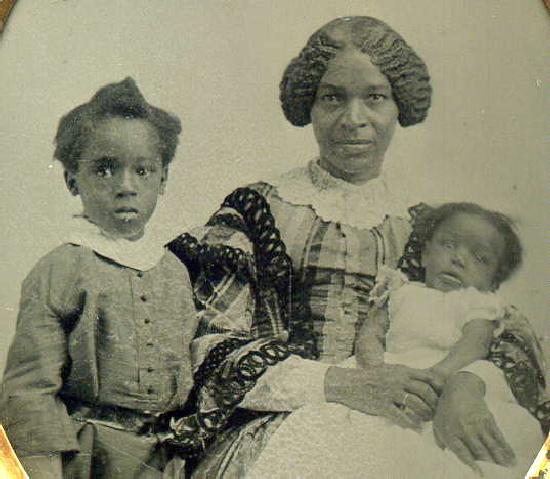
The history of black Americans before the Civil War primarily focuses on slavery. While most blacks lived in the South as slaves, there were free blacks and not only in the northern states. The northern states relatively soon after the Revolution abolished slavery. This was done state by state. While slavery was abolished, not all slaves were immediately emancipated. Interesting there seems to have been relatively little interest among free blacks to return to Africa, even after the American Colonization Society set up a settlement which would become Liberia. Even when emancipated, blacks in the South were not afforded full civil rights such as the franchise. And the Supreme Court Dread Scott decision essentially meant that blacks could not be citizens. There was also resistance in allowing black children to attend public schools. Slavery was retained by the border and southern states. Even in the southern states there were free blacks. Some southern states passed laws requiring freed slaves to leave the state, but here enforcement was often uneven. We are not sure just how many free blacks there were in the South. One study of Virginia, estimates that nearly 10 percent of the state's black population was free. [Ely] This proportion of the population rather surprised me. I'm not sure about the proportion in other slave states. What is interesting about the free blacks in the South before the Civil War is that they had the right to own property. They also had access to the courts. This is not to say there was equal justice. Court records show that blacks did bring civil actions and at least in property matters did receive some judicial relief. [Ely] Another interesting aspect of free blacks in the South before the Civil War is that there were shared institutions. Free blacks for example attended churches with whites. Of course the churches were run by the whites. It is also true that men that attended church together also did business with each other. [Ely] Many of the interactions and shared institutions disappeared after the War.
The history of black Americans before the Civil War primarily focuses on slavery. While most blacks lived in the South as slaves, there were free blacks in both the northern and southern states. The northern states relatively soon after the Revolution abolished slavery. This was done state by state. While slavery was abolished, not all slaves were immediately emancipated in the North. Northern blacks became a largely urban population, in contrast to southern blacks. Blacks were involved in a range of mostly manual occupations, in large measure because of limitations on educational opportunity. Women often worked as family domestics. Despite the open racism in the United States, interesting there seems to have been relatively little interest among free blacks to return to Africa, even after the American Colonization Society set up a settlement which would become Liberia. Even when emancipated, blacks in the south were not afforded full civil rights such as the franchise. There was also resistance in allowing black children to attend public schools. And the Supreme Court Dread Scott decision essentially meant that blacks even in Free States could not be citizens.
None of the border or southern states moved to end slavery. Even in the slave states, however, there were free blacks. Some blacks had obtained their freedom during the Revolutionary War. Others had been freed by their masers after years of faithful service. There was many other circumstances. Freed blacks were a small minority, but certainly not a negligible group. Some southern states passed laws requiring freed slaves to leave the state, but here enforcement was often uneven. We are not sure just how many free blacks there were in the South. One study of Virginia, estimates that nearly 10 percent of the state's black population was free. [Ely] This proportion of the population rather surprised me. I'm not sure about the proportion in other slave states. What is interesting about the free blacks in the South before the Civil War is that they had the right to own property. They also had access to the courts. This is not to say there was equal justice. Court records show that blacks did bring civil actions and at least in property matters did receive some judicial relif. [Ely] Another interesting aspect of free blacks in the South before the Civil War is that there were shared institutions. Free blacks for example attended churches with whites. Of course the churches were run by the whites. It is also true that men that attended church together also did business with each other. [Ely] Many of these interactions and shared institutions disappeared after the War.
Ely, Melvin Patrick. Israel on the Appomattox.

Navigate the CIH Civil War related pages
[Return to the Main U.S. slavery page]
[Return to the Main working page]
[About Us]
[Biographies]
[Campaign]
[Causes]
[Emancipation]
[Families and youth]
[Fiscal policy]
[Formations and units]
[Law]
[Military
[Railroads]
[Reconstruction]
[Slavery]
[Soldiers]
[Uniforms]
[War crimes]
[Weaponry]
[Return to the Main Civil War page]
[Lost Cause]
[Segregation]
[Civil Rights movement]
[Return to CIH Home page]