|
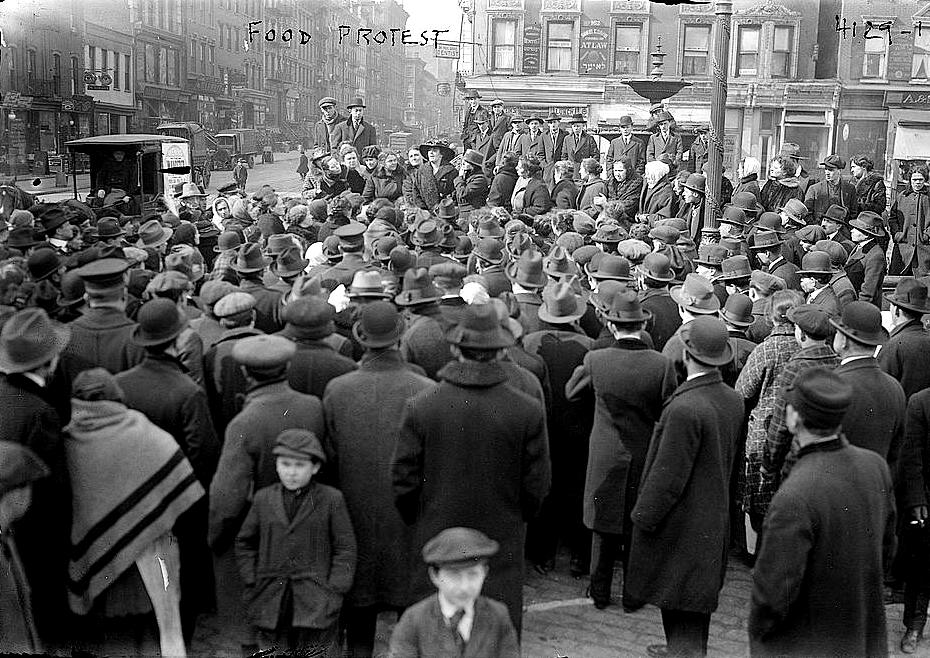
The New York City Food Riot of 1917 were a series of demonstrations leading and riots which began (February 19, 1917). This was just before America entered World War I (April 1917) The War had been raging in Europe for going on 3 years. Falling agricultural production was creating massive demand for food in Europe. This led to demonstrations about rapidly rising food prices in America. The demonstrations led to a mob consisting mostly of women descending on food stores and pushcart owners over the raising of food prices. prices following the shortages of World War I. 【"Women ..." 】 The New York Times article read, "Women in bread riot at doors of City Hall. With babies in arms they cry for cheaper food -- dispersed by mounted police. Four hundred east side mothers, many carrying babies and all shouting 'We want food for our children!' Poured from Rutgers Square through East Broadway and the Bowery to City Hall about 11 o'clock yesterday morning and clamored at the Mayor's office for relief from prices which, they said, were driving them to starvation." Starvation did not occur in New York City or elsewhere in America. But there is no doubt that many low-paid workers were experiencing considerable hardship. It was nothing like what was occurring in Europe, where there was far greater food shortages and more severe inflation. Catastrophic famine was prevented when America basically invented international humanitarianism through European food relief. America first provided food to the starving Belgians and later most of the rest of Europe. But there were American working-class families being impacted by the World War I inflation. Ida Harris, president of the socialist Mothers Vigilance Committee, and Anarchist labor organizer Marie Ganz, played prominent roles in the ensuing riots. 【Ferrara 】 Ida Harris, president of the socialist Mothers Vigilance Committee, and anarchist labor organizer Marie Ganz, led the crowds through Manhattan's Lower East Side. After another gathering Ganz was arrested for 'failing to comply with orders to stop stirring up the crowd.' (February 20). The women then went further and stormed the city's poultry markets, 'assaulting customers and destroying chickens' (February 22). We are not sure just how one destroys a chickens, but the women apparently did so. This all climaxed when, thousands of New Yorkers marched on Madison Square, here here "several high-profile speakers addressed the crowd." 【Ferrara 】 The food riots had some impact. City officails managed to obtained low-cost produce and wholesalers lowered prices. Inflation was, however a problem throughout the War. While all this was going on, the February Revolution broke our in Russia, leading to the abdication of the Tsar (March 1917). The inflation was not just impacting New Yorkers. Workers in other American cities were impacted. We do not, however, know of other food riots elsewhere in the United States.
Ferrara, Eric. "The Food Riots Of 1917," The Gotham Center for New York City History (May 4, 2013).
"Women in bread riot ..." New York Times (February 21, 1917).

Navigate the CIH World War I Section:
[Return to Main United States World War I food pahe]
[Return to Main U.S. World War I home front page]
[Return to Main U.S. World War I page]
[Aftermath]
[Alliances]
[Animals]
[Armistace]
[Biographies]
[Causes]
[Campaigns]
[Casualties]
[Children]
[Countries]
[Declaration of war]
[Deciding factors]
-------[Diplomacy]
[Economics]
-------[Geo-political crisis]
[Home front]
[Intelligence]
[Military forces]
[Neutrality]
[Pacifism]
[People]
[Peace treaties]
[Propaganda]
[POWs]
[Russian Revolution]
[Terrorism]
[Trench warfare]
------[Technology]
[Weaponry]
[Bibliographies]
[Contributions]
[FAQs]
[Images]
[Links]
[Registration]
[Tools]
[Return to Main World War I page]
[Return to Main war essay page]
[Return to CIH Home page]