|
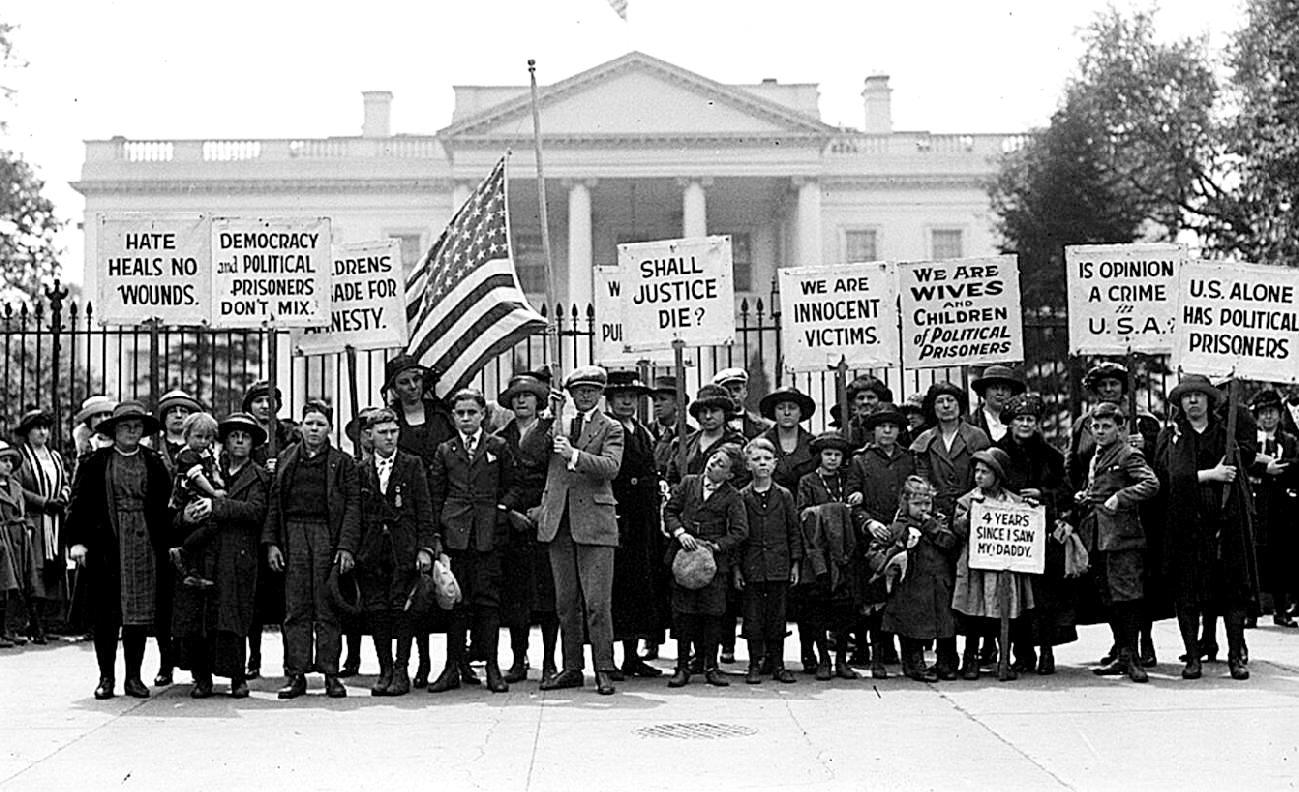
The vast majority of American had vociferously opposed entering World War I. President Wilson was reelected with the slogan, "He kept us out of war." (November 1916) While public opinion came to favor the Allies, there was still widespread opposition to entering the War. Only incredibly reckless behavior on the part of the Germans led he United States to declare war. Americanism quickly embraced the War effort with an enthusiastic explosion of patriotism. That does not mean that all Americans supported the War. Before the United States entered World War I (April 1917), Americans were free to say whatever they wanted about the War and American participation in the War. This changed substantially after America entered the War. The U.S. Government quickly moved to restricted free speech concerning the War. Congress passed the Espionage Act (1917) and even more restrictive Sedition Act (1918). These acts criminalized criticism of the War, the draft, and the Government. The result was prosecutions of war critics, most prominently Socialist Eugene Debs. This raised a range of First Amendment protections. The Espionage Act (June 1917) criminalized conveying false information that in any way interfered with the American war effort such as causing military insubordination or obstructing military recruitment. The Sedition Act (May 1918) went even further. It punished 'disloyal, profane, scurrilous or abusive' speech about the United States, the flag, or the war effort. This basically banned all dissent. The Postmaster General was authorized to deny war critics the ability to mail publications. Publications criticizing the War were suppressed. This was the most severe attach on free speech since resident Adams Alien and Sedition Acts (1797). Socialists, pacifists, and anti-war activists faced prosecution for speaking out against the War. Socialist leader Eugene Debs was imprisoned for an anti-war speech, famously defending his right to free speech even in wartime. The Wilson Administration argued these laws were necessary for national security and to maintain public support for the war. We have been unable to find the actual numbers prosecuted, but the fact that the Sedition Act was only passed months before the War ended limited prosecutions. The Sedition Act was repealed (December 1920). The War had been raging since 1914, but ended in less than 2 years after America entered the War. This was somewhat surprising given that the United States did no have a substantial army when it declared war. Germany asked for an armistice (November 1918). As a result, the legal challenges did not move though the courts until after the War had ended. The Supreme Court initially upheld the limits imposed by the new laws, although later had second thoughts and expanded free speech rights. The Supreme Court in Schenck v. U.S. (1919) upheld the convictions, establishing the 'clear and present danger' test. Writing for the majority, Justice Oliver Wendell Holmes, maintained that speech could be restricted if it posed a threat to national security, a concept later re-evaluated by the Court. Debs was released (December 1921) and most others remaining in prison for criticizing the War soon after. The Espionage and Sedition Acts are now viewed as significant overreaches that curtailed core First Amendment rights. This all led to later legal battles and a broader understanding of free speech protections in the decades that followed.

Navigate the CIH World Wat I Section:
[Return to Main United States World War I home front page]
[Return to Main American World War I mobilization page]
[Return to Main United States World War I page]
[About Us]
[Aftermath]
[Alliances]
[Animals]
[Armistace]
[Biographies]
[Causes]
[Campaigns]
[Casualties]
[Children]
[Countries]
[Declaration of war]
[Deciding factors]
-------[Diplomacy]
[Economics]
-------[Geo-political crisis]
[Home front]
[Intelligence]
[Military forces]
[Neutrality]
[Pacifism]
[People]
[Peace treaties]
[Propaganda]
[POWs]
[Russian Revolution]
[Terrorism]
[Trench warfare]
------[Technology]
[Weaponry]
[Bibliographies]
[Contributions]
[FAQs]
[Images]
[Links]
[Registration]
[Tools]
[Return to Main World War I page]
[Return to Main war essay page]
[Return to CIH Home page]