|
Britain's primary national rivalry over time was with France. Germany or more correctly thevGerman states for most of history was more of an ally. The Duke Marlborough's great victory at Blenheim was uniting with German allies to destroy the army of Louis XIV (1704). A century later it was a Prussian Army that saved Wellington at Waterloo (1815). Of course what was at play was the balance of power. The British did not want any European power to dominate the continent. After the Napoleonic Wars, the power of France declined. And as Germany industrialized the balance of power began to shift and German nationalism grew. It was unclear how Germany would unite. It proved to be Prussia that would unite Germany. Prince Albert and Victoria had a plan. They married the well-educated Princess Royal Victoria to the liberal minded Prince Friedrich. It made for a brilliant union--only
Friedrich III died and left the crown to his Bismarck influenced son Wilhelm (1888). The erratic Wilhelm and the growing industrial power of Germany raised eyebrows in Britain. The first major German critic was Princess/Queen Alexandria, a Danish Princess who married the Prince of Wales. Following the Franco-Prussian War, Britain began fearing German expansionism (1870-71) and Prussia uniting Germany. Anti German sentiment grew as Wilhelm dismissed Bismarck and pursued an increasingly aggressive foreign policy. And then recklessly began to build a modern navy--the first challenge to the Royal Navy since the Napoleonic Era. An economic economic and imperial rivalry grew in the late-19th century. Kaiser Wilhelm II’s actions included the Kruger Telegram (1896). Germany surpassed Britain in steel production--the backbone of arms production.
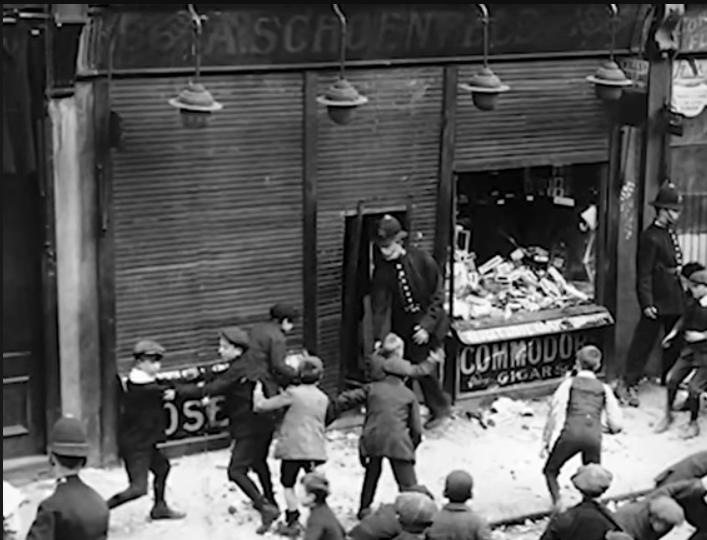
'Spy Fever' spread. Popular fiction like The Riddle of the Sands (1903) fueled the 'German Menace'. This all culminated with the German invasion of Belgium and Wold War I (1914). This resulted in the internment/deportation of Germans, forced name changes, and lasting suspicion that shaped British war-time identity. Of course the royal family was involved--they were Britain's most prominent German. British propaganda called the Germans 'Huns'. They portrayed Germans as barbaric enemies -- and it was not all imagined. German atrocities were not on the NAZI level, but very real. It created a widely-held anti-German sentiment. After the sinking of the Lusitania (1915), riots targeted German-owned shops and businesses in especially in cities like London and Liverpool. Battlefield casualties and German aerial bombing only intensified anti-German feeling, The government interned over 23,000 men in camps (e.g., Knockaloe) and deported women and children, reducing the German population to 22,254 by 1919 The Royal Family changed their name from Saxe-Coburg-Gotha to Windsor to appear more British (1917). Some members of the Royal Family had German titles. The Titles Deprivation Act authorized the deprivation of British peerages and royal titles from individuals who were designated enemies. The Duke of Cumberland and Teviotdale and Duke of Albany were British princes and dukes by birth, but also held German titles and were officers in the German Army

Navigate the CIH World War I Section:
[Return to the Main English home front page]
[About Us]
[Aftermath]
[Alliances]
[Animals]
[Armistace]
[Biographies]
[Causes]
[Campaigns]
[Casualties]
[Children]
[Countries]
[Declaration of war]
[Deciding factors]
-------[Diplomacy]
[Economics]
-------[Geo-political crisis]
[Home front]
[Intelligence]
[Military forces]
[Neutrality]
[Pacifism]
[People]
[Peace treaties]
[Propaganda]
[POWs]
[Russian Revolution]
[Terrorism]
[Trench warfare]
------[Technology]
[Weaponry]
[Bibliographies]
[Contributions]
[FAQs]
[Images]
[Links]
[Registration]
[Tools]
[Return to Main World War I page]
[Return to Main war essay page]
[Return to CIH Home page]
Navigate the Historic Boys' Clothing Web chronological pages:
[The 1840s]
[The 1900s]
[The 1930s]
[The 1940s]
[The 1950s]
[The 1960s]
[The 1970s]
[The 1980s]
[The 1990s]