|
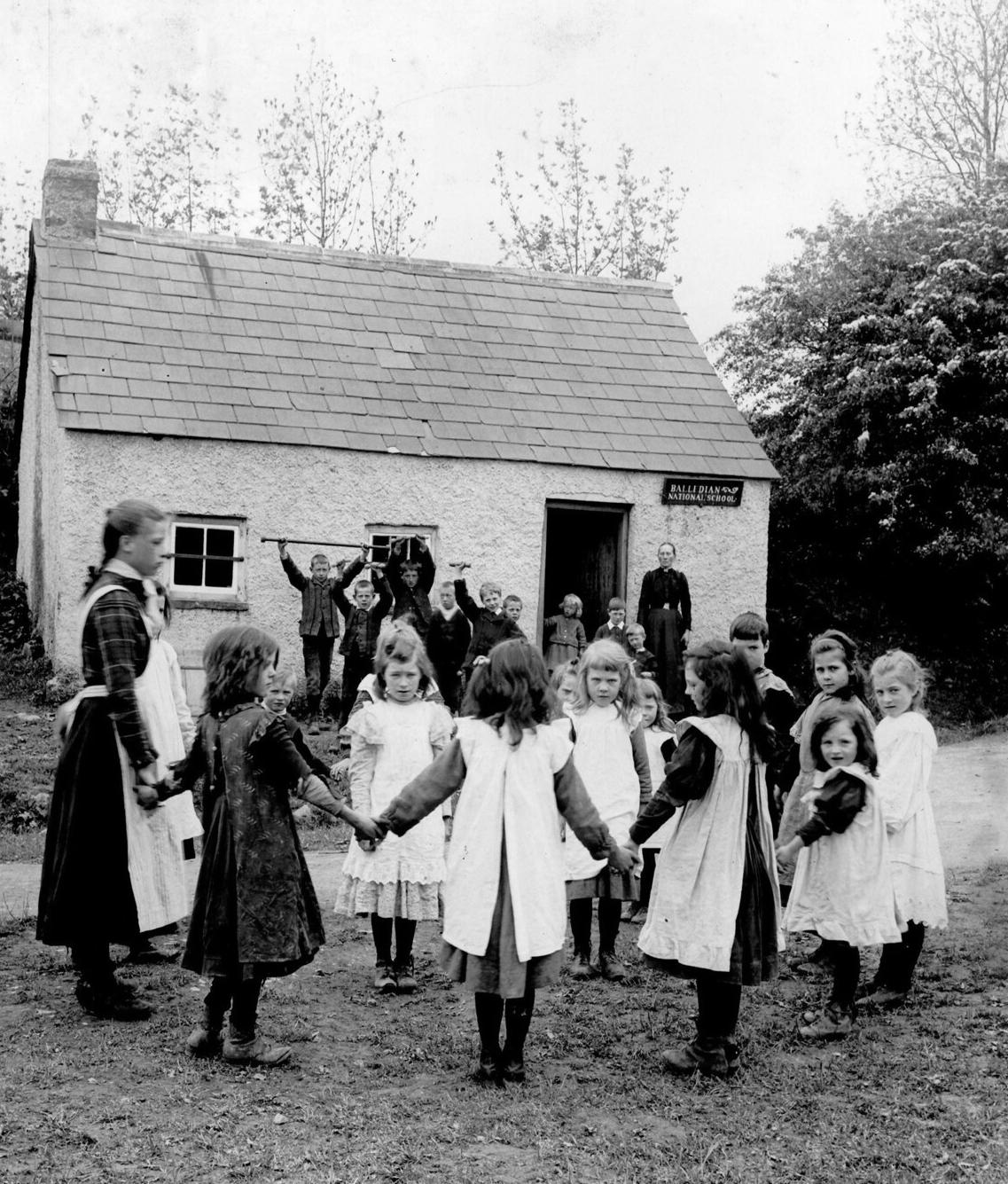
The trends have of course varied overtime. We have very limited information at this time as to how schools fitted into Irish history. As in England, there are a variety of historical schools of various types. The Bardic schools seem to be the earliest formal schools in Ireland and pre-dated the Christian era. Irish monasteries played an important role in early medieval Europe. These monasteries were known for their learning and must have had schools, but we have no information about them at this time. After the Reformation Schools became an issue between the English Protestants and native born Irish Catholics. The English used the schools to teach the Protestant faith. Irish nationalists attempted to perpetuate Irish culture through Hedge Schools. The illegal Hedge Schools which provided an Irish view of history, Gaelic language instruction, and Catholicism. Britain lagged behind many other countries in providing free public schools for children. This did not occur until the late 19th century when so-called National Schools were established. We are not sure about the curriculum in these schools. We do not know how religion was handled and who was allowed to teach in these schools. Were all the teachers Protestants? Nor do we know how they handled historical issues. Nor do we know when Catholics were allowed to found schools. We do know that the Christian Brothers played an important role in early Catholic schools. We do not know, however, to what extent the British authorities monitored the curriculum. Many of the school wear fashions are essentially English fashions and reflect trends in comparable schools. Whilst the private fee paying and voluntary schools were operated in the past by the relevant religious community, more recently they have been run by a board of management. They run on a government grant per pupil and funding either in fees or through small contributions from parents. Maintenance and construction cost for the voluntary secondary schools are funded by the state. The vocational, community and compressive secondary schools get all funding from the state. There are a few private secondary schools which cater for boarders, in some instances these do not have any day students. Whilst the private fee paying and voluntary schools were operated in the past by the relevant religious community, more recently they have been run by a board of management. They run on a government grant per pupil and funding either in fees or through small contributions from parents. Maintenance and construction cost for the voluntary secondary schools are funded by the state. The vocational, community and compressive secondary schools get all funding from the state. There are a few private secondary schools which cater for boarders, in some instances these do not have any day students. Many of the school wear fashions are essentially English fashions and reflect trends in comparable schools.
Our information on historic types of schools is still quite limited. During the centuries of English rule, the Irish were suppressed and their land taken away. Education in Ireland was affected by English efforts to restrict the Catholic Church and deny Catholics civil rights. Thus hedge schools sprang up to provide Catholic education, the Irish language, and promote Irish nationalism. Efforts to provide free public education began in the early-19th century. A major step was the National Schools (1831). As in England, there are a variety of historical schools of various types. The British founded National Schools (19th century). The Christian Brothers were active in Ireland. We are not sure what restrictions the English placed on Catholic education in the 19th Century. The major issue was that there was no funding for Catholic schools even though most Irish were Catholic. Ireland was technically made one with England, Scotland and Wales -- in the United Kingdom of Great Britain and Ireland (1800). In some ways, this was a good thing for Ireland, as it led to electoral reform, land reform, and the disestablishment of the Church of Ireland and its right to tax the whole population. But the colonial relationship remained, and as freedoms grew without real equality with England and the English, so did Irish nationalism grow. The Potato Famine (1840s) made independence inevitable.
The Bardic era was a well established tradition developed during Druidic times. There is little actual evidence to substantiate that actual schools existed during the Drudic period of antiquity. They may have, but but the actual record to substantiate their existence and when they were founded is limited. One rare piece of evidence is that Julius Caesar reports large schools run by druids for the youth of Celtic Gaul (first century BC). We know next to nothing about the education of poets and other men of learning in early Ireland during antiquity or the early- medieval era. The status of bard over time became an inherited role that became the preserve of individual families that were particularly successful For several generations the Bardic tradition continued. Over time, bardic schools appeared. Many Scholars believe that the formal bardic schools may have developed during the Christian era with the development of monastic schools, although there is no definitive evidence that they did not exist during Drudic times and unknown antiquity. There just is so little evidence that any definitive statement is impossible. Much of the information available comes from the late-middle ages. The Ó hUigínns originated in Leyney, Co. Sligo. They were one of Ireland's leading bardic families. They founded schools in a number of areas (15th century). They may have been active even earlier. They operated the Milltown’s Bardic School. Apparently this family role dos not mean strictly blood relatives.
Ireland was Christianized by St. Patrick and others (5th century). The Irish Church would play an important role in the re-Christianization of England. Monasteries were becoming important (6th century). Ireland had one of the most important monastic movements in Europe and became a rare center of learning and scholarship during what is referred to as the Dark Ages preserving many classical works that otherwise would have been lost. Patrick and others founded monasteries, but the Great Monastic Movement began (6th century). Monasteries needed schools to function. Choristers were an important part of religious services, but literacy was important to read the Bible and for the long-term functioning of the monastery. Monasteries were not just religious institutions, they were important economic units. Thus math was also important. Thus the monks taught young acolytes preparing for a life in the church. This led led to the establishment of monastic schools. Schools and colleges were founded throughout Ireland. Virtually every important monastery established a school. Some were small, but there were a number of substantial schools with large numbers of students. While these schools were founded for acolytes preparing for a life in the Church, over time they attracted students with mire secular orientation as well. There are records for some if these schools. Each of the three primary Church fathers after Patrick (St. Finnen in Clonard, St. Comgall in Bangor, and St. Brendan in Clonfert) oversaw schools of 3,000, which must have meant acolytes as well a individuals with a secular orientation.
The first form of public Public education began with diocesan schools. A plan to launch The first state-funded schools began with the the Church of Ireland diocesan schools (1539). They operated mostly in the towns of the English controlled Pale, meaning primarily Dublin. . The ongoing Reformation in England significantly impacted diocesan schools but primarily after 1695. One author writes, "The disruption of the educational work of the Church in Ireland, through the religious innovations introduced during the reigns of Henry VIII and his daughter Elizabeth I, was more in evidence in Dublin than elsewhere in this island. Beyond the Pale, the centuries old bardic schools, unconnected as they were with the monastic schools, continued, till the coming of Oliver Cromwell, their traditional teaching of Irish history, law, language and literature, together with Greek and Latin—the language of European scholarship." 【Quane, p. 26.】 This effort was fundamentally altered by the Education Act of 1695 which prohibited Catholics from running Catholic schools in Ireland or seeking a Catholic education abroad. The initial impact was the creation of hedge schools. The 1695 prohibition was repealed by the Roman Catholic Relief Act of 1782. When eventually when Catholic churches were allowed to open schools the initial impact was limited. Ireland was a very poor country. And the Irish Church without Government funding did not have the resources for a massive system of public education. This is why so many Irish immigrants to America driven by Potato Famine were illiterate (1840s). Literacy from Catholic countries was generally higher than from Protestant countries, but this was especially high among the Irish. As a result of the limited availability of schools, the hedge schools continued to function. Nor could the Catholic peasantry afford to educate many children even if there was no tuition. Diocesan schools became very important and are the basis for Catholic schools in Ireland today, what Americans call parochial schools.
Irish Nationalists founded hedge schools to perpetuate the Irish language and culture and to provide an Irish view of history. The Hedge Schools were in fact illegal. They are called Hedge Schools because they were held in the country side, sometimes in the open air in places like hedges hidden away from prying English eyes. Hedge Schools were founded after the English implemented laws prohibiting instruction in the Roman Catholic tradition. Not only was Catholicism banned, but the legally authorized schools had religious classes designed to convert the children to Protestantism (Anglicanism) of the Church of Ireland. However not all Irish children attended these schools. While there were usually no actual buildings, teaching often took place in homes. Teachers were paid small sums and often given room and board. This meant that for the most part only children whose parents could afford to pay attended the classes. Without buildings there could be very little teaching material such as books. Teaching thus was mostly oral. Once legalized, many of the hedge schools They became low-cost private schools.
The Christian Brothers are a Roman Catholic order which concentrates on education. Once the ban of Catholic schooling was lifted the creation of Catholic schools became possible. Ireland was, however, very poor and financing education was a serious problem. Edmund Rice was a well-to-do Waterford merchant who pursued a profitable career in business. Tragically his life was upset. A terrible accident occurred in which his wife was killed and his daughter disabled and suffering learning difficulties. The bereaved Rice decided to commit himself to prepare young men fir a life of prayers and teaching poor children who could not afford an education, Rice established his first in Waterford (1802). In order to get the first school up and running in 1802, Edmund Rice had to get a license to establish the school from a local Church of Ireland bishop!. Seven of the staff including Edmund Rice took religious vows under the authority of Bishop Power of Waterford (1808). Observing the success of Nano Nagle's Presentation Sisters, Rice called the order the Presentation Brothers. They were the first congregation of men to be founded in Ireland and one of the very few founded by a layman. The order worked with the 'quay boys' of Waterford. Rice and his brothers' taught, clothed, and fed the boys. Other bishops in Ireland sent young men to Waterford to be prepared prepared for a religious life of service through teaching poor children. Thus the Presentation Brothers, as they were called then spread throughout Ireland. But at this point Rice lost control. The men he prepared fell under the control of the bishops in each diocese. And this made it difficult to move teachers from one school to another as needed. As a result, Rice appealed to Pope Pius VII to make his order a a pontifical congregation with a Superior General. The Pope granted this (1820). The Pope's grant ordered that the members were to be bound by vows of obedience, chastity, poverty, and perseverance. They were to provide free instruction both religious and literary, of male children, especially the poor. The heads of houses were to elect a Superior General. Rice held this office (1822 -38). Finally Rice was able to move brothers across diocesan boundaries as he saw fit. 【Normoyle, pp. 45-50.】
Until National Schools were established, Irish families had to pay school fees. One study estimates that there were 11,000 schools in Ireland with a total of about 500,000 children attending them (1820s). Most were hedge schools or various types of paying schools. The Kildare Place Society sought to provide free education foe poor children. They received Government grants and some charitable donations. One source estimates that they supported over 1,600 schools caring for some 140,000 children (1831). The Kildare Place Society was also known as The Society for the Promotion of the Education of the Poor in Ireland They had offices and a model school in Kildare Place in Dublin. The Society not only helped finance schools, but trained teachers. It also produced school textbooks.
Before the establishment of National Schools, religious groups played an important part in education, although the Government restricted the role of the Catholic Church. Secondary schools were all private schools. Many had attached primary schools, but did not receive state funding. Hedge schools provided informal Catholic instruction. All of Ireland was part of Britain in the 19th century. And Britain was behind Germany and America in providing free public education. This was the case not only in Ireland, but in England as well. The Kildare Society helped support schools for the poor.
The Government established National Schools (1831). National School has the same meaning as in England, a primary school that was financed directly by the British Government, but administered jointly by the Government, a patron body, and local representatives. The purpose of the National Schools was to 'unite in one system children of different creeds'. This meant to promote British not Irish national spirit. Ireland at the time was mostly Catholic, with the exception of the north, Irish, but governed largely by Protestants. In the years before the Potato Famine there was still some possibility of a permanent relationship with Britain. The National Board was instructed 'to look with peculiar favour' on applicants for aid for schools jointly managed by Roman Catholics and Protestants. Most of of the early National Schools schools were jointly managed. The main Christian churches demanded that Government authorize aid to be given to schools being management by individual churches. 【Akenson】 As a result in only about two decades, a mere 4 percent of national schools were still under mixed management. Although the Irish Free State would not be established until after world War I, the tragedy of the Potato Famine mean that Irish independence was inevitable and the separation of Catholics and Protestants in the schools was a early step in that direction. The Irish Question and Home Rule became one of the most contentious issue faced by the British Parliament. There were other forms of primary school. The Department of Education and Skills managed the National Schools, including important policies like curriculum and teacher salaries and school conditions. Many less important policies were left to the individual school headmaster or the local school board. The clergy, was often involved as reprentative of the patron, through a local board of management. Most primary schools in Ireland today still fall into this category. We do not think school uniforms were required at these schools.
National Schools were primary schools catering for the education of per-teenage children. Secondary schools (for teenagers) were all private schools. Some religious run secondary schools had attached primary schools (for pre-teens), but did not receive state funding.
There are three types of schools in modern Ireland, state (national primary and vocational/technical schools, private schools (often run by Catholic religious orders, but also some with a Church of Ireland ethos) which charge fees, and Voluntary schools (often run by Catholic religious orders, but equally with some with a Church of Ireland or other ethos) -- kind of a cross between private schools and state schools (this is a rather strange explanation – if here you are referring to the post 1967 free secondary schools, then a better worded description is that), these schools were established out of schools that were previously fee funded before 1967, but which subsequently received state funding when they entered the free secondary school education scheme post 1967. Since the 1970’s a number of community schools and comprehensive schools have been established. There are many similarities among these schools, but also some notable differ. A major step in Ireland's modern education development was the introduction of free secondary school education (1967). Up to that date the law required that children up to 14 years of age be sent to school, however the state only funded national schools, once a child had attained the 'primary certificate' formally ending national school education, parents had to pay for the further education of their children up to the age of 14 years. After 1967 the law was changed requiring that children attend school up to 16 years of age. There are many similarities among these schools, but also some notable differences. The trends have of course varied overtime. Many of the school wear fashions are essentially English fashions and reflect trends in comparable schools. The Catholic schools are run by a board of management. They run on a government grant per pupil and funding from parents. The Public secondary schools are state run they get all funding from the state. The private secondary schools are mostly boarding schools. They are primarily supported by school fees, but do get some grants from the government but not much.
Akenson, D.H. The Irish Education Experiment: The National System of Education in Ireland in the Nineteenth Century (Routledge and Kegan Paul: London, 1970).
Normoyle, M.C. A Tree is Planted: The Life and Times of Edmund Rice. (Congregation of Christian Brothers: 1976).
Quane, Michasel. "The Diocesan Schools -— 1570-1870," Journal of the Cork Historical and Archaeological Society (1961) Vol. 66, No. 203, pp. 26-50.

Related Chronolgy Pages in the Boys' Historical Web Site
[Main Chronology Page]
[The 1900s]
[The 1910s]
[The 1920s]
[The 1930s]
Navigate the Relate Boys Historical Clothing Style Pages
[Main country page]
[Long pants suits]
[Short pants suits]
[Lederhosen]
[Kneesocks]
[Eton suits]
[Jacket and trousers]
[Blazer]
[School sandals]
Navigate the Boys' Historical Clothing Web Page
[About Us]
[Activities]
[Chronology]
[Clothing styles]
[Countries]
[Debate]
[Economics]
[Garment]
[Gender]
[Hair]
[History]
[Home trends]
[Literary characters]
[School types]
[Significance]
[Transport and travel
[Uniform regulations]
[Year level]
[Other topics]
[Images]
[Links]
[Registration]
[Tools]
[Return to the Historic Boys' School Home]