|
Boys throughout history have worked. America's history is relatively short, but since the founding of America boys have labored at their father's side and then done apprenticeships. Boys have been involved in a wide range of labor. Boys have traditionally learned various crafts. As American industrialized, children were heavily involved in industry. Many boys even at the turn of the 20th century had to work rather than go to school. Gender differences existed in the jobs open to children. There were also racial differences. Only boys woked in mines, but both boys and girls worked in factories, especially textile mills. Boys in cities earned money shining shoes. Other sold newspapers and were commonly called "newsies". Boys were involved in major industries, both mines and factories. A peculiarly America work area was pin spotting in bowling allies.
Boys were heavily involved in agriculture. American was primarily an agricultural country in the early-19th century and most Americans lived on farms. The modern school summer vacation is primarily an artifact of the need to have the children on the farm during the summer and early fall. Even by the turn-of-the 20th century, about a half of Americans continued to live on farms. Thus large numbers of childrem especially boys were involced in agricultural work. This took many forms. White boys worked on family farms or might get work on on other faems. Abraham Lioncoln's father used to hire him out to neigboring farmers and kept the money. This caused ill-feeling between the two which was never resolved. Blasck boys worked as slaves on plantations from an early age. (Not all slaves worked on plantations and other farms, but the great mnajority did.) After the Civil War, nany Black and White families took up share cropping. Before World war II, agricultural work was a major area in which children worked. For some it was a way of wearing pocket money. Others had to work to help support the family. Early child labor laws commonly exepted farm labor. Much of the 19th century agricultural work performed by children is unrecorded. We do see many examples after the turn-of-the 20th century. We see children, especially the boys, involved in a wide range of agricultural activities, especially ast hasrvest time. I\Unlike indiustrial labor, farm labor continued to be an area which ffected childrn, especially migrant worker families.
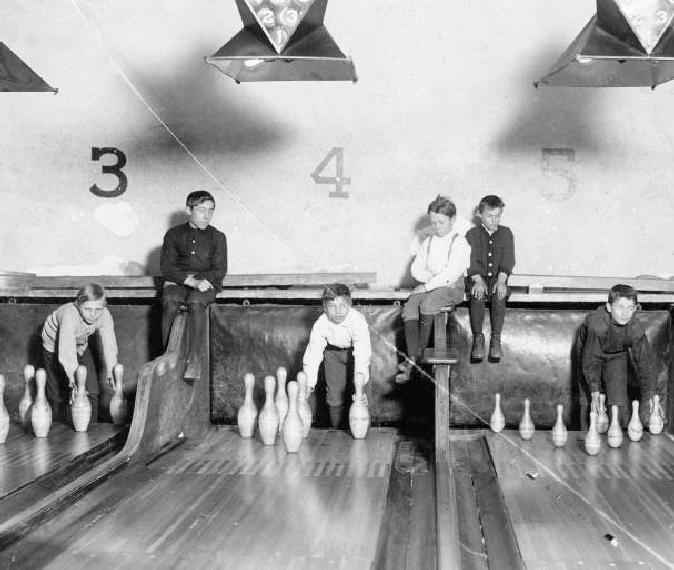
A peculiarly America work area was pin spotting in bowling allies. The photographer, Lewis Hine noted: "Photo of boys working in Arcade Bowling Alley, Trenton, New Jersey. Photo taken late at night. The boys work until midnight and later. I found practically no small boys selling late in the evening and several persons said it was not done except in baseball season." The photograph was taken December 1909.
We do not have a lot of information about golf caddies. Boys commonly caddied for golfers. This was mostly at country clubs. There may have been some municipal or commercial golf courses, but I think most were maintained by country clubs. I'm not sure just abougt boys were recruited to work as caddies. We tghink this may have been more of a part-time job than working in a mine, but here we are not sure, especially in the early 20th century. We do know that it was a part-time job after child labor laws were enacted. Nor are we sure how well the boys were paid. We think that tips may have been the principal rewards.
Boys might work as clerks in different kinds of shops and stores. Clerk as a vocational title commonly refers to a white-collar worker administrative position responsible for a variety of record keeping. Here we are talking about another meaning, individuals working in stores involved in various sales tasks. This almost always was a position for adult men. Clerking was very important in the 19th century and first half of the 20th century. Self-serve stores were not very common until after World war II. As a result, lsrge numbers of people were employed in stores, including gricery stores as clerks. Boys might get involved in very small stores, often country stores, where there were no individuals just working as ckerks. A boy might do all kinds of chores like sweeping up, stocking merchandise, and helping customers with packages. Their duties might include clerking as neeed, such as when the owner was absent or busy with other customers. This was less likely to be the case in city stores, especilly large stores such as department stores. But here there were jobs that might lead to a clerk position such as cash boys. Large retail stores might use boys (never girls) as a kind of cash messenger. He would carry the money the salesmen received from customers to a central cashier, and returns the proper change. We are not entirely sure how this worked. Perhaps the clerks were not entirely trusted with money. Or perhaps the cash registers were too expensive to have at each counter.
Both boys and girls worked in factories, especially textile mills.
Carrying messages was a common job for boys. Only boys worked as messengers, we do not see girls. We do not know anything about messenger boys in the 17th and 18th centuries. Messenger boys become quite importantin tghe 19th century. We do not have much information on the early-19th century, but with invention of photography we have more information. And technological advances changed the job of being a messenger boy. Boys were involved in the famed Pony Express, because light weight allowed the horses to go faster. The Pony Express was put out of business by Western Union and the telegram. Messenger boys were needed to deliver the telegrams to offices and homes. This continued until telegrams were finally displaced by new technology. Surprisingly, the telephone created the need for even more messengers. This was because for many years, only a few families had telephones. It even took a while for the White House to get one. Thus people would call the central exchange and leave a message to be delivered by the Bell Telephone messengers.
The Industrial Revolution began with textile mills in Edgland duringbthe second half of the 19th century. Weaving was essentially a hand powered mechanical process. And the profuction of textiles was a much more important sector of the ecomomy than is the case today. Thus the industrial revolution began at textile mills. The same process played out in America with the American Industrial Revolution which began with textile mills in New England during the early-19th century. We have realitively limited information about child labot at these early mills. Even after photography appeared in the 1840s, textile mills and child labor was not something that early photographers focused on. We mostly see studio portraits. We do begin to see images after the turn-of-the 20th century and those images played an important role in the Progrssive Movement and the effort to address child labor in America. Here Louis Heins was very active in creating an archive of child labor images. We note image which seems to be
the owner's or overseeer's son, but we can not yet confirm that. As northern states began to pass child labor laws and unions became more important, mill owners began moving south to states that did not have child labor laws or weak ones.
We do not have much information about child labor used un mines in general, but the photographic record shows that large numbers of boys were employed in coal mines as late as the ealy 20th century. We note boys working in anthracite coal minds in Pennsylvania, Maryland, and West Virginia. The younger boys by the early 20th century were often employed as breaker boys or tippler boys. By this time it was increasingly being seen as child abuse. Congressioinal investigations were conducted during the Theodore Roosevely administration. Social photographers documented the use of boys. Only boys woked in mines.
The images produced had a powerful impact on the American public. Coal mining was especially dangerous work. And even the jobs assigned to the boys, such as the breaker boys, could cause serious injuries.
Other sold newspapers and were commonly called "newsies". We note boys selling newspapers in American during the late 19th century. We know less about other countries. Selling newspapers was an important source of income for boys from low-income urban families. The boys were called Newsies. Here we see New York newsboys at the Brooklyn Bridge early in the morning before delivering their papers in the city. They wear typical newsboy clothes: outer jackets, knee pants, long black stockings, and flat caps.
Page has a variety of different meanings. Many do not fall within the concept of child labor. European court, American Congressional, and wedding pages are more honorific positions than child labor. The one type of page that is child labor is hotel pages. The term apparently derives from the mideieval pages who attended persons of rank. we are not when hotels began uniforming boys and calling them pages or bellhops to perform tasks at the request of guests. I think probably the 19th century. Working-class boys generally filled these positoons. Ages varied. In the 19th century even pre-teens might be involved. The boys wore uniforms. The practice began in Europe, but was adopted by better Americn hotels. We also see pages on oceanliners. We have found images from the 19th century. The age range shifted American states begannpassing cjild labor laws and compulsory school attndabce laws.
We note a range of portraits in the 19th century of children, mostly boys in fanciful outfits. These appear to be boys involved in performamve arts, mostly acrobatics. They would hasve performed in circuses or on the stage. I believe these woyld have been mostly family roteins, but do not know much about it. I'm also not etirely sure about the purpose of the portraits. Some may have been family keeposakes, but they also may have been a form of publicity as well. Theu also may have been sold as people at the time often added portraits of famous people and actotrrs to albums and scrapbooks. Vaudeville was a popular entertainment before the novies began to dominate local stages after World War I. The costumes varied greatly, but almost always included tights.
Sharecropping is an agricultural system which developed in the Southern states during the Civil War. It was a farm tenancy system in which families worked a farm or section of land in return for a share of the crop rather than wages. Sharecropping replaced the plantation system destroyed by the Civil War. The victorious Federal authorities which occupied the South did not seize plantations, but empancipation meant that the owners no longer had a captive laor force. The former planters, even those activly engged in rebellion, for the most part still had their land, but no slaves or money to pay wages. The former slaves on the other hand did not have jobs or land and because they had been denied education, had few options. Sharecropping developed because the former slaves and planters needed each other. The principal crop continued to be cotton. And the planters under the sharecropping system contnued to a large degree to control the lives of the blacks working their land. While the system at first developed to obtain black labor, eventually poor whites also entered the sharecropping system. The system varied, but in many cases all the cropper brouht to the arrangement was his labor. The planter provided the land, but also commonly animals, equipment, seeds and other items. The land owners also commonly advanced credits for the family's living expences until the crop was harvested. After World War II, migration to the North, farm mechinization, education, other employment options, and the Civil Rights movement brought the system to an end.
Boys in cities earned money shining shoes. Boys were involved in major industries, both mines and factories.

Navigate the Children in History Website:
[Return to the Main U.S. child labor page]
[Return to the Main U.S. activities page]
[About Us]
[Introduction]
[Biographies]
[Chronology]
[Climatology]
[Clothing]
[Disease and Health]
[Economics]
[Freedom]
[Geography]
[History]
[Human Nature]
[Ideology]
[Law]
[Nationalism]
[Presidents]
[Religion]
[Royalty]
[Science]
[Social Class]
[Bibliographies]
[Contributions]
[FAQs]
[Glossaries]
[Images]
[Links]
[Registration]
[Tools]
[Children in History Home]