|
The Roman conquest of Brition ws characterically brutal. It took longer than Caesar's conquest of Gaul. But the impact on Celtic Britain began even while the conquest was underway. Eventually Roman armies subjugated the British Celts and the era of Roman Britain began. The Romans called their new province Britannia. Some of the luxuries of the Roman Empire had reached Britain even before the conquest. There were cultural and economic links with the Celtic tribes in Gaul and these cotavts continued after the Roman conquest. The Romans brought with them many new technologies in agriculture, industry and architecture. One of the most significant imprint on Celtic Britain was urban life--a hallmark of Roman civilization. And with urbanization came a variety of luxuries. These luxuries were coveted by the Britanii. The British army built forts throughout Briton. Some were temporary emplacements. Others forts became the beginning of the major cities of Roman Britain. Almost from the beginning the Romans began constructing roads connecting these forts. The salaries paid the soldiers from an early period began attracting Celts willing to perform services of value to the soldiers and Roman officials. This included artisans, bakers, laborors, launderers, smiths, and many others. These people at first settled outside the Roman forts. The forts and Celtic selllements developed into cities. These Celts over time became Romanized to varying degrees. The Romans established definiticely that Briton was an island when Governor Gnaeus Julius Agricola dispatched a naval expedition to explore the northern reaches of the island (80s AD). Caesar left an account of his expeditions. And there are accounts of the conquest, but unfortunately very few written records of Roman Britannia have been found either in Briton or Rome itself. This probably testifies to the titality of the Anglo-Saxon assault on Roman Briton. Most of what we now know comes from archaeological and epigraphic work. With the withdrawl of the Legions (407 AD), Roman Briton was soon destroyed by Anglo-Saxon invaders. Some of the British retreated west, but the survivors seem for Celtic than Roman.
Very little is known about the early inhabitants of the British Isles, although archeological work has unearthened some fascinating informatin in recent years. The Celtic peoples appear to have begun migrating to Britain at about the tme Rome began to emerge in Italy (about 600 BC). There is some evidence that the Celts integrated the existing population. The Celts were a pre-literate society. Thus there are no written records. In fact, the first written accounts of Celtic Britain are provided by Julius Ceasar during his military expeditions (55-54 BC). Ceasar learned a good bit about the Britons and Celts while in Britain. The British war techhnology was more advanced than he anticipated. He was surprised to find the Britons had war chariots. He was also astonished to find that the Britons would rub their bodies with woad before going into battle. He picked up usefil information about the Gauls. King Commius of the Atrebates, who founded a dynasty in modern Sussex and Hampshire, was a source of information. Celtic legend was that he Druids, Celtic priests, had originally come from Britain and not Gaul itself. Caesar's assessment was that the Britons, much like the Gauls, were a quarrelsome tribal society. Even with the Roman Army in Britain, the various tribes seem primarily concerned with long standing tribal differences. Cassivellaunus appears to have been the most powerful of the Celtic tribes in southern Britain. Mandubracius, chief of the Trinovantes, north of the Thames in East Anglia, was attacked by Cassivellaunus and sought Ceasar's protection. Ceasar did not fully understsand the tribal relations, in particular whether the warring Britons were separate tribes or sub-groups of the same tribe. Very little is known of the Britons at this time because there are not British written records. One of the few sources of information or coins minted by the various British tribes. Many of these coins had the names of the tribal chiefs. Archeologists have found coins from the Dobunni (Gloucestershire), Durotriges (Dorset), Iceni (East Anglia), and Corieltauvi (Leicestershire, Lincolnshire).
Julius Caesar while campaigning in Gaul launched two expeditions accross the Channel (55 and 54 BC). Ceasar decided against a major military expedition. It is not enirely sure why. His focus at the time was on Gaul. Presumably he concluded the conquest would not justify the expense, especially when the situation in Gaul itself was not yet settled. Ceaser did, however, report on these explots to his adoring public back in Rome. The subsequent Roman invasion came a century later. Roman attempted to bring Britain within the Empire through diplomatic initiatives. By the time Rome initiated the conquest of Britain, Gaul had been firmly Romanized. Rome's new emperor, Claudius (43 AD), athorized The invasion. It was Claudiu's first foreign expedition. Successful military expeditions were important in establishing a prestigious reputation. Claudius assigned Aulus Plautius to carry out the invasion. The Britons were a Celtic people, related to the tribes of Gaul which Ceasar had conquered. The British proved to be a substantial military challenge, taking several decades to accomplish. Eventually Roman armies subjugated the British Celts and the era of Roman Britain began. The Roman conquest of Brition ws characterically brutal. It took longer than Caesar's conquest of Gaul.
There are no written records of Scotland until the arrival of the Romans (1st century AD). Scotland in antiquity was known by the Romans as Caledoinia. The Romans after subduing what is now England and Wales pushed north. Roman General Gnaeus Julius Agricola invaded Caledonia in the late 1st century AD and drove north ofthe Firth of Forthto an area near modern Aberdeen. Here he defeated the Caledonii (94), but was then recalled leaving the Caledonii and related northern tribes to recover. The Caledonii and other rebelious Britons pushed north by the Romans appeared to have successfully reoccupied the area between the Firth of Fourth and the Clyde. It is unclear if the rebelious tribes military victories or the Romans concluded that the cost of the militry campign was not worth the territory to be gained. This is interesting because a later generation of Scotts--the Scotts-Irish played a critical role in stopping anoher great imperial power--the British.
The Roman conquest of Britain is often depicted as a footnote in the history of the Roman Empire (1st century AD). It was located on the outerraches of the known world, but it became important to the Roman economy. Britain became an integral part of the Empire, if more troublesome than most. The mineral wealth of Britain and its agricultural productivity made it a very valuable privince. One author insists that Britain became vital to the prosperity of the Empire. [Morehead and Stuttard] This was especially true after the Empire was split between East and West (284 AD). And Rome's evetual withdrawl from Britain was a clear indicator that the Empire was collapsing.
The impact on Celtic Britain began even while the conquest was underway. Eventually Roman armies subjugated the British Celts and the era of Roman Britain began. The Romans called their new province Britannia. Some of the luxuries of the Roman Empire had reached Britain even before the conquest. There were cultural and economic links with the Celtic tribes in Gaul and these cotavts continued after the Roman conquest. The Romans brought with them many new technologies in agriculture, industry and architecture. One of the most significant imprint on Celtic Britain was urban life--a hallmark of Roman civilization. And with urbanization came a variety of luxuries. These luxuries were coveted by the Britanii.
There were no cities in Britain before the arrival of the British. The Celts hadbegun to form larger settlements that were developing in to cities in Gaul at the time of the Roman coquest (1st century BC). This process was at a more limited phase in Britin. The Celts were farmers. They intriduced the iron plough to farming which increased yiels and would have eventually led to the same irbanization that had begin in Gaul as the Rpmns arrived. In Britania we see some larger villages beginning to aear but there were not yet much in the way of towns, let alone cities. What we do see in Celtic Britania was a substantial number of hill forts. Forts may be an exageration. They were basically small ditch and bank combinations built to defend hilltops. Some were so small that they must have been built by single or small group of families. Many larger forts were built. Archeologists are not sure who built these hill forts. Some believe that the ere built by the native Britons to defend themselves from the advancing Celts. Others believe the Celts built them. As they were hill top constructions, they usually had no source of water. This suggests that ghey were not long term settlements. They may have been refuges able to withsnd xa short seige. Many were built over older causewayed camps. The Roman army as they advnced nrthward in Britania, built substantial forts throughout Britain. Some were temporary emplacements. Others forts became the beginning of the major cities of Roman Britain. Most important English citiesbegan as a Roman fort. The forts at places like Londinium have been largely destroyed by urban development over time, although thereare Roman remains in London, including a burried colliseum. The forts that did not become urban centers have proven to be valuable sources of information. One example is the fort at Ribchester. Almost from the beginning the Romans began constructing roads connecting these forts. The salaries paid the soldiers from an early period began attracting Celts willing to perform services of value to the soldiers and Roman officials. This included artisans, bakers, laborors, launderers, smiths, and many others. These people at first settled outside the Roman forts. The forts and Celtic selllements developed into cities. These Celts over time became Romanized to varying degrees.
The Britons conquered by Rome were mostly Celtic tribes speaking Celtic. Thus Roman Britain was aprovince where two languages were spoken, Celtic and Roman. Latin gradually increased in importance, but even after three centuries of Roman rule, it was still primarily an urban tiunge, spoken in the Roman towns like Londinium. The language of the countryside remaine Cektic. Actual details on thextent to which Latin spread are not available, but the fact that Latin did not survive the Anglo-Saxon invasions suggests that it did not spread much beyond the urban areas which constistuted a relatively small part of the population. Even so, some Latin words did enter the Old English (Germanic) tounge of the Anglo-Saxon invaders, before, during and after the conquest of Roman Britain. The Celtic impact on English is much more limited, primarily associated with place names.
The Roman conquest introduced a new peopkle to Celtic Britain. History does not, however, give us a good idea as to just hoiw many Romans emigrated to Britain. Much of the populartion of the cities of Britain were Romans or highly Romanized Celts, but the number and proportions of Romans are difficult to assess from the historical record. On going DNA studies will be able to provide some assessment. Romans not only emigrated to Britain, but many Legionaries who retired are believed to have settled in Britain rather than returning home. Another important question is just who these Romans were. They were not of course just from the city of Rome or even the wider Italian peninsula. They would have included merchants, adminisdtrators, artisans, Legionaires from all over the very extensive Empire. This was especially the case of the Legionaires. Interestingly, African DNA is being found in the several British DNA studies. What is surprising here is that the DNA is showing up from the Roman era and not just recent emigration from Africa and the Caribbean. Some of the Roman Military Soldiers under Emperor Hadrian serving along Hadrians Wall were black Africans. Researchers are not entirely sure if the African DNA is all directly from Africans or from migrating Celtic tribes.
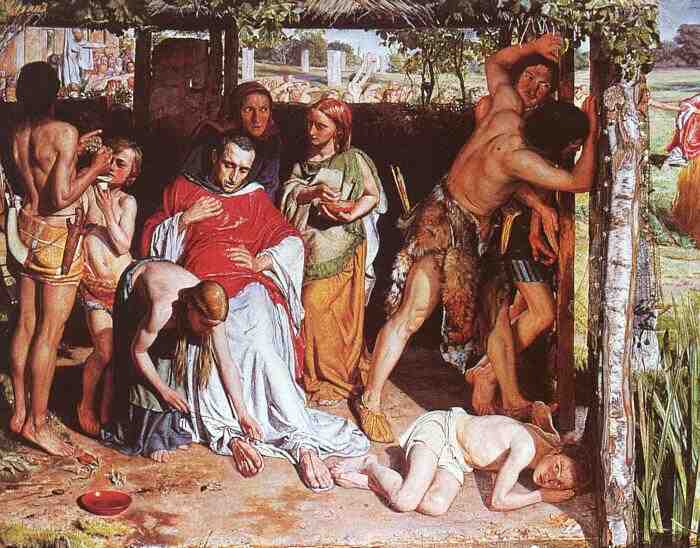
There is very little information available on Christianity in Roman Britain. The Celtic tribes that Rome conquered were a pagan people not yet reached by Christians which develoed from a small Jewish sect within the Roman Empire. Britain, in part because of the Channel was rthe most remote province of the Roman Empire. The Legionaries who conquuered Britain and the early Roman officials wouklld have not been Chrisins. Thus the Romans did not at first bring Christianity to Britain.
The first Christians must have reached Britain subsequently, but there is no indication that there was any early effort to convert the conquered Celtic tribes. As Christians were a percecuted sect, Romans who were Chrristians would have not wanted to draw attention to themselves. A great deal of informtion exists on the development of Christianity within the Empire. We know of very littl documentation specifuically on the province of Britain. The first knoewn Christian martyr in Britain was St. Alban during the reign of Diocletian (284-305). Constantine legalimized Christuanity and it became thestate religion (4thbcentury). Thus Roman Britains largely converted at this time. We have less information on the Celtic tribes, but Romanized Celts presumably converted in large numbers. The hard-pressed Empire withdrew its legions from Britin to concentrate its forces against the Visigoths (407). TheRomans never returned in force. It is believed tat despite the decline of Roman military and political authority, Christianity continued to grow. There is, however, very little actual documentation. A Celtic Church independent of Rome developed in neigboring Ireland. Very little is known about the Chtistian Church in Britain itself, but it is clear that it was well established. Many historians credit St. Augustine as introducing Christianity to Britain. This is incoreect. St. Augustine can more correctly be cresited with introducing the invading Anglo-Saxons to Christianity (597). In reality, Augustine who reopresented the Roman Church found a well established Christian church that had been widely adopted by Romanized Celtic people of Britain. The two churches were actually in competition. One medieval source explains, "When Augustine came to Britain he found in the province of the Angles seven bishoprics and archbishoprics, all flilled with the most devout prelates and also a great number of abbeys." [Geoffrey of Monmouth]
The Romans established definiticely that Briton was an island when Governor Gnaeus Julius Agricola dispatched a naval expedition to explore the northern reaches of the island (80s AD).
There is not much information available on the clothing worn in Roman Britains. The Romans who came to Britain would have worn Roman clothes. There is not a lot of information available specifically about Roman clothing in Britin. Messages have been found touching on clothing. And a few actual items have been found such as sandals. One fnd including women's leather �bikini-style under pants. The Celts in Britain as in France were gradually Romanized. It is likely that the Romanized Celts living in the towns that developed around Roman military outposts dressed basically like the Romans. This nean that boys wore a tunic down to their knees and a cloak when the wether turned cool. Girls also wore wore tunics, but with a woolen belt tied around their waist. Roman children wore a special charm around their neck which was called a bulla. These charms were given to them obnly a few days after their birth. At first the richer Celts in the cities who were granted Roman citizenship began to wear togas like the Romans. This gradually spread throuhout Celtic Britain. As the Roman occupation continued and the Celts became increasingly Romanized, more people adopted Roman clohing. Many men also began to shave and wear their hair short like the Romans. The poor and and more isolate rural Celts continued to wear the Celtic style of clothes such as woollen tunic and trousers. It appears that by the time that the Roman Legions left Britaain that the Celtic tribes had been extensively Romanized and adopted Roman styled-clothing.
Caesar left an account of his expeditions and the Celtic tribes he encounteed. And there are accounts of the conquest, but unfortunately very few written records of Roman Britannia have been found either in Britain or Rome itself. This probably testifies to the titality of the Anglo-Saxon assault on Roman Briton. Most of what we now know comes from archaeological and epigraphic work.
Rome for many years maintained a avery substantial military presence on Britain to control the restive Celtiv population and to try to defeat the Caledoni in the extreme north. At the time of the Boudiccan Rebellion , there were four standing legions in Britain (61). But even after the Celtic tribes were pacified there was a major presenece. Rome throughout the second century maintained three legions on Britain. This was necessary because of the constant threat from northern tribes which gradually united as the Pictts and the Irish to the west. Archaeological evidence from the late-4th century show signs of decay. This was not just observable in Britain, but other parts of the Empire as well. Urbanization had ceased to expand and had become observably less intense. There are several indicators. Pottery shards are found in declining numbers. Rome began withdrawing its Legions from Britain at the end of the 4th century. Coins become less common and very rare after 402. Constantine III was declared Emperor by his troops (407). He crossed the Channel with the most of the remaining units of the British garrison in an attempt to usurp the crown (407). This was effectively the end of Roman Britain. The Romans who remained in Britain had to organiz local defences against first the Pictts and eventually the Anglo-Saxon invaders without the well trined and drilled Legions. The Emperor Honorius in response to pleas from the Romans in Britain informed them thst that the cities of Britain would have to look after their own defences (410). The Romanized Britains attemptd to organize an east coast defences. The Count of the Saxon Shore spearheaded the effort. A fleet had been organized to control the Channel and the North Sea, but resources were insufficent for the task.
Many historic accounts focus on the Goths and other Germanuc tribes over running the Wesern Empire. A more limited, but historically important Germanic invasion took place in the north, the invasion of Roman Britain. The invasions took place after the last Roman garison withdrew from Britain (407 AD) abd was largely accomplished by the time St Augustine arrived (end of the 6th century). The Germaniv invasions significantly changed the democraphic and ethnic pattern of Britain, especially what we now call England. The make up of the population, language, political structure, and other institutions were fundamentally changed. The Germanic invaders replaced the Romanized Celts who might be called the British. Historians have differed over the interactions between Germanic invaders and British. The disappearance of Latin and Celtic suggested that the Germanic invaders did not absorbe the Celts, but rather conducted a war of extinction. Modern DNA studies tends to confirm this. Not only did Germanic dialects (which evolved into Old English) replace Latin and Celtic, but loose knit and often feuding hereditary kingships replaced the more centrally governed system of provinces left by the Romans. [Myres] Urban life desintegrated and the Roman cities were largely abandoned. The problem for historians is that the victors were the Germanic tribes or Anglo-Saxons who were not literate at the time and thus there are no surviving contemprary written accounts. The earliest accounts of the conquest come several centuries later. Available sources suggest that the British (Roman-Celtic) authorities after the departure of the Legions had increasing duifficulty resisting the depredations of the northern tribes. They apparently hired a Germanic warlord and his men as mercenaries (mid-5th century). Relations soon desintegrated and the Germans not only revolted, but invited kinsmen to join them. The Germanic tribes gradually gained controll over much of low-land Britain. The stuggle of the Romanized Celts and Germanic tribes appears to to be the genesis of the Arthurian legend. While the Britons apprarentlt held out for some time, they were eventually driven into the mountaneous western areas and survived as the Welsh people. At the time Saint Augustine arrived, the Anglo Saxons controlled most of southern Engkland and were expanding north and west (late 6th century). It is not all together clear who the Germanic invaders were. The Britons tended to call them Saxons. The name England of course comes from the Anglii, another Germanic tribe. The Anglii settlements evolved into the kingdoms of East Anglia, Mercia, and Northumbria. The Saxons settlements appeared to have founded the kingdoms of Sussex, Wessex, and Essex. The Jutes apprear to have predominated in Kent and the Isle of Wight. One poorly understood question is the role of the Frisians in the conquest. The Frisians were a seafarring people abd the Anglii and Saxons had to pass through their territory to reach Briton, yet the Frisians are rarely mentione in the medieval chronicles. Frisian is the the modern language most closely related to the Old English of the Anglo-Saxons.
Geoffrey of Monmouth, Bishop Elect of St Asaph in Wales.
Moorehead, Sam anbd David Stuttard. The Romans who Shaped Britain (2012), 288p.

Navigate the Children in History Website:
[Return to the Main Roman page]
[Return to the Main ancient civilization page]
[Return to the Main British history page]
[Introduction]
[Biographies]
[Chronology]
[Climatology]
[Clothing]
[Disease and Health]
[Economics]
[Geography]
[History]
[Human Nature]
[Law]
[Nationalism]
[Presidents]
[Religion]
[Royalty]
[Science]
[Social Class]
[Bibliographies]
[Contributions]
[FAQs]
[Glossaries]
[Images]
[Links]
[Registration]
[Tools]
[Children in History Home]