
Joseph Walton: The Boy Who Found a Roman Cavalry Helmet (1790s)
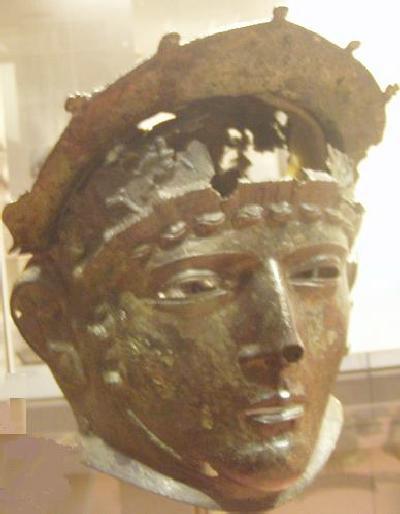
Figure 1.--The Ribchester Horde consists of a bronze cavalry ceremonial helmet, horse brasses, and eye protectors for the horses. The Roman treasure which was found that day are items used by the Roman cavalry in ceremonial pageants. The best cavalry riders would take part. Their horses would be decorated and they would wear the ceremonial helmet, fashioned rather like a thetrical mask. he British Museum says that the one found at Ribchester is the best preserved of its type. Here is the helmet/mask. Put your cursor on the image to see an artistic depictin of how the helmet would have been worn.
|
|
We do nok now a great deal about 13-year old Joseph Walton, except that he loved to fish. His father was a farm labourer.We do know that there was a very hot summer in 1796. Joseph always managed, despite his chores, to get in a spot of fishing every day. Joseph lived in a small Lancashire village called Ribchester. It is very close to the River Ribble. The children had a favourite spot on the river. Here the river bends and flows passed the village church. In AD 100 there had been a Roman Fort at the village of Ribchester. The fort guarded the roads which crossed the River Ribble. Many Roman forsts were locatted at ricer crossing. This is how many important English cities were founded, none the least Londinium. Ribcester had a garrison of about 500 cavalrymen. Rome thought it a very important place. It is written that ‘Ribchester was as rich as any town in Christendom.’ It is no wonder that from the 16th Century onwards Ribchester attracted attention as a place to learn about the Roman occupation of Britain because of the Roman artefacts which were being found there. The local children
were looking for worms to use as bait in their fishing. One of the diggers, as we now know was Joseph.
He suddenly saw something different in the earth. It was red sand. Joseph was intrigued and started to dig into it. Soon he had uncovered several metal objects.
Joseph Walton
We do nok now a great deal about 13-year old Joseph Walton, except that he loved to fish. His father was a farm labourer.We do know that there was a very hot summer in 1796. Joseph always managed, despite his chores, to get in a spot of fishing every day.
Ribchester
Joseph lived in a small Lancashire village called Ribchester. It is very close to the River Ribble. The children had a favourite spot on the river. Here the river bends and flows passed the village church.
Joseph's Find
The children found that fish always seemed to be easy to catch at the spot by the village church. Also that summer there was an archaeological dig looking for Roman artefacts. The dig was near to where the children fished. A group of children went searching for worms. Joseph was with them and they explored the archaeological site because they thought worms would be easy to find in the soft earth. Instead of worms, Joseph found a Roman military helmet that day in 1796. Since then no better example has ever been found. Joseph chanced upon a remarkable discovery. A find worthy of highly skilled archaeologists but in fact it was a discovery made by a young boy of 13. The area of the dig was near to village children’s favourite spot on the river where they did their fishing. Many a summers’ day had been spent fishing and that day in 1796 was no exception. There were children fishing but not many fish were being caught. This may have been because it was a hot sunny day or maybe the children were bored by the activity. What ever the reason, some children moved away from the river and started to play chasing games. A good place to play was soon discovered and this was the excavation site.
They raced each other over to the hollow and slid down the sides. Their joyous laughter could be heard even if they could not been seen. This is the opposite of a parent’s proverb for their children to be seen and not heard. The earth was soft and some of the children started digging in it. They were looking for worms to use as bait in their fishing. One of the diggers, as we now know was Joseph.
He suddenly saw something different in the earth. It was red sand. Joseph was intrigued and started to dig into it. Soon he had uncovered several metal objects.
Roman Fort
In AD 100 there had been a Roman Fort at the village of Ribchester. The fort guarded the roads which crossed the River Ribble. Many Roman forsts were locatted at ricer crossing. This is how many important English cities were founded, none the least Londinium. Ribcester had a garrison of about 500 cavalrymen. Rome thought it a very important place. It is written that ‘Ribchester was as rich as any town in Christendom.’ It is no wonder that from the 16th Century onwards Ribchester attracted attention as a place to learn about the Roman occupation of Britain because of the Roman artefacts which were being found there.
1796 Dig
By 1796 there had been many excavations and the 1796 dig was the latest one. It was organised by Dr.
Whitaker. He had been in Ribchester for several months. Whitaker had carefully chosen a spot just off
the road, near to the village church, by the bank of the River Ribble. By the summer the site had been dug to a depth of about 2 meters. He had uncovered the remains of a Roman temple. Lots of broken pieces of pottery had been found. These he had carefully put together but in truth the finds were not particularly exciting because better examples of pottery had been previously been discovered.
Purchasing the Items
Joseph called to the other children who were amazed at what he had found. They gathered up
the things and took them home. As they walked home they called to the villagers and showed them the
things that had been found. Joseph’s dad was taken aback by the things which his son had discovered. He
did not know quite what to do. He decided to visit Dr. Whitaker and show him his son’s finds. When he saw these things he must have felt miffed by not being the finder of them. Mr. Townley, the local land owner, purchased these artefacts from Joseph’s dad.
What Joseph found was what Dr. Whitiker was looking for--metal objects. These were bronze objects. They looked like household utensils and ornaments. The most impressive item was what proved to be a bronze calvalry helmet. What had caused the sensation was the bronze military headwear. It was too thin and ornate to be worn in battle. And a calvalry man would have not wanted his vision limited to small eye holes. It was soon discovered that it was a ceremonial helmet. In fact they were more like theatrical masks. (Actors in Greek and Roman plays wore masks.) It seems that in Roman times cavalrymen liked to re-enact their military campaigns at public pageants. To make their role more grandiose they used to wear bronze ceremonial helmets. These were decorated with scenes of battle between cavalry troops and foot soldiers. The Roman cavalry would have looked courageous and brave during these military pageants. Many museums have this type of headgear but the British Museum holds the Ribchester. To-date no finer example has been found than the one 13 year old
Joseph Walton discovered in 1796. The original helmet is in the British Museum. The Roman Museum at Ribchester, Lancashire has the replica. Both are on public display. In the annuals of British Archaeology the find of the century was made by 13 year old Joseph Walton that hot summer so
long ago.
Source
Smith and Short. History of Ribchester (Bemrose and Son. Pub.: London, 1890), pp. 32-35. (Book held in Blackburn Public Library, Lancashire, U.K.)
William Eric Ferguson
HBC

Navigate the Historic Boys' Clothing Web Site:
[Return to the Main English individual experience page]
[Return to the Main Roman British page]
[Introduction]
[Activities]
[Biographies]
[Chronologies]
[Countries]
[Style Index]
[Bibliographies]
[Contributions]
[Frequently Asked Questions]
[Glossary]
[Images]
[Links]
[Registration]
[Tools]
[Boys' Clothing Home]
Navigate the Historic Boys' Clothing Web chronological pages:
[The 1840s]
[The 1850s]
[The 1860s]
[The 1870s]
[The 1880s]
[The 1890s]
[The 1900s]
Navigate the Historic Boys' Clothing Web style pages:
[Dresses]
[Suits]
[Vests]
[Knickers]
[Caps]
[Socks]
[Neckwear]
[Collars]
[Strap shoes]
Created: March 23, 2003
Last updated: March 23, 2003