|
Vests have been widely worn by men and boys since at least the 18th century. The vest was initially part of a suit. Most suits were worn with vests through the late-19th century. By the early 20th century, suits were vest became less common. By the late 20th century only the most formal suits came with vests. The vest was in he 19th century mostly worn with the suit jacket. A new fashion for boys of wearing the vest without the jacket developed in the 1950s. This was primarily a winter fashion. Interestingly in the late 20th century, the vest worn without a suit became a kind of dressy summer fashion.
A vest is largely ornamental sleeveless garment worn either without without a suit jacket. The British refer to the garment as a "waistcoat", the word "vest" meaning an undershirt. Vest is also used to mean an undershirt in the United States, but less commonly. Usually Americans use vest to meant waistcoat. A HBC reader suggests that there differences between a vest and waistcoat (pronounced "weskit"), in that there are lapels on a waistcoat and none on vest. HBC has not yet had time to research this.
The vest or waistcoat was a common part of many 19th century suits, especially in the mid- and late 19th century. (The British use waistcoat as a vest there means an undershirt.) Most fashionable 19th suits had them and they were still very common in the early 20th century.
We are beginning to build a chronology of vests. HBC has noted the vest in the 18th century, I'm not sure just went it first appeared are what garment it may have evolved from. Vests have been widely worn by men and boys since at least the 18th century. The vest was initially part of a suit. Vests were very common with suits in the 19th century. Suits were worn with vests through the late 19th century. There were significant changes in the color of the vests worn as the century progressed. Suits in the early 19th century varied widely. There was still no mass production of clothes, leading to greater variety of styles. Suits and vests were still widely worn in the early 20th century, but after World War I declined in popularity. They were worn with very formal suits, but most boys' suits were two-piece rathr tham three pice by the 195os. The garment has continued into the 21st century, although the popularity has come and wained over time. The modern vest is primarikly a boy;s garment to be worn rather than a suit jacket rather than with it.
|
The vest or waistcoat was a common part of many 19th century suits, especially in themid and late 19th century. (The British use waistcoat as a vest there means an undershirt.) Most fashionable suits had them. There were even common with boys wearing kiltsuit. We have noted them both made in the same material as the suit or in contradting material and colors. The three piece suit as it was called continued to be worn in the 20th century, but by the 1930s it began to be seen as a particularly formal style and was optional. Thus many boys' suits wre made with just the jacket and pants. In the post-World War II era, many mothers decided that a boy just did not need a vest. They are still available for particularly formal occasions, but are rarely worn with a suit. We do note that in the 1970s and 80s, it became fassionable for younger to boys to wrar vests rather than a suit coat for formal occassions.
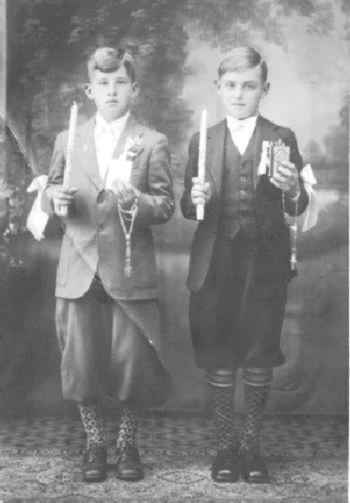
We are not yet sure to what extent vests varied as to the different kinds of suits such as collar buttoning, Eton, Rugby, Norfolk, single and double-breated sack suits, ect. We have maby of these suits archived on HBC and will have to index them here to assess the pooularity of vests with the different suit styles. We have seen vests more commonly worn with some of these suits. We had always assumed that boys wearing suits with jackets that did not have lapels and buttoned at the collar probably wore shirt waits and blouses. We have since noted that vests were worn with suits even when they could not be seen. Some portraitsd, however, are quite rare. We are unsure though how common this was. It is of course much easier to assess the suits worn with vests when you can see the vests
Nor do we know if the type of suit trousers affected the vest. There were even common with boys wearing kiltsuit.
Unlike suit jackets and trousers, vests have remained generally constant over time in the 19th and 20th centuries. The major changes in styling over time has been the number of buttons. At first there were no conventions about buttons and the size of the boy was another factor. Vests were made with front "V" cuts without lapels. This like the cut off the suit allowed a necktie or other neck adornment to show. Vests we have seen in the 20th century had front which were made to match the suit, being made in the same material. The backs were done in a different material, often silk or satin. Other materials might be used with less expensive suits. We are not sure if this was also the case in the 19th century. We note vests with belts at the back so the fit of the vest could be ajusted. We think this was quite common, but again are unsure about the 19th century.
The vest was in he 19th century mostly worn with the suit jacket. A new fashion for boys of wearing the vest without the jacket developed in the 1950s. This was primarily a winter fashion. Some discount stores like K-Mart began selling inexpemnsive trouser and vest sets to provide a dressy out fit for boys. This was a destinctly boys' style. Men did not commonly wear a vest and trouser set. Sometimes they were fancy vests added a bit of a festive air to a holiday celebration. The modern convention is for younger boys to wear a vest for dressing up without a suit jacket. Adults generally wear it with a suit jacket. A three-piece suit jacket commonly has a vest in the same material. Brightly colored vests can be worn for holidays or special occassions. Brightly colored vests were once worn by Eton and other British schoolboys.
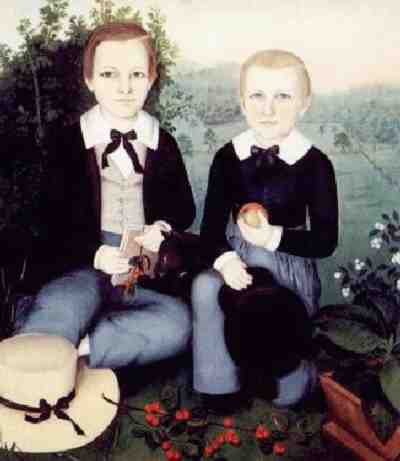
We have noted vests both made in the same material as the suit or in contrasting material and colors. The front of a typical vest is made out of the same material as the suit jacket. The back is commonly made out of satin or some other finished material. It was fashionable in the mid-19th century to make the vests in contasting colors and patterns. We note bright colors and bold [patterns. They might also be made in different materials. An example is an unidntified American boy about 1850. Not all vests were done like that. Even at mid-century we see vests done in the same material as the jacket. A good example is an unidentified American boy about 1850. By the end of the century the more consevative approach of the same material and color became the standard. During the Christmas holiday season, especilly by the mid-20th century, a vest in a festive contrasting color might be worn.
We have not yet acquired enough information about vests to understand trends in very many countries. The vest was a ubiquitous garment worn by men and boys in many different countries. We believe that it was very common throughtout Europe to wears vests in the 19th century. There were country differences. Vests were somewhat less common in southern Europe because it was warmer and probably because of lower income levels. We have begun to build some individual country pages, such as the German vest page. Vests were also common in America. We note an unidentified American boy wearing a colorful plaid vest in 1847. We note another American boy with a plain vest about the same time. We note unidentfied boys wearing vests in short jackets about 1850. By the late-19th century the vests more commonly matched the suit. A good example is Frank Baily about 1915.
Vests were also worn with a range of collars. This of course varies significantly over time. Here we see a boy wearing a vess with a ruffled collar (figure 1).
Vests were not only parts of suits, but were worn on their own without jackets. Until the late 20th-century we mostly see them being worn as part of suits. We can not access how common this was in the 18th century or even in the early-19th century before the advent of photography. And we do note boys wearing just vests in the earliest photographs--Daguerreotypes, at least in America (1840s-50s). We do not know if they were worn like this earlier. We suspect that they were worn like this earlier, but before photography this is hard to establish. Most of the examples we have found are Dags and Ambros !1830s-50s), we have found few CDVs which boys wearing just vests (1860s). Almost all the vests were worn as part of suits. This conyinued into the late-19th ad early- and mid-20th century. We note that in the 1970s and 80s, it became popular for younger boys to wear vests rather than a suit coat for formal occassions. This convention developed as suits were becomng invreasinly less common and casul clothing bcoming acceptavble at more and mnore occassions.
We are building an archive of vintage clothes. It is often possible to make out details as to material and consruction elements that are not readily apparent in portrais and snapshots. In particulasr we can see color in vintage clothing. As this time we have only one vintage wool vest archived. It was from the turn-of-the-20th-century.

Navigate the Historic Boys' Clothing Web Site:
[Return to the Main suit jacket style page]
[Introduction]
[Activities]
[Biographies]
[Chronology]
[Cloth and textiles]
[Clothing styles]
[Countries]
[Topics]
[Bibliographies]
[Contributions]
[FAQs]
[Glossaries]
[Images]
[Links]
[Registration]
[Tools]
[Boys' Clothing Home]
Navigate the Historic Boys' Clothing Web chronological pages:
[Early 19th century]
[Mid-19th century]
[The 1860s]
[The 1870s]
[The 1880s]
[The 1890s]
[The 1900s]
[The 1910s]
[The 1920s]
[The 1930s]
[The 1940s]
[The 1950s]
[The 1960s]
[The 1970s]
[The 1980s]
Navigate the Historic Boys' Clothing Web style pages:
[Skeleton suits]
[Eton suits]
[Norfolk jackets]
[Kilts]
[Knicker suits]
[Blazers]
[Short pants suits]
[Long pants suits]