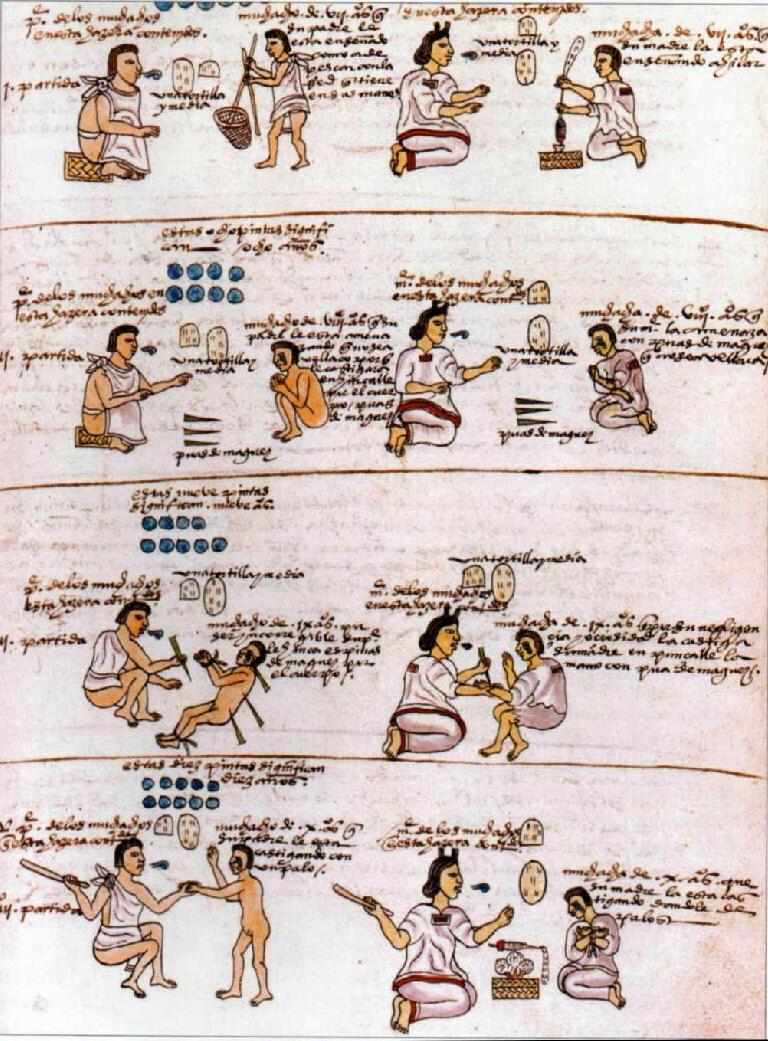
Figure 1.--The Codex Mendoza made a few years after the Conquest by native scribes provides informatrion about the lives of children. Two pannels are especially informative about the tasks children were expected to perform and how children who neglected their chores were punished. The Codex suggests that parents were tolerant until the children were about 9 years old, but then began to punish malcreants severely. This pannel deals with children 7-10 years old. The left column deals with boys while the right pannel with girls. At 7 years of age, the boy is taught to fish with a net and the girl learns to spin thread. At 8 years the children are treatened with catus spines if they misbehave. At 9 years parents begin to use the spines. At 10 years the children are beaten for mibehavior. The drawing suggests that the girl has neglected her spinning dutuies. Click on the image for information about older children.
The Aztec were a war-like people located in the central valley of Mexico and dominated much of southern Mexico during the 15th and early 16th centuries until the arrival of the Spanish conquistadores. The Aztecs were a Nahua-speaking peoples. The Aztecs known to history and which the Spanish encountered were a tribe of the Mexica peoples--the Tenochca. The Mexica migrated south into the Valley of Mexico about the 12th century AD. They were a small group that eked out a meager existence in some of the least desirable land in the Central Valley. They gradually adopted the more advanced culture (Mixteca-Pueblo) that dominated the Central Valley and originated in the culture of Teotihuacán. The Tenocha who built Tenochititlan were at first a small tribal group surrounded by more powerful neighbors, but gradually developed more effective civil and military organizations. The Mexica by the 15th century had organized a military alliance with neighboring Nahua tribes known as the Aztec Confederation. The Confederation through wars of conquest came to dominate vitually all of the tribes of southern Mexico, from Rio Fuerte south to Guatemala. The Aztec Empire was not a centralized state, but rather composed of allies and tributary states that were not forced to adopt Aztec culture. Within the Aztec domains were tribes that resisted their rule, especially the Tlaxcalan tribe which was more than willing to fight with the Spanish. The Aztecs were notable archetects and astronomers. Their religion was, however, barabaric and involved mass human scarifices. A major goal in Aztec wars was the acquisition of victims for human sacrifice. Human sacrifice was practiced by many Native American cultures, but the Azztec are notable for the large numbers of sacrificial victims.
Chronology
The Aztec were a war-like people located in the central valley of Mexico and dominated much of southern Mexico during the 15th and early 16th centuries until the arrival of the Spanish conquistadores.
The Mexica
War-like hunter gather peoples without any centralized organization began moving south into the Central Valley (about 600 AD). The migratory groups seem to have been small and unorganized. The major common cultural thread was language. They were
Nahua-speaking peoples. Gradually as they settled down and developed agricultural skills, they began to grow in power. Nahuatl speakers because of their war skills and agricultural harvests gradually became the dominant power in central Mexico (about 1000 AD). Seven allied Nahuatlan tribes migrated south probably from New Mexico and Arizona to the Central Valley (12th century). This seems a story rather like thecGermabs moving into the Roman Empire. Little is known about the Mexica, except that they were at the tail end of the migration from the north. It is unclear why, but they gradually became the dominant force in the Central Valley. It was the Mexica who founded the Aztec empire. The Aztecs known to history and which the Spanish encountered were a tribe of the Mexica peoples--the Tenochca. The Mexica were one of the last northern groups to arrive in the Central Valley. Assessments vary, some time between the 12th and early 14th century AD. As a small, weak group they were unable to dispossess the erarly arrivals. They were thus forced to inhabit some of the least desirable land in the Central Valley. Here they attempted to eke out a meager existence. why the Mexica became the dominant group in the Central Valley is largely unexplained. Perhaos because they were late arrivals, they had the strongest warrior tradition. Perhaps the agricultural technology they developed to farm marginal land was a factor. Perhaps they were more flexible and willing to adopt the advanced Toltec culture.
Language
The Aztecs were a Nahua-speaking peoples. Language study is a major part of Native American studies. Before the development of DNA, language was one of the few ways anthropologists could establish connections between the many different tribes. Nahua languages were was introduced by migratory waves of northern tribes. Languages similar to what the Aztec spoke are believed to have appeared in central America for centuries (about 600 AD). Little is known about the origins and culture of these people before they arrived in the Central Valley. With the growth of the Empire so did the importance of Nahuatl, variously referred to as Classical Nahuatl, Mexicano, or Aztec. Rather like Latin, those who wanted to prosper in the Central Valley, needed to speak Nahuatl. It became a language of trade, prestige, and literature.
The Mexico Valley Basin or Valley of Mexico is a highlands plateau in central Mexico. It is now occupied by Mexico City, one of the largest metropolitn cities in the world. It is a large internally-drained basin which is surrounded by towering volcanic mountains, some of which reach exceed 3,000 meters in elevation. The Valley is part of the Trans-Mexican Volcanic Belt. It is a completely enclosed elevated valley. Despite the elevation, there is no natural outlet for water to flow out if the valley system. This is what attracted Native Americans, the resulting watershed and Lake Texcoco with its abundant water supply. There is a gap in the mountins to the north where there is a high mesa but no mountain peaks.
Lake Texcoco was the largest of five now-extinct lakes, which was located in the southernmost and largest of the four sub-basins. There was also a piedmont and the mountainsides that collected the precipitation that flowed to the lake area.
Archeologists reoport himan inhabitation for at least 12,000 years, meaning from afairly early period of the arival of humanns ccrioss the \Bearing Sea ice bridge. Native Americans were attracted by the mild, healthy cliamate as a result of the elevatin and the plentuful water. This meant abundant game and the ability to conduct intensive agriculure on a large-scale. The Valley was a center of several pre-Columbian civilizations, most notably Teotihuacan, the Toltec, and the Aztec civilization. The Aztecs called it Anahuac (Land Between the Waters). The Mexica or Aztec civilization was the last Native American civilization to occupy the Valley. Their civiization was based round Kake Texcoco t heart of the Valley.
Culture
The Aztecs adopted many aspects of the Toltec civilization. The Toltecs in the first centuries of the Christian era migrated south and entered the Central Valley of Mexico. They founded Tulan Tulantzinco. The archeological remains are evidence of a great civilization. The Totecs were largely conquered by the Chicimecas who essentially adopted Toltec culture (11th century). The Aztecs after entering the Central Valley gradually adopted the more advanced culture (Mixteca-Pueblo) that dominated the Central Valley and originated in the culture of Teotihuacán. The Tenocha who built Tenochtitlán were at first a small tribal group surrounded by more powerful neighbors, but gradually developed more effective civil and military organizations. The Aztecs were notable archetects and astronomers. There appear to have been a less-civilized tribe than those they conquered. [Wells, p. 656.] Some writers romanticize the Incas and other native American peoples. Their achievments were remarkable, but they were a neolithical civilization, perhaps 2-3 millenia behind the technology of Europe and Asia, comparable to pre-dynastic Egypt or the Simerians. [Wells, p. 656.] The interesting question is why the technology of native Americans was so retarded. We have never noted a fully satisfying assessment of this question. Surely a primary factor was the total isolation of the Americas. There was no Silk Road connecting America with Europe or Asia or even connecting the two great civilizations within the Americas. The Aztecs were a Nahua-speaking peoples.
Aztec Agriculture
The Aztec were a small group that eked out a meager existence in some of the least desirable land in the Central Valley. Aztec agriculture was one of the reasons they emerged as a dominant force in central Mexico. They were simply a more productive society which meant their population could increase. Their superior output meant that the ztec could devote more time and energy to other persuits, such as war. The Mexica founded a settlement on Lake Texcoco in an undesirable and unihabited marshy area (about 1325 AD). Aztec legend proclaims that the Gods instructed the Aztec to build their city on the spot where an eagle, perched on a cactus, would be seen eating a snake. This is how the Aztecs suposedly selected the site for their city in a region of lakes and islands. Causeways were erected to Tenochtitlán. This not only served to make Tenochtitlán a virtually impregnable fortress, but daming the marshes increased the land available for cultivation. The area was avoided by other peoples because of the marshy, snake infested land. The Aztecs and Tenochtitlán, however, flourished. The Aztecs cut irrigation channels to drain the marshy land. Shallow areas of the lake awere filled in and anchored with trees. The abundant water allowed the Aztecs to farm more intensely than neighboring people. Crops could be grown throughout the year.
Tenochtitlán
The Aztec capital of Tenochtitlán was a small agrarian village in the early-15th century before the Aztec Aztec conquests of the mid-15th century. The Aztec triumps provided the wealth and slave labor to build a great city. Tenochtitlán became a city of palaces and pyramid temples to the gods. The canals became part of the city's defense system. Cortez and the other Spanish were astounded by the beauty and order of Tenochtitlán when they first saw it. It was a huge city in comparion to other cities of the day, including Euopean cities. Historians estimate the size of the city at anywhere from 150,000 to 300,000 inhabitants. Cortez provided an acount of the city, "This great city of Tenochtitlán is built on the salt lake , and no matter by what road you travel there are two leagues from the main body of the city to the mainland. There are four artificial causeways leading to it, and each is as wide as two cavalry lances. The city itself is as big as Seville or Córdoba. The main streets are very wide and very straight; some of these are on the land, but the rest and all the smaller ones are half on land, half canals where they paddle their canoes. All the streets have openings in places so that the water may pass from one canal to another. Over all these openings, and some of them are very wide, there are bridges ... There are, in all districts of this great city, many temples or houses for their idols. They are all very beautiful buildings.... Amongst these temples there is one , the principal one, whose great size and magnificence no human tongue could describe, for it is so large that within the precincts, which are surrounded by very high wall, a town of some five hundred inhabitants could easily be built. All round inside this wall there are very elegant quarters with very large rooms and corridors where their priests live. There are as many as forty towers, all of which are so high that in the case of the largest there are fifty steps leading up to the main part of it and the most important of these towers is higher than that of the cathedral of Seville..." [Cortez]
Religion
Their religion was, however, barabaric and involved mass human scarifices. A major goal in Aztec wars was the acquisition of victims for human sacrifice. Human sacrifice was practiced by many Native American cultures, but the Azztec are notable for the large numbers of sacrificial victims. The Aztecs believed that it was necessary to appease the gods with human hearts in order to ensure that the sun would rise each morning. One reason the Aztec engaged in war was to secure living prisoners for sacrifice. These victims would not be sacrificedimmediuately. Instead many would be held for some time before being required for sacrifice. The victims would be ushered up a templel pyramid, laid over a stone altar, and then an Aztec priest would cut their chests open with an obsedian blade and rip out their still beating hearts. Their lifeless bodies were then down the steps of the pyramids. Cortez was horrified at this practice when he arrived in Tenochtitlán. He ordered thge pyramids razed. And on those sites churches were built. The remains of Tenochtitlán today provide the foundations of Mexico City. The Templo Mayor has ben ecavatd. It can be seen today adjacent to the Mexico City Cathedral. Many more Aztec sites have not be excavated.
The Aztecs despite their many accomplishments are sxyrely best known today for human sacrifice. Other Native Americans practiced human sacrifice, but none on the scale of the Aztecs. When Hernan Cortez and his force of Conquistadores first saw
the Aztec capital of Tenochtitlán they were amazed (1519). The Aztec capital rivaled and many ways surpassed the great cities of Europe at the time. It was set in a great lake and seemed to shimmer with the gleaming white walls of imposing buildings. Easily defended causeways linked the city to the shore. The Spanish after they arrived in Tenochtitlán were horrified by the human sacrifical rituals practived by the Aztecs, although they were at first unaware of the dimensions of the practice. Some historians estimate that the Aztecs annually sacrified about 20,000 people to their gods. Aztec priests drawn from royal families took captives to the top of the great pyramids where they splayed the victims on a flat stone stone altar and cut the chests of individuals open with obsedian knives and ripped out the hearts from their living victims. The quivering bodies of the victims were then thrown down the steps of the pyramids. The still beating heart was added to the hearts on a stone altar. The Aztecs believed in the concept of 'tonalli'--animating spirit. The Aztecs believed that tonalli in humans was located in the blood and it concentrates in the heart when an individual becomes frightened. This is why the gods' hungered for human hearts. The Aztecs believed that unless the gods were placated, the world wome come to a hlt. All motion would cease, including the sun and other celestial bodies. Thus in the Aztec mind, their sacrifices were keeping the world functioning, especially the all important sun. Many historians now question the scale of the himan sacrifice attribjuted to the Aztec. The historians ho report large numbers are basically relying on the Spanish accounts. And the Soanish of course had a vested in exzgerating the brutal asoects of Aztec life. There certainly bis archeologicl evidence to substabtite this practice, but not on the huge scale commonly reported. [Majora Z] It is interesting that the Spaniush who bwere tarnished with the Black Legend soun a dark legend of their own.
History is the experimental testing grounds for humanity. Proto Indians arrived in the New World milennia before the Neolitic Revolution and the advent of civilization. And as in the Old World, the Neolithic or Agriculturl revolution which occured indepebently in the New World created great civilizations in both Meso-America and the Andes. Some of the cultures which developed are some of the most violent and bloody societies known to mankind. No societies have ever come close to the levels of human scarifies conducted publically and on a massive scale by the Aztecs. And many other Native American civilizations practiced human sacrifice. Even on a smaller scale than the Aztecs, it was an important part of their culture. The Spanish friars accompsnying the Conquistadores had good reason to be horrified. These civilizations also made important cutural achievements. But at the time of contact with the Europens they were still largely stone age societies which had not even mastered the concept of the wheel or metalury beyond gold and silver, metals with low melting points and thus requiring limited technology. Thus they were conquered by small bands of European Conquistadores. The question thus rises as to why the New World lagged so far behind the Old World in cultural and technological development. There have been many theories offered. The north-south axis of the mountain ranges impeded communication and contact while the east-west axis of Eurasian mountaints promoted communication and contact. This is a strong argument because the relative isolation of the New World. This may have been an important factor. The lack of important load-bearing animals like oxen, horses, and cammels may also been a factor. [Diamond] Of course the development of corn amd potatoes were more valuable food crops than the crops developed in the Old World. A factor rarely considered is the failure of the great Native American civilizations to develop the concept of freedom. This is interesting because Native americans during the Enligtenment and today in popular culture are often seen as the embodiment of freedom.
Parents had high expectations for their children. They expected then to be both hard-working and dutiful.
We do not know much about play among Aztec children. We do know that from aelatively early age they were expected to make themselves useful. As in Europe, a child's education began at home. Aztec society was socially stratified. Children inherited the occupation and social status of their parents. This began at about 3 years of age. The younger children were assigned simple tasks like feyching fire word or carrying water. Common boys learned the trades and skills of their father. We do not know if such skills were adressed in Aztec schools or just learned from fathers. Boys learned to farm and fish from their fathers. Artisan skills were taught like pottery making and bsasket weaving in the same manner. Trades or crafts were taught as approprite to his calpulli (family kinship group). Girls learned domestic skills like cooking and weaving from their mothers. Especially important was learning to grind maize and make tortillas. The skills taught were graduated according to the child's age. Aal of this was similar to Europe. Younger children might be endulged, but older childern if they did not behave or perform assigned tasks dutifully could be trrated very harshly.
Parents seem to have been very inventive in how to discipline misbehaving children. They might be beaten, but there were other punishments like piercing them with cactus spines or force to inhale hot pepper (chiles) fumes.
Perhaps the most interesting aspect of the life of Aztec children was school. At a time that only a fraction of European childtren sttended school, most Aztec children attended state schools. The Aztecs believed in education. As they grew older, however, Aztec children went to schools. Details on the schools are sketchy and some of the details are disputed. All Aztec boys were educated. Sources vary widely as to just what age the childreb began school. We have seen reports barying from 7-16 years. There were schools for both boys and girls. Aztec schools were separated by both gender and social class. Common children went to schools called telpochalli--meaning "house of youth". The telpochalli wre set up next to the local temple. In villages cthe children were taught together, In cities there might be a telpochalli for each calpulli. Here they were taught both history and religion which to a degree were merged. Also strongly pursued was the child's civic duties as well as public speaking. The classes were not just academic. There were also taught dance, music, and singing. The curriculum was in part gender based. Older boys learned the art of war. The classes in martial skills were rigorous and demanding. Girls learned to serve in the temples. A major focus of Aztec education was to create a sence of personal responsibility so that the individual found fulfilment not in his own personal desires, but in finding fulfilment in serving the gods, the Aztec state, and the family calpplli. Slave boys were for the most part excluded from the telpuchcalli. There were special schools for the children of aristocrats called calmecac. This was for the members of the six most important calpulli. A few commoner children were chosen for the calmecac, but most of the students were from the upper classes. Upper class children also studied the subjects taught to the common children, but with many added classes, including mathematics, architecture, and astrology. Here they learned to read and write. The Aztecs made paper for wruting from the bark of fig trees. Aztec writing was not as advanced as that of the Maya. It consisted of pictograms. Upper class children also learned the religious duties of priests and secret rituals. This involved learning the sacred calendars. They also needed to learn to interpret the tonalamatl. There was aso much to learn about the various annual festivals. The graduates of the calmecac would become the leading figures in the state, military cimmabnders, judges, bureaycrats, and priests.
Clothing
Aztec clothing in part reflected social rank. While the nobility wore the same basic garments as common people, the fabric and workmanship as well as the dyes used reflected social rank. Adornments like fur and feathers were also used by the nobility. The Aztec had very strict sumtory laws. Common people might be severely punished or even put to death if seen wering clothes ment for high-status individuals. The basic Aztec garment for men was a simple cloth knotted in the front, a kind of loin cloth. Men also wore a length of fabric tied in a knot on their shoulder, depending on the circumstances. More important individuals wore finer materials and decorated cloaks. Men did not wear cloaks unless they had scars or cuts on their legs. A war commander was entitled to wear a cloak because it showed that he had captured many prisoners. Cloaks were seen as a sign of courage. Women wore tunics made rather like ponchos which could be brightly embroidered and fringed. Heavier cloaks might be made of rabbit fur, but this was for the upper-class. Women also wore wrap around skirts and tunics with short sleeves. The skirts and tunics were of varying length from the knee to the ankles.
Social class was a major factor. The nobility while wearing the same basic garments as common people had garments that were more intensely colored and decorated. The Aztecs liked clothes dyed bright colors. A bright red dye was made from the cochineal beetle. This became a valuable export after the Conquest. We do not yet have details as to the clothing worn by children. Young children mught go naked in war weather. Older children seem to have worn clothing reflecting the social standing of their parents. Ordinary Aztecs wore clothes fashioned from from maguey cactus fibre. This was thus the principal cloth worn by the common people was woven with fibre from the maguey cactus.
The cloth was woven by women in the home. The upper class were entitled to wear cotton clothes and feather headdresses. This was mandated by law and commoners violating the law could be put to death. High status individuals wore clothing woven from more comfortable fabric. There was no wool. Cotton was used, but was reserved for the upper class because it was labor internsive to produce. One material used was rabbit fur, but this required tedious weaving and were only worn by high-status individuals.
Hair Styling
A boy's hair was left uncut. This was seen as a sign of youth or imaturity because it symbolized that the boy was still a child and had not yet fought and killed in a battle. Warriors had their hair tied in a knot with a ribbon tied on top of his head. Unmarried girls wore their head let down, with their hair down and colored ribbon round the top of their head. Married women wound their hair into plaits coiled around their head with two ends sticking out looking rather like horns. Importantindividuals ore hair dresses. Green quetzal feathers and blue cotinga feathers were used in hairdresses. Gold and jade were also used. An Aztec baby might be given a small jade pendant as a good luck charm which h or she might wear as a child.
The Aztec Confederation
Mexica warriors sustained by their intensive agriculture and invulnerable city. They gradually developed more effective civil and military organizations. The Mexica gradually expanded their terriory and power over neighboring tribes. The Mexica by the 15th century had organized a military alliance with neighboring Nahua tribes known as the Aztec Confederation. The first Aztec Emperor was Itzcoatl who began to conquer neigboring tribes and buld an Aztec Empire. The Confederation through wars of conquest came to dominate vitually all of the tribes of southern Mexico, from Rio Fuerte south to Guatemala. The Aztec Empire was not a centralized state, but rather composed of allies and tributary states that were not forced to adopt Aztec culture. They did have to pay tribute as well as human victims for sacrifice. Within the Aztec domains were also tribes that managed to successfully resist their rule, especially the Tlaxcalan tribe which was more than willing to fight with the Spanish.
Slavery was common and an important institution in Aztecs culture. It was different than the modern concept of slavery. It was not racially based nor was it a permanent condition. There were various ways a individual became a slave: 1) being captured in war, 2) committing certain crimes, especially theft, and by 3) voluntarily entering into slavery because od debts, or 4) being sold by one's parents again primarily because of debts. Vast numbers of prisoners taken by the Aztecs in war were used for human sacrifices. There are accounts of such sacrifices on a vast scale. Others were spared and enslaved for labor. The Aztecs ececuted major building programs for roads and aqueducts as well as temples and other buildings in Tenochtitlán. Not a great deal is known about the numbers of captives that the Aztecs spared for slavery or about the conditions of servitude and ultimate disposition. Captives who had a useful trade were the most likely to be spared sacrifice. Nor do we know much about the captives taken and the extent to which children were enslaved. It was not just foreign tribes that were enslaved. We know that some Aztecs sold themselves or their children into slavery to settle debts. This parctice played a role in the demise of the Aztecs. Tha Aztec skave girl Malinche became a key adviser and confident to Cortez. Aztec slavery is, however, apparently not forgotten. A law firm in Oaxaca, Mexico in 2002 announced plans to file a lawsuit against Mexico City municipal government seeking reparations for the Aztec use of slave labor. The lawsuit claims slaves captured by the Aztec ruler Ahuitzotl as a result of military operations in Oaxaca during the late 15th century built the foundations for Mexico City. The suit claims that the ancestors of those slaves should now be compensated. A Mexico City Municipal Counsel Emilio Montalban did not take the suit to seriously, telling a reporter that the plaintiffs "ought to be joyous," to know their ancestors did not have their living hearts cut from their chests, which was the fate of many of the human sacrifices. [Smeed]
The voyages of Columbus and the other European Voyages of Discovery had profound consequences for both Europe and the world. Following on Columbus' voyages, Spain rapidly beagan estalishing colonies. At first Columbus and the Spanish did not realize that they had chanced upon an entirely new continent--the Americas. They thought it ws India and thus called it the Indies and the Caribbean Islands have become known to us as the West Indies. Spanish colonization was at first in the Caribbean and extrodinarily brutal. The native Americans on the islands were for the most part exterminated. Next the Spanish looked to the mainland where rumors described natin American civilizations of vast wealth. This led to Diego Cortez's Conquest of Mexico. The gold and silver flowing from the Americas made Spain a European super-power and financed the Great Armada.
Sources
Diamond, Jared. Guns, Germs, and Steel: The Fates of Human Societies (W.W. Norton & Co.: 1997). Also published with the title "Guns, germs and steel: A short history of everybody for the last 13,000 years".
Gruzinski, Serge. The Aztecs: Rise and Fall of an Empire (Thames and Hudson).
Majora Z, personal communications (July 3, 2021).
Smeed, Dover. "Reparations Sought For Descendants of Aztec Slavery," CNSNews.com, March 26, 2002.
Wells, H.G. The Outline of History: The Whole History of Man (Doybleday & Company: New York, 1971), 1103p.
West, Rbecca. Survivors in Mexico (Yale University Press, 2003), 264p.