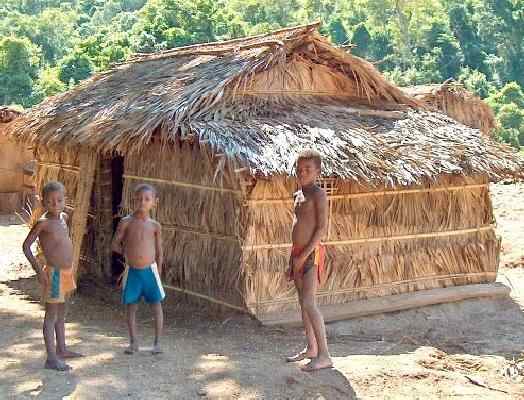
Figure 1.--Here is an image from Madagascar taken about 2000 showing traditiinal thstch huts. Notice the boys' Western-style short pants. |

|
Madagascar is the large Indian Ocean island country off the coast of southern Africa. The Arabs dominated the Indian Ocean during the 9th and 14th centuries and established colonies on the island. The ruins of Arab fortifications date from the 9th century.
Arab dominance of the Indian Ocean was first challenged by the Portuguese (16th century). Dutch, English, and French seamen soon followed the Portuguese. The first French settlement appeared (1643). French settlement occurred at Tolagnaro (formerly Faradofay) on the southeast coast. The French were active there for over 30 years. The settlers made an effort to coexist with the Antanosy, the principal local ethnic group. Eventually relatins deteriorated. The Antanosy massacred the French (1674). A few survivors managed to reach Reunion. The French did not return for more than a century. The French finally made Madagascar a protectorate (1883) and a colony (1896). The country achieved independence (1960) and for many years was called the Malagasy Republic. The people referred to are a varied ethnic mix black, Malay, and perhaps Polynesian origins with Arab and European influences. Madagascar's tropical rainforest contain a highly diverse population, but are unrelentless assault. The forests includes lemurs, periwinkles and baobabs, aloes, geckoes, sifakas and octopus trees. The country has serious environmental problems, all exacerbated by over population.
Madagascar is the large Indian Ocean island country off the coast of southern Africa. Madagascar's tropical rainforest contain a highly diverse population, but are unrelentless assault. The forests includes lemurs, periwinkles and baobabs, aloes, geckoes, sifakas and octopus trees. The country has serious environmental problems, all exacerbated by over population.
Madagascar is separated from southern Africa by the 400 km-wide Mozambique Channel. For reasons of geography we have included it with our African history section. Some historians argue that culturally it has more in common with Asia. The people are etnically African and Malay. DNA studies will provide some important information. The Mozambique Channel wile relatively narrow was wide enough to prevent Africans from reaching Madagascar in the various waves of pre-historic migrations. They are believed have followed herds of migrating animals along land routes. The first humans did not reach Madagascar until fairly modern times, about 2,000 years ago. The origins of these early people and how they reached Madagascar is still unknown. They appear to have been prople from India, Africa, and Arabia. These people lived in tribes. Little is known about the early tribal history. The interesting aspect of the country's history is that over time these people merged to form a fascinating cultural and ethnic synthesis. Living on an island may have been a factor. This has left the country a national society that despite the disparate origind that is remarkably uniform in lenicity, language and culture. Arab traders dominated the Induian Ocean and established coastal trading posts (9th-14th centuries). The ruins of Arab fortifications date from the 9th century. Arab dominance of the Indian Ocean was first challenged by the Portuguese (16th century). Portugese explorers landed on the island (1500), but did not colonize it. They and the Spanish defeated Arab seapower in the Indian Ocean. Dutch, English, and French seamen soon followed the Portuguese.
As Portuguese and Spanish seapower wained, Madagascar became an object of both British and French imperial interest.
The first French settlement appeared (1643). French settlement occurred at Tolagnaro (formerly Faradofay) on the southeast coast. The French were active there for over 30 years. The settlers made an effort to coexist with the Antanosy, the principal local ethnic group. Eventually relations deteriorated. The Antanosy massacred the French (1674). A few survivors managed to reach Reunion. The French did not return for more than a century. The Malagasy tribes formed coalitions to defend themselves from the Europeans. King Andrianampoinimerina united the tribes, forming a single united kingdom for the first time (1794). Missionary efforts began (19th century). Among other activities the missiionaries founded the first formal schools on the island. The French finally made Madagascar a protectorate (1883) and a colony (1896). Madagascar became a memembr of the French Community (1958). The country achieved independence (1960) and for many years was called the Malagasy Republic. The first president was Philibert Tsiranand.
Madagascar is a fscinating country. It is classified as an African country, but has an historical evolution lasrgely mostly independent of the the continent. This is reflected in the ethnic make up of the island. The people of Madagascar are a varied ethnic mix black, Malay, and perhaps Polynesian origins with Arab and European influences.
The Malagasy language is spoken throughout the island by the entire population. It is the only African language which belongs to the Malayo-Polynesian language family, reflecting the migration of southeastern Asian peoples. Linguists have studied this unique languafe and believe that it is most c;osely related to Maanyan, a language prevalent in southeast Borneo. Malagasy and Maanyan are clearly related to the major languages spoken in the the western Indonesian archipelago (Malay, Javanese, Balinese, and the Minangkabau language of Sumatra). Arab dominance of the Indian Ocean cut Madagascar off from India and southeast Asia.
We have very little information about boys' activities in Madagascar. We do have a page on Malagasy Scouts.
Madagascar like most Aftrican socities before the arrival of the French had no formal school system. There ws an informal education system. Traditional Malagasy society as was often the case throuhout Africa, Asia, and the Americas emphasized stabilkity and maintaining one inherited place in society. Social mobility was limited in the hierarchical societies the Europeans encountered. The French in Madagascar found a society that emphasized the poroper observance of ritual and compliance with a wide range of taboos (called 'fady') food and other prohibitions. Malagasy society was both pacifist and tolerant. Inter-tribal warfare was less common than in other areas of Africa, but common with much of Africa was respect for the elderly and ancestors. Formal education in the Western sene came with the Europeans, but not for several centuries. Despite French Catholic influence, it was the Protestants who founded the first school. David Jones of the London Missionary Society (LMS) established a school in Antananarivo (1820). The LMS was active throughout Africa and a major force in the abolitionist movement that had helped launch Britain and the Royal Navy on a decades-long effort to end the slave trade. Jones convinced King Radama I to support a small school. The first students were children of the royal family. The Imerina missionaries launched a larger effort, building many schools. This began to increase the number of literate Malagasy. After the French established a colonial admninistration, they also set up a public school system modeled on France's own education stystem. As in France after the establishment of the Third Republic, this was a secular system. We are not sure yet about how the academic standards varied in the missionary abd seculkar schools. There were elite schools resembling schools in France. They were reserved for the children of French citizens. These were mostly French families living in in Madagascar. Few Malagasy people were granted French citizendhip. Schools for the Malasay people emphasized practical and vocational education. They did not attempt to train students for positions of leadership as such positions were to be filled by the French. There was a need for lower level civil servants. These individuals were trained at the écoles régionales (regional schools), the most important of which was the École le Myre de Villers in the capital. French educational policy began to change after World War II. The French began to provide more educational opportunities for Malagasy children. As a result, Madagascar when France granted independence (1960) had an educatiinal system similar to France.
Traditional beliefs were very strongly held in Madagascar. Despite Arab control of the Indian Ocean for centuries, unlike East Africa, Islam seems to have few inroads on Madagascar. Nor did Hinduism reach Madagascar from India. Christianity reached Madagascar first with the Portuguese. There was, however, little effort to convert the Malagasy until the French colonial era (19th century). This mean primarily Catholics, but Protestant missonary activitiws began in the late-19th centuries. We note a Protestant missionary family in Ambatomanga during 1901. While many Malagasy people covered to Christimity, many did so without completely abandoning their traditional beliefs. No precise statistics exist, but a reasonable estimate is that about 55 percent of the population continue to mauintain traditional beliefs. This proportion would be even higher in the countryside. About 40 percent are Christian, about evenly divided between Roman Catholics and Protestants--surprising because the country was a French colony. You would think the Catholic share would be higher. Many villages in the central highlands have two competing churches, one Protestant and one Roman Catholic. Commonly they face each other, situated at at opposite ends of the village. We have limited information on Madagascar, but there is a First Communion page. The remaining 5 percent are mostly Muslim, both Sunni and Shia. Most Muslims are Comorans or Indo-Pakistanis, only a small number are native Malagasy. Most Muslims live in live in Mahajanga Province.
We have very little information about boys clothing in Madagascar. Both poverty and the semi-tropical climate are factors whicvh have affected clothing. A reader tells us that a the cloak was a common traditional garment. We also notice the white below the knee pants that were common in Portugal and Brazil. We are unsure just how common these garments weee in Madagascar. Since indeperndencem Western style clothing has vecome increasingly common in Madagascar.

Navigate the Boys' Historical Clothing Web Site:
[Introduction]
[Activities]
[Biographies]
[Chronology]
[Cloth and textiles]
[Clothing styles]
[Countries]
[Topics]
[Bibliographies]
[Contributions]
[FAQs]
[Glossaries]
[Images]
[Links]
[Registration]
[Tools]
[Boys' Clothing Home]
Navigate the Boys' Historical Clothing national pages:
[Return to the Main African page]
[Algeria]
[Angola]
[Congo]
[Ethiopia]
[Gabon]
[Ivory Coast]
[Kenya]
[Lesotho]
[]
[Mali]
[Somalia]
[South Africa]
[Uganda]
[Zimbanwe]