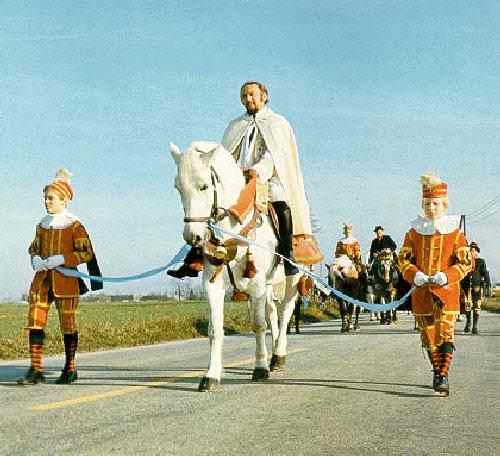
Figure 1.--This image shows the Firmung at Wien and another about the Leonardiritt in Pettenbach. The boys leading the horse are altar boys and are wearing a pageboy costume. The costume is red with yellow detailing and buttons. They wear a red cap with a plume and white gloves. Furthermore red trousers and laced shoes. Finally a large ruffled white collar.
Germany is a predominantly Protestant country. The Reformation was born in Germany with Marin Luther posting his "95 Thesis. The resulting religious wars devestated Germany, especially the 30 Years War. Luthernism is the primary Protestant denomination. There is, however, a very sunstantial Catholic minority, especially in southern and eastern Germany. The NAZIs did not ban Christianity, but supressed relious thought, especially Catholic. They promoted a Reichskirche, a 'state church' loyal to Nazism and subordinate to the state. It was to be the fomdation for a new NAZI state religion to relace the existing chutches after the NAZIs won the War. Church membership is now substatially reduced and attendance declining since World War II. The post=War Communist atheist camapign in the DDR (East Germany) substantially reduced religious religious belief. Atheists now outnumber Christians in Eastern Germany. Germany. German boys wear a variety of dress outfits for relious events ceremonies associated with formal religious events. Catholic boys often have special suits for first communion or serve as altar boys. Protestant boys may get new suits for communion or confirmation. Boys may also have costumes for weddings, serving either as the ring bearer or ushers.
Germany is a predominantly Protestant country. The Reformation was born in Germany with Marin Luther posting his "95 Thesis. The resulting religious wars devestated Germany, especially the 30 Years War. Luthernism is the primary Protestant denomination. There is, however, a very sunstantial Catholic minority, especially in southern Germany. While Catholics are a minoriy in Germany, this is not true in every German state (Landen), especially in Bavaria and other southern German states. One 1964 source reports that 95 percent of Germans were either Protestant or Catholics and only 5 percent to other religions. There were about 30,000 Jews, compared to 600,000 before the NAZIs seized power in 1933. Protestants live throughout Germany, but mostly in North and Middle Germany. In the south most people are Catholics (especially Bavaria and Austria. A more recent source indicated that in Austria about 85 percent were Catholics, 6 percent protestants, and 1 percent Islamic. Some parts of Baden and Württemberg were originally Protestant, but due to the refugees from the Sudetenland after World War II, there are today some Catholics as well. In the former Communist East Germny (DDR), most people were protestants, too. East Germany had about 35 percent of all German protestants, but only 8 percent of Catholics. In West Germany the ratio between Protestants and Catholics was much closer, 51 and 44 per cent. Another source indicates that West Germany during 1989 there were 41 percent protestants, 43 percent catholics, 3 percent Islamics. The East German composition was 30 percent protestants, 6 catholics, and 64 percent had or reported no religion. A source indicates that in 2000, 42 percent of Germans were protestants, 33 percent catholics and 3 percent Islamic people. Today in larger towns throughout Germany, both both religions are present, but you can tell by the age of
the churches, which one was originally there.
Germany after World War I was a largely Protestant country. About two-thirds of the German population was Protestant and the remainder mostly Roman Catholic. Bavaria in southern Germany was strongly Roman Catholic stronghold. There were also Roman Catholics in western Germany, including Baden-W�rttemberg, the Saarland, and in much of the Rhineland. The rest of Germany, especially the north and northeast were strongly Protestants. Church attendance was still substanial, especially amomg the country's middle-class. Bismarck had given up on his Kulturkampf against Catholics to focus on socialists. The Catholic Center Part actually joined with Bismarck and his sucessoers to oppose the Socialists. The Weimar national constitution provided for no state church, and guaranteed complete freedom of faith and religion (1919). In the Imperial era, such freedoms were accorded only in state constitutions, meaning proimarily the former German states that were united to form Imperial Germany. Protestants and Catholics were made fully equal before the law. Jews had acquired ful;l citizenship and civil rights. And German Jews were among the most assimilated in Europe. Freethought flourished and was also protected. The German Freethinkers League was popular, acquiring some 0.5 milliom members. They were essentially atheists. TYhe NAZIs supressed the League a few months after seizing power (May 1933). ["Atheist Hall ..."] Attendance at religious services was affected by World and the growth of left-wing thought, especially Communism and Socialism. This in particular affected working-class Germans which were attracted by Socialist and Communist thought. Middle-class and rural Germans still attended Church services in large numbers. Church rolls declined further during the Great Depression. Some 186,000 Germans stopped attending Christian churches in one yera alome (1932)> Even so the vast majority of Germans identified themselves as Christians.
Children partricipated in a range of Christian religious ceremonioes and celebrations in various ways. We have less information on Germany's small Jewish community. Baptism, First Communion, and Communion were specifical children. They involved children, both boys and girls, at three age stages. There wee akso choirs which weee mostly religious in character. We do not have many photographic images from the 19th century and are not sure just why. Photohroaphy was well established in Germnany, especially by the late-19th centuyry. There is extensive information from the 20th century, even during the NAZI era where the churches, especially the Catholic Church, came under attack. The children dressed up for these events. And we have many images of them as partents liked to have images, bith studio portraits and family snapshots. The outfits were formal through much of the 20th century, but have become more informal, especially for the boys. Altar boys participated in a wide range of ceremonies and events Weddings had ring bearers and flower girls. We are not so sure about Sunday School. This seems more important in Ameruca than European countries. We note some images where the event or ceremony is unclear. Religiius observation in Germany has steadily declined after World War II, many of the churches are now largely empty during services. The major exception to this are the mosques now in Germany.
Saints
Hünermann has written several books about saints and Catholic people (Deveuster, Don Bosco, Francis of Assisi, etc). The books reveal a great deal of information about Catholics in Germany. His accounts are based on factual information aboyt their background.
Germany has a wide range of destinctive religious traditions. Many date from the Medieval era. Some are little known outside of Germany. These traditions are primarikly Catholic ones. The Protestant as part of the Reformaion abolished most of them and they removed pictures and cultural relics as well. They wanted to focus on the Bible as the center of parish life. The Chatolic Church abolished customs as well when they turned into
uncontrolled events (like Palmeselumzüge or Boy bishops). Some of these traditions survived in a few towns. In recent years some of the lost traditions are being revived. And some of the Protestant sects have shown some interest in these historic traditions, once seen as essentially Catholic.
The Germany that Hitler seized control of was a Christian nation, split between the Catholic and Protestant (mostly Lutheran) faiths. Religion was still a strong element of national life, although as in other European countries declining. Here World War I had been a major factor in undermining religion. The NAZIs in their propaganda drew on Christian symbolism as well as pagan symbols. This disturbed many Christian, mostly Protestant, theologians. NAZI leaders were drawn from both Catholic and Protestant families, but generally rejected traditional Christian teaching. The most prominant outlook among NAZI leads was a variety scientific or quasi-scientific theories. Especially prominant was Social Darwinism). This was Hitler's outlook. For political reasons, however, he did not openly attack Christianity. Other NAZI leaders dabeled in mysticism and occultism. This was especially notable in the SS that steadily grew in importance. The interest in mysticism and occultism was primarily the result of Himmler's interest. There was a common thread in both approaches (science and mysticism), that was a belief in Aryan racial superiority. Hitler authorized a Ministry of Church Affairs (1935). It was heded by Hanns Kerrl, but had no great impact in the NAZI state. The principal NAZI ideologue was Alfred Rosenberg. He gave little notice of the Ministry or Chrisinity in general. Hitler'a attitude toward religion was that an open campaign of atheism was unecessary and would be harmful politically. He bleieved that religious beliefs would gradually weaken. And in fact large numbers of Germans left their churches during the NAZI era, although the numbers declined sharply as the War began to go against the Germans. While there was no open atheism campaign, there were discrete steps taken. There was no religious component to the Hitler Youth. The church role in education was curtailed. Some mosly lower level NAZIs who wanted to retain their religious connections promoted what becane known as Positive Christianity. This wa essentially to associate NAZI beliefs within in Christian teachings. Many German Christians throughout the NAZI era saw no incompatability between their Christian faith and the NAZI state. Thus there was no loud rejection of attempts to integrate Natinal Socialism and Christinity. This was not just the layity. Many Protestant and Catholic clergy did not reject National Socialism even during the later years of the War. This is not to say that the clergy was NAZIfied, but the clergy did accept the NAZIs as the legitimate government and out of patriotism supported it. There were disenters, but this was dangerous and substantial numbers of clergy were arrested.
Sources
"Atheist Hall converted: Berlin churches establish bureau to win back worshipers," The New York Times (May 14,1933), p. 2.