|
We believe Austrian boys clothes are today similar to German boys clothes, but I have no significant information yet on Austrian fashions. Until after World war I, we believe there were more diferences. We believe there was more of a French and Italian influence in Austria. Lederhosen were commonly worn by boys until jeans began to replace them in the 1960s. Here the pattern was similar to Bavaria. I believe that after World War I and especially the NAZI Anschluss that Austrian and German styles essentially merged. oday there is little difference between German and Austrian boys' clothing wuith the exception of the greater popularity of folk styles in Austria.
Austria is today a small German-speaking state. This has only been the case since 1918 and the end of World War I. For much of European history Austria-Hungary and earlier the Austrian Empire or the lands goverened by the Hapsburgs were one of the great powers of Europe. Austria-Hungary was a compromised reached in 1867 after Ausrtria's defeat in the Austro-Prussian War (1866). The Hungarians wanted independence. To prevent this, a dual monarchy was created. Hungary was given its own parliament and primeminister. The Empire itself was a patch work creation of a large number of nationalities. Some like the Hungarians and later the Czechs were able to gain language rights. Other areas like Bosnia were eentially under military occupation. Vienna itself because of the nature of the Empire was a very cosmopolitan city where people of many nationalities, including Jews, lived together producing an intelectual ferment that produced men like Freud. It also was a reason that so few Vienese Jews turned to Zionism.
Austria has had a tumultous history. It began as a small, multi-ethnic Alpine principality and evolved into a major European power. The Austrian Empire came to dominate much of central Europe building a vast multi-ethnic empire governed by a German dynaty. The Hapsburg dynasty came to be the principal source of German emperors and during the Reformation led the Catholic forces trying to supress Protestantism. With Russia they contested control of the Balkans with the Ottoman Turks. Austria confronted both Louis XIV expansion plans. Austria under Empress Maria Theressa had to confront Prussia in the War of the Austrian Sucession. The two countries fought again in the Seven Years War. Te three empires (Austria, Prussia, and Russia) conspired in the Polish Prtitions. Austria was the major continental power which initially confronted the French Revolution and Napoleon. After the Napoleonic Wars Austria, layed a major role in the Congress of Vienna which reorganized Europe, attempting to reinstiture the Old Regime. Austria then struggled with Prussia to unify Germany. Prussia prevailed and Austria formed the Austro-Hungarian Empire. Emigrants from the Empire played an important role in diversifying America. The problem in governing restive ethnic groups eventually led to World War I and the Empire's demise. Austria became a small, mosly German republic, but was eventually annexed by NAZI Germany in the Anschluss. After World War II Austria again became an independent republic which as a result of the Cold War was premised on neutrality.
Any historical assessment of the Austrian economy is very complicated because the Austria as a state has changed so dramatically over time. Under the Hapsburgs it began as a tiny Alpine principality. It evolved into the Austrian Empire. The Hapsburgs were commonly chosen as the Holy Roman Empire and the dimensions of their personal empire spread east from Austria into Central and Eastrern Rurope, including
Bohrmniua, Hungary, and parts of Romania, Hungary, Poland, and Ukraiune and south into northern Italy and the Balkans. For several centuries it was one of the great powers of Europe. The ecionomy iof the Empire was based on agriculture and bonded labor. Serfdom was an important part of the economy of the Empire. This was not unusual in mediueval Europe, but at the time that Austria expsnded into the East, serfdom was declining in Western Europe as the modern economy began to take shape in the West. In the East, however, serfdom became more enhtenched. And as a result, the Austrian economy and Eastern Europe in geneal remained primarily focused on agriculture. While the emancipatiuoin of the serfs began (1781), but fedudal obligations continued until the Revolution of 1848. Even so the economy of he Austrian Empire continued to be dominate by the agricultural production of large estates wrked by landless former serfs. Even the German portion of the Haposburgs Empire, a small part of the of the overall Empire, lagged behind the other German states at the beginning of the 19th century. Vienna was an exception, but even ruyral Austria as well as the non-Germam provinces of the Empire were backward compared to many of the developing Westerin European states. Here we are talking about literacy, science, art, living standards, snd other economic indicators. This included Hungary, he largest part of the Austrian Empire. Before the Industrial Revolution, this economic divide was not readily apparemy. After the Napoleonic Wars and the rise of modern economies it significantly impacted Austria's standing in Europe. The Imperial Governmrnt made lottle effort to indudrilize. This was in part due to the influence of the aristocrsvy which oned and operate lsrge estates with an uneducated, landless workforce--the descendents if the former serfs. Austria and Prussia comoeted over which country would lead the unification of Germany. The only significant industrial development in the Austrian Empire occurred in Bohemnia, the only regiuon with coal desposits, and with little Imperial support. Austria did make some ecoinomic progress, but not at the same pace as the German states to the north. Austria was excluded from the Zollverein (Custom Union) because of its protectionist trade policy. Prussia in contrast began a major indudstrialization effirt, priomoted and directed by the Hohnzillern monarchy. The result was a Prussian viuctory in the Austro-Prussian War (1866) which essentially ejected Austria from Fermsny and kled to German Unification under Prusdia. The Austrian Empire was transformed into the Austro-Hungarian Empire, but few economic changes occurred. As a result, Austria-Hungary was unable to bear the burden of World War and was disolved. Austria became a small Alpine republic which had trouble adjusting to the massive econimic challenge of separtion from its former eastern empire. Like Germany, it sucumed to the Hitler and the NAZI vision, ending in World War II massive loss of life and destruction. After the War, Austria has arisen like a phonexix. After the departure of the Soviets (1955), Austria kept pace with the German Economic Miracle. Austria today is one of the most prosperous countries in the world.
Austrian boys wore the common early 19th century styles of skeleton suits and tunics. I'm not sure just when they began wearing lederhosen, other than as rural dress, probably the mid- or late-19th century. About this time the sailor suit was imported and became quite popular. Few boys' garments proved more popular in Austria than the sailior suit. At the time the Austrian-Hungarian Empire had a small navy which it deployed in the Mediteranean. Popular 19th century boys' styles that do not seem to have been important in Austria were the kilt and Eton collar. Sailor suits continued to be worn, although they fevlined in popularity after the NAZI Anschluss in 1937. Kneepants became ibnvreasingly common in the late 19th century, but were replaced with short pants after World War I (1914-18). Older boys might wear knickers, but shorts and long pants were also worn. Most boys wore shorts until long pants began to replace them in the 1960s.
German and Austrian styles seem quite similar in the 19th century. Austrian clothes may have been more stylish as the Austrians were more affected by French clothes style. Anti-French feeling in Germany, which was only unified in 1870, probably caused many to reject identifiably French styles. We also notice a greater popularity of folk styles in Austria. After the Anschluss in 1937, significan differences between Austrian and German styles disappeared and this continued to the present day. American blue jeans and T shirts began to appear in the 1950 and by the 1960s had become very popular. American-style casual clothes appealed to the more casual post-War outlook. Austrian boys today, dress almost the same as American boys, jeans, T shirts, baseball caps, and baggy shorts.
The garments worn by Austrian boys were quite similar to those worn in Germany. They were not identical, but very similar, especially with Bavaria and southern Germny. Sailor outfits were very popular, especially for the urban middle class. There was a considerable difference betweem the populparlity of the sailor suit and other styles between Vienna abd other cities and rural areas and villages. Social class was also a factor. Eton collars and kilts never caught on, but the sailor suit was very popular and commonly worn through the 1930s. Younger boys wore dresses until breeching in the 19th and very early-20th century. We notice a range of suits. Knee pants became increasingly popular in the 1890s and after World War I (1914-18) when the Austrian-Hungarian Empire was broken up, short pants became increasingly common. Short pants were for several decaded standard for boys and even worn in the winter. Lederhosen were very popular in Austria. Most boys commonly wore shorts until the 1960s when long pants, especially jeans, became more common. Long stockings were very common, especially during the colder months, even after World War II. The differences between cities and vllages and social clases largely disppeard after Austria recovered from World War II and began participating in the general European revival generated by the German Economic Miracle. This and American influenses eventially led to the development of a general European style with boys throughout the continent wearing the same garments and styles. With climate being the main differential.
We have limited information on Austrian hair styles at this time. On the basis of our limited archive, we note many similarities with Austria and Germany. During the late 19th and 20th century, many boys had cloesed croped hair. This seems especially the case of boys from working class families. I think some schools may have required it. We also note some boys with llongist hair., This seems especially common with boys from aflluent or upper-class famolies. This seems to have been more common in Austria than in Germany. It may have been in part a French influence. The NAZIs absorbed Austria with the Anschluss (1938). From that point German and Austrian hair styles as far as we can tell have been identical.
Here we will follow family fashions over time. HBC has decided to also gather information on entire families. One of the limitations of HBC is that too oftn we just view boys' clothing in contex with what the rest of the family was wearng. This will help to compare boys' clothing with that worn by mothers, fathers, and sisters. These images will help show show differences in both age and gender appropriate clothing.
A French reader has described what the French refer to as a "gar�on mod�les", a model boy. He was was expected to be obdedient and polite as well as clean and neat. He was also expected to be well dressed. There were very formal rules about behavior and polite speech. One French reader stresses that this concept of a beautifully behaved and well dressed boy was particularly prevalent for French mothers in the 1940s and 50s. Perhaps the disaster of World War II caused mothers to treat their children even more carefully and mother them more than in past generations. Thus fashions for boys emphasizing their innonsence and youth were very popular. He notes that very similar standards were prevalent in Austria at the time.
Austria or more correctly the Austrran Empire was for several centuries one of the great powers of Europe. For a time it looked like Austria would be the country that would unify Germany. And Austria was firmly set in the Germanic cultural world. Unlike Prussia, Austria built a substantial non-Germanic empire, far outnumbering the Germanic population in Austria itself. Vienna was an important cultural center. Fashions were influenced by both France and Germany. France was the primary influence for female fashions througout Europe. Economic and cultural ties to Germany made that country with a huge clothing industry an importnt influence. One particularly popular style was the saiko suit. Initially sailor outfits were a boys' style, but also became very popular with Austral girls. There were also influences from the non-Germanic peoples to the east that comprised most of the Empire, especially the Hungarians.
HBC has collected information on a variety of activities in which German boys have participated in over time. Many of these activiities involve specialized costumes. Other images show trends in German boys' clothing over time. Some of the activities include choir, choir, dance, games, religious observation, school, sport, and many other activities.
Even after World War I and the disolution of the Austro-Hungarian Empire, there were still destint regions in Austria. The most important was the capital, Vienna. It was no longer the center of a vast-mult-ethnic empire and capital of a major European power. Even so it was a large, cosmopolitan city respected for its rich cultural heritage. Outside Vienna, the villages were very different. Here dirt roads and barefoot children were common place. We have little information on Austrian regions at this time. One former area of Austria is of some note--the South Tirol. This area was annexed by Italy as part of the World War I peace settlement. Notably the plight of the German population there was ignored by Hitler, primarily because of the importance of the Axis Alliance.
We have little information on Austrian youth groups. I do not know to what extent Wandervogel, the impprtant German youth group, was organized in Austria. Souting was organized in the early 20th century. The Hitler Youth was the only group permitted after the Anchluss in 1937 until NAZI Germany's defeat in World War II. The Scouts are currently the most importannt group. I do not know if there are any other Austrian youth groups.
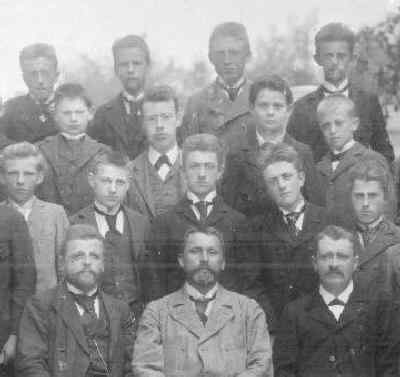
We note quite a few institutional group photographs of German and Austrian children. We think the trends are very similar in both countries. Most of the group photographs of course are photographs at school, often class groups. We also note what look like boarding school photographs. There are other group photographs and they are not easy to destinguish among them when they are not identified. There were not very many boarding schools, but they were some. Some are oprphanages. This would have been particularly common after World War I in the 1920s. We are less sure about the situation after World War II. As in Germany, I think that the school arranged summer and vacation group trips in which the children stayed together in facilities in various vacation spots. Youth groups may have also had camp and other facilities for children. While we do not understand some of the photographs, we think that they are useful to assess them to better understand Austria childhood experiences.
Austrian boys like German boys did not wear school uniforms, except fpr a small number of boys who went to military schools. The boys simply wore their ordinary clothes. Younger boys at the turn of the century often wore the popular sailor suit. Older boys wore various styles of suits, usually without the Eton collars that were so popular in England. Sailor suits became less popular in the 1930s, especially after the Anschlus in 1937. Interestingly after the Anschlus, school children were one of the few groups that did not wear uniforms. Although boys and girls often wore their Hitler Youth uniforms to school. Boys also common wore lederhosen, although these durable leather shorts declined in popularity in the 1960s as jeans became increasingly popular.
Austria has an extensive religious history. Religion is deeply etrenched in Austrian history and played a major role in European history. With the Reformation, Europe was engulfhed in terrible religious wars. Austria was the center of the Catholic Counter Reformation. Austria is primarily associated with the Roman Catholic church, but the coutry's religious history is much more diverse. While Catholics predominate, over tume a spirit of toleration has developed. Austria since he early-Medieval era has been mosly Catholic. Most Austrians are Roman Catholic. The 1971 Census indicated ovr 87 percent. Austria has been affected by the secular trends that have affected all of Europe. The 1991 Census indicated that the percentage of Catholics had declined to 78 percent. The number of Protestants aklso declined. One of Austria's most important minorities were the Jews. There were about 0.2 million Jews in Austria, primarily concentrated in Vienna. Tragically, the NAZIs destroyed Austria's Jewish minority in the Holocaust.
Austrians are still mostly Catholics. Many are culturally Catholic, but do not actively practice. Boys of course dress up to go to church. Often new suits are bought for First Communion, Confirmation, and Firmung.
Folk costumes are popular in Austria. We see boys and girls wearing them, both for special events and vestivals, but for regular wear as well. This is a subject we do not yet know much about. We have just begun to collect information on Austrian folk costumes. There is no single Austrian folk outfit, although there were some similarities. We note regional differences within Austria. There are of course similarities with German folk costumes, especially areas of southern Germany such as Bavaria. There are also similarities with Switzerland, another Alpine area. We have fouind some individual and family portraits with the children dressed up in folk outfits. Hopefully an Austrian reader will provide some background information for us.
We do not know much about Austrian minorities. The Jewish minority was largely destroyed in the Holocaust. There was also a gypsey minority which was targeted by the NAZIs.
HBC at this time knows very little about Austrian clothing and fashion magazines. Hopefully Austraian HBC readers will provide us some basic information on this topic. One reader has mentioned Masche. It was an Austrian sewing magazine for woman with patterns and suggestions about sewing anmd knitting clothes. It was no specially focused on children's clothes, but did include a lot of information on children's outfits. It was first published in 1945. We have information through 1955, but I do not know about its current status. At this time, this is the only Austrian magazine on which we have any information.
We have developed considerable information about Austrian artists. When we first began HBC we knew very little about Austrian artists. We have since compiled a sizeable list. HBC is somewhat unsure how to treat Austrian artists. Ausdtria itself is a very small country so its artistic accomplishments would theoretically be small compared to much lrger countries like France. Austra and its capital of Vienna were, however, the center of a huge eastern and central European empire. Austians until the 19th century were generally considered Germans. With the German artists, nationality can be complicated. There were a large number of German states with the Holy Roman Empire and later the German Confederation. For several centuries the Hapsburg ruler of Austria was always elected emperorof the German Holy Roman Empire. Austria after the Ausrtro-Prussian War (1866) was exccuded by Bismarck from Geramny, but where many which historically has been an essential part of Germany. We will classify non-Austrian painters in the Austro-Hungarian Empire under theiur various nationalities. We note Austrians painting in many different styles. Many of the Austrians we found painted in the clasical realist style.
Austrians as far as can tell were not involved in the reseaech that led to the invention of photography in the 1820s and 30s. As far as we can tell, the industry was slow to develop in Austria after the Daguerreotype appear (1839). We have not found any 1840s dags and 50s dags seem rare. We note Joseph Puchberger invented the first panoramic camera (1843). We have no information on Ambrotypes and Tintypes. The Albertina Museum and research project in Vienna does a lot of work on photography and the graohic arts. We note that two of the three books they offerd on their webite in 2010 about Vienese photography began in 1860. The rarity of early photographs is similar to the pattern in Germany. We do begin to see substantial numbers of Austria photographs in the 1860s with the appearance of the CDV. From this point the photographic industry in Austria seems very similar to that of other German states. (Germany was only unified in 1871). Austrian Karl Klic invented photogravure (1879). This was an important step toward the ability to print photographs. Until this, phoptographs and paintings had to be engraved, an expensive process to be printyed in books and magazines. Photogravure was a relatively inexpensive photomechanical process. One of the best known Austrian photographers is Ernst Haas (1921-86). His gradually moved from experiments with abrstraction to photo journalism. His innovations in color photography are highly regarded. An associate of Haas, Inge Morath (1923-2002) is also highly regarded.
Few personal experiences about Austrian boys clothes are available at this time. Hopefully our Austrian readers will provide us more details about their boyhood expeiences. We have some literary accounts as well as some photographic collections. Readers have contributed some acoounts, bit so far none of our Austrian readers.

Navigate the Boys' Historical Clothing Austrian pages:
[]
[Austrian art ]
[Austrian choirs]
[Austrian Lederhosen]
[Austrian royalty]
[Austrian school uniforms]
[Austrian movies]
[Austrian youth groups]
Navigate the Boys' Historical Clothing Web Site:
[Introduction]
[Activities]
[Biographies]
[Chronology]
[Clothing styles]
[Countries]
[Bibliographies]
[Contributions]
[Essays]
[FAQs]
[German glossary]
[Images]
[Links]
[Registration]
[Tools]
[Boys' Clothing Home]
Navigate the Boys' Historical Clothing national pages:
[Return to the Main Europeans page]
[Return to the Main countries page]
[]
[Bosnia]
[Croatia]
[Czech Republic]
[Hungary]
[Slovakia]
[Slovenia]
[Belgium]
[England]
[France]
[Germany]
[Ireland]
[Italy]
[Scotland]
[Serbia]
[United States]