
Brazlian Ethnic Groups
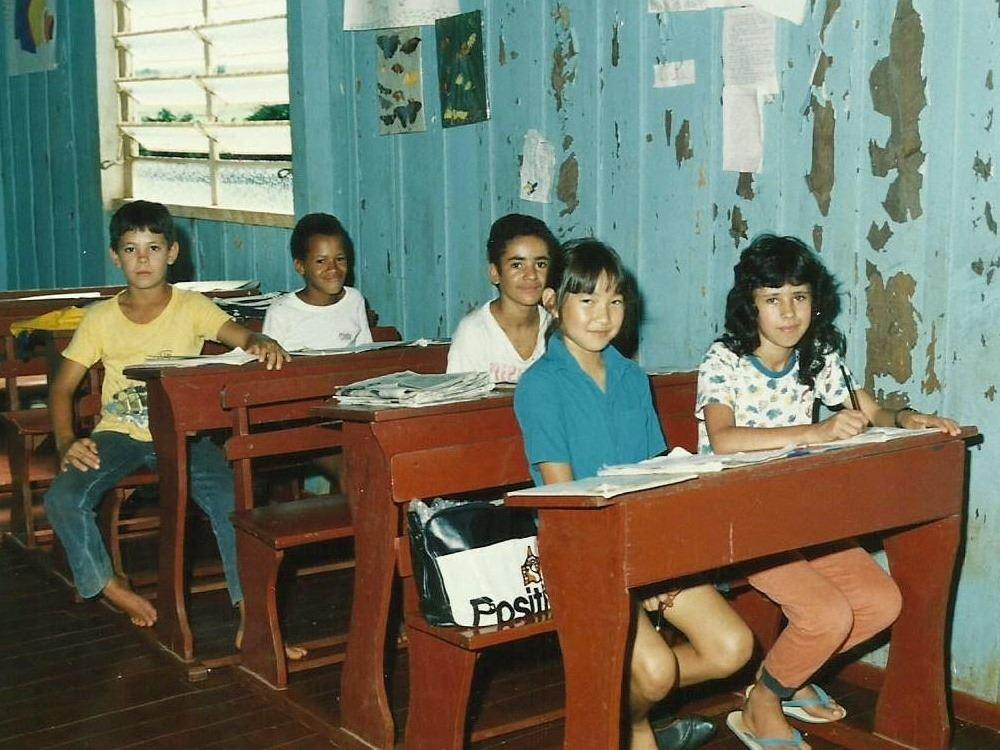
Figure 1.--This photograph shows some of the different faces of Brazil. They are students at a small rural school in the 1970s. It was taken near Curitiba, in Paraná, a state in southeastern Brazil. These one room schools were built in the fazendas. (Fazenda is a term for a plantation, which in the southeast was usually for coffee. Gradually the term is now being used more for farm.) These small mschools were commonly attended by the children of fazenda workers, although we are not sure many fazenda workers by the 1970s were Japanese Brailians.
|
|
There are three important ethnic groups in Brazil: whites (Europeans), pardos (mixed ethnicity) and pretos (black Africans). Whites and pardos are the two most important, roughly equal in size. They consitute about 90 prcent of the the country's population. The pardo group based on physical appearnces is primarily mulato, mixes of whites and blacks. as the native population was largely destroyed. This is misleading, however, as Native American ethnicity has survived in the DNA of modern Brazilians. Something like 10-20 percent of Brazilian ancestry is Native American. The various DNA stydies very widely, but it is clear that the Native American proportion is substantial. he Portuguese did not encounter an advanced Native American civilization. The Native American population collapsed. Mistratement by the Portuguese was a factor, but the major cause was disease. As a result, the ancestors of Portugiese fathers and Native Ameicans did survive vbecause they has a resistance to European diseases that Native amerivans alone did not have. Unable to enslave the Indians, they imported large numbers of African slaves. Many other Europeans have emmigrated to Brazil. Other than Poruguese, the largest European immigrant groyp is Italian. Large numbers of Itlians emigrated to Argentina and Brazil in the late 19th century. These two countries offfered cultural similarities (religion and language). Eventually Italian emigration shifted to the United States because of the greater economic opportunities there. One reader tells us, "Brazil has a large German population, Especially in the southern states Santa Catarina and Rio Grande do Sul thousands of Germans settled there in the 19th century. I have been to the Oktoberfest in Blumenau some years ago, the second largest after Munich. People come from all over Brazil, Argentina and Uruguay to celebrate. The telephone books are full with German names. I noticed that more people spoke German than English with foreigners. Famous German-Brazilians are Oscar Niemeyer, the architect of many government buildings in the capital Brasilia, tennis star Gustavo Kuerten and supermodel Gisele Buendchen, both from Rio Grande do Sul." There is also a Japanese community centered in Sâo Paulo. There was even a group of Confederates that settled in Brazil after the Civil War. There are also Native American groups. One such tribe is Enawene-Nawe.
Whites (Brancos-Europeans)
Whites or brancos meaning Brazilians of European ancestry are the single largest ethnic group in Brazil nearly half the population. The Portuguese are the largest group. And as they were the first to arrive and dominated the colonial administratin and the church, it is Portuguese culture that dominated Brazilian society. We have not yet found a good account of immigration numbers by nationality. We note immigrants from many European countries. nd the distribution of the various nationalities varies substanially by region. We have noted numerous reports about German and Italian immigrants, perhaps because they were relatively recent immigrants. We note some asessments hoing substantial numbers of Spamish and French immigrants which may outnumber the Italians and Germans. So this is a topic we are still working on.
Portuguese
Portugal was the European country which colonized Brazil. Ironically, Portugal is among the smallest European countries and Brazil is essentially half of South America. This is true in both population nd area. Most Brazilian states are larger than Portugal. Portuguese Brazilians (Luso-brasileiros) are Brazilians whose ancestry originates wholly or mostly in Portugal. The Portuguese came first like the Spanish as conquistadores (16th century). Then they came more as settlers (behinning in the 18th century). They are the largest European group in the Brazilian population, although during the late-19th centuty peak period of immigration, the most important group was Italians. Unlike the Italians, Portuguese people began migrating to Brazil in larger numbers and without state support. The importance in the population stems from over 19th century of immigration. Portuguese immigrants have a special status in Brazil and a direct path to citizenship. Brazil declared its independence from Portugal during the Napoleonic Wars, but the special status of Portuguese immigrants continues to this day, granted by the Constitution. Article 12 grants to Portuguese citizens with permanent residence in Brazil "the rights attached to Brazilians". There are no reliable data on how many Brazilians descend from Portuguese ancestors. The Portuguese presence in Brazil is very old, making it virtually impossible to determine the Portuguese share of the population. Most Brazilians have some degree of Portuguese ancestry.
Many Europeans have emigrated to Brazil. Other than Poruguese, the largest European immigrant group in Brazil is Italian. A factor here is that Italy is one of the most populace European country, and the poorest of the major countries. Large numbers of Itlians emigrated to the United States, Argentina, and Brazil in the late-19th century and early 20th-century. Argentina and Brazil offfered cultural similarities (religion and language) that the United states did not offer. And in the 19th century it was not at all clear that America would emerge as such a succesful, rich country. In fact it look at the time that Argentina was going to become a very successful country. And there were high hopes for Brazil as well. As a result, many Italians opted for Argentina and Brazil rather than the United States. Italian emigration began shifting to the United States because of the greater economic opportunities there.
Even larger numbers of Italuans eventually emigrated to the United States, despite the fact that America was a largely Protestant country. Economic opportunity was a major draw, but openess and toleration of cultural differences overcame the cultural similarities of Argentina and Brazil. More than a million Italians entered Brazil, far more than any other nationality (1884-1903). This was the peak period of immigration. The Prinetti Decree (1902) ended subsidised emigration to Brazil. This significantly reduced Italian immigration. After World War I the United States began restricting immigraion. This reduced the options for Italian and other European immigrants. Various sourcs estimate that Italians represent 10-15 percent of the population. This is based on cultural self identification. Actualy etnicity may be somewhat less. Italians are especially imprtant in the São Paulo area. We note the Quadri family in 1927, an Italian immigrant family.
The United States was the primary destination for German emigrants. There was also emigration to Latin America. We believe on factor in the choice was religion. America until the late-19th century was a largely Protesant country. And Latin Americ was alsomost entirely Catholic. Brazil was the main destination for German emigrants. This meant seveal different states. In fact Germany was not unified until 1870 and thee German-speakers outside of Germany. Some 200,000 Germns (meaning German speakers) emograted to Brazil (1820-1940). Most settled in southern Brazil. Many were landless peasants who in Brazil were able to acquire land. They settled as farmers and over time came to become aubtanial population in the south. Thee were also middle-class merchants and eben industrialists who settled in the cities. There they founded German-speaking societies and newspapers there. German pastors, teachers and diplomats were sent by various societies in Germany. The growing German communities in southrn Brazil promoted the preservation of Deutschtum (Germanness) as well as strengthen German economical and political influence in the region. Some Brazilians were uncomfortable that many Gerrman immigrants eemed unwilling to assimilate. They founded schools and churches, and tried to preserve the German language. This was the case in the United States, but apprently to a leser degree. We are not sure just why. One reader tells us, "Brazil has a large German population, especially in the southern states Santa Catarina and Rio Grande do Sul thousands of Germans settled there in the 19th century. I have been to the Oktoberfest in Blumenau some years ago, the second largest after Munich. People come from all over Brazil, Argentina and Uruguay to celebrate. The telephone books are full with German names. I noticed that more people spoke German than English with foreigners. Famous German-Brazilians are Oscar Niemeyer, the architect of many government buildings in the capital Brasilia, tennis star Gustavo Kuerten and supermodel Gisele Buendchen, both from Rio Grande do Sul."
Americans
There was even a group of Confederates that settled in Brazil after the Civil War. At the time, slavery was still legal in Brazil.
Pardos (Multi-ethnic)
Brailians of mixed ethnicity are the other major component of the Brazilian population. At about 45 percent of the population, it is only slightly under the white population. Brazilian academics for what ever reason do not like the standard terms or mixed race people in the America--mestizo and mulatto. The term for mixed race Brazilians is 'pardo'. This is an early Portuguese term for Native Americans meaning naked as the Native amerivans did hot war clothes.
The pardo group based on physical appearnces is primarily mulato, mixes of whites and blacks. Aas the native population was largely destroyed, it was assumed that they had disappeared. And basing ethnicity on sjin color and other physical features mean thr pardos were lareglu thought to be mulatos. The phyical appearance of Native Americans was less visinle. This this was misleading. Ethnologists have discovered that Native American ethnicity has survived as a significant portion of the ethnic heritage of modern Braziliams. This was largely unknown until scientists discovered and began using DNA. Something like 10-20 percent of Brazilian ancestry is Native American. The various DNA stydies very widely, but it is clear that the Native American proportion is substantial. It appears to be less than blacks, nut still a very important component. Native Americans are not an important ethnic groups in modern Brail, but gthey are aan important part of the Brazulian ethnic mix.
Blacks (Africans/Pretos)
The Prtugese word for black is 'preto'. And blacks are the third most imporatnt ethnic group in Brazul, although far below the proportion of whites and pardos. The Portuguese did not encounter an advanced Native American civilization. There certainly was no monumntal architecture. There is now some debate about the nature of Native American civilizations. One matter that is not contested is that the Portuguese were unable to enslave the native people in large numbers. They thus imported large numbers of African slaves. Most came from areas south of the Gulf of Guinea Slave Coast. Angola was especially important. Brazil along with the Caribbean sugar islands were the major destinations for African slavers. Some 5 million Africans may have been brought to Brazil. Brazil was the largest single destination. The voyages for the slavers were much shorter than those to the Caribbean and North America which to some extent refuced the mortalities of the Middle Passage. Slavery became a mjor aspect of Brazilian life--the mainstay of plantation labor. The sugar industry was especially important. In fact it was not possible without slave labor. Portugal pushed by the British finally outlawed the Atlantic slave trade (1850). By this time Brazil of coure was independemt. Thanks to the Royal Navy, the Alantic slave trade was greatly reduced. The donestic slave trade in Brazil continud. Brazil did not abloished slavery until the late 19th-century (1888). Except for the Ottomans and their Arab provinces, Brazil and Spain (Cuba and Purto Rico) was the last jurisdictions to do so. Just before the abolition of slavery, people of African ancestry were a substantial portion of the Brazilian population, something like 20 percent (1872). At the same time, the largest number of European immigrants, especially Italians, were flooding into Brazil. This is in part why the African portion of the population declined in the 20th century. The African ethnic population is noe about 8 percent (2010). This seems a rather small population given the dimensiions of the slave trade transporting slaves yo Brazil. Only about 0.5 million captive Africans were transported to what is now the United States and the black population is about 12 percent. The reason for this discrepanct is the the genocidal nature of sugar plantations, the same situation as in the Caribbean. The economic disparities based on ethnicity are another factor.
There was a substantial Native American population in Brazil at the time of the Portugese discovery. Anthropolgists now disagree as to the nature of the Native Amricans in the Amazonian basin. There aew early reports that not only was there a substantial population, but they had a prosperous agricultural lifestyle. The Portuguese attempted to enslave the Native Americans to work on landed estate. Authors speculate that Portuguese slave raids along the coast and up the rivers forced them to abandon this culture and move into the interior to become hunter gathers. This way they were no longer vulnerable to slave raiders. This may or may not have been the case. The absence of monumental architecture suggests thst they may not have been as advanced as simr have suggested. We do know that the combined impact of Portuguese drepadations and lack of resistance toEuropean disease. The result was a disasterous collapse of the indigenous population. The only artifact of this once vibrant people are the
Caiçara people still fond along the coast in southern Brazil. They are the descendents of Portuguese Conquistadores and native women. The Caiçara seem to be the most prevalent in remote fishing villages. Only the tribes seeking refuge in the vast unexplored interior survived. Thus the survivors were not the advanced cultures the Spanish found in Mexico and Peru with large quantities of gold and silver. Only primitive tribes deep in the Amazon survived. One such tribe is Enawene-Nawe. We have begun to collect information on the Amazonian tribes
Asians
Brazil has a small Asian population from several different countries. The largest single group is Japanese. There is an imortant also a Japanese community centered in Sâo Paulo.
HBC

Related Chronolgy Pages in the Boys' Historical Web Site
[The 1880s]
[The 1890s]
[The 1900s]
[The 1910s]
[The 1920s]
[The 1930s]
[The 1940s]
[The 1930s]
[The 1940s]
[The 1950s]
[The 1960s]
[The 1970s]
[The 1980s]
Related Style Pages in the Boys' Historical Web Site
[Smocks]
[Long pants suits]
[Knicker suits]
[Short pants suits]
[Socks]
[Eton suits]
[Jacket and trousers]
[Blazer]
[School sandals]
[School smocks]
[Sailor suits]
[Pinafores]
[Long stockings]
Navigate the Boys' Historical Clothing Web Page
[Return to the Main Brazilian country page]
[Introduction]
[Activities]
[Biographies]
[Chronology]
[Clothing styles]
[Countries]
[Bibliographies]
[Contributions]
[FAQs]
[Portuguese glossaries]
[Images]
[Links]
[Registration]
[Tools]
[Boys' Clothing Home]
Created: 9:38 PM 1/13/2008
Last updated: 7:44 PM 5/13/2019