
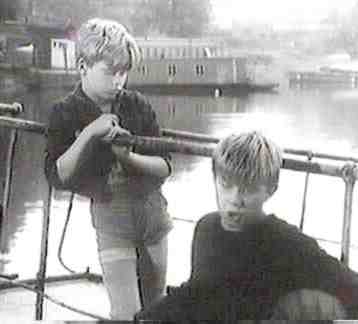
Figure 1.--This Polish movie depicted boys playing on a boat orbarge. It appears to be a clip from a movie. We did not initially know the title of the film. It is 'Paragon, Gola'. One boys wears the short cut shorts that became common during the 1950s with long stockings. A reader dates the film to 1969. We are not sure if the setting is contemporary or the 1950s. Hopefully our Polish readws will know.
|
|
Polish Boys' Clothes: Communist Era
Poland is located between Germany abnd Russia, bith of which have occupied Poland in relatuively recent times. Histgorically Poland has been more associated with Hermant than Russia which until the 18th century was rather isolated from European affaurs, in part because it was ciontrolled by the Mongols/Tatars. Poland lost a struggle with Russia to control Ukraine (17th century). Most of Poland was annexed by Russia (18th century), ending indpendent Polish life. It is at this time that Russian influences increase. Poland reappeared after World War I (1914-18). The Poles had to fight a War with the Soviets (1920-21) to maintain their indepehndence. Thus trade and cultural relations were mostly with Germant. Thus we see a stong German influence in fashionn. During World War II, Poland was caught between Hitler and Stalin with disaterous consequences for the Polish people. After theWar, Stalin installed a pupet Communist regime. We so not yet know much about fashion trends as we have so few images from the era. We jave found a Polish film that proivides ome views of period boys' clothing.
Historical Background: Post-War Era
Russian "liberation" resulted in the reserection of an independent Poland. The border was pushed far to the west. Territory adquired by the Soviets in the east was replaced by former German Silessia and other territories in the East. Millions of people were forcibly moved, the Poles by the Soviets in the east and the Getrmans by the Poles in the west. A provisional government was set up under Soviet auspices. Government-controlled elections in 1947 ensured that the Communists could seize full control, and in 1952 Poland became a People's Republic on the Soviet model. The following years were a cycle of Soviet mandated supression followed by brief periods of relaxation. The Russians did all they could to recast Poland in the Soviet mold. The Church and the strength of Polish nationalism made this difficult from the start. It was eventually Poland, spearheaded by the Solidarity movement, that led to the unraveling of Russia's Eastern European Empire in the 1980s and eventually the Soviet Union itself.
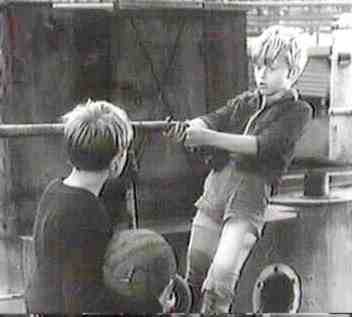
Figure 2.--Many boy in the cooler weather continued wearing short pants, but might wear them with long stockings and later tights.
|
|
Clothing Trends
We have few details so far on Polish clothing trends during the post-War wea. We notice a shift from German infuences abd styles before the War to Soviet infliences after the War. factor here is East Germany which was also influenced by Soviet trends. This it is difficult to sort out influences fom the Soviet Union directly and through East Hermny. This included fashion influences. Some basic information, however, is available. As in Western Europe there appears to have been a major shift in clothing styles in the late 1960s and early 1970s. Unfortuntely we have managed to archive very few photographic images from the era.
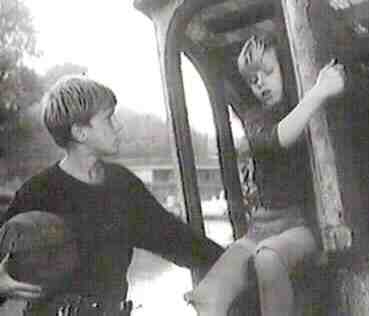
Figure 3.--Many boy in the cooler weather continued wearing short pants, but might wear them with long stockings or tights.
|
|
Post War era (1945-70)
Poland was desvestated by World War II and the organized NAZI plunder of the country. No country suffered more. In addition
to the horendous lost of life, the economy was devestated. Factories were in ruin and few jobs existed. Families were separated. Conditions were very poor after the war as so much of the country had been damaged. Millions of Poles were packed into boxed cars and shipped west by the Russians. The Poles inturn expelled Germans. Parenrs had little money to buy clothes and thus could not afford stylish clothes even if the wanted to do so. In addition, the new political regime affected clothing styles. The Soviet controlled Communist Government distrusted people from weatly bourgeois families. People
were sent to concentration camps on the merest suspicions. Thus it was not wise to dress children in stylish suits drawing attention to the family. Boys commonly wore short pants. The style was for quite short cut shorts in the 1940s and 50s. Many boys in the difficult years follow the War wore their clothes even after they had grown out of them. Thus quite
old boys in the 1940s and early 1950s were wearing short pants--even short pants suits. Kinckers went out of style and were rarely seen afterthe late 1940s. Even older boys wore shorts through the 1950s and into the 1960s. Little boys
might wear short pants even during the cold winter months. The idea apparently was that short pants were boys clothes--not seasonal attire. The long stockings that boys had worn during the winter were replaced by tights by the early 1950s, but by the 1960s were becoming less common for boys, although girls still wore them. The sandals that boys had often worn before the War disappeared. Boys wore canvas shoes for play, but leather shoes for school or special occasions
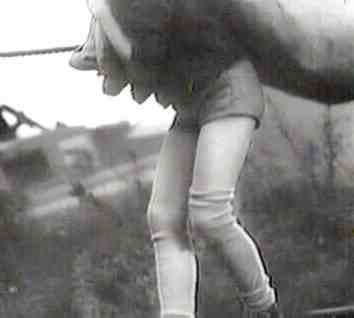
Figure 4.--Polish boys commonly wore long over the knee stockings and
tights in the 1950s. They were eventually replaced with tights, but HBC is unsure of the precise chronology. We believe that tights began to replave long stockings probably about 1970.
|
|
Later Era (1970-89)
Even the Iron Curtain could not keep out poweful lure of western fashion. Many observers believe that the alure of western
consumerism was the principal reason for the fall of Communist Governments in Poland and other Eastern European countries.
Boys clothes began to change in the 1960s. We still see long stockings in the1960s, but as in the Soviet Union, thry very rapidly disappeared at the end of the decade. Two trends were at play here. First, tights were intriduced abd vry commonly replsced long sgockings. And we see short pants declining as boys wear, especially during ghe winter months. Older boys by the 1970s were no longer wearing shorts. Gradually blue jeans became the fashion of choice, although for many years they were mostly worn by teenagers and were enormously expensive as they had to be imported. They thus became a status symbol. Domestically produced jeans were gen erlly of inferior quality.
HBC

Navigate the Boys' Historical Clothing Web Site:
[Introduction]
[Activities]
[Biographies]
[Bibliographies]
[Chronology]
[Clothing styles]
[Country]
[Photography]
[Contributions]
[FAQs]
[Glossaries]
[Images]
[Links]
[Registration]
[Boys' Clothing Home]
Navigate the Boys' Historical Clothing Polish pages:
[Polish choirs]
[Polish movies]
[Polish orphanages]
[Polish school uniforms]
[Polish sailor suits]
[Polish youth groups]
Navigate the Boys' Historical Clothing Web Site:
[Return to the Main country page]
[Return to the Main Polish page]
[Australia]
[Canada]
[England]
[France]
[Germany]
[Ireland]
[Italy]
[Mexico]
[New Zealand]
[Russia]
[Scotland]
[United States]
Last updated: March 15, 1998
Last updated: 5:34 AM 1/31/2013