|
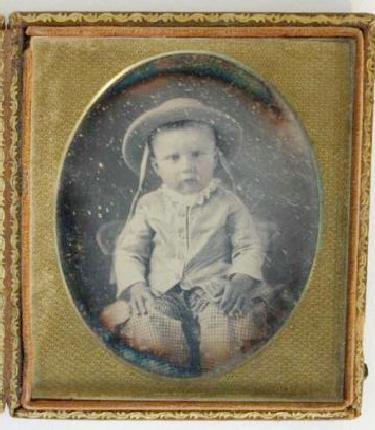
It was commonn to dress younger boys in dresses and other skirted garments. We are not entirely sure about colonial America, but we believe this was common. We have much more information on the 19th century. It was quite common for boys to wear skirted garments until they began school at about age 6 years. There was, however no hard and fast rule. We note quite young boys who have been breeched and wearing trousers. Apparently they never wore dresses as boys. We believe that the most common convention was for the younger boys to wear skirted garments. What varied widely was the age of breeching. We notice boys older than 6 years wearing skirted grments. Conventions here varied greatly from family to family. Families varied as to the age of breeching as well as whether to cut a boy's hair before or after breeching. We see boys at many different ages wearing dresses. Social class was a factor, especially for older boys waring skirted garments. Younger boys still wore dresses in the early 20th century, but the fashion was going out of style and rarely seen after World War I, except for very yong boys. We have not yet developed the subject of breeching in America inn much detail. We have, however worked on the topic of breeching in general.
American boys like boys in other countries have worn a variety of skirted garments. The conventions involved was essentially brought to America by European immigrants. Thus fashion trends in Britain, Ireland, and Germany were especially important. There were substantial differences among families as to the conventions. Social class was an important influence. The styles and conventions involved have varied over time. It was very common for younger boys to werars dresses and other skirted garmens. The skirted garments have inclided dresses, skirts, kilts, and tunics as well as smocks and pinafores. For many years the styles worn by boys and girls were essentially identical, but in the late 19th century you begin to see boy-styled dresses. Boys still wore these garments in the late 19th century, but they rapidly went out of fashion after the turn of the 20th century and were no longer commonly seen after World War I. Dresses disappered first. Tunics were worn a lottlke longer. It is not entirely clear why a convention that persisted for so many years disappeared so quickly. The garment that persisted the longest was the tunic. Kilts are occassionally worn, but primarily at ethnic events like Scottish Highland gatterings,Irish feishes, and Greek celebrations.
Breeching depended somewhat on the type of shirted farment the boy was wearing. Dresses and skirts were prtty straignt forward. Both boys and girls normally wore pantalettes with both these garments in the 19th century. Kilted garments were a little different. We were are not entirely sure what was worn with Hihjland kilts. And in this casethe boys were often already breched. This depended somewhat on the age of the boy. Jighland kilts could be worn bu younger boys not yet breeched as well as older boys already breecjd. In the later case it woyld have been just one outfit and the boy probnlu had suits with pants. Highland kilts were much less common in American than Scotland or even England. Klit suits were a very different matter indeed. Nowhere were kiltsuits so prevlenbt as jn America. We se them in Scotland and England as well as in other countries. But it was in America that the kiltsuit was atandad item for boys, at least middle-class boys. And here a boy mat have been breeched, at least we see some boys wearing matching pants with kilt suits. We are not entirely sure, however, that this constituted breeching, we have never seen any written references to it. Tunic suits were a special case. Tunics were worn with bloomer knickers. Thus the boy would have been breched for this skirted garments. We are not syure, however, if these boys wore other kinds of pants besides bloomer knickers. This of course can not be determined unless perhaps we have a family lbum.
We are not entirely sure about colonial America, but we believe it was common for little boys to wear dressed in the 17th and 18th centuries. We are not at all sure as to the age that boys were breeched in the colonial era. We have much more information on the 19th century, largely because photography became commercially viable in the 1840s. Family portraits provide valuable informatiion on breeching conventions. We see boys wearing dresses throughout the 19th century. At the end of the century in the 1890s we see fewer boys wearing dresses and being breeched at an earlier age. especially older boys. Many boys wearing skirted garments wore kilt suits rather than dresses. Younger boys still wore dresses in the early-20th century, but only relatively little boys. The fashion of boys wearing dresses was going out of style and rarely seen after World War I, except for infants and younger todlers.
The age at which American boys were breeched is an interesting question. Here there is not a great deal written about. We suspect it was a subject discussed within the family. And it may have been a topic appeqaring in letters. We have not been able to find many letters in which the subject is raised. Fashion magazines may have contained references or domestic advise articles and publications. This is all information we would like to acquire. At this time, however, are primary source of information is the photographic record. We can estimate the ages of boys even when the age is not indicated. Particularly helpful are family portraits in wgich bith breeched abnd unbreeched xhildren are shiwn. This permits us to estimate the approximate age of breeching in a particular family. We see boys at many different ages wearing dresses and other skirted garments. A good example is a Stanton boy wearing a kilt suit at about 4-5 years of age during the 1880s. So we know he would have been breeched at about age 5-6 years old. It was quite common for boys to wear skirted garments until they began school at about age 6 years. There was, however no hard and fast rule. We note quite young boys who have been breeched and wearing trousers. Apparently they never wore dresses as boys. We believe that the most common convention was for the younger boys to wear skirted garments. What varied widely was the age of breeching. We notice boys older than 6 years wearing skirted grments.
Conventions concerning breecing and hair styling varied greatly from family to family. Families varied as to the age of breeching as well as whether to cut a boy's hair before or after breeching. Thus you see boys with their hair cut before they were breeched. We note a variety of longer hair styles, including ringlet curls. Other bots had their hair cut at the same time they were breeched. Another option was delaing the cutting of their curls until after they were breeched. And the actual ages varied as well. There was no established conventions for all this. It was entirely up the family, usually the mother. Most of this was done before age 6, but some older boys were involved as well. And all this was further complicated with hair bows, types of skirted garments, and chronological trends.
Social class was a factor, especially for older boys waring skirted garments.
There are several useful sources of information on breeching. The most useful are family correspondence and published accounts from family members. These are difficult to find. Individuals often do not recall their early childhood and thus such events, no matter how important at the time, are often not remembered. We have primarily relied on the photographic record for HBC. Portraits of boys in skirted outfits are common and useful, but they do not tell us when a boy was actually breeched. Sone of the most useful images are family portraits. The ages of the boys in skirted outfits and pants can help determine the approximate age of breeching for that particular family. A good example is the Drowne boys in the 1870s. The problem with using the photographic record, however, is that the children are often not identified. Thus in many cases we do not know who the children in skirted garments are.
One unanseweed question about breeching is why did boys after centuries of wearung dresses when they were young syddenly stoped wearing dresses and the breeching event ceased to exist. Thuis coinventiin disappeared relatively quickly. Within 10 years (1895-1905) in bdecame much less common. Annd after World War I in the 1920s it had bvecome a realtive rarity. We believe one factor as to why this change took place around the turn of the 20th century is the emense popularity of the Little Lord Fauntleroy suit. Fashionable mothers wanted to dress their sons, including very young boys in Fauntleroy suits. This was thus a strong motive for breeching much earlier than had been the case earlier. If you read the literature on this, one reason is reported over and over--toilet training. Now we think it is clear that toilet training is a factor. It is absolutely the case that boys' clothing through the 19th century and into the early-20th century was complicated, virtually impossible for a todler boy to affress on his on. Skirted garments were ceasier to out on and take off. This did not change until thr 1910s and 20s. It is also true that boys are more difficult to toilet train than girls. As a result, it does not seen reasobable thatthe decline of boys wearing dresses wouuld have behin the decline in the late-1890s decade if toilet training was so important. It seems to us that there must have been other factors involved. As detailed above, we believe Little Lord Fauntleroy suits were involved. And by the 1900s dedcade, we also suspect that many grown up boys recalled their experiences with Fauntleroy suits and may have been more atuned to how their sons were dressed. Previously, how the younger children were dressed, was the exclusive province of the mothers. Gender roles began to change after the turn of the century. This was reflected in legal changes including voting rights. Women began to play a greater role in the workplace. This affected how gender roles were preceived. Other factors may have been involved, but by the time of World War I, gender connventioins for whatever reason were becoming increasingly impotant. It no longer set well with many fathers to see their sons weraing dresses.
We have not yet developed the subject of breeching in America inn much detail. We have, however worked on the topic of breeching in general. One of the least studied events of boyhood by social historians is breeching, a major rite of passage for boys. This event for centuries was an important event in a boy's life until the 1920s. Boys until that time wore dresses. For several centuries European and American boys wore dresses just like their sisters, with perhaps only little clues such as sashes to distinguish them. By the late 19th century, some dresses were made specifically for boys, usually plainer than the styles for girls. Boys did not, however, always get these boy dresses. Many dresses were designated as "children's styles" for both boys and girls. Some mothers did not like these plainer styles and purchased the more elaborate girls' styles for their sons. Other boys inherited the hand-me-downs of their older sisters. I hope to acquire references to breeching in the correspondence of mothers. There appears to be relatively few accounts on the part of boys as they were rather young to remember much. (More accounts appear to exist about Little Lord Fauntleroy and curls as the boys were generally older. Happily the developing science of photography have beginning in the 1840s has left us some actual images of the breeching process.
We have collected several images of individual American boys show then before and after breeching. Or we see family portraits which provide some breeching clues. Here it can be complicated to assess because in many available portraits, the children are not identified. It is sometimes possible to assess agee and thus the time of breeching. But in other portraits it is more comolicated. A good examole is an unidentified family photohraphed in Randal's studio, we think in the 1880s. We also have portraits taken at different times. Here the time frame varies somewhat. We note unidentified brothers and sister from West Union, Iowa in the 1890s.

Navigate the Historic Boys' Clothing Web dress pages:
[Return to the Main U.S. skirted garment page]
[Return to the Main U.S. national dress page]
[Pinafores]
[Ringlet curls]
[Smocks]
[Bodice kilts]
[Kilts]
[Fauntleroy dresses]
[Sailor dresses]
[Fancy dresses]
[Dresses: 16th-18th centuries]
[Dresses: Early-Mid-19th century]
[Dresses: Late-19th century]
[Dresses: Early 20th century]
[Difficult images]
[Movie dresses]
Navigate the Boys' Historical Clothing Web Site:
[Introduction]
[Activities]
[Biographies]
[Chronology]
[Clothing styles]
[Countries]
[Bibliographies]
[Contributions]
[Essays]
[FAQs]
[Glossaries]
[Images]
[Links]
[Registration]
[Tools]
[Boys' Clothing Home]