|
The Inca Empire lasted only a short period before being cut short by the arrival of Franciso Pizarro and his Spanish Conquistadores. The Spanish wanted gold, but it would be the lowly potato that was Peru's great contribution to human society. The feats of the Spanish Conquistadores are some of the most dramatic accounts in history. The conquest of Peru is one of these epic feats. Here we can not begin to do justice to the story other than outline it for the casual reader. A great empire was destroyed by a handful of Spanish adventurers led by an obscure, illiterate commander who grew up illegitimate and poor. Francisco Pizarro landed on the Pacific coast of South America with a force of only 167 soldiers. The Incas had constructed a great empire stretching from modern day Ecuador south to Chile. The Incas had not yet developed technologies common in the West such as metal tools, the wheel, and a written language, but they had developed a rich culture and agriculture which in many ways was more productive than modern Peruvian agriculture. The Inca Empire fielded vast armies and constructed powerful fortifications. Pizarro knew relatively little about the Inca, but he considered Cortez's strategy in Mexico and had decided to pursue a similar approach. Pizarro on arriving in the Inca Empire sent message to the Inca Emperor Atahualpa and like Cortez in Mexico managed to take him prisoner and destroy a great empire. Pizarro was able to succeed with even a smaller force than Cortez. As in Mexico, the story is one of courage and audacity mingled with avarice, treachery, and cruelty and stands in sharp contrast to that of North America where colonization was largely based on the desire for religious expression and land to farm. The gold and silver from Peru combined with that from Mexico turned Spain with its powerful army into a European super power. Inca society was destroyed in the collision with the Conquistadores and the Catholic Church. The Spanish Conquest of Peru is one of the great epics of history. Europeans diseases ravaged the Native American peoples. The pre-Conquest population and the extent of the resulting plagues is still debated by historians, but population estimates have risen in recent yeas as are estimates of the totality od the size of the population disaster.
Spain for most of European history has been a poor country, often a backwater located as it is in the Atlantic fringe. Here climate was a factor. Much of the country is relatively arid. Thus as wealth was until the 19th century primarily a function of agricultural productivity, Spain was relatively poor. In Roman times it was especially important for its mines. Much of the Iberian Peninsula is unsuitable for agriculture. Rain is sparse and the land heavily corrugated. At a time when agriculture was the primary producer of wealth, this left Spain and its people poor. Spain at the beginning of the 16th century, however, suddenly became the most powerful country in Europe. [Wells. p. 658.] Spain had finally after several centuries achieved the Reconquista. The Reconquista had sharpened Spain's martial skills. The marriage of Ferdinand and Isabella had united the two major Spanish kingdoms. With Europe's most powerful army, Spain desired to expand. There was, however, Muslim kingdoms to the south across the Straits of Gibraltar and the French kingdom to the north across the Pyrenees that were able to resist even the Spanish army. This left overseas maritime conquest as the only realistic outlet for Spanish expansionism. And this expansion brought Spain immense wealth in gold and silver, first from Mexico and then from Peru. The vast riches plundered from native American allowed Spain for a brief period to dominate Europe.
Francisco Pizarro was one of the most renowned Spanish conquistador who led the Spanish in their conquest of the Inca Empire. He was born in Trujillo. He was the illegitimate son of a Spanish gentleman (minor noble). Little is known of his childhood. Pizarro grew up in poverty and was a swineherd as a boy. He was not schooled and like many with his background illiterate. He decided to seek his fortune with Ojeda in the New World (1510). He arrived in Hispaniola and then joined an expedition led by Nuñez de Balboa, serving as his chief lieutenant. The expedition crossed the Isthmus of Panama and were the first Europeans to see the Pacific from the New World (1513). Pizarro settled in Panama (1519) where he led a prosperous life compared to his early life in Spain.
Spanish sailors returned to Peru with rumors of a rich and powerful empire south of Panama. After hearing rumors of a empire of vast wealth to the south of Panama, Pizarro formed an association with Diego de Almagro, Ferando de Luque, and others to explore the Pacific coast of
South America and conquer any important native kingdom they may find there. De Luque was a priest who played an important role in obtaining funds. The partners organized three private expeditions in the conquistador tradition (1522, 1524, and 1526). These expeditions encountered great difficulties because of the lack of understanding of local conditions and marine currents. The first expedition reached the San Juan River, the coastal boundary between modern Ecuador and Colombia, but the expedition brought no tangible gain. The second expedition penetrated further south (1526-28). Pizarro explored the swampy coast of norther Ecuador and moved south. He reached a northern outpost of the Inca Empire, Tumbez. Here he acquired three Inca youths to train as interpreters. His pilot, Bartolomé Ruiz, continued further south, crossing the equator and then returned with reports of rich realms to the south.
Pizarro with the knowledge and information he had collected traveled to Spain to seek assistance and royal authorization (1528). Emperor Charles V granted Pizarro and his associates permission, but the arrangement meant that most of the profits of the enterprise would go to the royal treasury. Pizarro returned to Panama with a contract, a capitulacion. Charles named him the Governor of Peru, and ennobled 13 associates.
The Incas were one of the great naive American civilizations of the Americas. Some writers romanticize the Incas and other native American peoples. Their achievements were remarkable, but they were a still neolithic civilization, perhaps 2-3 millennia behind the technology of Europe and Asia, comparable to pre-dynastic Egypt or the Sumerians. [Wells, p. 656.] The interesting question is why the technology of native Americans was so retarded. We have never noted a fully satisfying assessment of this question. Surely a primary factor was the total isolation of the Americas. There was o Silk Road connecting America with Europe or Asia or even connecting the two great civilizations within the Americas. With a capital located high in the Andes at Cuzco in modern Peru, the Inca carved out a vast empire stretching along the Pacific coast of South America from Ecuador south to central Chile. The Empire included land of great climatic and geographical extremes. There coastal deserts where it almost never rained. The Atacama Desert is the driest on earth. The Andes is one of the highest mountain ranges in the world with peaks towering above 22,000 feet. The eastern slopes of the Andes descend into steamy Amazonian rain forests. A contemporary Spanish author considered these areas uninhabitable. [Pedro Cieza de Le�n] The Inca eked arable land out of precipitous slopes by terracing it. The coastal desert was made arable by an extensive irrigation system. These technically advanced system produced food for a population of an estimated 12 million people. Some areas cultivated by the Inca were more productive than in modern Peru.
The Inca economic system was a form of pure state socialism. No money existed in the Empire. Nobles paid their retainers in clothing and food. Peasants contributed their labor as a form of taxation. The Inca also constructed a vast road network stretching 10,000-miles and radiating out from Cuzco. Despite these technological refinements, the Inca had no written language. They did have a system of colored and knotted ropes called a quipu to maintain records. While the Inca had no metal tools, they did refine silver and god which they fashioned into beautiful jewelry and objects, often for religious purposes. The Inca in contrast to the Spanish admired silver and gold for its beauty, not for its monetary value. Gold was seen as the "sweat of the sun" and silver as the "tears of the moon". The Inca religion was centered on the Sun God. The Inca believed that the Sun God had entrusted gold and silver with them for safekeeping. All the gold and silver of the Empire belonged to the Emperor or Inca. (The term is used for both the emperor and the people.) Gold and silver was used to fashion jewelery and decorative objects for palaces and temples and to reward loyal retainers. Most of the Inca gold came from nuggets and flakes in streams and rivers running down from the mountains. The Inca conquered many other cultures in building their empire. One of those cultures were the Chimu, a coastal people who had developed great skill in metal working. Most of the magnificent Inca gold and silver objects have been lost because the Spanish smelted them down for shipment back to Spain.
The vast Inca Empire was completely unknown to Europeans. Pizarro had managed to learn some sketchy details. Civil war had weakened the Empire after the death of Huyana Capac (1525). His two sons, half brothers Huáscar and Atahualpa, struggled for control. Huáscar was selected by the court elite in Cuzco. Atahualpa controlled much of the army and possesed newly conquered northern regions (modern Ecuador and parts of Columbia). This set in process a civil war between the two half brothers . The war was bitterly fought, causing great dame to the economy and important cities. Large numbers of people were killed in the fighting or died as a result of the destruction. Only months before Pizarro arrived, Atahualpa's army finally decisively defeated Huáscar's army. Atahualpa captured Huáscar and had him executed.
Columbus thought he has reached the Indies off Asia (1492). Soon the Spanish realized that they had discovered a new continent. At first they were content with settling the Caribbean Islands--the Spanish Main. Settlers in Cuba began hearing rumors of a fabulously wealthy mainland empire. Conquistador Hernando Cortez set out for riches in Mexico (1519). He managed to bring down the Aztec Empire with a smll force, primarily by seizing Emperor Moctezuma and aquired unhearsof wealth. The Maya were more of a problem because there was no central state, but the Conquistadores drove them into the Guatemalan hinterlands. Then rumors began circulating of a vast and rich South American empire. This was the Inca, the third of the great Native American empires centered in the hifh Andes which were largely unknown to the Spanish. Conquistador Francisco Pizarro set out with Cortez's tactics in mind and an equal thirst for gold. He set out with mere 200 men and a few war horses to conquer the Inca (1532). He knew as little about the Inca as the Inca knew about him, but he did have Cortez's successful tactics in mind. European diseases had preceeded him as well as an Inca civil war which had weakened the Empire. A handfull of Conquistadores as in Mexico managed to seize the Emperor--Atahualpa. They then proceeded to conquer an empire of millions ruled by a warrior class. Pizarro found what he was looking for, gold and silver beyond his widest dreams. As in Mexico Pizarro and his men would as aresult become fabulously wealthy.
With the lifting of the siege, Pizarro began founding new settlements. The most important was the new capital--Lima. Land and the peasants living on it was allocated as encomiendas to Pizarro's followers.
Relations between Pizarro and Almagro began to deteriorate even before the expedition to Peru was launched. These disagreements intensified as the question of how to divide the spoils arose. Pizarro's partner Almagro, became his principal rival. The result was a civil war among the Spanish. The fighting in the first civil war lasted from 1535 to 1548. The situation was complicated when Pedro de Alvarado attempted to claim Quito. Sebastián de Benalcázar and Almagro prevented this. Pizarro subsequently made a pact with Almagro, whom he had already cheated several times in the division of the Inca spoils. Pizarro offered him the opportunity to conquer Chile, the southern reaches of the Inca Empire. Amargo finally frustrated by his dealings with Pizarro. He attempted to get what he thought was his due by seizing Cuzco. Pizarro ordered his half brother, Hernando Pizarro, to Cuzco. Hernando in a pitched battle on the plains near Cuzco defeated Almagro's forces, arrestd him, and then had him executed (1539). Francisco's greed and ambition his said to have been even among conquistadores--which says a great deal. Two years later Almagro loyalists retaliated. They surprised him at dinner. He reportedly fought desperately, despite his age. They overpowered and slayed him (1541). [Prescot]
King Charles I appointed Christobal Vaca de Castro as Governor of Peru, who, with the aid of the Pizarro loyalists, ended the political crisis. The new royal governor arrived in Peru after Pizarro's death. He attempted to enforce The New Laws of 1542 which greatly restricted the abuses perpetrated by the encomenderos on the natives as part of the Encomienda System. Francisco had appointed his brother Gonzalo Pizarro governor of Quito, which was a province of Peru and under the authority of the new royal governor.
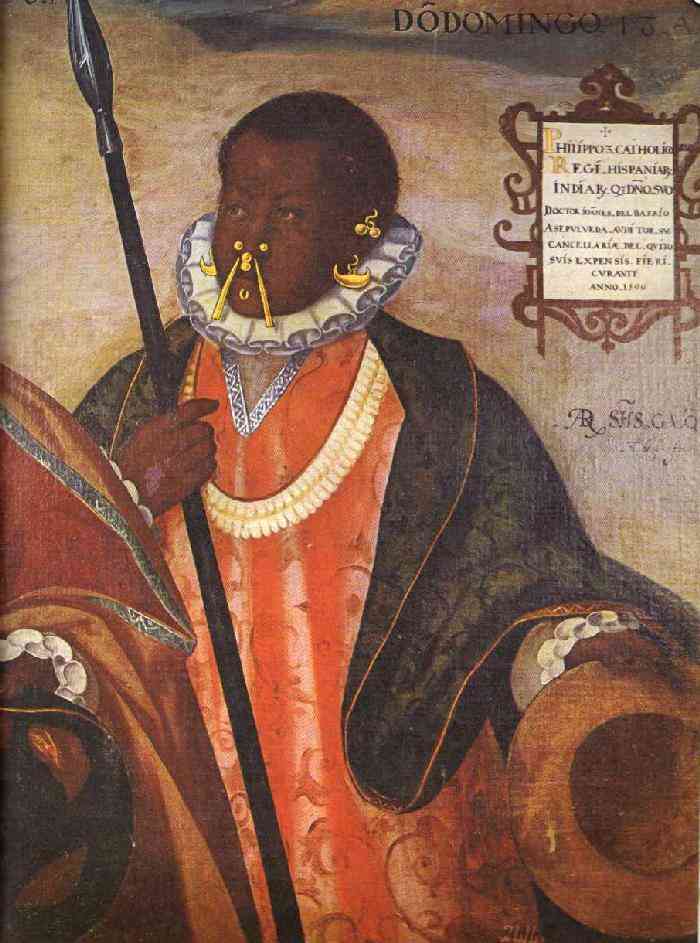
Slowly Spanish civil society began to develop in Peru. Spanish towns were founded in Inca towns, including Tumbes, Cajamarca, Lima, Quito, and Piura. Spanish social and economic structure developed. The population continued to be overwhelming native Americans. The Spanish also brought in African slaves to work in the hot coastal areas. One report indicates that by 1560 even the African slave population outnumbered the Spanish.
The natives were terribly abused by their new masters. There are many accounts of horrendous cruelties. Some caution is needed because in Europe religious wars had begun and the Spain had become a major supporter of the Catholic cause. The Protestants circulate accounts of Spanish cruelties, including both the inquisition and the treatment of the native Americans. The natives were, however, not without their defenders. The Dominicans became major defenders of the natives. The most notable defender was Spanish planter and slave owner in Cuba whose conscious led him to the Church and priesthood--Las Casas. [Wells, p. 658.]
The story of the conquest is one of courage and audacity mingled with avarice, treachery, loot, and cruelty and stands in sharp contrast to that of North America where colonization was largely based on the desire for religious expression and land to farm. The conquest was to have a major impact on Europe. The gold and silver bullion had a major impact on European economies. In the long run it may have been the lowly potato that had the greatest impact.
Cieza de León, Pedro
De Xeres, Francisco. Narrative of the Conquest of Peru, 1530-34. Xeres was Pizarro's secretary.
Prescott, W.H. History of the Conquest of Peru (1847). This is the classic account of the conquest. Prescott was a blind Massachusetts historian. His studies of the conquest of Mexico and Peru are perhaps the two best written studies of the Conquistadores. Although Prescott did not have the benefit of modern scholarship, his studies are not only very well written but historically accurate.
Pizarro, Pedro. Relation of the Discovery and Conquest of the Kingdoms of Peru (translated 1921).
Wells, H.G. The Outline of History: The Whole Story of Man (Doubleday: New York, 1971), 1103p.

Navigate the Children in History Website:
[Return to Main conquest of the Americas page]
[Return to Main Inca page]
[Return to Spain and the Americas]
[Return to Main 16th century wars page]
[Return to Main Peruviann history page]
[About Us]
[Introduction]
[Biographies]
[Chronology]
[Climatology]
[Clothing]
[Disease and Health]
[Economics]
[Freedom]
[Geography]
[History]
[Human Nature]
[Ideology]
[Law]
[Nationalism]
[Presidents]
[Religion]
[Royalty]
[Science]
[Social Class]
[Bibliographies]
[Contributions]
[FAQs]
[Glossaries]
[Images]
[Links]
[Registration]
[Tools]
[Children in History Home]