***
history chronologies native American civilizations -- the Inca Incans Inka
Native American Civilizations: The Inca
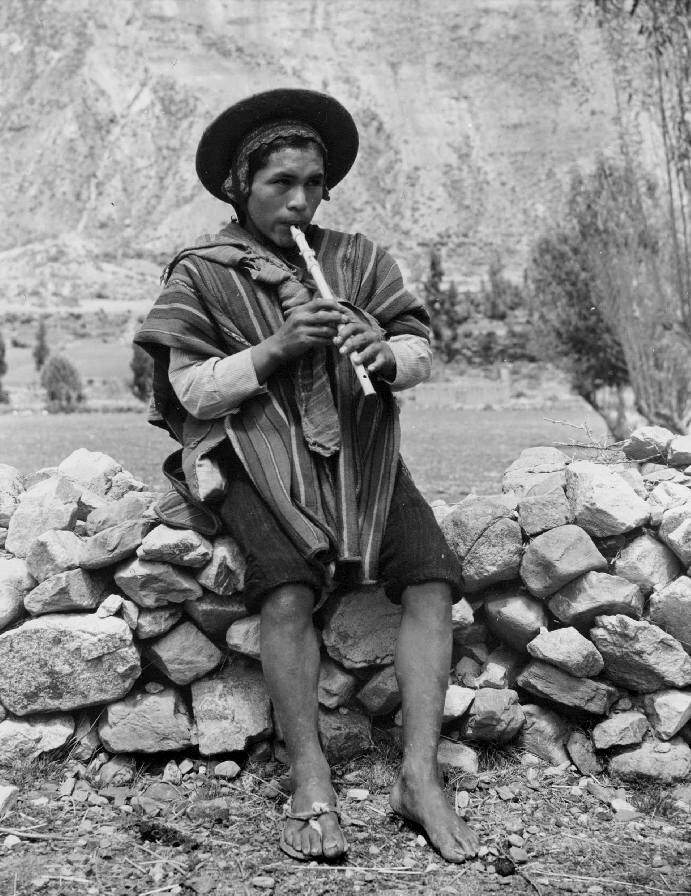
Figure 1.--This Quechua boy was photographed near Machu Pichu in 1940. Quechua was the language of the Inca and is still spoken in Peru and Bolivia. He is dressed in some ways like the Inca. The round-brimmed hat is European. as are the pants. We believe the flute was Incan.
The Inca until the early 15th century were but one of a large number of tribes situated in the Andes and narrow coastal plain from Chile north to Colombia. The tribes shared many common cultural cahracteristoics. The Inca were possessed with a messianic creed which taught that they were destined to dominate the world. They proceeded to conquer and assimilate neighboring tribes in southern Peru around Lake Titicaca. at the beginning of the 15th entury the Inca was just one of large number of Andean and costal tribes. Then there was an amazing explosioin out of their mountain domain and within 100 years carved out an emense empire. Theh absorbed conquered peoples relatively beningly as long as thy accepted the Inca Sun God. The Inca had a genius for public administration, enineering, as well as military strategy. One of their mostal notable inovations was the construction of a road network allowing the rapid movement of armies. Runners operating rather like pony express riders moved messages with great rapidity from th most remote imperial outposts to the capital at Cuzco. Eventually this network streached the length of South America from cebtral Chile to southern Colombia--over 2,500 miles. Terraces were carved out of steep mountains, creating cultivateable land.
These teraces were notable engineering achievements. The Inca were master weavers. The nobility wore garments woven from vicuña. The common people wore garments wove from the more course llama wool. There was no written language, but records were kept by Quipus--colored and knoted strings. The most important Inca ruler was Pachacuti (He Who Shakes the Earth) who regined from 1438-1471 and helped create the administrative structure needed for a great empire. The
Incan Empire was operate on a system of state socialism. The Empire's output was the property of the Emperor or Inca and he distribute the food and clothing that wa produced among his subjects as he saw fit. To the Inca, the gods resided in their native Andean mountains. The Inca placated the gods with offerings of corn, chica, meat, and occasionally human sacrifices. The Inca were conquered and systematically plundered by Spanish conquistadors. The gold and silver treasures were smelted down and thast bullion as well as the humble potato fundamentally changed European society.
Chronology
The origins of the Inca are unknown. The Inca Empire was relastively short lived , lasting less than 100 years. The Inca until the early 15th century were but one of a large number of tribes situated in the Andes and narrow coastal plain from Chile north to Colombia. The tribes shared many common cultural cahracteristics. The Inca were possessed with a messianic creed which taught that they were destined to dominate the world. The Inca within 50 years conquered an empire carved out of modern Peru, Bolivia, northern Argentina, Chile, and Ecuador. Pachacuti and his descendents conquered and assimilate neighboring tribes in southern Peru around Lake Titicaca The Empire was founded by Pachacuti Inca who began conquering territory and negighboiring tribes in the southern highlands around Cuzco (1438). Then there was an amazing explosioin out of their mountain domain.
The Inca first targeted the other Aymara-speaking tribes along the shore of Lake Titicaca (the Colla and Lupaca). The Inca then moved against the Chanca to the west a war the Inca nearly loist when the Chanca attacked Cuzco. Other tribes offered less resistance. Tribes to the north were conquered as far as Quito (Ecuador). One tribe which did resist were the Chimú along the northern coast of modern Peru. Topa Inca followed his father's successes by moving south and coinquering much of northern Chile to the Maule River which proved to be the southernmost limit of the Empire. Topa's son Huayna Capac waged campasigns in the north, extending the Emire's borders to the , continued conquests in Ecuador to the Ancasmayo River which is the modern boundary between Ecuador and Colombia. Less than 100 years later after it was founded by Pachacuti, the Empire was shattered by the arrival of Francisco Pizarro and the Spanish Conquistadores (1532).
The Inca State
The Inca established what might todat be called a totalitarian state. The Inca state was larger than any European natioin in the 16th century. It was also the largest of all thev native American states. The tribal ruler and nobles dominated the largely rural population. The Inca absorbed conquered peoples relatively beningly as long as thy accepted the Inca Sun God. The Inca had a genius for public administration, enineering, as well as military strategy.
Geography
The Inca established their Empire in some of the most difficult and diverse teraine on the plannet. The Incas named their empire 'Land of the Four Quarters' or the Tahuantinsuyu Empire. It stretched north to south along the Andean cordillera about 2,500 miles from Colombia south to Chile. It encompased lands of astounding diversity from the Atacama Desert in the west, snowcapped peaks in the Cordillera, to the Amazonian rain forestn in the east.
Roads
Administering an expansive empire required sophisticated communuications. The Inca was especially noted for their sophistiucated system of roads. The construction of a road network allowing the rapid movement of armies and messages. Runners operating rather like pony express riders moved messages with great rapidity from the most remote imperial outposts to the capital at Cuzco. Eventually this network streached the length of South America from central Chile to southern Colombia--over 2,500 miles. The road system was in effect the Empire's nervous system. There were two principal north-south rodes. There was a high road running along the Cordillera. There was another north-south rode to the west running through the coastal plain. These two main routes were bisected by a series of must shorter east-west roasds running down from the sierra to the coast.
Given the geography of the Andean Cordillera, Inca roads required extrodinary feats of engineering and architectural skill. The coastal roads were less difficult to build and were not paved. The Incas gave more attention to the their roads in the sierra. The roads varied. In high transit areas approaching the cities they might be paved with flat, smoothed stones. In mountain areas the roads were carved through rock. There were walls following the rivers to prevent falls. To asscend heights there were steps hewn out of rock or built up dirtt steps. There were rest facilities every few miles. Here they could have a meal and rest at night. Llamas could be fed. The roads were well maintained, swept and kept free of debris. Repairs as needed were made very quickly. The ruggesd mountains mean that bridges were needed to span deep ravines and gorges cut by rivers. Most were rope brudges abd had to be crosed on foot. Local comminities were responsible for maintaining the bridges. The roads were built with facilities such as lodgings, storehouses with provisions, and temples to the sun at appropriate intervals. Archeolohists estimate thast the Inca maintained a road system extending more than 14,000 miles. The quality of engineering was such that some of these roads still survive today. The surprising aspect of Inca roads is that despite the enormous effort devoted to road building, Inca engineers never invented the wheel. Thus travel was on foot. They had llamas to carry burdens, but they carried rather limited loads.
One of the interesting historical questions is why Pre-Colombian Native American civilization lagged behind Old World civilizations. One reaon we believe was transport and communication. The terrain made both much more difficult and thus costly. This placed greater burdens on economic and cultural exchanges. The terraine of the Inca Empire was formidable. [Ciezo de Leon] The Inca road system extending over high, rugged mountains and falling into deep cut valleys. There were was ice and snow, marshy quagmires, fast flowing turbulent mountain streams and much more to span. The roads were not wide. Only enough for a man and llama to transit. A major limitation is that the Inca did not have a powerful pack animal or the wheel. This severely limited what could be transported and the cost of transportation. They used llamas, but these animals could carry only small loads. Communication was also a problem. The Incas used the 'chasqui' young male runners. The runners ran short distances between rest ares nd huts. Thus they could run very fast before passing the message or package on to the next runner. This chain would be continued for hundreds of miles. Their training began as boys, including how to recall and deliver messages precisely. Quipus could convey more detailed information. The Inca roads as impressive as they were, only partially sloved the transport and communication problem. They were nothing like the Silk Road that connected Asia and Europe. While Inca roads connected the Empire, there was no organized system for acquiring unfirmation beyond the Empire. Thus Atahaupa had no knowkedge of even major events such as Spanish conquests in Mexico or even in northern South America.
Cuzco
Cusco was both the original center of the Inca people and the capital of the emense empire they created. Cuzco reflected the engineering skills of the Inca. There were advanced hydraulics, architecture, textiles, ceramics and ironworks all based on the wealth created by the Inca's productive agricultural economy.
Agriculture
Terraces were carved out of steep mountains, creating cultivateable land. These teraces were notable engineering achievements.
Textiles
One of the high points of Andean civilization and technologu, if not the fnest achievements were textiles. This focus on textiles could even be seen in the 20th century. Quechua women in the Andes (Ecuador, Peru, and Bolivia) while tending flocks, walking along the roads, are selling in the markets can often be seen always winding or spinning yarn out of raw wool. Individuals at home still produced shawls, ponchos, and blankets on hand looms. While the spiners are mostly women, the weavers can be any family members. The tradition they represent is some of the finest weaving in human history. European weaving until modern times was primarily flax and sheep wool suplemented with silk imported from China. Andean weavers used cotton and alpaca wool. The Inca aristocracy also had garments made from the fine wool of the vicu�a, This was a rare animal that was never domesticated, but rather gather in round-ups. Textiles are very perhisable, but some have survived in the high Andes, but mostly in the dry coastal deserts. They compare favorably to the finest examples of Egyptian or Chinese weaving. The Inca textiles were made by the Chosen Women (Virgins of the Sun) in the convents associated with the Temples of the Sun. The women were thoroughly trained in weaving skills.
The Inca were master weavers. The nobility wore garments woven from vicuña. The common people wore garments wove from the more course llama wool. We have very limited information at this time. The child sacrifical victims found in the High Andes has added some information. The Inca were vmadsters weavers, but weaving is the production of textiles and textiles are only the first step in the production of clothing. Inca weaving produced rectangular texttiles. Creating garments out of those textiles was difficult undertaking, especially without metal sewing needles.
Both men and women wore headbands.
Inca men wore as their basic garment a sleeveless tunic. It was generally made of a broad piece of cloth that was doubled over and sewn together along the outer edges. The bottom was left open. The other basic garment was a large cloak that was worn over the shoulders. The two corners were tied closed in front. The cloak might be tied under one arm to leave the latter free for active work, especially field labor. Breech cloths might be worn underneath.
Men also might have a large cloak or mantle which was worn over the shoulders and fasted at the front with a metal pin. All these garments were made from woven cloth. They were fairly standard within the Quechua heart of the Empire, but variation was found in the newly conquered perifery. Diferetiation existed as a result of the varied colors and designs of the weavers. Social status affected the quality of the weaving and the grade of wool utilized. The Incas swore sandals made from untanned llama hide but we also note braided fiber. Here there were probably status and regional variations. Men did not have pockets, but they carried a small bag which served the samne purpose. There was no money in the socialist Inca world, but the Inca man used the bag for coca leave which they chewed, amulets, and a variety of other personal possessions.
Inca women commonly wore a large piece cloth on their head in addition to headbands. The basic woman's garment was a kind of one-piece dress that extended from the shoulder to the ankles. It was worn with a a wide, ornamented waist sash. The top of the dress was connected over the shoulders used long pins that passed under the arms at the sides. Like the men's garments, thw woman's dress was a rectangular woven textile, in this case wrapped around the body. Women also wore sandals.
The metal pins were large straight pins called astopos. They were made of copper, silver, and gold, depending on the individual's social status. The Inca had not yet developed bronze. The pins were made with large heads.
Fancy ones were done as animal figures or even human figures. Most were use circular, or semicircular disks.
They were large enough that the sharp edges could be used as a small knife.
Language
The Inca were a Quechua-speaking people. They have traditionally been described as a people without a written language. This would make them an anomaly. No other great civiization developed with out a written language. The Inca did have a record keeping system. Records were kept by quipu / khipu --colored and knottd strings. Most accounts of the kipus decribe them as accounting devices, rather like textile abacuses. It should be recalled that writing in Mesopotamia developed out of prelmiary efforts to keep track of marketable products. Some current Inca scholars are now revising this assessment, believing that they may have been much more.
Quipu ( khipu / kipu ) are sometimes called talking knots. Quipus consisted of thick primary cords from which thinner pendant cords hung. Usually there were about 100-200 pendant cords, but some quipus had much more up to about 2,000 pendant cords. Some pendant cords and pendant cords of their own. On these pendent cords knots of various size and tied in different ways encoded information. The threads involved were done in various colors and material (llama and alpaca wool and cotton) and the knows were tied in different ways. They have traditionally been described as accounting devices used by the Inca. Current scholarship are increasingly finding that the quipus were much more. If so they may be a raadically different form of writing than developed by all other great civilizations. Early Spanish accounts after the Conquest refer to the Spanish consulting Inca khipukamayuq (quipu readers) for information about Inca history and other matters. Spanish govenor Cristóbal Vaca de Castro (1542) had khipukamayuq consulted in an effort to prepare an Inca history (1542). The inference is that there was much more information on the quipus than numerical accounts. This is very difficult to assess becuse the Spanish finally decided that the quipus were works of the deveil and had all the ones they could find burned (1583). Quite a number survived, but no one knows how to read them. Some scholars are now attemting to dechiper 900 or so surviving quipus. Now there is no doubt that the quipus contained numerical information, a kind of ncient spreadsheet. But some reaserchers believe that they also cointained narative infirmation. Harvard University has a data base of kipus that researchers are using to try to crack the kipu code. One author looking into the research underway writes, "We thought the Incas couldn't write. These knots change everything. A lost language encoded in intricate cords is finally revealing its secrets, and it could upend what we know about Incan history and culture." [Cossins]
Education
Inca children were educated informally at home in basic skills. This depended on the status of the family, but for most of the population it meant farming skills for the boys and weaving skills for the girls. The Inca began to exert its influence at age 9. Community officials began to give the children assignments. Boys hunted birds for feathers. Girls might gather nuts, flovers, insects, and minerald for dyeing. As they grew older they would be given more demanding assignments. Some training may have been needed, but there were no actual schools for the common people. Boys and girls become adult citizens at about ahge 14 years. (For girls the omset of menstration determined this. Boys and teenagers participated in a range of phsical competitions preparing them for obligatory miltary service at age 16 years. Formal education in the modern sence did not begun until age 20 years. Schools were not as important in the Inca Empire as other high-level civilizations because there was no written language. The young men were send to the Yachayhuasi or house of the knowledge and women were send to the Acllahuasi or house of the chosen. Here the young men pursued a 4 year education program. The first year was for language. We do not fully understand this because we know that language skills are best learned at an earlier age. Just what Inca language education consisted of and how it was taught we do not know. The second year religion. The third and fourth year was devoted to the quipu. The use of the Quipu, however, had to be taught. We are not sure just who attended these Inca schools. Whole sometimes referred to as Royal Education, clearly far more people attended than just the ruling family. While the great bulk of the population who were farmers were not taught, the quipu had to be learned by quite a number of people including merchants, soldiers, clerks, priests, and others. The complexities of the quipu are not fully understood, but the fact that a 2-year training program was needed suugest that they were far more complex than has long been thought.
Rulers
Inca history agree on thirteen emperors or Incas. The Inca emperors were referred to in various ways, including "Sapa Inca," "Capac Apu," and "Intip Cori." Commonly modern historians refer to both the rulers and the peopke as simply the "inca". The first seven Incas are believed to be legendary or rulers at a time when the Inca were only a minor tribe. The most important Inca ruler was Viracocha's son Pachacuti (He Who Shakes the Earth) who regined from 1438-1471 and helped create the administrative structure needed for a great empire. Pachacuti was one of the great warrior chieftans of history--perhaps the greastes of all native Americans. Pachacuti in addition to his military skills is believed to have been a an important civic planner who according to legend worked out the city plan for Cuzco and founded many of the major temples and public buildings. Pachacuti's son Topa Inca added even more land to the Inca domains. Huayna Capac's sons Huascar and Atahuallpa fought a civil war which had finished just before Cotes arrived.
Economics
The Incan Empire was operate on a system of state socialism. Actually it was the only know example of a sicialist economy that actually worked. Almostr always modern sicialist state failed moist motably with agriculture. The Incan economy was based on aruiculture and it actually was very successful. Areas of the Andeans administeed by the Innca actualy had a higher agruiculture output than these areas in modern Peru. The Empire's output was the property of the Emperor or Inca and he distribute the food and clothing that wa produced among his subjects as he saw fit.
Religion
The northern coast of Peru was one of the five locatiions where civilization arose. Ecuador was on the northern fringe of this development. Many different civilizations developed. Their religiions shared many common elements, but there were also many differences. The Inca inherited these religious traditions dating back millennia. The Inca were the last of the graet Amner-indian civilizations emerging from northern Peru, both coastal and Andean civilizations. The Incan religion was basically animistic with an impressive polythestic pantheon. To the Inca, the gods resided in their native Andean mountains. The Inca placated the gods with offerings of corn, chica, meat, and occasionally human sacrifices. While they practiced human sacrifise, it was not on the same level as Mesoamerican peoples. Their religion emphasized ancestor worship. At its basis, Incan religious beliefs were intimately connected with nature and included the belief that Inca rulers were direct descendants of the sun god, Inti. The Inca imposed their religion on conquered oeopole, but this process had only begun. The Inca approach to asssimalating conquered peoople was to combine their own deities with that of the conquered peoople. But they did so in ways that raised the status of their dities. An example is Pachamama--the goddess of Earth, who was worshiped long before the rise of the Inca. In the Inca mythology, once Pachamama was integrated, it was placed below the Moon who the Inca believed ruled over all female gods.
The feats of the Spanish Conquistadores are some of the most dramatic accounts in history. The conquest of Peru is one of these epic feats. Here we can not begin to do justice to the story other than outline it for the casual reder. A great empire was destroyed by a handfull of Spanish adventurers led by an obscure, illiterate commander who grew up illigitimate and poor. Franciso Pizarro landed on the Pacific coast of South America with a force of only 167 soldiers. The Incas had constructed a great empire streaching from modern day Ecuador south to Chile. The Incas had not yet developed technologies common in the West such as metal tools, the wheel, and a written language, but they had developed a rich culture and agriculture which in many ways was more productve than modern Peruvian agriculture. The Inca Empire fielded vast armies and constructed powerful fortifications. Pizarro knew relatively little about the Inca, but he considered Cortez's strategy in Mexico as had decided to persue a similar approch. Pizarro on arriving in the Inca Empire sent message to the Inca Emeror Atahualpa and like Cortez in Mexico managedt take him prisoner and destroy a great empire. Pizarro was able to succeed with even a smaller force than Cortez. As in Mexico, the story is one of courage and audacity mingled with avarice, treachery, and cruelty and stands in sharp contrast to that of North America where colonization was largely based on
the desire for religious expression and land to farm. The gold and silver from Peru combined with that from Mexico turned Spain with its powerful army into a European super power. Ironically the most significant aspect of the Conquest may have been the introduction of the lowly potato to Europe.
Sources
Ciezo de Leon, Pedro. Crónicas del Perú. Pedro Cieza de León was a Spanish Conquistador who fought with the Pizaros. He is best known for his history and description of the Inca and Peru.
Cossins, Daniel. "We thought the Incas couldn't write. These knots change everything," New Scientist (September 26, 2018).