***
war and social upheaval: World War II campaigns -- D-Day fighting in Normandy
D-Day: Fighting in Normandy (June-July 1944)
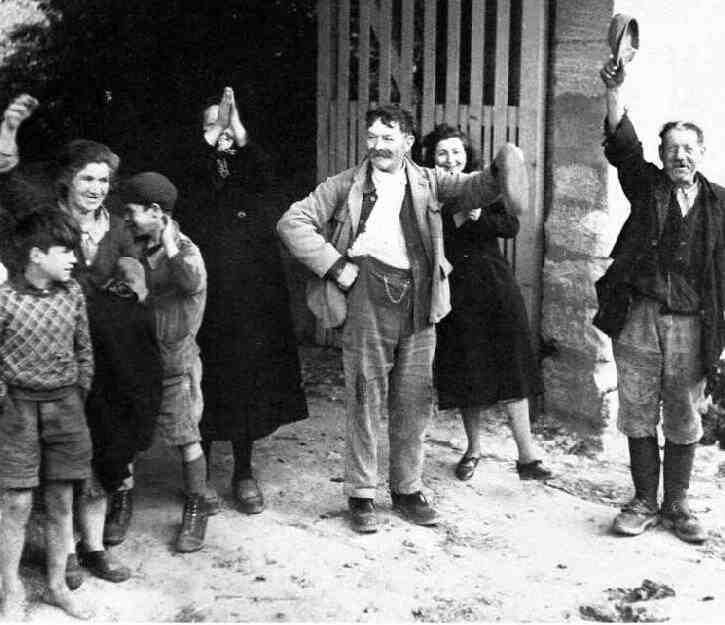
Figure 1.--The Normandy population welcomed the Allies, but the landings meant that for the first time they were in the middle of the fighting. Normandy until June 4 had been a backwater of the War. It had not been affected by the fighting in 1940. The figting during June and July, however, had caused considerable damage throught out the areas. Many villiages and even cities like Caen were destroyed. Here we see a farm family cheering the advancing Allied soldiers, in this case British. I'm not sure precisely when the photograph was taken, but it was shortly after the D-Day landings. Botice the elderly lady wearing black, meaning she was in mourning. Someone in her family had just died. Also notice that there are no young men. Note the barefoot boy. Scenes like that were not common before the German invasion. During the occuption, large quantities of French consumer goods were shipped to the Reich as war reparations. Source: Imperial War Museum.
Fighting for several weeks after D-Day was confined to the Normandy area. The most important inland objedtive for the D-Day invasion was Caen. This it was because Caen was a road junction with the most direct highway to Paris. Caen was the onjective of the British troops landing at Sword Beach. The Germans were well aware of the importance of Caen and it was well defended. The powerful German 21st Panzer Division was located near Caen. This division because of German confusion was not immeiately deployed against the landings and in the afternoon when it received orders to move toward the beeches it was engaged by Allied fighters. The division, however, played a key role in the defense of Caen, resisting repeated British and Canadians attacks. Thus the Allies under Montgomery in the east were heald up for weeks. Cherbourg at the tip of the Conteneau Peninsula was a key objective because of its important port. The Americans from Utah Beach cut off the Peninsula. The Germans in Cherbourg held out for a few weeks and did their best to destroy the port. The Germany thought that without a deepwater port that the Allies could not ammount a decisive military force in France. The Germans did not anticipate Mulberry. They also expected the German garrison to hold out longer than it did. General Sattler, deputy German commander, surendered June 27 bringing the end to directed German resistance on the Cotentin Peninsula, although some isolated German units around the city continued to hold out for a few days. Hitler ordered the garison to hold out to the last man. Few of the soldiers involved chose to do so. By July 1 all organized resistenced was ended. The Germans held the Allies at Normandy for several weeks, effectively using the hedgerows in the Bockage country to twart the American advances. After the fall of Cherbourg (June 27), the Normandy Bridgehead was complete. With Montgomery still stopped at Caen, Bradley began to focus on breaking out at the western end of the bridgehead on a line Carentan and Portbail. Bradley launched his offensive at the beginning of July with torrential rain in the middle of the Bockage country. Allied planners had failed to appreciate the potential tactical use of the fortress-like hedgerows in Normandy. The American offensive, however, soon bogged down.
Normandy
Normandy until June 4 had been a backwater of the War. It had not been affected by the fighting in 1940 which took place in the north. Normandy was a largely rural area, was not targetted heavily by the Allied bombing, except for ports like Cherborg. The location of the invasion was the best kept secret of the War. The Germans with Allied help, convinced themselves that the invasion was coming further nofth at Pal de Calais. Thus Normandy for the Germans continued to be a backwater even as they braced for the invasion in May-June 1944.
German Occupation
Pétain and his Vichy regime sought to collaborate with the Germans to receive referentional trearment. This worked to the extent that the occupation was not genocidal as it was in the East. It did not stop the NAZIs, however, from looting the country. During the occuption, large quantities of French consumer goods were shipped to the Reich as war preparations. This included not only clothes and other manufactured goods, but raw materials and food as well. A French reader writes, "Food in France began to become difficult to obtain in 1941, largely because the Germans were shipping so much back to the Reich. France unlike Germany was self-suffient in food production. Thus food shipments to Germany were an important part of the occupation. One could buy some in Black market
but was very expensive. As the occupation continued food became more and more difficult for most families to obtain. Rationing prevented actual starvation, but most families suffered, especially in the cities. The rural areas like Normandy fared better because the peasants were able to keep food back from the Germans. This did not, however, help the French urban population. During the inter-war period, some regions in France were poor, such as Bretagne (Britany). It was much worse during the occupation, especially for the families of the POWs held by the Germans. By the time of the D-Day invasion, the Germans had thorougly pillaged France. Note the barefoot boy (figure 1). Scenes like that were not common before the German invasion.
France unlike in World War I whem the morthern part of the countru was devestated, was spared extensive war dmage at the omset of the War. The Germny victory was so swift and overwealming, that relatively little damage was dome to French cities. Sunsequently France was still relatively little dmnaged, except for the ports targetted by the RAF. This was especuallt the case for the ports where the Un=boats or Kriegsmarine surface elements had bases. Admiral Dönitz had impregnable U-boat pens built, so the RAF had no choice but to taget the rail lines and roads leading into to the pens. Outside of theports, there was relatively limiyted damage. This chnged with D-Day. Most of France was still untouched, but Normabdy became the focus of the emense panoply of Allied firepower. On the first day it was primarily air power and naval gunfire. As the Allied ground forces became entrenched we have tanks, artillery, and small arms fire added to the torrent of raw power unleashed. And of course the Germans inland were answered with their artillert, tanks and small arms fire. The Allied firepower and the failure of the Germans to unleash the Panzers the first day, allowed the Allies to establish their beachead. Once that was acomplished, the outcome was inveitable given the superior Allied firpower. The Germans lacked the emnse advantage of air power or naval gunfire, but they added to the carnage. And with thehedgerows, were able to delau the Allied brealout for two long months. Meanwhile, many of the towns and villages in Normandy were terribly battered and reduced to rubble. Normandy thus became the most devestated are of France besides the ports bing used by the U-boats. Many in Normandy were delightged to be liberated, but others having their homes and farms desrouyed were les enthusiastic about the processass the Germans by themselves had not caused anywhere near the damage.
The Allied invasion transformed Normandy from a backwater of the War to perhaps the Wars most critical focal point. Both the Allies and Germans appreciated this and the fighting was not only intense, but confined to a relatively small area. The Germans knew that retreating from Normandy mean losing the War. The Allies had their backs to the Channel. The intense figting during June and July caused considerable damage throught out the area. This was especially true because the Germans managed to bottleup the Allies in the Normandy beidgehead for several weeks. This meant the fighting on the Western front was confined to Normandy. Many villiages and even cities like Caen were destroyed. There were large numbers of civilian casualties. The French during World War I had evacuated civilians from the Western Front in northern France. In Normandy there was no where to evacuate the civilians.
Caen (June 6)
The most important inland objective for the D-Day invasion was Caen. This it was because Caen was a road junction with the most direct highway out of Normany to Paris. Field Marshal Montgomery was a central planner in the D-Day invasion. Montgomery was ordered to Britain to take command of the 21st Army Group which consisted of the ground forces for the D-Day landings (December 1943). Eisenhower in his D-Day Planning alternated positions to ensure that the effirt was an allied effort. Thus as he was an American, his deputies were British. And Montgomery was chosen as his ground commander. Thus Montgomery was central in the D-Day planning. Montgomery's concept was for a 90-day battle with the Allied armies reaching the Seineby pivoting on an Allied-held Caen. British and Canadian armies forming a shoulder and the American mechanized armies wheeling on the right. [Oxford] Given Montgomery's behavior we suspect that he planned to do more thn act as a shoulder for a war-winning American drive. In gact this looks suspiciously like the Socilan campaign where he landed cloest to Messina and the American were relegated to cobering his flank. (Patton changed this by taking Syracuse anddriving toward Messina along the northern coast.) We suspect that Montgomery wanted his armies placed closest to Paris in command of the main roads leading out of Normandy to Paris and the north. The only problem for Montgomery was that the Grmans could also read maps. Thius throjghout the campaihn, the Germans placed their stronget forces positioned their stronest forces to defend Caen and the nothwest quadrabt of the Normandy lodgement. Caen was the objective of the British troops landing at Sword Beach. Montgomery was schuelded to take it on the first day. The powerful German 12st Panzer Hitler Jugend Division was located near Caen. This division because of German confusion and Hitler's insistence that he control their commitment was not immeiately deployed against the landings. When orders finally came in the afternoon, the Division when it began moving toward the landing beaches was immediately engaged by Allied fighter-bombers. It thus had no real imoact against the landing beaches on that critical first day. The Division, however, played a key role in the defense of Caen, resisting repeated British and Canadians attacks. Hill 112 which dominatee Nornmandy became a focal point of the battle. Thus the Allies under Montgomery in the east were held up for weeks. Rommel wanted to shift the focus of his attack to the Armerican sector in the Cotentin so as to relieve persure on Cherbourg. British and Canadian pressure on Caen made this impossible. But after the American Operation Cobra break out at St Lo, Montgomery's forces found it difficult to move forward even after taking Caen. They failed to close the Falaise pocket from the north. He was sharply criticized by American commanders (both General Bradley and Patton) for first not taking Caen and then not moving aggresively to close the Falise Pocket. Amajor tank attack, Operation Goodwood, proved to be a disaster.
Carentan after the Alliees had secured their initial lodgement emerged as a key strategic position. It was a small town of only about 4,000 people, but it was a crossroads that sat astride the N-13 highway as well as the Cherbourg-Paris railroad. And Cherbourg with its invaluable port was a key onbjective that the Allies desperately needed. Carentan itself was also located between the American beaches--Utah and Omaha. The Germans as well as the Americans could read a map. It would thus be a critical battle fallowing the Ameican landings. The town had existed since Roman days. The Romans were master engineers. The land around Carentan was low-lying, crossed by rivers and extensive marshes. Cnls were built to drain the are for agriculture. Napoleon had once flooded the area, turing Carentan into a fortified island. The Germand did the same, making Carentan a very difficult objective for ground forces to take. The Americans had few options. They had to attack overthe narrow roads, the only dry approaches. The Germans deployed Major Friedrich von der Heydte's 6th Fallschirmjäger Regiment to defend the town. And they had their guns zeroed in on the roads. General Bradley ordered the 101st Airborne, the "Screaming Eagles" to take the town. The lightly armed 101st had been droped on the night preceeding the D-Day landings. The drop had not gone well and the Division was spread all over Normandy. They managed, however to regroup sufficently to protect the access roads onto Utah--th western flank of the D-Day landings. The 101st fought a bruising fight with the Germans, but they made it impossible for the Germand to attack the Utah Beach landing on the critical first day. They were to be evacuated, but Carentan was so important that Bradley ordered them to take the town, setting up one of the most important battles of the Normandy campaign. The 101st was part of VII Corps which had landed at Utah. Taking Carentn would enable VII Corps to link up with the 29th Infantry Division of V Corps driving west from the Omaha Beachhead.
Villers-Bocage (June 13)
The Allies rapidly landed tanks and other armored vehicles and field artillery in the Normandy beachead. With offshire naval artillery and air support, the beachead was unasailable by the forces available to the Germans, including the Panzers. The direct route north to oaris was cythrough Caen. As soon as a sizeable armored force was available, the British were anxious to pursue the breakout from the beachhead. They took an opportunity of bypassing the strong defenses arond Caen. The British fought a major tank battle near the village of Villers-Bocage (June 13). The British 22nd Armored Brigade (7th Armiored Division) reached the village. There the lead elements were decimated by the 101st Panzer Battalion (1st SS Panzer Coros). German Tiger tanks position in the village ambushed the lead elements of the attacking Britidh force. The deciding factor was the superior German tanks. The German assault on the village was repulsed leaving the British with an exposed salient. The British subsequentlky withdrew leaving the Germans in possessiion of the village. [Porter] And the breakout would not come from the estern British sector, but rather the western sector where the Americans faced the Bocage Country.
The Germans were unable to prevent the Allied lodgement, but held the much larger Allied forces in Normandy for several weeks. In the American sector, after the Allies landed, they fell back to the Bocage Country and effectively used the dence complex of hedgerows to thwart the American advance. Neither the Germans or the Allies had recognized the military significance of the Bocage before the invasion. But the German commanders in the field quickly recognized it and took advantage of it. After the fall of Cherbourg (June 27), the Normandy Bridgehead was complete. The adverse weather conditioins and the Allies need to secure the beachead gave the Germans time to prepare a defense which in the American sector meant the Bocage Country. This left Caen the only D-Day objective not achieved. The Germans held at Caen with a powerful Panzer force. This blocked the Allies direct route to Paris. With Briutish and Canadians stopped at Caen, the Americans began to focus on breaking out at the western end of the bridgehead on a line between Carentan and Portbail. Bradley launched his offensive at the beginning of July with torrential rain in the middle of the Bocage country. Allied planners had failed to appreciate the potential tactical use of the fortress-like hedgerows in Normandy. The Germans had akso iugnoired the hedgeriws, but as the Allies worked on deeloping their bridhehead, had time to take advantage of the defensive potenial of the hedgerows. The American offensive soon bogged down in the Bockage country. The Germans with the Americans concentrating on Cherbourg had reinforced and resupplied their forces and had had orgnized entrenched positions within the hedgerows. Grounded parachutists and elements of the Das Reich and Götz von Berlichingen SS Divisions were deployed. These were all experienced, highly motivated units. Normandy's Bocage country was a maze of small fields enclosed by fortress-like hedgerows and sunken lanes. Here American advantages (mobility, numerical superiority, artillery and air power) were lrgely negated. The artillery and airpower were not effective unless German targets could be located and because they were hidden in the dense hedgerows vegetation, this was difficult. A relatively small German force using snipers and panzerschrecks were able to hold back vastly superior American forces. American advances were meaured in meters at terrible cost. Gradually the American infantry learned how to fught in the hedgerows. An imortant step was that an American seargeant devised a serated front attachment to Sherman tanks to help them break through the hedgerows.
Margival Conference (June 17)
Rommel from the beginning of his work on the Atlantic Wall premised the German strategy on stopping the Allies on the beach. Ruendstedt did not agree, but Rommel was proven correct. The Germans after the D-Day invasion failed to do this. German reinforcements were slow in reaching Normandy, in paet because of the Allied misinformation campaign. The Germans believed that the main invasion would come at the Pas de Calais. The poweful SS Panzer divisions were thus held back from Normandy. And the German units were deployed peace-meal when they did arrive. Allied air power and the Resistance made it difficult to supply the German troops in France. The Allies not only had vastly superior forces and once they were esrablished established in Normandy had no way of defeating them or interdicting the flow of supplies. This meant that the result in France was a forgone conclussion once the initial invasion suceeded. Rundstedt and Rommel and disagreed on the initial stragegy, but both understood that their forces could not hold out in Normandy very long as the Allies daily built of their forces. This was not what Hitler had expected. He was convinced thtat once the Allies had landed that a superior Germany Army could defet them. But the Germany Army was not the German Army of 1940 nor the Allied Armny not the Allied Army of 1940. Rundstedt and Rommel asked for a meeting with the Führer to explain this. They met with Hitler at Margival to discuss the campaign. Hitler had fantasized on decisively defeating the Allies so that the Wehrmacht could focus its strength on the Red Army in the East. He had even claimed on D-Day that he had lured the Allies to invade so they could be destroyed. This was not, however, how the campaign was developing and Hitler was not at all pleased and blamed his commanders. Margival was located dear Soissons in northeastern France. The Germans had built a bunker there in 1940 from which Hitler was to over see the Operation Sea Lion invasion of England. The session began at 9:00 am and lasted until 4:00 PM with a lunch break. The Führer sat pouring over maps with colored pencils in his hand. Rundstedt and Rommel briefed the Führer standing up. Rundstedt explained that Allied air power made it impossible to assemble the forces need to mount a major offensive. Rommel was less tactful. He had come from the front with little sleep. He suggested disengaging the Panzers from Caen and reorganizing a defensive line on the Orne River. As the brifing continued, he became increasingly blunt, finally telling Hitler that the Wehrmacht could not hold in France, Itly and the East and that the Allies were poised to enter the Reich itself. He told the Führer that Germany would have to end the War. This of course was not what the Führer was preoared to hear. He ordered Rommel to attend to his duties in France and not concern himself with the conduct of the War. He then explained that German had wonder weapons that would win the War. Germany had in fact already begun the V-1 attacks which he assured the two field marshalls would devestate Britain. (One V-1 went off course and landed near the bunker that very day.) Hitler also claimed the new jet ME-262 would enable the Luftwaffe to regin control of the sky. Nothing had been accomplished. Rundstedt and Rommel returned to their headquarters. Hitler decided against a planned visit with the troops in Normandy.
Less than a week after the Margival Conerence the war situation chabnged fundamentally. The Soviets launched Operation Basgration (June 22). At Margival, the war situatiion did not look good for the Germans notb matter how Hitler attempted to color it. The Soviets chose June 22nd, the third anniversary of the German Operation Basrbarossa--the uinvasuon of the Soviet Union. And the target was Arny Group Center, the largestvand most powerful German formation. This would lead to its destruction. And the destruction of Army Group Center meant that Germany would noy only lose the war, but lose it dusasterously. After Basgration, German firces would not only face larger Soviet and Allied firces, but at huge numerical and mzaterial superiority. It mean that the German forces in France would get not manpower nor significant material support. While the Americans were ammasing a huge, higghly motirized force with asir cover and massive artillery suport. Gor a month the bokage would hold back the Americans, but gto any German commander of any anility it was clear that the end was coming. Rundstedt and Rommel saw this and Kluge when he replaced Rundstedt quickly saw uit.
Cherbourg (June 27)
Cherbourg was the major port located near te Normandy landings. It was situated at the tip of the Cotentin Peninsula and thus could not be taken with the initial assault. It was, however, a key Allied objective. The Americans from Utah Beach cut off the Peninsula. After Carentan fell to te Americans, the Germans were not in a position to defend the Cotentin Peninsula which mean that the Cherbourg garrison was on its own. The Germans in Cherbourg held out for a few weeks and did their best to destroy the port. The Germany thought that without a deepwater port that the Allies could not ammount a decisive military force in France. The Germans did not anticipate Mulberry. They also expected the German garrison to hold out longer than it did. General Sattler, deputy German commander, surendered (June 27). This brought an end to directed German resistance on the Cotentin Peninsula, although some isolated German units around the city continued to hold out for a few days. Hitler ordered the garison to hold out to the last man. Few of the soldiers at Cherbourg chose to do so. All organized resistenced ended (July 1). Other Herman garrisons in Channel ports would hold out longer as the Allies swept through France. This was important as the major constraint for Allied armies after the breakout from Normandy was supplies. And to efficently land supplies, a port was needed. While Cherbourg fell, the Germans did such a thorough job of wreck the port, that it would be months before the port could be used. Cherbourg was the first ebntry point for the Allied Pluto undersea oil pipeline (August).
Allied Assessment
The Allies were not at all sure about sucess on D-Day. Eisenhower had a statement prepared in case the landings failed. And in fact they almost had to withdraw from Omaha Beach. Most of the planners were surprised and releaved that Hitler's Atlantic Wall and the Normandy Brachhead achieved at auch smaller cost in lives than had been anticipated. Planners believed that once established, that victory could be achieved relatiovely quickly given the overwealming force available to the Allies. This quick victory proved frustratingly elusive. Several factors were involved which military historians still to this day debate, both the factirs involved and the importance of the various factors. First, the Bockage country provided the Germans an excellent environment for defensive fighting, something that the D-Day planners had not anticipated. The Bockage made it difficult for the Allies to effectively utilize their advantage in manpower and airpower. Second, the Germans held tenaceously to the ports such as Cherbourg and La Harve, slowing the landing of supplies. Even when the Allies took Cherbourg, it wa so titally wrecked that it would take several months before it could be used. Third, Allied commanders seemed excessivly cautious and aeluctance to employ strategic boldness. Eisenhower in particular had a broad front mindset which would deny the Germans any tactical oportunities as the safest approach. He can be criticiaed for this, but it has to be considered that much of his forces, unlike the Germans, were green units without battle experience. Montgromery has also been criticized for excessive caution. Fourth, the Germans by this stage of the War were masters of defensive warfare. The German's tactical skill and dogged determination has to be a major factor. [Ludewig]
Caen was a road hub on the Orne river, the eastern edge of the Normandy landing objectivess. It was of great strategic importance because who ever held Caen could move forces rapidly where needed. In British hands, the roads fron Caen were a way out of the Nornmandy Beachead toward Paris, a way to avoid the bockasge country. In German hands, the road were a way to attack into the Allied beachead or as the battle developed to bottle up the Allies in Normandy. The city thus became the primary objecive for the British and Canadians on the eastern edge of the Normandy lodgement. The Germans deployed substantial forces to hold Caen. Caen was the key objective for 3rd British Division, landing on Sword Beach, the easern flank of the D-Day invasion. The Allies were unable to capture the strategically important city on D-Day, however, in the teeth of armored counter-attacks from 21st SS Hitler Youth Panzer Division. Bruitishb infabntry from Sword Beach approached Caen, but without armor support werec driven back. The the 21st Panzer Division attacked between Sword and Juno and approched the Channel, butv a single Pnzer division could not overwhealm the Allied firce. It was stopped by the British 3rd Division and was ordered back to defend Caen and Bayeux. [Ford and Zaloga] Renewed attempts by 3rd Canadian Division (June 7-8) were foiled by 12th SS Panzer Division as were 7th British Armoured Division's thrusts towards the city (June 11-14). The German forces were powerful, but limited because the Germans held so many Panzer divisions in the north to repulse an expected second more powerful invasion at the the Pas de Calais, 150 miles northeast of Normandy. This was the invaluable payoff for Operation Bodyguard, the Allied misinformation campaign. Caen thus became the linchpin of the German defense. As a result, the German forces facing the Americans in the bokage country to the west were spread thin, but effectivrly usedthe bokage to contain the Americans. In the developing war of attrition that followed the Germans got few replacements, especially after the Soviets launched Oprtation Bagration (June 22). In contrast, the Americans were pouring men and equipment into the Normandy beachhead. Caen and the bokage were key factor in the German ability to hold the Allies in Normandy. Montgomery with the 3rd British Infantry was to take Cane on Day 1, but fell short. The city of Caen and heavily defended ridges behind the city were the greatest major obstacle in the path of the British and Canadian forces to break out of Normandy. It set up more than a 2 month battle for the city streaching into August.
The British and Canadians congtinuing to hammar away at Caen on the eastern end of the Normandy bridgehead, but it was in the West that the American offensive finally broke the through badly streached German lines -- Operation Cobra (July 25). A month and a half of combat had battle attrited German strength. Once powerful Panzer divisions had been badly reduced. Replacements and new equipment was not being committed to the battle. The Allies on the other hand kept pouring men and equipment into the Normandy bridgehead. The Allied after weeks of costly fighting in the Bokage countty finally broke out from the Normandy beachhead at the end of July. The Bokage had favored the Germans who efficently used it to bottle growing Allied strength. The offensive named Operation Cobra finally broke through the badly streached German lines and into the flat French country side where they could put their superiority in numbers and mobility to full use. A concentrated carpet bombing shattered the vaunted Panzer Lehr Division. The American strikes left uoturned Panzer tanks in their wake. The Americans then pierced the German lines with armoured thrusts near Saint-Lô and then rapidly fanned out behind German lines. Patton's highly mobile Third Army was activated the sanme day Avranches was taken (August 1). While the Third Army's M-4 Sherman tanks were inferior to the German Panzers in terms of armor abd fire power, they were faster and much more numerous. They could not slug it out with the Germans one-to one, but they were perfect for a rapid advance behind enenmy lines. This was ideal for rapid maneur in the open terraine beyond the Normandy brokage country. Combined with Allied air power this made it impossible for the Germans to plug the gap and contain the American offensive.
The German response ordered by Hitler was the Mortain Counter-offensive. American units as part of Operation Cobra drove out of the Normany south into Brittany. Hitler determined to maintain his hold on France ordered a counter-attack--the Mortain offensive (Operation "Luttich"). It would be the last German effort to hold on to France. He ordered General Hausser's 7th Army to drive west and cut off the Americans. Hausser was ordered to attack from Mortain in Brittany toward Avranches and the Atlantic, cutting of the Americans seeping into the French countryside as a result of Operation Cobra. Hausser struck (August 7). The Germany Army, however, was no longer an overpowering force. They did have very effective tanks, but not very many. The German tanks were superior, but unlike 1940, the infantry now had had effective anti-tank weapons. And thanks to Ultra, the Allies were not totally surprised. Nor did the Germans have the critical air support needed for an effective offensive. The Germans advanced west, but within hours were stopped far short of the coast. They attacked with inadequate forces and simply did not have adequate reserves to exploit a break in the Amerucan lines. The result was that it simply put the German Panzers further west and in a more exposed position to the developing Allied encirclement. The Americans continued to attack behind the German lines. The German commitment of force to the far west of their position put them into a very vulnerable position with the Americans rapidly moving to close the developing pocket.
Falaise was the final battle in Normandy. This time it was no longer a battle for Normabndy, but a struggle to destroy the two German field armies that had attempted to reduce and then bottleup the Allies in Normandy. It was the only major Allied encircelent effort until the end of the War. After Falause Eisenhower would pursue a briad front campaign. At Falaise, German soldiers paid the price for their Führer's intransigence as was so often the case on the Eastern Front. The American breakout and the aborted German Mortain offensive drive to the coast led directly to the battle for Falaise. Falaise is on the river Ante, a tributary of the river Dives. It is about 20 miles southeast of Caen. Thus after the British and Canadians took Caen, Falaise emerged as a perfect place for the British and American asrmirs to meet and trap the renmaining German forces in Normandy. Falaise was notable in French and British history as the birthplace of William I the Conqueror who invaded Englanhd and founded the Norman dynasty. After the failure of their Mortain offensive, the Germans attempted to extricate what was left of the battered forces in Normandy. This set up the battle of the "Falaise Pocket". The Americans moved to trap the Germans in a pocket forming around Falaise. American, Polish, British and Canadian troops had nearly cokpleted the encirclement of the German 5th and 7th Panzer armies at Falaise--what has come to be known as Falaise Pocket. Somehow the Germans managed to open an escape gap to the east. While the ground troops tried to close off the Falasise Pocket, air strikes hammared away wreaked terrible carrnage on the Germans in the pocket. As mamy as 100,000 Germans made it out. The Allies encircled and destroyed two Germann armies, killing 10,000 Germans and taking 50,000 prisoners along with some 350 tanks and 2,500 other military vehicles. Generaloberst Hausser who had led the Mortain Counter Offensive stayed with his nmen in Falaise and was severly wounded again and finally evacuated. The Allies, however, failed to close the Falaise pocket in time to complelety destroy the German forces. The Germans troops managed to slip through the Allied encirclement, but had to abandon the heavy weaons that had not been lost in the Mortain offensive. The Americans complained that Montgomery did not act decisively enough.
Upper Normandy (Haute-Normandie) was located just beyond the Normandy D-Day invasion beaches and subsequent beachhead. It is one of the 27 regions of France. It was created in 1984 from two departments: Seine-Maritime and Eure, when Normandy was divided into Lower Normandy and Upper Normandy. Rouen and Le Havre are important urban centers. Le Harve because it was a port was heavily defended by the Germans. Rouen is the regional capital, historically important with many beautiful medievel churches. The cathedral has the tallest tower in France. Roun was heavily damaged during World War II. Nearly half of the city was destroyed. During the German invasion the area between the Notre-Dame Cathedral and the Seine river burned for 48 hours because the Germans denied the firemen access to the fire (June 1940). Other areas were destroyed during the allied bombing in preparation for D-Day and the subsequent fighting (March and August 1944). A major goal of the bombing was to cut off access to the Atantic Wall. And Rouen was a transportation hub on the Seine. During the German occupation, the German Kriegsmarine had its headquarters located in a château near Rouen. The Germans did not want to be on the coast because it was would be vulnrable to British raids. The Dieppe landings were rahed in Upper Normandy just nortb of La Harve and Rouen (August 1942). Rouen's cathedral and several important monuments were damaged by Allied bombing. The British focus was in Caen and did not move north into Upper Normandy. As a result, much of France was liberted before Upper Nirmandu despite being so close to the invasion beaches. The break out from Normandy came in the west when the Americans broke out at St. Lo/Avranches and with the with the Dragoon Landings in the South. The The German Fifth Panzer Army did not abandom their defensive positions along the lower Seine until the American 2nd Armored Division advanced from the west after the liberation of Paris and threatened to cut off their retreat to the Reich. The Battle for Normandy esentilly ended on the left bank of the Seine with the destruction of several regiments of the German 7th Army. The Canadians liberated Rouen (August 30). The Germans in La Harve continued to resit for two more weeks. .
Le Harve was after Cherbourg, the next most important port in the Normandy area and thus was of enormous importance. It was, however, located just outside the initial Normandy landing sites. The Allies knew that Le Harve would be strongly fortified and because it was located just north of the Seine, did not go for it on the first day. It was tantalizingly close, but just out of reach. Putting a force across the Seine would have exposed them to a German coutr attack. As it worked out, the German Le Harve garrison resisted even after the Allies crossed the Seine and the port was surounded. Hitler and the Whermacht OKW believed that wihout ports, the Allies could not support a major offensive. Thus the Germans left gaeisons in the Channel ports with orders to fight to the death. Fighting in th city was very heavy. The city was almost totally destoyed by the Germans to destroy the port and the fighting. The Germans did not surrender until September 12, by that time the Allies had reached Belgium and had liberated most of France. The German surrender was the final chapter of the D-Day campaign. Le Harve was to play a role after the War. It was a major embarcation point for thousands of GIs returning home. The first GIs to return home were those wounded in cobat and then the POWs liberated from German camps.
Sources
Amouroux, Henri. La Grande histoire des Français sous l'Occupation Vol. 8.
"Bernard Montgomery, 1st Viscount Montgomery of Alamein," Oxford Dictionary of National Biography.
Ford, Ken and Stephen J. Zaloga. Overlord: The D-Day Landings (Oxford/New York: Osprey, 2009).
Ludewig, Joachim. Rückzug: The German Retret from France, 1944 (2012), 504p. The hostory of D-DAy and the fighting in France are usually written from he Allied perspective. This volume written from the German perspective is a valuable addition to the literature on the fighting in the West.
Overy, Richard. Why the Allies Won: Explaining Victory in World War II (Pimlico: 1996).
Porter, David.
Valla, Jean-Claude. La France sous les bombes américaines 1942-1945 (Librairie nationale, Paris 2001).