|
The terms of the June 1940 armistace between Germany and France divided France into an occupied and unoccupied zone, with a rigid demarcation or boundary line between the two. The Germans obtained direct control three-fifths of France, including northern and western France and the entire Atlantic coast which was critical to the Ferman war effort against Britain. The Atlantic coast region provided air bases for the Luftwaffe air campaign and the Kriegesmarine U-boat capaign. The rest of France was left to be administered by the Petain's Government at Vichy. Provisions of the armistice, the "surrender on demand clause", was an obligation to arrest and turn over anyone requested by the Germans. Thus the Germans to persue any one they wanted even in the unoccupied or Vichy zone. Initially this included Jews, Communists, Socialists, as well as political officials who had been outspokingly critical of the NAZIs. France was forced to disband its army, except for a minimal force of 100,000 men for maintaining domestic order. This was the same size force that Gerrmany had been allowed under the Versailles Peace Treaty. The 1.5 million French Prisioners of War (POWs) were to remain in Germanm prisoner of war camps. The French government agreed to stop military units from leaving France to fight with the British. France had to agree to pay for the cost the Germans incurred in occupying the country.
Vichy has a substantial history. It enters history as the result of Marie de Rabutin-Chantal, marquise de Sévigné. She was a patient st VIcvhy (1676-77). She wouls bring Vichy's Thermal Baths tyo thec attention of her aristocrtic friends in her letters. She believed that the Vichy waters cured the paralysis in her hands that helped resume letter-writing. A century later, princesses Adélaïde and Victoire of France, the daughters of King Louis XV, came to Vichy (1761). They were not impressed with the facilities. They convinced their nephew, tyhe future Louis XVI to build more luxurious thermal baths. They were completed in 1787. with the Revolution, Laetitia Bonaparte, Napoleon's mother arrived in Vichy with her son Louis. The Emperor ordered the Parc des Sources (1812). After the Napoleonic Wars, balneology became important with the development of a preoccupations with health-conscious in the 19th century. It occurred along with the rise of a wealthy middle class as a result of the rise of industrial Europe. They began to challenge the reigning aristocracy. Along with this there was the beginning of the leisure-oriented society. Vichy became known as the Queen of Spas. There were many competiors in France, Germany, and other countries. Vichy played a major role in the development of the 19th century European spa culture. It is the most prestigious and well-known of all French spas. It is seen by many as the model spa. Vichy is located on a flat plain along the River Allier. One author describes it as combining 'Parisian urban principles with a spa promenade'. Emperor Napoleon III took a special interest in Vichy. He promoted the creation of a new spa town with parks and boulevards, seeing Vichy as a cosmopolitan ‘Little Paris. The Emperor's support led to Vichy rise among French spa towns. There were grand bath complexes, fed by pump rooms. This covered promenades connected casinos, theaters, hotels and stately villas. The luster of Vichy was tarnished by Pétain's, colaborationist regime. Spas never regained their pre-War status as it was beaches that dominated the post-War era. Vichy bottled water became famous--'reine des villes d’eaux'. It became exported to countries rund the world. This became the basis for trademarked cosmetics and other skin care products coming out of the Vichy Laboratories, becoming a leading European skincare brand.
The Popular Front was the coalition of Communists, Socialists, and other left-wing political parties which developed emerged in France during the 1930s in reaction to the threat of Fascism, especially the rise of the NAZIs in Germany. The Popular Front won the elections of 1936 and Léon Blum became France's first socialist premier. The Depression was a major reason for the Popular Front's victory. The Popular Front's economic policy generally failed. The strikes of 1936 affected the Government's image. The Government decided not to intervene in the Spanish Civil War, the first Fascist military exploit in Europe. The Popular Front was not just a political movement, but rather a social and cultural movement as well. The movment's goal was to break down the trditional barriers that separated the highly compartmentalised society of France in the 1930s. As such, the Popular Front was reviled by traditional and right-wing elements in French society. Aftr the Germany victory in 1940, Blum and the Popular Front were blamed by Vichy politicians rather than the French military planners. While the Popular Front failed in many of its goals, the myth of the Popular Front has achieved legendary status in modern France. [Jackson, Popular Front]
The Germans proceeded to conquer virtually all of Western Europe. After a few months of the "Phony War", France's turn came. The Germans struck on a wide front against the neutral Netherlands, Belgiym, and Luxemburg. The terror bombing of Rotterdam convinced the already hard-pressed Dutch Army to surrender. The British Expeditionary Force (BEF) rushed north to aid the Dutch. The Germans then struck in the Belgian Ardenes which allowed them to avoid the formidable Maginot Line. The French and Belgians considered the Ardenes impassable to tanks. The Germans managed to easily penetrate the rough terraine, crossed two substantial rivers, and the XIX Panzer Corps rapidly reached the English Channel--cutting the BEF off from the French and rendering the Maginot Line uselss. The French entrenched behind the Maginot Line simply could not cope with the exposive highly mobil style of Blitzkrieg warfare. The Panzers surrounded the Belgian Army which King Leopold III surrendered. The BEF was within Hitler's grasp. The Panzers were only a few miles south of Dunkirk and facing no serious opposition. Hitler ordered the Panzers to halt. Some believe that he hoped this gesture would help convince the British to comes to terms, other believe that is was just as it was described at the time, aneeded pause to regroup and prepare for a more coordinated assault. [Davidson, p. 408 and Fest, p. 630.] What ever the reason, this 48-hour respite allowed the British to organize a defensive perimter around Dunkirk and begin an almost miraculous withdawl. Nearly 340,000 men were evacuated from Dunkirk, including French and Dutch sholdiers. This is even more important that it sounds as akmost all if the British sholdiers were regulars and would form the corps of the future British Army that would play such an important role in the War. All of the BEF's equipment, however, was lost. Paris soon fell and the French signed a NAZI imposed armistace. The collapse of France after only a few weeks was a disaster of emense proportions. It was the French Army that had provided the bulk of the allied War Western Front in World War I. The German victory was no ccomplished with superior numbers or weaponry. In fact they had fewer men, tank, and planes. What they had was a superior tactical doctrine. The Germans were amazed to find, for example, that French tanks were not even equipped with radios, and a more disciplined fighting force. NAZI propaganda began to describe Hitler as " Der größte Feldherr Allerzeiten " (the greatest field commander of all time). [Davidson, p. 483.]
After Dunkirk, the Germans turned the Panzers south. It is soon apparent that the French Army is broken and will not be able to hold. Refugeees flow out of Paris to the south. The French declared Paris an open city. The Germans entered Paris (June 14). Churchill offered a union of France and Britain. The French Government rejected the offer. [Freidel, p. 337.] French Prime Minister Reynaud resigned (June 16). He was replaced by Marshall Pétain, the hero of Verdun in World War I. The French ask toi be released from the commitment to Britain not to make a separate peace. Pétain immediately asked for an armistace (June 17). France capitulated (June 22). Hitler had found the railroad car in which the Germans had signed the World War I Armistace (1918). The the armistace was signed at Compiegne. France was thus out of the War and Britain now faced the Germans alone. The terms of the Armistice are dictated by the Germans. Thgey are harsh, but not as harsh as some had anticipated. The Germans treat France vert ifferently than Poland.The terms of the June 1940 armistace between Germany and France divided France into an occupied and unoccupied zone, with a rigid demarcation or boundary line between the two. The unoccupied zone becoes known as Vichy as aew capital is established there. The French had to agree to hand over anyone the Germans wanted. Former Primeminister Reynaud was among those detained. And they had to pay heavy reparations for starting the War.
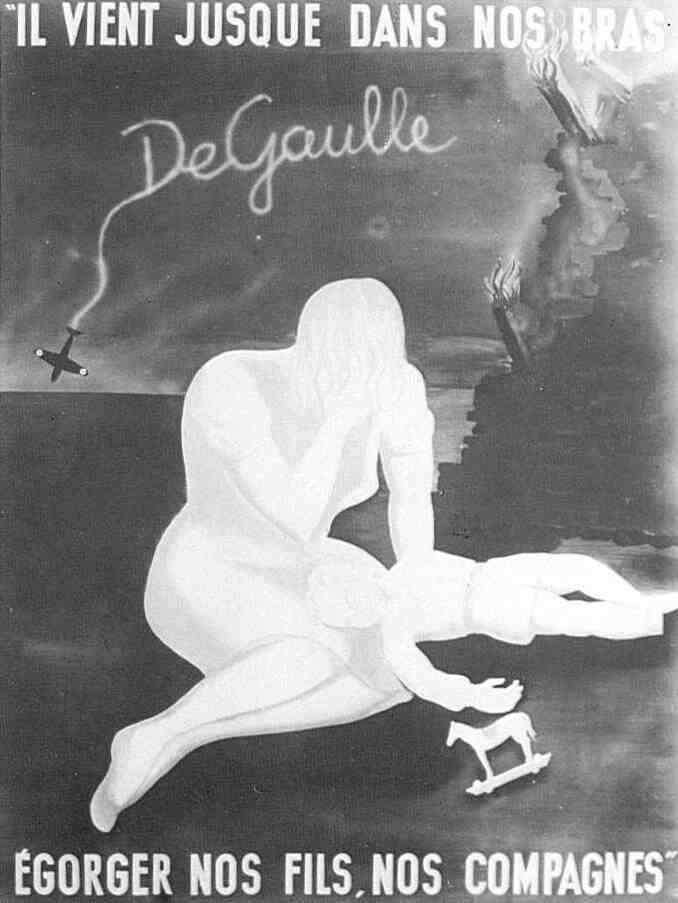
General Charles de Gualle rejected the armistace as well as the Pétain Vichy Goverment. He formed the French National Committee and fled to England. The Committe was to become the Free French movemnent. A French reader writes, "General de Gaulle was not very well understoood by President Roosevelt and Primeminister Churchill. Gen. de Gaulle is still highly respected in France. One finds his name everywhere . He is for us the real France in his independance, shining through the world. He is the father of our nuclear force; the friendly Franco-German; and peace in the world. President Chirac admired Gen. Gaulle. Still to day some anti-American French mentality is coming of this problem, but all the French are aware that the French-American friendship is for ever."
The Germans obrained direct control three-fifths of France, including northern and western France and the entire Atlantic coast which was critical to the Ferman war effort against Britain. The Atlantic coast region provided air bases for the Luftwaffe air campaign and the Kriegesmarine U-boat capaign.
The NAZIs occupied the north and Atlantic coast of France. These were the areas most critical for persuing the war against Britain. It also cut France off from their former ally. The rest of France was left unoccupied to be administered by the Pétain's Government at Vichy. This was wssentially central and southern France. As Paris was in the occupied zone, the capital of unoccupied France becme Vichy where Pétain set up his government. The terms of the armistace, however, conferred effective control to NAZI authorities, although the foot print of the German military was much less conscipious. The terms of the armistae was severe, but not draconian as was the occupation in Poland. Many French people had expected much worse from the NAZIs. Except for Jews, Communists, and vocal anti-NAZIs, life in the unoccupied zone could at first continue relatively normally. This did not begin to chnge until the NAZIs began demanding conscript labor for war industries in the Reich (May 1942) and the Allies launched Operation Torch (November 1942). The NAZIs responded to Torch by occupying the unoccupied zone.
Provisions of the armistice, the "surrender on demand clause", was an obligation to arrest and turn over anyone requested by the Germans. Thus the Germans to persue any one they wanted even in the unoccupied or Vichy zone. Initially this included Jews, Communists, Socialists, as well as political officials who had been outspokingly critical of the NAZIs. France was forced to disband its army, except for a minimal force of 100,000 men for maintaining domestic order. This was the same size force that Gerrmany had been allowed under the Versailles Peace Treaty. The 1.5 million French Prisioners of War (POWs) were to remain in Germanm prisoner of war camps. The French government agreed to stop military units from leaving France to fight with the British. France had to agree to pay for the cost the Germans incurred in occupying the country.
The Royal Navy began World War II with only 9? battleships, a fraction of the World War I Grand Fleet. Italy's fleet of fast modern battleships and carriers already outnumbered the Royal Navy in the Mediterranean. The French batleships if they had fallen into German hands would havegiven the Axis the striking power to confront
the Royal Navy. Churchill's most difficult decission upon becoming First Lord of the Admiralty was the order he gave to neutralize the French fleet. A British squadron was dispatched to Oran where the French fleet had sought shelter. The French fleet was given the options of joining the British in the fight against the NAZIs, imobiling their vessels, or destruction. The French rejected the British demands and the British opened fire. Only the French battleship Strassbourg survived. French publicopinion was outraged. The attack proved useful to help strengthen the Vicy regime. It was also extensively used in NAZI propaganda. Churchill was to say it was the most difficult decesion he ever took. While an agonizing decesion, Britain in fact had little choice. If Germany could have gained control over the French battleships, the British command of the seas and ability to maintain its Atlantic lifeline would have been seriously compromised.
Marshal Henri-Philippe Pétain was one of the great heros of France. He played a key role in saving the French Army during World war I when it looked like in my crack in the face of the German onslaught. He led the heroic French defense at Verdun, the single-most horific battle of World War I. The French stopped a massive German assault. An elderly Pétain was voted premier of France by a fleeing French Assembly as the German Wehrmacht took Paris and poured into central France. He agrred to an armistace with NAZI Germany 8 days after becoming premier. Britain and France had an agreement that there would be no seprate peace. The British realized that the French Army was defeated, but Churchill did not expect the French to sign a peace treaty and colaborate with the Germans in the war effort. Pétain set up his government in Vichy, a resort city in the unoccupied zone of southern France. One historian described him as as becoming 'a despised puppet' of NAZI Germany. This was not the case at first. He was at first very popular with the French people during the first years of the occupation. Many French people believed he saved them from a horific German occupation. Pétain portrayed France's defeat as the fault of Communists, Socialists, and cosmopolitans, a code word for Jews. As far as the Communists and socialists are concered, this wa in part true, but the major cause was military incompetence. And Pétain was detrmined above all to protect the honor of the French Army. A military leader himself, he was not about to place the blame on the French Army, a still widely repected institution in France. Pétain sought to institute a social revolution with he called a National Rvolution, by focusing on patriotism and rooting out left-wing, cosmopolitan influences. Pétain like many French people saw the NAZIs as having won the war making resistance futile. If the poweful French Army could be defeated in weeks, how could anuone resist the NAZIs? Thus Pétain sought an accomdation with Hitler. After the British attack on the French fleet, he was willing to collaborate with the German war effort, he drew the line, however, at participating in and committing French soldiers to combatg and joining Hitler's invasion of the Soviet Union. When the Allies liberated France in 1944, the retreating Germans brought Pétain Germany. Pétains collaboration with the Germas probably did save Frenchmen some of the more brutal asoects of NAZI rule. But in doinf so it made it easier forthe Germans to loot the Frebch economy and allowed them ti use France t support the war economy. The major mistake that Pétain and his supporters made is assuming that the war-time occupation was as bad as it got. Not at all understading what hitler and the NAZIs had in store fir France after they won the War. After the NAZI surrender in 1945, Pétain was returned to France. He was tried and found guilty of treason. He was sentenced to prison for life rather than death because of his age and previous srvice to the nation. He died in prison 6 years later (1951).
The Pétain Government after signing the armistace with the NAZIs on June 22 set up a governmnt in Vichy for the sector of southern France that was not occupied by the Germans. The Vichy Government was officially established on July 12, 1940. Cooperation with NAZI Germany was a necessary precondition. The Vichy regime in many ways cooperated with the NAZIs. Vichy officials after the War maintined that provided a "shield" against what would have been even more severe measures by the NAZIs. The increasing verdict of historians was that Vichy was more the story of collaboration with the NAZIs than a shield protecting the French people. [Curtis and Paxton]
Pierre Laval was born in Châteldon (1883). He was a French politician and statesman. He made his name as a lawyer degending the poor, trade unionists and Communists. This led to a parrlimentary career as a Socialist. He was also an ardent pacifist like many Soxcilaists at thed time. He served as primier during the 1930s during which he attempted work with Mussolini in creatuing the Strassa Front to contain Hitler and the NAZis. This fell apart when the public learned that he was passifying Mussolini by accepting the Italian invasion of Ethiopia. He was embitered by his fall from power and blamed his political opponents for the War and evedntual fall of Ffance. Oetain cjose him for the new Vichy premier. He led the Vichy into collaboration with NAZI Germany. As France was fefedated militarily, any French Government would have to collaborate. The question with Laval becomes when does collaboration cross the line into treason. Some of his public statements are daming. But Laval at his trial after the War asked to be judged as to what he did not what he said. And it is true that the German occupation of France was more correct than in most other countries. And Lacal did gain some comcessions from the Germans, but the Germans were prepared to rule softly in France as long as they got pasive acceotancve allowing them to exploit the French economy. Laval mase many concessions to the Germans, including releaing French hold reserves, adopting anti-Semitic pokicies and using the French policer to round up Jews, conscripting French workers for work in the Reich, and most damnubg seeing up the Malice. He was arrested at the end of the War, tried, and executed as a traitor.
Hitler in the armistice negotiations after Paris fell permitted an unoccupied zone in southern France, about one-third of the country. This was probably to enduce the British to also submit to NAZI dominance. After meeting with Franco at Hendaye, Hitler's train headed back to Montoire where he met with Marshall Pétain (October 24-26). Accounts of the meeting vary somewhat as do the relative roles of Laval and Pétain. The meetings took place at Montoire, primarily because it was an isolated location close to the main Paris-Hendaye rail line. A rail tunnel was close in case of a British air attack. Hitler believed that the defeat of France and Pétain's anti-Communist views would enable him to get Vichy's support for the war with Britain and eventually the Soviets. The French wanted improved relations with her NAZI masters. of particular concern were the French POWs who had been interned in the Reich and the staggering reparations imposed on France. The actual meeting took place in a train car just outside Montoire's train station. At Montoire Pétain announced Collaboration in the new European order as French policy. This was the genesis of the term for those who cooperated with the Germans during the War. At the time, Laval and Pétain were convinved that the Germans had won the War and the only hope for France was to cooperate. Pétain like Franco did not behave as Hitler expected. He refused to give the Germans access French North Africa. While he was willing to collaborate, he was not willing to declare war on Britain. German Minister von Renthe-Finck wrote that Montoire, "constitutes the greatest defeat of German policy". if there had not been Montoire, there would probably have been no allied landing in North Africa." That is probably an exageration. Hitler's focus was rapidly shifting east and any German military commitment to North Africa seems unlikely. Even so, Hitler clearly did not get what he wanted. Hitler's interperrter, Dr. Paul Schmidt, writes, "I am inclined to regard the winner of Verdun as the winner in the duel of diplomacy at Montoire." In the discussions of Vichy's role in the new European Order, Pétain "listened to Hitler in silence. Not once did he offer a sympathetic word for Germany". Vichy France remained a neutral state. The meeting itself was secret. It was only announced to the French public several days later when Pétain spoke to the French people on the radio (October 30). Pétain declared, " It is with honour and to nmaintain French unity, a unity of 10 centuries , within the framework of a constructive activity of the new European order, that I embark enter to-day the path of collaboration. " [Why ..., p.5] This is gebnerally seen as the beginning of organised French collaboration with the NAZIs. Actually collaboration had already begun, including actions against Jews.
Pétain replaced Paul Renaud as premier on June 17, 1940. His first objective was to end the War and bloodshed. His larger goal was to establish a long-term political relationship with NAZI Germany. Stunned with the collapse of the French Army, Pétain saw an armistice as necessary to stop further bloodshed and to begin the creation of a relationship with a Germany. Pétain, Laval, and other Vichy associates believed that the NAZIs would quickly defeat Britain and establish Germany as the dominant country in Europe. Some Vichy politicans used the term "une Europe allemande--a Europe dominated by Germany. Despite the humiliating defeat, Pétain and his Vichy associates convinced themselves that France, as a colonial power and a major European power would be potentially useful ally to Germany in the new NAZI-dominated European order, un nouveau ordre européen. Pétain soketo the French people made a speech on the radio October 11, 1940. He mentioned the possibility of France and Germany working together once the War ended. (At the time only Britain was actively fighting the NAZIs.) Pétain in his speech used the term 'collaboration', associating the word with the idea of working with Germany in the post-War era. This was the origin of the word "collaborationist" that had such negative connotations after liberation in 1944. Pétain and Laval saw collaboration with the NAZIs as the way in which France might secure a place at the table with Germany in Europe once the War was over. Collaboration for P(tain was a wy that France could establish it's good faith and willingness to accept Germany's role as the dominant force in Europe. Pétain saw collaboration as the only way of advancing France's interests. Pétain's primary concerns were the return of 1.6 million French POWs, the safety of the French population, a reduction in the war indemnity, and Vichy's sovereignty over Occupied and Unoccupied zones. Collaboration for Pétain was needed to ensure that his Government was given time to rebuild France based on the principles of Vichy's National Revolution. The French people were shocked by the defeat of the French Army. The Popular Front and the Third Republic were thoroughly discredited. Thus Pétain and his right-wing allies wee able to initiate their ideological reforms of French society. Vichy persued collabration as a matter of policy. Pétain and his Vichy Government, however, were not an entirely free agent. The German having defeated the French army had insisted on provisions in thar armistace convention that compeled French cooperation ith occipation authorities. Article 3 required France to cooperate with the German military authorities. The Germans had the right and ample power in the Occupied zone.
German Propaganda Minister, Dr. Josef Goebbels, provided in his diary a fairly accurate assessment of Vichy. "I have received a confidential report about a talk which one of our special informants had with Pétain. The situation at Vichy, according to this report, is exactly as it was characterized in my recent entry. Vichy desires neither a Bolshevik nor a complete German victory. Pétain, according to our informant, is absolutely vigorous in mind and body. He is the real force behind the policy of watcheful waiting. He would far prefer to have Germany and the Soviet Union grind each other to pieces and bleed each other hite, thereby enabling France to resume the status of a great power, at least to a certain extent. The French are certinly cuttung into their own flesh and, when the war us ended, will have to pay the piper for having maintained a waiting attitude far too long. [January24, 1942--Goebbels, p. 42.]
The United States after the fall of France and German occupation decided to grant Vichy full diplomatic recognition as the legitimate government of France. President Roosevelt brought Admiral William D. Leahy out of retirement to seve as ambassador (January 1941). President Roosevelt and Secretary of State Cordell Hull wanted to keep Vichy on the American side. They wanted to convince Pétain and the Vichy men to resist military collaboration with NAZI Germany. This was a tough assigment. France was traumitized by the German victory. And the Germans seem unstopoable in 1940-41. Many Vichy men decided to throw in their lot with the Grrmans. Adm. Leahy worked dilgently amd at first concluded that he could work. with Marshal Pétain. Leahy attempted to convince Vichy to resist German war demands. There were several issues such as the French fleet, air bases in French-mandated Syria. moving war supplies through French North Africa, and other issues. The American policy was to insist that Vichy take no action not explicitly required by the 1940 armistice that could adversely affect the Allied war efforts. And this was before Pearl Harbor and America entering the War. DeGualle of course objected to this effort. And rge effort was contriversial becuse Vichy was seen by many as pro-NAZI. And this was before the level of Vichy cooperation with the NAZI Holocaust was not yet widely known. Neither the President or Leahy liked DeGualle. [Mayers, p. 160.] Adm. Leahy returned to Amnerica after the death of his wife (May 1942). Ny this time he realized that the Vichy men would not work with the Allies. And the United sttares did b=not replace him. He was not replaced. The United States ended relations with Vichy after the Torch landings in French North Africa (November 1942). It is at this time that the Germans occupied all of France. The Americans had hoped that Vichy would cooperate with the Allied lamdings in North Africa. It did not occur. And Gen. Eisenhower's decision to work with Vichy men like Adm. Darlan woild blow up in his face.
The popular view of Vichy in France today is that Vichy was a dark period of occupation by the hated Germans. Marshall Pétain is seened as a flawed, aging figure foisted on them by the Germans and those arounf Pétain as traitors. The heros of this period are seen as DeFualle and resistance leaders. This was not, however, how Vichy was viewed by the French at the time. Pétain was an extremely popular figure. A popular song of the time was "Maréchal, nous voilà !" (Marshal , here we are!) Most French people saw Pétain as successfully avoiding the full horror of NAZI occupation. In a sence they were correct. The NAZI occupation regime, except for the actions against Jews, was generally more correct than in other countries. France was the only conquered country with which Hitler bother to sign an armistace. The armistace as discussed above was severe, but not draconian. We are not sure why Hitler showed a degreee of generosity. The most likely explanation was a desire to come to terms with the British. Most young French people who study the Vichy period are shocked at the popularity of Vichy and of the level of colaboration. Many post-War leaders collaborated to varying degrees, even President Mitterand. Many French people saw Pétain's National Revolution as a needed revival of French values, a nostaslgic return to an era of France's greatness. His emphasis on the Catholic Church appealed to many. Church leaders were critical of the left-ward drift of the Third Republic, especiaslly the Popular Front. They echoed the charges the Church made of declining public morals. Churches attendance increased. Even military figures picked up this theme. General Wegand himself charged, "France deserved her defeat; she was beaten because, for half a century, her government banned religious instruction in schools." [Duquesne, p. 27.] Of course such an explanation averts the more obvious charge of military incompetence. When Cardinal Gerlier claimed that "Pétain is France and France today is Pétain," the French people generally agreed (November 13, 1940). The British attacks on the French fleet and bombing raids at first strenthened Vichy. An odd fact is that the British and Americans bombed France more than the Germans. The balance in the air war had begun to turn in 1942 with the German commitment in the East and the American arrival in the West. The popularitly of Vichy began to decline only after 2 years of occupation. Here there were several factors involved, but more than anyhing it was the fiorced recruitment of French workers for war industries in the Reich.
The critical error of Vichy was that Pétain and his colleagues did not appreciate the full depravity of Hitler and the NAZIs. Pétain thought he could carve out a role for France in a NAZI-dominated Europe. It does not seem to have occured to them that a regime capable of killing Jews could just as easily kill French Christians. One can ask what the options were. One option of course was colaboration which is what Vichy did. They even cooperate in the Holocaust. And Vichy did this. Vichy not only did not object to the rouding up of Jews, but passed anti-Semetic laws modeled on the NAZI Nuremberg laws and put the French police at the disposal of the German authorities to track down and deport Jews. The other option was to form a government-in exile. The French fleet would have been a major aid to the Royal Navy in the Battle of the Atlantic. France coukld have resisted from its colonies. Vichy chose not to do so and essentially left France at the mercy of the NAZIs. And we know that mercy was not a strong point of the NAZIs. The demand for French workers showed that Vichy could not really protect the French people. The NAZIs looted and exploited France during the occupation. Again Vichy was powerless to prevent this, but it did not have to cooperate in the process. What would have happened to France had the NAZIs won the War we can not know for sure. Continued and perhaps expanded economic exploitation as as a colony is France's likely fate. It is also likely that France would have been broken up into several smaller states on as regional basies such as Britainy and other regions. The NAZIs early on seized Alsaise-Loraine and reincorporated it into the Reich. What the NAZIs had in mind for France began in Belgium abd northern France: Reichsgau Flandern, Reichsgau Wallonien, District of Brusselsm and the (Reichskommissariat Belgien und Nordfrankreich. The French département of Moselle, renamed 'CdZ-Gebiet Lothringen', was added to the Gau Saarpfalz (November 30, 1940) and was renamed Gau Westmark (December 7, 1940). We do know that the NAZIs viewed France differently than the British and Scandinavians. The Jews were the obvious targets during the occupatipon. There most probably would have been further racial actions in a NAZI controlled Europe. We know what the NAZIs had in mind for Eastern Europe--Generalplan Ost. Precisely what they would have done in Western Europe is less clear. It probably would not have been as draconian as the fate planned for the Slavs and Balts, but there is little doubt that it would have been dreadful. Vichy may have provided some relief from NAZI oppression, but the cost for the French had the NAZIs won the war would have been very high indeed. Hitler would have dictated France's future. It would be up to Britain and America to save France while the French themselves colaborated with the NAZI.
Pétain and his associates knew about NAZI anti-semitism, they were not fully aware of the extent to which the NAZI-worldview was goverened by race, or the NAZI concept of race. Hitler had never traveled outside of Austria and Germany, except to northern France in World war I. He was convinced tha France was a debased nation. NAZI proaganda made a great deal out of the Black African soldiers that served in the French Army. Images of the forlorn, defeated French Army certainly must have further influenced Hitler's view of France. For Hitler, Britain with its Anglo-Saxon population was a much more attractive ally for Germany.
One of the few instance where Marshal Pétain is known to have stood up to Hitler and the NAZIs was over the invasion of the Soviet Union. Hitler tried to recruit both Generalismo Franco in Spaon and Marshal Pétain in France to his anti-Bolshevick crusade. Both Franco and Pétain refused. (Although Franco did supply one division of volunteers.) Germany invaded the Soviet Union (June 1941). It launched th most titantic military campaign in history. In retrospect it proved to be the turning point of World War II. The failure of the Wehrmacht to defeat the the Red army before the Winter changed the complexion of the War and the premise upon which the Vichy regime was based. Pétain had based his regime on the inevitability of a NAZI victory. A the fortunes of the German military declined so did the popularity of Pétain and Vichy.
Although horrified at the collapse of the French Army, many French people could not help admire the Germans and this included the children. For the most part the Germans behaved relatively correctly in France, atleast in comparison to their barbarous behavior in the East, and this also affected public attitudes, especially during the early years of the occupation. A French reader writes, "The Germans were critical of our attitude toward children. Though we pampered them bit too much and that organized youth group activities like their Hitler Youth were not adequately developed. In the city parks, the children continued to play as usual, even in the German presence. In the school nothing was changed. The Germans were very fond of our clothes, food, and culture."
France had one of the finest education systems in the world. It has a decidedly acacademic orientation. Many teachers as reflected by the Syndicat National des Instituteurs had left-wing socialist orietations. The horrors of World War I and the depradations of the Great Depression had greatly increased the orientation of mny French people. Even so, France was a deply fractured country with many Frenh people holding right ing views and other left wing views. The majority as reflected in French elections had left wing views to the frustration of the right. The German victory broght Defense Minister and World War I hero, Philippe Pétain, to power. As a result, Vichy Goverment recognized by German had a right wing orientation bordering on Fascism. Pétain and some army commanders even before the War had deep concerns about the left-wing, pacifist orientation of teachers and the impact they were having on French youth. (Hitler and the NAZIs had the same concern about German teachers when they seized power.) The collapse of the French Army in 1940 shocked the French people. It was a time of national soul searching. The pacifist, anti-War message of the socialists must have had som impact, albeit difficult to assess. What really sealed the fate of France, however, was the incompetence of senior French military commanders. Pétain was, however, determined to presreve the honor of the French Army. Thus the issue of national moral became important for Vichy to deflect responsibilyy for France's defeat away from the Army. Pétain had some of his pre-War ideas about education put in place and ordered major changes in teacher training. He named Georges Ripert Secretary of State for Public Instruction and Youth. He was a lawyer who had written about morals and public administration and served as Dean of the Faculty of Law of Paris. As Secretary of State hehelped draft the first Jewish Statute which excluded Jews from universities as students or teachers and dismissed the Jewish professors. He was followed by three other appointes before the Allies liberated France. These reforms had nothing to do with Germans which unlike World War did not interfere with the schools to any extent duuring the 4 years of occupation.
We have very little information on Scouting in Vichy or the occupied zone. The Vichy regime's youth policies during World War II was the state-directed mobilization of young people through sports along with the nd the politicization and militarization of youth activities. We had thought that the NAZIs banned Scouting in France as they did in other occupied countries. The fact that the French signed an Armistace with the Germans meant that the situation in the country, or at leasdt the unoccupied Vichy area was different than in other occupied countries. We think Vichy authorities did allow Scouting, but we have few details about this. A factor here was that Scouting had very strong ties with the Catholic Church and importabt part of Vichy's effort was to restore the authority of the Church in many areas of French society, including education and other areas of youth formation. We are also unsure if the situation for Scouting changed after the Torch invasiins when the NAZIs occupied the unoccupied zone (November 1942). We note that even in 1944 there were French Scouting publications such as calsndars. The situation is complicated and we have very litt;e information. There were several different Scout associations. We know that Vichy banned the Jewish Scout association (Eclaireurs Israelites). We do not know if they banned any of the other Scout assoiciation. One factor affecting the Vichy policy toward Scouting was the Catholic Church. There was a Catholic Scout association. Vichy would have had more difficulty banning that association than other Frech Scout associations. We also do not know to what extent Vichy attempted to exercize control over Scouting or to promote the non Scouting youth groups that they founded or supported. Nor do we know if the Catholic and other French Scout associations made any effort to assist Jewish Scouts. Hopefully French readers will be able to provide some information about Scouting during the War.
One interesting aspect of the German occupation was culture. The Germans in the East waged a war on culture in Poland and the Soviet Union. The goal was to destroy Polish and Russian culture as part of the overall goal of destroying the Polish and Russian state and nationlist sentiment. This did not occur in France, although it must be born in mind that we do not know how the Germans woukd have treayed France had they won the War. One of the proposals being considered was to partition France and promote the growrth of small regional states. French cultural life continued under German occupation, including both book publishing and film making. There were shortages of paper needed for publishing. Albert Camus' greatest work The Stranger /L'Étrangerr was published during the occupation (1942). Many films were made during the occipation. Mamy of the German officials involved in the occupation were familiar with French culture, a number admirers of it. The principal German book censor was an admirer of French literatute. Very little of the French art beloning to the great museums was pillaged as was common in the East. The private collections of French Jews were pillaged. Actions against pre-War anti-NAZIs varied. Picasso managed to survive the occupation. One story has it that a German visiting his stidio asked him, did you do that, referring to the 'Guernica' painting. Picasso replied, "No, you did it." [Riding] There was no attempt to impose German culture on the France, but many German music groups perforned in France and were carried on French radio. This is because Music is the easiest artistic medium to cross national boundaries and the Germans had such a rich musical tradition. After the War, the French had to wrestle with question of just what constituted colaboration.
Vichy officials cooperated with the NAZI Holocaust. Vichy appllied NAZI anti-Jewish rgulations, including seizure ofJewish property and expelling Jewish children from French schools. The most shameful single act was assistance in rounding up over 80,000 foreign and French Jews as part of the Holocaust in concentration camps so they could be shipped to the death camps in Poland. Vichy even ran camps in France with apauling death rates. The experiences of Jews in France in a sad chapter of French history. [Klarsfeld] Historians have difficulty understanding how French institutions like the Church, civil service, and legal profesion did not resist Vichy's Aryanisation process. One historian argues that in times of crisis and danger, people naturally become cautious, even cruel rather than heroic. [Curtis]
One subject that we have not yet been able to properly assess is the extent to which Vichy France economically supported the NAZI war effort. We know that Vichy supported the German war-effort. we do not know how effective that support was. Pétain on October 24, 1940 met with Hitler at Montoire. At that meeting Pétain and Laval discussed Franco-German cooperation. They were unable, however, to get any commitment from Hitler on key issues such as the post-War border of France and the return of the French POWs. Hitler had not yet made up his mind on these issues. The fact was that Hitler had little respect for France or the potential benefits of a French ally. He had convinced himself that the War was already won. The ally he really wanted was Britain. Vichy did make an important economic contribution to the German war effort, but it seems limited in terms of the potential economic potential of France.
Vichy after the armistace with Germany adopted an official policy of neutrality. Even so, Vichy supported the NAZI war effot. The French industry supplied the Germans and French workers were consprited to work in Germany. There was a level of cooperation with the Germans beyound economic support. Vichy was allowing German U-boats in the Indian Ocean to resupply at Diego Suarez. Admiral Darlan provided logistical support to the German military in Tunisia and Syria (May 27-28, 1941). Vichy officials after the Totch invasion of North Africa offered to create a Légion tricolore in which French soldiers would fight with the Germans in Tunisia (November 1942). The Germans rejected the Vichy offer. The rejection was consistent with NAZI failure to consider Vichy an ally. Doubtless the possibility of such units defecting to the allies must have been another consideration. Vichy's primary concern was to avoid combat in France and the inevitable destruction of French cities and civilian casualties. For this reason, Vichy was willing to resist by force the Allied Torch invasion of its North African colonies. This meant open conflict with the Allies. Germany's reversals in russia and North africa led to an adoption of "Total War". The German economy was finally put on a total war footing. More French workers were demanded from Vichy. Frenchmen were permitted to join the Waffen-SS (July 22, 1943). Few did so, but more importantly Laval was granted permission to create aprar-military Fascist force--the Milice. The Milice proved vital to the Whrmacht in confronting the increasingly effective Resistance. A small number of Frenchmen joined the NAZI war effort. A Légion des volontaires français contre le bolchevisme (LVF) was formed in the Occupied Zone. About 10,000 men volunteered and were deployed on the Eastern Front in Grman uniforms against the Red Army. This was common practice by the NAZIS who consistently deployedmen recruited in the West to the Eastern Front, not trusting them to fight against the Western Allies. The small numbers of men involved testify to the declining popularity of Vichy and the growing hatred of the Germans. The LVF eventually became a Wehrmacht infantry regiment. After the allies liberated France, the LVF fought in Germany as part of the SS Charlemagne division.
The Germans maintained a large occupation force in France. The inevitable result was a substantial number of children fathered by German soldiers. One estimate suggests 50,000 through May 1943. Himmler thought that the children of a French woman with a German soldier could produce suitable children for "Eindeutschung". Although not as entusiastic as with the children fathered by German soldiers in Norway, Himmler still saw the French children as "valuable German blood". The SS opened a Lebenborn home near Chantilly called Westwald. There were disagreements amomg the French as to how to deal with these children. Many were hostile. The widow of French General Huntzinger argued that they should be integrated into the French society. Despite the stigma of having a German boy friend, the women involved reportedly avoided the Lebensborn at Westwald because the SS insisted that the babies be given up for adoption in Germany.
The collapse of the French Army was a catacysmic event for the French people. There were many trends in popular thought. Some were derermined to resist. These were realatively small in number, especially in the early years of occupation when the NAZIs seemed unbeatable. Ther was xenophobic view toward foreigners. The French Right was able to give vent to its anti-Semitim. The Church could also scapegot Jews and blame than for modernization. There was wide-spread condemnation of the Third Republic and even show trials of officials. Fear of the NAZIs and Milicie were also factors. In addition, as in Germny, many French benefitted from actions against the Jews in a variety of ways. Jean-Paul Sartre, for example, obtained a teaching position vacated when a Jewish professor was dismissed. His wife Simone de Beauvoir worked for Vichy's Radio Nationale. [Curtis]
Many people think that The Nuremberg Trials were the first war crime trials of World War II. Actually they were not. The Germans were hard at work collecting information on war crimes for trials they would conduct after they won the War. The first trials, however took place in Riom, France--the Riom Trials (February-April 1942). Since the fall of France (June 1940), the lively French press had been silenced, both by the Germans in the Occupied Zone and Vichy in the Un-occupied Zone. This changed for a brief period with the Riom trials. The seven carefully chosen defendants were: Léon Blum (leader of the SFIO Socialist party and former prime Minister), Édouard Daladier (another former prime-minister), Paul Reynaud (another prime-minister), Georges Mandel (former Interior Minister and also Jewish), Maurice Gamelin (commander of the French Army), Guy La Chambre (Minister for the French Air Force), and Robert Jacomet (former Controller-General of the Army Administration). Blum was premier during the Popular Front (1936-38). As a Jew and Socialist, he was seen as the principal target. The defendants were held by Vichy in Fort Portalet.) Court sessions began (February 19, 1942) and were turned into a kind of parliament to put the blame on five carefully chosen defendants. The principal purpose was salvage the reputation and honor of the French Army. Petain was determined to prove that the Socialist Third Republic was at fault and not the French Army. A range of political questions were addressed. The Trials are interesting, because unlike a NAZI or Soviet trial, the defendants were allowed to refute the charges. Even so, the trial was approved by the NAZIs who wanted to prove the War was brought on by French leaders (Socialists and Jews). It was Frace after all that had declared war in Germany.) The trial did not develop at Vichy and the NAZIs had planned. The defendants who were not silences, very effectively rebutted the charges and were sympathetically covered in the international press. Hitler complained. Goebbels writes in his diary, "The defendants began immediately to defend themselves vigorously. It remains to be seen whether political sensations will develop. We had thought that the causes of the war would be gone into. Instead the intention is to determine the causes of the French defeat. We are certainly not particularly interested in that." [Goebbels, February 20, 1942.] The sessions were open and journalists from neutral countries covered the trials, including the defendants' testimony. It was thus covered in American newspapers. Mrs. Roosevelt sent Blum a supportive telegram. Eventually the German Ambassador complained personally to Pétain. Vichy as a result, suspended the trials (April 14), although they were not officially ended until later (May 1943).
American President Franklin D. Roosevelt and British Prime Minister Winston Churchill decided that the Allies needed to open a Second Front to take pressure off the hard-pressed Red Army reeling under the German summer offensive driving toward Stalingrad and the oil-rich Caucauses (July 1942). Joseph Stalin demanded an invasion of Europe. Wisely Roosevelt and Churchill targetted French North Africa. American General George Marshall, in many ways the architect of the American victory, was opposed to Totch, considering it a diversion. Roosevelt insisted. While Montgomery's victory at El Alemain often receives more attentiin, it was the Torch landings that were the decisive action. The Amercan and British landings in North Africa sealed the fate of the Axis desert campaign. Even if Rommel had broken through to Suez, he would have been forced to turn west to deal with the Allied landings in French North Africa. General Dwight D. Eisenhower was appointed Allied commander to oversee the Torch Landings. The Allies driving east from their Moroccan and Algerian beachheads linked up with the Brish advancing west (November 1942). Although Hitler rushed reinforcements to Tunisia, the end result was the first major defeat of a German Army by the Western Allies.
Joseph Darnand in July 1941 created a right-wing collaborationist military group, Service d'Ordre Legionnaire. The organization strongly supported Marshal Henri-Philippe Pétain and his Vichy government. At the time the Germans had just invaded the Soviet Union with brutal effectiveness and it looked like the NAZIs would dominate Europe. Darnand offered to assist the Germans and Vichy officials round up Jews and to help fight the still nascent Resistance movement. The Service d'Ordre Legionnaire in January 1943 was reorganized into the Milice Française becoming in effect the secret police of the Vichy Government. The Germand gave Darnand the Waffen SS rank of Sturmbannfuehrer. The SS had been a strictltly Aryan German organization when the War began. As the tide of war began to turn against the Germans, the SS began accepting foreigners in its military wing the Waffen SS. Darnand for his part took a personal oath of loyalty to German Führer Adolf Hitler. The Milice began as a 5,000-strong special police force of the Vichy government. Darnand greatly expanded the Milice and by 1944 it reportedly totaled 35,000 members. The Milice greatly assisted the Gestapo in its efforts to root out the resistance. Without French collaborators this pricess would have been much more difficult. Unlike the regular French police, the miliciens like the Gestapo had no quams about using brutal means to gain the information they desired. Paul Touvier was another Milice leader.
The Communists after the War claimed to be the hear of the ressistance to the NAZI occupation. Is it true that they played a very important role in the armed resistance. The role of the Communists, however, is much more complicated. The Communists joined with the democratic parties to opose Fascism in the Popular Front (1936). This chanhed dramatically, however, when Stalin approved the Non-Agression Pact with Hitler (August 1938) which made possible the dismembermentb of Poland and the launching of World War II. This made Stalin and Hitler virtual allies. The French Communists following directives from Moscow, endorsed the Non-Aggression Pact. The French Communists did not begin to resist the German occupation until the NAZIs invaded the Soviet Union (June 1941).
Resistance groups in France played an important tole in the success of the D-day invasion. France surrendered to the German Army on June 22, 1940. The terms of the armistace divided France into an occupied and unoccupied zone, with a rigid demarcation or boundary line between the two. Provisions of the armistice, the "surrender on demand clause", was an obligation to arrest and turn over anyone requested by the Germans. French soldiers escaped to England in the Dunkirt evacualtion. Other French soldiers, including General Charles DeGaulle, also reached England. DeGualle when he arrived in England made an inspiring radio speech where he proclaimed that "whatever happens, the flame of French Resistance must not and will not be extinguished." This was in fact the beginning of the French Resistance. Most French people thought that the Germans had weon the War and that resistance was futile. It looked at first like Britain, the only country still resisting the Germans, would also soon fall. The Germans banned political activity. They were most concerned about the Communists and Socialists which had been the most critical of then. The Gestapo in the occupied zone began arresting members of the Communist Party and Socialist Party. The Gestapo also demanded that Vichy authorities make similar arrests. As a result, many Communists and Socialists went into hising. The safest place was the rugged forests of the unoccupied zones. Some soldiers who refused to surrender to the Germans also hid in the forests. The men and women involved gradually formed into small units. Often the units were based on common political beliefs such as Communists or Free French. The groups also formed on geographic lines as the Germans made communications difficult. These groups, despite their political differences joined together to organize the Maquis. The success of the RAF in the Battle of Britain (July-October 1940) proved that the Geramns could be defeated. Then the German invasion of the Soviet Union (June 1941) meant that Britain no longer fought alone. The German losses before Moscow and the entry of the United States into the War (December 1941), changed the whole power ballance. The Germans no longer looked unbeatable and ressistance futile. Winston Churchill was a strong believer in unconventional forces. Thus when he became prime-minister he ordered that resistance movements in occupied countries be promoted and supported. The Ressiatance gradually movement grew in strength and began to organize small-scale attacks on German forces. These attacks were answered savegely with German reprisals on civilians. The Allies did not have the strength to engage the Germans militarily in 1941, but British Bomber Command carried out limited air attacks in 1941 which they escalted in 1942 as the Lancaster long-range bomber became available. The Resistance assisted Allied airman, still mostly British in 1942, shot down over France to get back to Britain. When the American 8th Air Force joined the startegic bombing camapign in 1943, the Resistance also helped the American aviators. Usually they helped get the airmen to Spain whuch allowed them to return to England. General Dwight D. Eisenhower wrote: "Throughout France the Resistance had been of inestimable value in the campaign. Without their great assistance the liberation of France would have consumed a much longer time and meant greater losses to ourselves."
The kind of mass murder conducted by the Germans in the East never occurred in France. The NAZis pursued the Holocaust in France, but most of the killing was done in the death camps located in Poland. One reason the mass killing pursued in the East was not an aspect of the French occupation was that the NAZI racial attitudes toward the French. Another reason was French Vichy authorities collaborated with the German occupation. There were some notable exceptions. Most were connected with the Resistance. The Gestapo targeted the Resistance. As they were difficult to find, the Gestapo took civiluan hostages and then executed the hostages in retaliation for Resistance attacks. Several attrocities followed the D-Day invasion (June 6). The Germans killed civilians at Tulle and Argenton (June 9). The most terrible attrocity was committed by SS men at Oradour sur Glane. There the SS killed 642 men, women, and children.
French attitudes toward Pétain and Vichy had fundamentally changed by the final year of the German occupation. Germany massively exloited the French economy during the occupation and this only incresed as the War increasingly went against the NAZIs. France was a major support for the German war economy. Massive quantities of food and manufactured goods was shippe to the Reich. The result was that severe shortages of consumer goods and especially food developed in France. Press censorship prevented publiched accounts of the degree to which Germany ws exploiting France, but the shortages made it very clear what was happening. And this affected attitudes toward Vichy. The whole ratlionale of Vichy was that collaboration would protect the French people from NAZI excesses. The shortages, especilly the food shortages, destroyed that argument. This change negan when the Germans began conscripting French workers. Vichy also made no progress in getting the contry's POWs held in Germany released. Another serious problem for Vichy was Germany militartyreverses. Vichy and colloaborationseemed the only alternaribve hen it looked like the Germans wer going to win the War. By 1944 it was not only clear that the Germans had lost te War, but that the Allied cross-Channel invasion and liberation was imminent. This only increased the brutality of the Milice wich was seen as a Vichy force. The Resistance only grew in strength. And Pétain who had been a Frebch hero was now increasingly sen as a traitor. The vast majority of the French people no longer looke at Pétin as their proctector, but rather Gen. de Gaulle with his stirring broadcasts from England.
D-Day, the invasion of Normandy code named Overlord, was the single most important battle fought by the Western Allies in World War II. On the outcome of the battle hinged no less than the future of democracy and Western civilization in Europe. Failure at Normandy would have meant that the future of Europe would have been settled by the titantic struggle in the East between Hitler and Stalin, cerainly the two most evil men in European history. An invasion of France had been the primary goal of American military planners and President Roosevelt since the entry of America into the War in December 1941. Churchill was less convinced. And largely at urging, the first joint Allied offensive was in the Meditteranean. The invasion was an enormous risk. All Allied victories in Europe were achieved by the weight of overwealing superority of men and material to badly over streached German forces. In France, the Allies faced some of the strongest units in the Gernany Army who would until several weeks into the battle be able to amass far superior forces. The Allies had to plan on naval and air superiority to protect the inital beach lodgements until powerful land forces could be landed and deployed. For over 2 years the Allies had been building and training a massive force in England which was finally unleased on Hitler's Fortress Europe (June 6). The Allies struck with the largest armada ever assembled. First paratroop landings inland and then at after dawn came British, Canadian, and American landings on five Normandy beaches. It was a complete surprise, an incredible accomplishment for an operation of this scope and magnitude.
The American capture of Cherbourg placed the first important French port in Allied control (June 27). While the Germans held in Normandy, a huge logistical enterprise was building up a huge army with emense capabilities. The Allies in the first 100 days after D-Day landed an incredible 2.2 million men, 450,000 vehicles, and 4 million tons of supplies. This was a force that the Germans could not begin to match and their situation was rendered untenable by the virtual complete lack of air support. The Allied offensive broke the badly streachedGermans in July. British and Canadian troops under Montgomery finally captured Caen (July 9). The major break through came further south. Patton's Third Army after a concentrated bombing pierced the German lines with armoured thrusts near St. Lô and rapidly fanned out behind German lines. While American Sherman tanks were inferior to the German tanks, they were fastr and more numerous. Allied air power made it impossible for the Germans to contain the American offensive. German units were foirced to abandon their tanks and flee east. Efforts to surround an entire German army failed when SS units held an escape rour open at Falaise, allowing a substantial part of the Germany forces to escape. American airpower, however, wreked havoc on the retreating Germans. I The Americans landed another force on the French Mediterranean coast between Marseilles and Nice (August 15). The German hold on France was broken. The Paris Ressistance rose up against the German occupation forces as Allied armour divisions raced toward the capital and crossed the Seine. French Forces of the Interior (FFI) attacked Germans retreating through the city. Hitler ordered the city to be destroyed. The German commander refused to carry out the orders. Allied forces entred the city (August 25). The Allies pressed north into Belgium and liberated Brussels (September 2).
Pétain and his ministers remained in Vichy long after the issue was settled in France. After the liberation of Paris Pétain from Vichy sent an emissary to arrange for a peaceful transfer of power (August 1944). De Gaulle rejected the effort and refused to acknowledge Vichy as a legitimate French Government. He would not receive the Vichy envoy. As the final German troops withdrew from France, they took the major Vichy figures with them (September 7). Most went voluntarily. Pétain, however, had to be forced to leave with the Germans. By this time, much of France was liberated and the Allies armies were sweeping into the Low Countries. They Vichy men must have been shocked by the devestation they saw as they passed through German cities. We are not entirely sure to what extent this was done by force or with the consent of the Vichy officials. In the chatoc situation accompanying the liberation, it is likely that some Resistance groups woukd have summarily shot them if they got their hands on them. Pétain refused to participste in the rump regime. His colleagues, however, set up a government-in-exile at Sigmaringen. This is a town in southern Germany east of the Rhine, but relatively close to France on the upper Danube. Sigmaringen became a French enclave in the Reich. Sigmaringen is famous as the crade of the Hohenzollern dynasty. As such it was an unlikely choice for a French Government. One author describes it as the 'Götterdämmerung of French fascism'. Pétain got special treatment. The others suffered from the collpasing German economy. Laval complained that he was treated like a 'peasant'. He brought 20 million francs with him, but the German banks refused to accept it. The Vichy officials turned Schloss Sigmaringen into their new government center, although it was more like a kind of prison. Fernand de Brinon as Pétain refused to participate headed the rump regime. There were three embassies established, all the Axis allies--Germany, Italy (Salo Republic), and Japan. Accompabying the Vichy ministers were writers Céline, Lucien Rebatet and Roland Gaucher. They had writen what might be called semi-Fascist tracts, but more consistently castigating Jews. Members of the Milice escaping the vengence of the Resistance also sought refuge at Sigmaringen. Céline would write about the vain infigting in a book published after the War--D'un Chateau a l'autre. Their major concern was preparing their defenses when they faced DeGualle's Haute Cour de Justice (High Court of Justice). [Beevor and Cooper] About 2,000 Vichy men wee housed in the Castle. A number worked on a newspaper--La France. News of the Hitler's desperate Ardennes offensive produced a rate burst of optimism among the Vichy men (December 1944). Some reportedly proclaimed that they would follow the Germans back to Paris by New Year. This of course speeks volumes about their claimed patriotism. The optimism was short lived and they were soon back to planning their defenses.
The Allies crossed the Rhine (March 1945). The reconsituted French Army was the Allies right wing in the south. Pétain as the French Army was approaching Sigmaringen wrote a note to Hitler expressing his wish to be allowed to return to France (April 5). Hitler did not reply. German authorities, however on his birthday escorted him to the Swiss border (April 24). He crossed the French frontier (April 26). Meanwhile French troops entered Sigmaringen (April 22, 1945). They arrested the Vichy men in the Castle and returned them to France for trial.
Collaboration was a term that Marshall Petain introduced. It did not at first have a sinister connotation. Rather most French people still in shock at the Germany victory were inclined to support Petain and his Vichy regime. At the time there seemed no altrnative. As the Germans experienced military reverses, French attitudes began to change. The increasing severity of German occuption, especially the conscription of French workers for work in the Reich was a major factor. Vichy and collaboration continues to be a veey sensitive subject in France. Collaboration took many forms. Some French actively helped the Germans hunt down Jews, including Jewish children, and members of the Resirance. A number of French women collaborated by falling in love with German soldiers. There is of course a vast differece between the two extreems and many levels of collaboration in between. There were a variety of summnary actions in the heat of Liberation. In improvisated local actions during the first weeks after the Liberation. About 1,000 persons are believedcto have been executed, mostly by the Communists. Many women had their hair shaved publically or were otherwise humiliated. Theor primary crime was liasons with German soldiers. A French Provision Government was formed (August) and very quickly took action to prevent such summary executions. [Lottman] Many were arrested and tried for collaboration after the War. Officers of the Vichy Government were some of targets of these procecutions. Admiral Darlan was sentenced to death. Marshall Petain was sentenced to a long jail term. The Gaullists nurtured a myth that the great majority of the French people bravely resisted the Germans.
Gaullist claimed that the French people never accepted the Vichy regime as a legitimate French Government. Gradually it has become increasingly clear that the bulk of the French people, shocked by the collapse of the French army and thinking that the War was lost, sought accompdation with the NAZI occcupiers and looked upon Marshal Philippe Pétain with reverence. [Curtis] For years, any questioning of that myth was highly controversial.
The film by Marcel Ophuls "Le chagrin et la pitié" (The Sorrow and the Pitty) (1969) was commissioned by French Government-controlled television, but the documentary on French life during the occupation proved so embarassing that officials were afraid to broadcast it. In the end the project could only be completed through German and Swiss financing. It is an extremely powerful documentary showing how popular Marshall Pétain was and how most French people sought accomodation with the NAZIs. Scenes from World War II and the Vichy era France are intertwined with contemprary interviews. Ophuls decided to focus on one small town.
The Gaullist myth that Vichy was an ilegitimate government that was not supported by the French people was important in the post-War aftermath. It would have affected the claim to power of the Free French movement. DeGaulle maintained that there was no support for Vichy and that the Frech people supported his Free French movement. This might have meant that the British and French would have played a role in creating a new French Government as President Roosevelt had wanted. DeGualle always claimed that had largely liberated itself though the Ressistance and the Free French. In fact the Allies were aided by a valliant, but numerically small French Ressistance. In the end, with liberation Free French seized control of the French Government. France ws given an occupation zone in Germany and a seat on the courts that judged NAZI war criminals.
Beevor, Anthony and Artemis Cooper. Paris after the Liberation.
Curtis, Michael. Verdict on Vichy: Power and Prejudice in the Vichy French Regime (Arcade, 2003), 419p.
Davidson, Eugene. The Unmaking of Adolf Hitler (Univesity of Missouri: Columbia, 1996), 519p.
Duquesne, J. Les Catholiques français sous l'occupation (Paris: Grasset, 1966).
Fest, Joachim C. Hitler (Vintage Books: New York, 1974), 844p.
Freidel, Frank. Franklin D. Roosevelt: Rendezuous with Destiny (Little Brown: Boston, 1990), 710p.
Goebbels, Joseph. ed, Louis B. Lochner, The Goebbels Diaries, 1942-1943 (Doubleday: New York, 1948), 566p.
Jackson, Julian. France: The Dark Years, 1940-1944.
Jackson, Julian. The Popular Front in France: Defending Democracy, 1934-38 (Cambridge University Press: 1990), 369p.
Klarsfeld, Serge. French Children of the Holocaust (1996).
Lottman, Herbert R. The Purge: The Purification of French Collaborators after World War II.
Mayers, David. (2012). FDR's Ambassadors and the Diplomacy of Crisis: From the Rise of Hitler to the End of World War II. (Cambridge U.P.: 2012).
Mazower, Mark. Hitler's Empire: How the Nazis Ruled Europe (Penguin Press: New York, 2008), 726p.
Nettlebeck, Colin. "A forgotton zone of menory: French primary school children and the history of the occupation," Paxton, Robert.
Proud, Judith K. Children and Propaganda.
Riding, Alan. And the ShowWent On: Cultural Life in Nazi Occupied Paris.
Smith, Meredith. "The ivilan experience in German occupied France, 1940-1944," History Honors Paspers, Connecticut College (2010).
"1940: Vichy Schools Again to Teach Concept of God," New York Herald Tribune European Edition (December 7, 1940).
Navigate the CIH World War II Section:
CIH -- WW II

[Return to Main World War II campaign page]
[Return to Main French World War II page]
[Biographies]
[Campaigns]
[Children]
[Countries]
[Deciding factors]
[Diplomacy]
[Geo-political crisis]
[Economics]
[Home front]
[Intelligence]
[POWs]
[Resistance]
[Race]
[Refugees]
[Technology]
[Bibliographies]
[Contributions]
[FAQs]
[Images]
[Links]
[Registration]
[Tools]
[Return to Main World War II page]
[Return to Main war essay page]
Created: August 12 , 2003
Last edited: 6:01 AM 12/16/2023