|
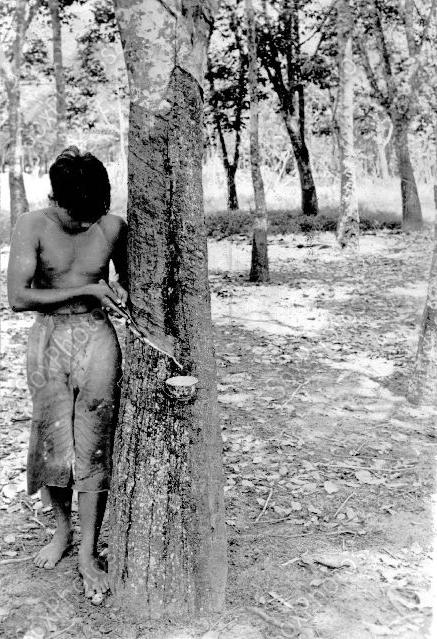
Britain in the late 19th and early 20th century established contol over Malaya through a variety of treaties. Agricultural input was of minor importance in the 19th century. Planters experimented with different crops. Then in the early 20th century rubber cultivation began to take off. Along with rubber plants, the British brought Indian workers to man the new plantations. This occurred just as the development of the automobile created a vast demand for rubber. Malay which had been an economic backwater rapidly became one of the most valuable British colonies.
One part of the Japanese offensive following Pearl Harbor was the invasion of Malaya. The Japanese 25th army commanded by Lieutenant-General Tomoyuki Yamashita launched the invasion of Malaya (December 8, 1941). Yamashita's 25th Army was smaller than the defending British force. Yamashita commanded only 30,000 men, but he had a well thoughout campaign, an adequate air cover, and naval support. Yamashita landed a small force in the nort. English commander General Arthur Percival when of the landings was advised to set up a defensive line and famously is sad to have worried about the effect on morale. A staff office is said to have replied, "It would be bad for morale when the Japanese start running all over the island." Yamahita moved down the Peninsula in a stunning 8-week campaign. Sinapore had substantial defenses. There were 15-inch gun implacements and a 88,000 man garrison. It was called the "Gibraltar of the East". The garrison, however, was undersupplied. The shore guns had anti-ship ammunition and could not be turned back on jungle roads that the Japanese were using to approach from the land. The RAF had 158 aircraft, but many were obsolete types, including biplanes and the retreating units could not hold major airfields Yamashita after taking most of the Malay Peninsula commenced the assault on Singapore (February 2). Lieutenant General Arthur Percival surrendered Singapore (February 15). This was the greatest defeat ever suffered by the British Army. Percival surrendered 130,000 Allied troops. Churchill was staggered. The Japanese held Singapore and Malaya for the duration of the War. Conquest of Malaya not only gave the Japanese tin mines, but the great bulk of the world's rubber resource. Tin was important, but the Allies had altermative resources. There was no real alternative to Malaya as a source of natural rubber. The Allied could not have fought World War II unlss a new source of rubber was found.
Britain in the late 19th and early 20th century established contol over Malaya through a variety of treaties. There were both federated and non-federated states. The British modernized the tin mines. Agricultural input was of minor importance in the 19th century. Planters experimented with different crops. Then in the early 20th century rubber cultivation began to take off. Along with rubber plants, the British brought Indian workers to man the new plantations. This occurred just as the development of the automobile created a vast demand for rubber. Malay which had been an economic backwater rapidly became one of the most valuable British colonies. Britain begn to play an incresingly direct role in the peninsula (late-19th century). There was several potentially severe festering oroblems. There was tension between Chinese settlers worked in the tin mines and Malays. There wasalso internecine conflict between Malay groups. There was serius piracy problem along the western coast. Merchants wanted the British to resore order. The British were also concerned about competing Euripean colonial interests. The Dutch, French, and German were all interested in the area. The British resonse was to negotiate treaties with Perak, Selangor, Pahang, and the unit which became Negeri Sembilan (1895). The Brutish practice was to install a British 'resident' to advise the sultan (who the British paid a stipend) and to supervise administration. The Pangkor Treaty (1874) with Perak became a a model for the subsequent treaties.
The Japanese had moved substantial forces into Indochina (Vietnam) after the fall of France. Firsrtnorthern Indi=Chinand than the South. The occupation of southern Indo-China promted the U.S. oil embargo. The oil embargo set the war in motion. Japan was dependent on American oil exports. Japan had to either withdraw from China or go to war. And given the nndset of the Japanese mikitarists, they were not going to withdraw from China. The Imperial Japanese Army Southern Expeditionary Army was headquartered in Saigon, commanded by General Count Hisaichi Terauchi (1941-45).
The British defense of its Pacific territoiries was based on the bastion of Singapore at the base of the Malay Peninsula. The defense of Singapore was presimssed on the assumption that the Malay jungles were inpenitable. Thus the British based their defense of Singapore on resisting an assualt from the sea, not a land attack down the Malay peninsula. The defense of Singapore was premissed on the garison holding out for 6 months until a naval task force could be organized to relieve it. No one fully understood the impoetance of the Japanese carrier force or invisioned the shattering imobilization of the U.S. Pacific fleet at Pearl Harbor.
A Japanese carrier taskforce composed of six carriers on December 7, 1941, executed a surprise attack on the American Pacific Fleet at Pearl Harbor. It was a brilliant tactical victory for Japan, but perhaps the greatest mistake in modern military history as it brought a suddenly united America with its vast industrial capacity into the War. The Japanese launched 360 aircraft which in 2 hours struck Peal Harbor just as the American sailors were waking up on a sleepy Sunday morning. The strike sunk or heavily damaged six of the eight American battleships, thrre cruisrs, three destroyers, and most of the Army Air Corps planes on the island. America was at war.
Thailand stood betwwen Burma and Malaya and the Japanese in Indochina. The Thais offered pro forma resistance at Prachuab Khirikhan, Nakorn Sri Thammarat, Chumporn, Songkhla, and Pattani, but signed an alliance with Japan (December 21).
Thai officials quickly agreed to Japanese demands to allow transit to Japanese forces moving against the British in Malaya and Burma. Phibun announced that the arrangement with the Japanese was "prearranged". Phibun proceeded to sign a mutual defense pact with Japan (December 1941). The Japanese rapidly moved through Thailand to engage the British in Burma and Malaya.
One part of the Japanese offensive following Pearl Harbor was the invasion of Malaya. The Japanese 25th army commanded by Lieutenant-General Tomoyuki Yamashita launched the invasion of Malaya (December 8, 1941). Yamashita's 25th Army was smaller than the defending British force. Yamashita commanded only 30,000 men, but he had a well thoughout campaign, an adequate air cover, and naval support. Yamashita attacked immediately after Pearl Harbor (December 8, 1941). Yamashita landed a small force in the nort. English commander General Arthur Percival when of the landings was advised to set up a defensive line and famously is sad to have worried about the effect on morale. A staff office is said to have replied, "It would be bad for morale when the Japanese start running all over the island." Yamahita moved down the Peninsula in a stunning 8-week campaign. The Japanese proved adept at jungle warfare, adjusting to the environment in a way the British were unwilling to do. The British had moved HMS Repulse and HMS Prince of Wales to the Pacific to bolster the defense of Singapore. The vessels without aircover attempted to intercept Japanese landing forces, but were found by Japanese land-based bombers and sunk off Malaya (December 10, 1941).
This was the only creditable Royal Navy force defending Singapore. Japanese infantry used bicycles to move through areas without developed roads. The British organized opposition using III Corps of the Indian Army, the Australian 8th Division and various British units. There were no developed defensive positions and Japanese air and sea superority allowed them to rapidly move down the Peninsula. The Japanese moved so rapidly that the British were never able to establish asolid defensive line. Command of the sea enabled Yamashita to make amphibious landings to undo British efforts to organize a denensive line.
Sinapore had substantial defenses. There were 15-inch gun implacements and a 88,000 man garrison. It was called the "Gibraltar of the East". The garrison, however, was undersupplied. The shore guns had anti-ship ammunition and could not be turned back on jungle roads that the Japanese were using to approach from the land. The RAF had 158 aircraft, but many were obsolete types, including biplanes and the retreating units could not hold major airfields
Yamashita after taking most of the Malay Peninsula commenced the assault on Singapore (February 2). Yamashita moved up tanks which British military planners believed could not be operated in the jungle. Lieutenant General Arthur Percival surrendered Singapore (February 15). This was the greatest defeat ever suffered by the British Army. Percival surrendered 130,000 Allied troops. Churchill was staggered. The Japanese held Singapore and Malaya for the duration of the War. Japanese naval and air superority probably doomed any efforts to hold Singapore. But the sizeable garrison should have put up a more effective resistance as MacArthur and Wainright did on Batan. Percival thus has to be considered the most ineffective British commander of the War.
The Japanese conquest of Malaya posed a astrategic nightmare for the Allies. The defense of Australia was premessed on the Singapore bastion. Singapore also opened up the Indian Ocean to the Japanese. Only the American carrier victory at Midway made it impossible for the Japanese to exploit the opportunities offered.
Strategic raw materials were very important in World War II. Rubber was one of the most important, but often not fully appreciated in World War II gitories. The Japanese conquest of Malaya not only gave them tin mines, but the great bulk of the world's rubber resource. Tin was important, but the Allies had altermative resources. There was no real alternative to Malaya as a source of natural rubber. And rubber was essential in mechanized warfare. The Allies could not have fought World War II unless a new source of rubber was found. Rubber was needed to drive a truck and land a plane as well as counless other functions. A battleship for example had thousands of rubber parts. The United States launched a crash program to build a synthentic rubber industry. This was a key component to the Allied victory. It was not as good as natural rubber, but it could be produced in large quantity and was good enough along with conservation efforts as well as programs to expand production in tropical areas controlled by the Allies.
The Japanese occupation as in other countries was brutal. Policies were significantly affected by ethnicity. The Japanese partioned Malaya, assigning the northern provinces (Perlis, Kedah, Kelantan and Trengganuwere) to Thailand which became an Axis ally. The Japanese administered the rest of Malaya as a unitary Malay province. The division between Thailand and Japan, meant that the Japanese controlled area had a substantial Chinese population. The Malay states were primarily populated by ethnic Malayas, but there was a large Chinese poppulastion in Singapore and the south. There was also a smaller Indian population. The British had introduced the Chinese and Indians to work the plantations and mines. The Japanese treated the Chinese population very harshly. Japanese occupation policies caused food shortage which caused many Chinese, especially from Singapore, to move into the countryside where food was more available. Many became squatters. ThecJapanese were generally histile to the Chinese, seeing them as hostile because of the Japanese invasion of China (1937). The Japanese launched a major pogrom, the Sook Ching Massacre (February 1942). Thousands of Chinese were masacred. As a result, resistance groups began to organize, especially among the Chinese. The most important group was the Malayan People's Anti-Japanese Army (MPAJA). The MPAJA targeted collaborators, especially at the end of the War. As most collaborators were Malays, this exacerbated existing ethnic tensions.
The Japanese victory in Malaya and surrender of Singapore released troops to assist in the conquest of Burma (January-May 1942). The failed Imphal offensive severly wekened the Japanese Army (1944). This was followed by British 14th Army's invasion of Burma. The 14th Army was British in name only. It was an Empire force, primarily made up of Indian units as well as African and British units. It was led by William Slim. He proved to be the leading figure in the CBI theater. Slim managed to weave his disparate forces (Indian, African, British, Americam, Chinese, Burmese irregulars, and others into an effective fighting force. The British Indian Army attacked in the south and the Ameican/Cinese Army in the north. This enabled the Americans to build the Ledo Road which reached the nothern part of the Burma Road and reopeed overland supply deliveries to China. Slim led the successful Allied offensive which reoccupied Burma (mid-1944 to mid-1945). The Japanese had lost only 5,000 men inconquering Burma (1942). Their defense of Burma would result in ten times that number. The British after hard fighting reached Mandalay. Pnly a handfull of Japanese soldiers managed to retreat out of Burma.
The Allied victory in Burma, meant that the next British action in the CBI would be the liberation of Malaya and Singapore. The British began preparing for another major offensive. While these preparations were in process, the Americans driopped two atomic bombs and the Soviets invaded Japanese occpied Manchuria (Mznchuko). Emperor Hirohito addressed the Japanese people in a recorded radio address announcing acceptance of the Potsdam Declaration (August 15, 1945). The Unites States was prepating a invasion of the Hime Islands, but Japan at the time had substntial forces in the field, in both Chin anbd Southeast Asia. The terms for ending the war that the Allies had set down in the Potsdam Declaration. The huge areas still occupied by the Japabese and the distances involved meant that it would be some time before Allied forces could get to the various locations to accept the Japanese surrender. And before this occurred, violence broke out in Malaya. Sporadic communal violence occurred between the Chinese ana Malay communities. The violence in Perak was particularly severe. The Communist Malayan Peoples' Anti-Japanese Army (MPAJA) attacked collaborators in the Malay police force and amonf the civilians. They alsi began extort funds from civilians. Many MPAJA members favored a revolution to prevent the restoration of British rule. MPAJA leader Lai Teck counceled a more cautious approach. He was not yet known to be a Japanese agent. Thee were also attacks on small groups of Japanese troops withdrawing from outlying posts. Japanese forces in Malaya officially surrendered to the Allies at Penang (Septemvber 4), Singapore (surrender 12), and Kuala Lumpur (September 13). The British Military Administration (BMA) was set up in Kuala Lumpur (September 12). The Japanese signed the Malaya surrender document at Kuala Lumpur. Lieutenant-General Teizo Ishiguro, commander of the 29th Army signed in the name of the Emperor. Major-General Naoichi Kawahara, Chief of Staff and Colonel Oguri winessed the document. Subsequently the British compeled the MPAJA to disband. They handed over their weapons at ceremonies where the British commended their wartime resistanhce efforts.

Navigate the CIH World War II Section:
[Return to Main World War II M-Z country page ]
[Biographies]
[Campaigns]
[Children]
[Countries]
[Deciding factors]
[Diplomacy]
[Geo-political crisis]
[Economics]
[Home front]
[Intelligence]
[POWs]
[Resistance]
[Race]
[Refugees]
[Technology]
[Totalitarian powers]
[Bibliographies]
[Contributions]
[FAQs]
[Images]
[Links]
[Registration]
[Tools]
[Return to Main World War II page]
[Return to Main war essay page]
[Return to CIH Home page]