|
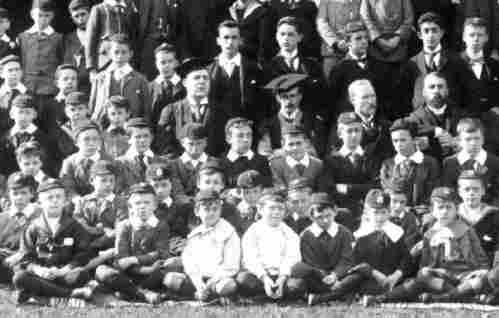
The English education system went through great changes in the 19th century, shifting from formal education that was almost exclusively for upper class males to education that was accessible to everyone. As the English student became more often of a lower social class, schools took on different forms and the methods of teaching changed as well. In the 19th century, new theories, such as those of Johann Pestalozzi, were taking hold as the government and upper society were pushing to maintain the status quo. The classic English novelJane Eyre takes place in the midst of these changes, Jane herself spending most of her life, as depicted in the novel, in the English education system, first as student and later as teacher. Some modern schoolwear styles emerged in the 19th century, but at the country's elite private schools. Eton boys by the early part of the century were wearing long pants suits with short jackets, long pants, and what was to become known as Eton collars. This style proved to be enormously popular at the country's public (private) schools, although each school had their own differences. Most public schools, however, did not require uniforms. Actually many parents refused to send their children to the public schools and educated them at home. The English public school made minimal efforts to supervise the boys and the schools could be rather dismal if not dangerous places, especially for the younger boys. Gradually the outrageous, riotous behavior at these schools forced the schools to introduce a variety of reforms to control student behavior. One of the reforms was to require standardized uniforms which until the 19th century had been a feature only at charity schools. School uniform garments like peaked caps, boaterrs, and blazers emerged at the the public schools. Especially after mid-century as part of the educational reforms sweeping the public schools, preparatory schools for the younger boys began to proliferate. Many younger boys, however, continued to be educated at home or attend dame schools where uniforms were not required. Even more imortantly, Englabd began to develop a pubically financed state school system. While lagging behind several countries on the continent there was a great expansion of schools for the average English boy during this period. A wide variety of schools were opened, including ragged schools, board schools, national schools and several others. Only by the late 19th century did educational reforms began creating a national system of state schools out of the variety of schools that had been created. Uniforms were not required at these elementary schools. State financed secondary schools were a rarity throughout the 19th century.
England had no state supported schools in the early 19th century that the children of poor people or modest income people could attend. Several countries, especially in Germany had begun to found state supported primary schools, but this was not yet the case in England. While England had no state schools, there were many private, fee-paying schools. Younger children might be educated in fee-paying schools called dame schools where they were taught to read or simple mathematics. Older children might attend public schools. These public schools were not schools in the American sence of state-supported schools. There were public schools, but by this the British meant that the schools were open to the public that could afford to pay school fees. It was not just at the public schools that England's future leders were educated. The children of wealthy aristocratic children, often did not attend the public scchools. They tended to be rough, sometimes even dangerous places. Children from wealthy families might be tutored at home. The Industrial Revolution which began in England during the mid-18th century had by the early 19th century profounfly affected British society. The experience of childood and education were two of many areas affected. There were attempts through charity to educate the poor. There were both older schools as well as new schools founded in the early 19th cebntury to educate working class children. Europeans in the 18th century treated children essentially as small adults. They excpected children to become responsible at a very young age. Play was seen as idele behavior and discouraged. One indication of this was the fact that children in the 18th century were dressed as small adults. There was in the late 18th and early 19th century considerable debate about educational approaches. Teaching methods in the early 19th century were strongly influenced by English philosopher John Locke.
England lagged behind Germaby and America, even Scotland, in developing state-financed public education system. Public education emerged in the form of several different types of schools from which the public school system developed. Some of the first English state schools were founded during mid-century. There were two primary types of private schools in England during the mid-19th century. The princpal school type wwre the public schhols. Despite the term 'public', these were fee-paying private schools, in most cases boarding schools. Many of the public schools had long historie, some founded as far back as the 16th century. Children of a wide age range attededvthe schools, but they tended to be rough places for younger children. Reconizing this, number of school masters began fopunding prepararory chools for the younger children. This began in the mid-19th century. Gradually the conventopn developed of preprtoy dchools handling boys 7-13 years of age anf the public schools 3-8 years of age. there were variaions from school to school. Colleges were a lkittle different. Oor information on schoolwear during this period is limited. There were on uniforms at the dame schools and even by the 1860s there ere few state chools. Charity scghiols were some of thge first nglish school to adopt uniforms. Most public schools by the 19th century had uniforms. The best known is Eton College.
The idea of a standard school uniform gradually was accepted and by the 1870s was widely observed at mpst public schools. The clothing list at these schools coulod be amazingly extensive. Another part of the reforms implemented at mid-century was to separate or take special steps to protect the younger boys. Many preparatory schools appeared in the late 19th century to accomodate the needs of the yonger boys. Uniform requirements were more relacked at these new schools, but they gradually adopted uniform requirrements as well. England began to develop a pubically financed state school system. The English effort to found a national system of state schools lagged behind several countries on the continent. Countries like Prussia at an early stage saw an educated population as important in building a strong state. Important elemenent in England were concerned about the social impact of educating the working class. Despite the misgivings, there was a great expansion of schools for the average English boy during the late 19th century. A wide variety of schools were opened, including ragged schools, board schools, national schools and several others. Only by the late-19th century did educational reforms began creating a national system of state schools out of the variety of schools that had been created. Uniforms were not required at these elementary schools. State financed secondary schools were a rarity throughout the 19th century.
Careful, clicking on these will exit you from the Boys' Historical Clothing web site, but several are highly recommended

Related Chronolgy Pages in the Boys' Historical Web Site
[Main Chronology Page]
[The 1880s]
[The 1930s]
[The 1940s]
[The 1950s]
[The 1960s]
[The 1970s]
[The 1980s]
Related Style Pages in the Boys' Historical Web Site
[Rerurn to the Main English school chronological page]
[Return to the Main school page]
[Long pants suits]
[Short pants suits]
[Socks]
[Eton suits]
[Jacket and trousers]
[Blazer
[School sandals]
Navigate the Boys' Historical Clothing Country School Pages
[Main School Uniform Page]
[Australia]
[England]
[France]
[Germany]
[Italy]
[Japan]
[New Zealand]
[Scotland]
[United States]
Navigate the HBC School Section:
[Introduction]
[Animals]
[Biographies]
[Chronology]
[Climatology]
[Clothing]
[Disease and Health]
[Economics]
[Ethnicity]
[Geography]
[History]
[Human Nature]
[Law]
[Nationalism]
[Presidents]
[Religion]
[Royalty]
[Science]
[Social Class]
[Bibliographies]
[Contributions]
[FAQs]
[Glossaries]
[Images]
[Links]
[Registration]
[Tools]
[Children in History Home]