|
The idea of a standard school uniform gradually was accepted and by the 1870s was widely observed at most public (private) schools. The clothing list at these schools could be amazingly extensive. Another part of the reforms implemented at mid-century was to separate or take special steps to protect the younger boys. Many preparatory schools appeared in the late 19th century to accomodate the needs of the yonger boys. Uniform requirements were more relacked at these new schools, but they gradually adopted uniform requirrements as well. England began to develop a pubically financed state school system. The English effort to found a national system of state schools lagged behind several countries on the continent. Countries like Prussia at an early stage saw an educated population as important in building a strong state. Important elemenent in England were concerned about the social impact of educating the working class. Despite the misgivings, there was a great expansion of schools for the average English boy during the late 19th century. A wide variety of schools were opened, including ragged schools, board schools, national schools and several others. Only by the late 19th century did educational reforms began creating a national system of state schools out of the variety of schools that had been created. Uniforms were not required at these elementary schools. State financed secondary schools were a rarity throughout the 19th century.
Major changes ocuured in British education during the late-19th century. There was a major expansion of both state and private schools. Local authorties began to implement the Education Act of 1864 which massively expanded free primary education. The demands of the growing Empite also let to the expansion of the private sector with the creation of new preparato\ry and public schools. The idea of a standard school uniform gradually was accepted at private schools and by the 1870s was widely observed at most public schools. And by this time we begin to see many more photographic images showing the boys in their uniforms. The clothing list at these schools coulod be amazingly extensive. Another part of the reforms implemented at mid-century was to separate or take special steps to protect the younger boys. Many preparatory schools appeared in the late 19th century to accomodate the needs of the yonger boys. Uniform requirements were more relacked at these new schools, but they gradually adopted uniform requirrements as well. England began to develop a pubically financed state school system. The English effort to found a national system of state schools lagged behind several countries on the continent. Countries like Prussia at an early stage saw an educated population as important in building a strong state. Important elemenent in England were concerned about the social impact of educating the working class. Despite the misgivings, there was a great expansion of schools for the average English boy during the late 19th century. A wide variety of schools were opened, including ragged schools, board schools, national schools and several others. Only by the late 19th century did educational reforms began creating a national system of state schools out of the variety of schools that had been created. Uniforms were not required at these elementary schools. State financed secondary schools were a rarity throughout the 19th century.
Britain lagged behind America and Germany in the development of a state school system. The country, however had a well-established private school system, confusingly called 'public' schools. Various other types of school existed like dame schools or ragged schools. Churches supported some schools. Many of the public schools had histories dating back centuries, some to the Tudor era. These schools, however, were only for the well-off sector of scociety which could afford the school fees. There was resistance among the land-holding aristocracy to a free state school system referred to as public schools in other countries. Industrialists were more supportive. Democratic reforms created increasing support in Parliamebt for a free national public school. Some minor commitment were made as the century profressed, but it was not until the late-19th century that a firm national commitmnt was made (1870). The public schools provided secondary education. The state system was primariy a primary system for all children. Grammar schools offered secondary education for more modest people, but were not free. The state schools did not have uniforms. The public schools did have uniforms, often quite elaborate iniforms although many looked like the suits that were commonly worn. The grammar schools tended to follow the education program of the secondary schools as well as uniform trends.
|
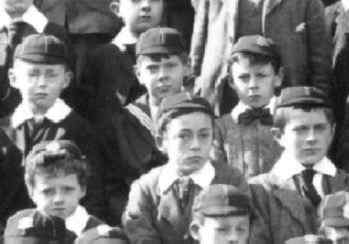
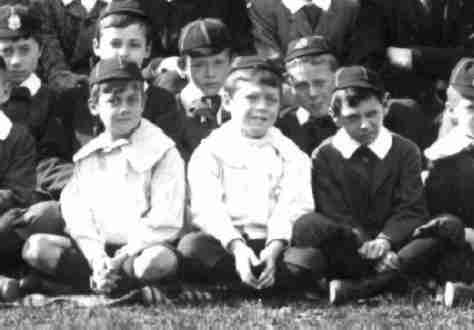
The clothing list at private schools schools could be amazingly extensive. State schhols did not haveb uniforms, but bschoolwear trends were influenced by the private schools. As school portaits became an established convention we have a substanial photograpic record to work with. Caps were almost always worn. The peaked cap was a standard. Boys at some schools wore the rather unpractical boater. Jackets varied. Eton and Norfolk jackets were the most common. Some of the younger boys might wear their sailor suits which were very popular at the time. Some schools, primarily the private schools, required the boys to wear knickers and long stockings or kneesocks. Perhaps more imprtantly such trousers were the ordinary boys' style and thus schools did not have to require that they be worn to achieve uniformity. Most boys wore their suit suits with white stiffly starched Eton collars. Many schools did insist on Eton collars, but again this was not always necessary. Many parents simply saw the Eton collar as a necessary element of good dress and would have not thought about sending their sons off to school without a crisp white Eton collar. At private boarding schools the Eton collars were provided the boys and they were expected to wear them. There was often an extensive list of sports clothing. Blazers were still primarily worn for games (sports).
It is interesting to dress what school boys wore in other countries during the late 19th century.
Many French boys in the late 19th cebtury wore smocks and berets to school. I believe this was a stanfard set by the national government after a new republican government steeped in equality replaced Napoleon III as a result of France's defeat in the Franco-Prussian War. Sailor suits were also much more common for schoolwear than in England.
Sailor suits were particularly popular in Germany and were often worn to school during the late 19th century.
I do not yet have any information on 19th century Italian schoolwear, but would be interested in any insights from HBC readers.
American schoolwear during the late 19th century was similar English styles. American boys more commonly wore sailor suits, but not as much as in Germany. Norfolk suits were also common as were Eton collars, but not as much as in England. There were significant differences in American between urban and rural schools. Dress in rural schools was often work clothes. In many cases rural boys did not have a dress suit, thus overalls would be commonly worn.
Careful, clicking on these will exit you from the Boys' Historical Clothing web site, but several are highly recommended

Related Chronolgy Pages in the Boys' Historical Web Site
[Main Chronology Page]
[The 1880s]
[The 1930s]
[The 1940s]
[The 1950s]
[The 1960s]
[The 1970s]
[The 1980s]
Related Style Pages in the Boys' Historical Web Site
[Main English 19th century school page]
[Main school uniform page]
[Long pants suits]
[Short pants suits]
[Socks]
[Eton suits]
[Jacket and trousers]
[Blazer
[School sandals]
Navigate the HBC School Country Pages
[Main School Uniform Page]
[Australia]
[England]
[France]
[Germany]
[Italy]
[Japan] [New Zealand]
[Scotland]
[United States]
Navigate the Boys' Historical Clothing Web Page
[Activities]
[Chronology]
[Clothing styles]
[Countries]
[Debate]
[Economics]
[Garment]
[Gender]
[Hair]
[History]
[Home trends]
[Literary characters]
[School types]
[Significance]
[Transport and travel
[Uniform regulations]
[Year level]
[Other topics]
[Images]
[Links]
[Registration]
[Tools]
[Return to the Historic Boys' School Home]