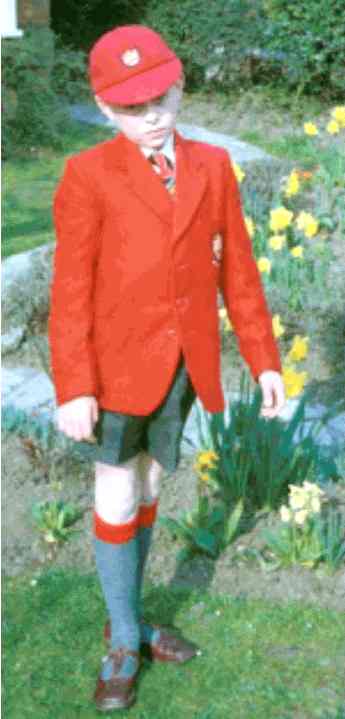
Figure 1.--This boy attended the Clare House Preparatory School un 1962. He wears the classic prep school uniform of cap, blazer, tie, grey short pants, kneesocks, and school sandals. Click on the image to see the school crest. |
|
Many prep schools were established in the late 19th Century just as uniforms were becoming established and many new public schools were being opened. Like the public school, the preparatory school had a dautingly long list for the boys school kit. The games (sports) items could be especially involved. But also people in the late 19th and early 20th century dressed up much more than is the case today. Many prep schools were quite strict about the uniform and how it was worn. The standard prep school uniform in the mid-20th century included a cap, blazer, tie, jumper (sweater), grey or white long-sleeved shirt, grey short trousers, kneesocks, and school sandals. Headmasters often viewed the boys as walking advertisements for the school and insisted that the boys wear the uniform correctly. Different headmasters had different ideas on this. One contastant refrain at many schools was "Pull your socks up, boy". The kneesocks the boys wore had the constant tendency to fall down to their ankles. The uniform has been significantly simplified at the modern prep school, but it is still given substantial emphasis at many schools. The uniform has been significantly simplified at the modern prep school, but it is still given substantial emphasis at many schools.
Several English public (private boarding) schools are centuries old. They accepted boys of a wide age range. Preparatory schools are much more recent in foundation. The first prep schools appeared in the mid-19th century to provide for the needs of younger boys. Public schgools at he time were rough places, often dangerous for younger boys.
Many new public schools were founded in the mid-19th century to meet the needs of an expanding Empire. Reforms improved standards at the schools. Most of the new schools had uniforms, often more modern than the the older scholls. Many prep schools were established in the late 19th Century just as uniforms were becoming established. The prep schools were designed for young boys and to prepare them for the public schools. Most attempted to follow the organization and ethos of public schools. At the time most public schools had uniforms, in many cases very strictly enforced uniforms. The Eton school unifirm was the most famous. Most of the schools seem to have standard sack suits. Eton collars in particular were very common. We also see a lot of boys wearing knickers. As best we can tell the uniforms at prep schools were more informal, although out 19th century archice is limited. Many prep schools seem to have had more dress codes than strict uniforms. The small size of many prep schools may have been a factor here as well as the lack of tradition at school new schools. Like the public school, the preparatory school had a dautingly long list for the boys school kit. The games (sports) items could be especially involved. But also people in the late 19th and early 20th century dressed up much more than is the case today. We begin to see sandardized uniforms more commonly by the tutn-of-the 20th century. Long pants suits seem common as well as the pervadive Eton collar. Prep schools were quite strict about the uniform and how it was worn. By the 1910s we begin to see more boys wearing knee pants, but knickers do not seem very common. We note both long stockings and knee socks. A major change occurred ad=fter World war I (1914-18). Wesee most schools afopting short panbts uniforms. School sabdals also became added to the unifrm. The standard prep school uniform in the mid-20th century included a cap, blazer, tie, jumper (sweater), grey or white long-sleeved shirt, grey short trousers, kneesocks, and school sandals. This continued well after World War II (1939-45). Schools began adopting more simple uniforms (1970s). This reflected changing dress standards as well as cost factors. Quite a number if prep schools closed. We also see more boys wearing long pants at the schools.
Virtually all prepratory schools require uniforms. Most early prep schools in the 19th century did not have uniforms. We have seen several ptep schools in the early 20th century that did not have uniforms. After the turn of the 20th century, however, the trend at most prep schools was to adopt uniforms. The number of prep schools without uniforms dropped sharply during the 1910s. Virtually all prepschools by the 1920s had uniforms. There are currently a few that do not, but the number is extrmely small.
Prep schools have varied greatly over time as to the formality of the uniform. Uniforms were once very formal. The Eton collar was widely worn until after World War I (1914-18). Through the 1950s most prep schools has rather extensive, formal uniforms. Ties were worn at virtually all schools. This began to shift in the 1960s. Quite a bnumber of prep schools adopted more casual uniforms. Caps became less common. The major change was in the every day uniform. Boys mostly wore sweaters and shirts in class. Blazers were rarely worn during the day. Some schools began dropping the tie for everyday wear, but this varied from school to school. A few schools adopted a more casual corduroy uniform, but even these schools usually required a tie.
Headmasters often viewed the boys as walking advertisements for the school and insisted that the boys wear the uniform correctly. Different headmasters had different ideas on this. One contastant refrain at many schools was "Pull your socks up, boy". The kneesocks the boys wore had the constant tendency to fall down to their ankles.
Boys at English prep schools wore a variety of garments, although there were many similarities. This has changed over time as well as depending on the activity involved. Schools usually had an everyday uniform, especially after World War II. There was often a uniformn for special events. Sometimes this just meant wearing a white rather than a grey shirt or oxfords rather than sandals. Some schools, however, had an entirely different uniform, often a suit rather than a blazer. There were also gym and sports items. Some of the basic garments commonly worn at prep schools have included peaked caps, blazers, white abnd grey shirts, sweaters, short pants, kneesovks and school sandals. Many other garnents have been worn. Several scghools adopted corduroy uniforms. The popularity of these and other uniform garments has varied substantially over time. Eton collars were once de regure, but largely disappeared in the 1920s. Caps were once worn by nearly all boys, but are now worn at only a few schools. Most boys once wore short pants, but long pants are now more common, especially for the older boys.

Related Chronolgy Pages in the Boys' Historical Web Site
[The 1880s]
[The 1930s]
[The 1940s]
[The 1950s]
[The 1960s]
[The 1970s]
[The 1980s]
Related Style Pages in the Boys' Historical Web Site
[Long pants suits]
[Short pants suits]
[Socks]
[Eton suits]
[Jacket and trousers]
[Blazer
[School sandals
Navigate the HBC Schools Section
[Return to the Main English Prep School Uniform Type Page]
[Australia]
[England]
[France]
[Germany]
[Italy]
[Japan]
[New Zealand]
[Scotland]
[United States]
Navigate the Boys' Historical Clothing Web Page
[Activities]
[Chronology]
[Clothing styles]
[Countries]
[Debate]
[Economics]
[Garment]
[Gender]
[Hair]
[History]
[Home trends]
[Literary characters]
[School types]
[Significance]
[Transport and travel
[Uniform regulations]
[Year level]
[Other topics]
[Images]
[Links]
[Registration]
[Tools]
[Return to the Historic Boys' School Home]