|
English preparatory schools are elementary-level schools, generally for boys 8-13 years of age. (There are also girls' and coed prep schools, but the girls often leave for their public schools at age 11.) They are called preparatory schools as they were created to prepare younger boys for the public schools. The public schools in the 19th Century could be and often were very rough places. Many had no definite age for accepting children, but were not generally suitable for younger boys. The prep schools were mostly set up as boarding schools and persued an academic and sports program designed to hrlp the boys do well at their public school. Many prep schools were established in the late 19th Century just as uniforms were becoming established and many new public schools were being opened. Like the public school, the preparatory school had a dautingly long list for the boys school kit. Many prep schools were quite strict about the uniform and how it was worn. Headmasters often viewed the boys as walking advertisements for the school and insisted that the boys wear the uniform correctly. The uniform has been significantly simplified at the modern prep school, but it is still given substantial emphasis at many schools.
English preparatory schools are primary-level schools which extend into the early secondary level. Generally prrp schools are for boys 8-13 years of age. (There are also girls' and coed prep schools, but the girls often leave for their public schools at age 11.) The schools are called preparatory schools as they were created to prepare younger boys for the public schools. English preparatory schools are destinct from American prep schools which are secondary schools--more like English public schools. The prep school program is geared to the public school program. Often prep schools send most of their pupils on to a single or to a few nearby public schools. They commonly coordinate closely with these schools to ensure that the children are well prepared. Most earrly prep schools were boarding schools situated in rural areas. This has changed since World War II. Boarding is now less important than it once was. And a real advantage for modern prep schools is to be located in or near major populstion centetrs.
England's public schools (elite private boarding schools) could be and often were very rough places. For several centuries there were no clear age at which boys were asdmitted. Thus you have a much wider age range than is the case at today's public schools. Many had no definite age for accepting children, but were not generally suitable for younger boys. And few schools made serious provision for the younger pre-teen boys at the schools. With the advent of the 19th century and the changes wrought by the industrial revolution, the growing middle-class began to become concerned aboutt a range of social issues such as child land women's labor. Among the social issues of concern was education. England began building a state educatuin system and the publication of Thomas Hughe's John Brown's School Days (1857) helped promote major changes at these very traditional schools. One was the standardization of admission ages. This begame set at about 13-years of age at most of the schools. At about the same time we see preparatory schools appearing for the younger boys. They weredesigned to prepare the yonger boys for the rigors of public school life, hence the term preparatory. . Here age levels varied, but 8 years of age begame the common age of entry. The prep schools were mostly set up as boarding schools and persued an academic and sports program designed to help the boys do well at their public school. Early schools were founded as private schools by headmasters of varying backgrounds who often owned the school. From these early foundations, most of the schools have evolved into charitable trusts. This was a process that often followed the retirement of the original owners. Charitable trusts offered importznt tax bnefits.
Educators began founding preparatory schools in the mid-19th century. The purpose was to provide a safe envuiroment for younger children while prepring them for the public schools. Most public schools were founded as boarding schools. Over time the tradition of boarding school education became firmly etrenched in British education. Boarding became more important in England than any other country. Quite a number of the public schools date to the 19th century when Britain was expanding its educational system to train administrators and technicials for its huge overseas empire. It was at this time that preparatory schools began to appear. Public schools originzlly taught boys of varying age, some quite young. Public schools could be very rough places, especially for younger boys. Educators by the early 19th century increasing realized that the educational needs of the younger boys required a school specifical suited for their needs. Thus the preparatory school was created, a school designed to prepare boys for the public schools. Boardoing continued to be the predominant pre-school approach for parents who could afford it. This did not begin to change until well after World War II when parents began to question the appropriteness for younger children.
The primary purpose of a prep school is to prepar the boys for the public schools. And an important part of public school life was the boarding house. These were grops of boys from each form that boarded together, commonly in aseparate houses on camus. Which of course is why they are called houses. This worked well with teenage boys. In a properly run houses with an housemasrer and wife, the older boys were a positive influence on the younger boys. This arrangement, however, did not suit the youngr prep school boys. Prep schools attempted to replicate thepublic school environment, this included boarding, games and many other aspects. Boarding houses were, however, a rare exception. Boarding arrangements in the prep schools wre sone by age groups. This facilitated both sleeping arrangements and going to bed rotines in the evening. A few prep schools had a boarding house for the older boys, but this was not very common. Houses existed in prep schools, but they were not boarding houses. Rather they were artificial divisions of the schools for purposes of various intra-school competitions in sports, accademics, and other matters. This proved useful in inspiring the boys who are found of competitins, especially in athletics. At many schools the children wore identifying marks of the houses such as colored knee socks flashes or pins.
The traditional preparatory school was for boys 8-13 years of age. This was a general standard. Some boys began at an earlirt age, but boys younger than 7 were not common. The older boys usually began the last year at age 12, but most turnefd 13 by the end of the school term. Only occassionaly were boys still at the chools by age 14. This age range became standardized when public (elite secondary) schools began standardizing the entry age at 13. Modern prep schools have a somewhat more complicated age range. This is because to guarantee a more steady entry rate and to prepare the boys for prep school, many prepschools opened pre-prearatory schools. Thus some prep schools have programs beginning at age 4-5 years old. The age range for girls is some what different. Many girls' public schools have a program behinning at age 11. Thus some girls often left their preparatory school earlier than boys. This is why coed [rep schools often have fewer girls in the last 2 years. Another complication is that some public schools have internal prep sections. Often these schools mirror the state system and move the children from the primary (junior) to the secondary (senior) section at age 11 or 12. Prep school boys going to these schools might make the move at ahe 11-12 so they start the secondary program at the same time as the boys from the schools internal junior section.
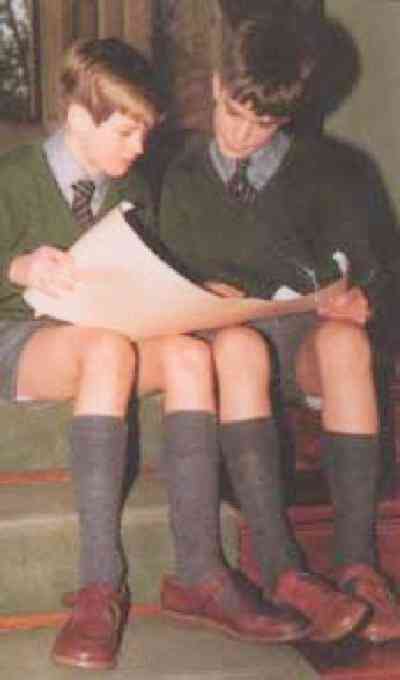
Many prep schools were established in the late 19th Century just as uniforms were becoming established and many new public schools were being opened. Like the public school, the preparatory school had a dautingly long list for the boys school kit. The games (sports) items could be especially involved. But also people in the alte 19th and early 20th century dressed up much more than is the case today. Many prep schools were quite strict about the uniform and how it was worn. The standard prep school uniform in the mid-20th century included a cap, blazer, tie, jumper (sweater) greybor whaite long sleeved shirt, grey short ants, kneesocks, and school sandals. Headmasters oftn viewed the boys as walking advertisements for the school and insisted that the boys wear the uniform correctly. Different headmasters had different ideas on this. One contastant refrain at many schools was "Pull your socks up, boy". The kneesocks the boys wore had the cobstant tendenvy to fall down to their ankles. The uniform has been significantly simplified at the modern prep school, but it is still given substantial emphasis at many schools.
The primary reason for sending boys to prparatory schools was to prepare the boys academically and athletically for the public sdchools. A very important factor was also that parents wanted their sons to speak and behave properly. Boys were taught to speak proper English and loose their regional accents--still quite pronounced n England. While the moden preparatory school is less concerned with eliminating accents, they are still very concerned with promoting proper behavior, Boys are taught to say sir and miss. They were required to tip their caps. While hat tipping is less common--primarily because of caps are less abnd less common, other elements of proper behavior such as stanfing when the teacher ebters the room and opening doors are still promoted.
Games or sport was a major focus at prep schools and cntunues to be today. Games were important at most public schools and thus the prep schools had to prepare the boys for the games played at the public schools to whic they sent the boys. There was a class element here. While cricket in England spanned the classes, football did not. Curiously it was the rough and tumble of rugby that was adopted by the English upper class and most public schools. Many schools had no fottbal (soccer) programs and many had school rules prohibitong the boys from kicking a ball to make sure they were not corrupted by a working class game.
Most of the prepsaratory schools were single gender schools. Thus therec were boys and girls prep schools. There were a handful of coed schools, but most parents wanted to send their children to single gender schools. Not only were most prep schools single gender schools, but there were many more boys' schools than girls schools--especially bosarding schools. This was because parents were more concerbed about educating their sons and were less willing to send their daughters away to school. This difference continued through the 1950s. There are images showing a few girls at boys' prep schools. (There are fewer images showing boys at a girls' school.) The girls involved are normally the children of the head master or other msters, In some cases local girls in a rural area may be allowed. This single gen\nder approach began to change in the 1970s. There does not appear to have been a reassessment of educational apoprosach involved. Rather economic conditions created problems for fee paying schools, msnu of which became desperate to recruit new students. At the same time the complications for families to deal with two or three schools at the same time created a desire to find a coed school. At the same time parents were changing their attitudes toward coeducation.
Early private boarding schools were of a religious foundation and many of the masters (teachers) were clerics (16th century). The religious connection was Aglican meaning the Church of England. As far as we know there was no provision made for other religions. Religion at this time was a very important matter, in some cases life and death matters. Catholics and discenting sects did not have full civil rights for several centuries. Over time this changed. And by the mid-19th centurty when preparatory schools began to appear, the relgious issues had been largely settled. Most of the prep schools had Anglican connections, but we begin to see some schools with Anglican and other connections. And we begin to see schools making accommodationd for children of other faiths. This includes both non-Anglican Brits and even some non-Christian children from the Empire. This process continued in the 20th century with increasig tolerance and accomodation. Schools had religious instruction and mandatory attendance at religious services. The schools today are sympathetic to religion and other cultural differences. Of course this varies from school to school. Accomodation today is commonly made in such matters as dietary requirements, specific times and places of prayer and worship, particular clothing, and a general accommodation of non-Anglican practices. And in recent years these schools have been affected by the increasing secularization of society. English schools today, including those of a religious foundation, routinely accept children from a wide range of faiths. A change has occurred in modern times was that there was an educational benefit, added to the breadth of educational experience.
One reader reports, "The images in HBC appear very familiar to me from the time of my own school days. The uniforms are the same, as are the classrooms and desks and even the boys themselves seem to be familiar as though I'm looking at pictures of my own school chums. I've been astonished with the memories that your photographs have invoked in me. Long-forgotten images have sprung up in my mind such as the carvings I made on a desktop lid or the Bakelite inkwells that always seemed to be broken. Pinning school timetables to the underside of desk lids with drawing pins (thumb tacks) and catching the backs of one's legs on the splintered edges of the wooden seats. 'Duffle' coats that were very warm and cosy and leather satchels with well-worn straps and buckles and a home address and telephone number stencilled in under the flap. Rain dripping off the peaks of school caps and sodden socks. Struggling to get the school tie just so--the 'big end' tip just below the waistband of the trousers. T-bar sandals that were a joy to wear new but the white soles quickly grew dirty and the uppers were easily scuffed. Scarves in the school colours that our Mothers made us wear in cold weather despite it being viewed as 'sissy' by one's peers. At night in the dormatories trying to sob away the awful despair of homesickness as silently as possible lest we be ridiculed by the 'hard kids' or punished by the house master for not being asleep. Changing over to ankle socks from knee socks in the Summer term showed just how white calves could get compared to tanned knees and thighs."
The classic English preparartory school uniform was worn by perhaps the most famous prep school boy--Jennings. Jennijngs and his mates attended Linbury Court Preparatory School. Jennings as he was usually referred to is a prep school boy. (Although elementary age boys, they used their last names.) In fact I do not even know what his first name was. The other famous schoolboy was of course William Brown, a boy a generation earlier who went to who went to a state elementary school. Of course William by the time the Jennings book were written, old enough to be Jenning's father--a challenging thought.
Most prep school boys take the Common Entrance Examination for admission to public (exclusive private) schools. Public schools use to have their own individual examination. A few still do. Most now accept the results of a common examination. This is a test of the basic foundation knowledge, required to enter a public school. There is a minimum pass mark (it's slightly flexible.) Fail miserably and you will not get into the school of your choice. some boys will end up applying to several public schools, before being accepted or not. It can be one of the most traumatic times in some boys lives. All the boys, taking this exam, will have some nerves, and in some cases this will affect performance. I am not sure where the boys take these examinations. The boys here look to be from several diffeent schools with different uniform regulations. Some boys had to wear their formal chool uniform. Other schools allowed the boys take the exam in casual clothing.
Related Links: Careful this will exit you from the Boys' Historical Clothing web site, but both sites are highly recommended
Apertures Press New Zealand E-book: New E-book on New Zealand schools is available
School Uniform Web SiteInformative review of British school uniforms with some excellent photographs
Boys' Preparatory Schools: A lovely photographic essay on British Preparatory Schools during the 1980s with over 200 color and black and white photographs.

Related Chronolgy Pages in the Boys' Historical Web Site
[The 1880s]
[The 1930s]
[The 1940s]
[The 1950s]
[The 1960s]
[The 1970s]
[The 1980s]
Navigate the Boys' Historical Clothing School Uniform Pages
[Main English School Uniform Type Page]
[Australia]
[England]
[France]
[Germany]
[Italy]
[Japan]
[New Zealand]
[Scotland]
[United States]
Navigate the Boys' Historical Clothing Web Page
[Activities]
[Chronology]
[Clothing styles]
[Countries]
[Debate]
[Economics]
[Garment]
[Gender]
[Hair]
[History]
[Home trends]
[Literary characters]
[School types]
[Significance]
[Transport and travel
[Uniform regulations]
[Year level]
[Other topics]
[Images]
[Links]
[Registration]
[Tools]
[Return to the Historic Boys' School Home]