
Children's Footware: Overshoes
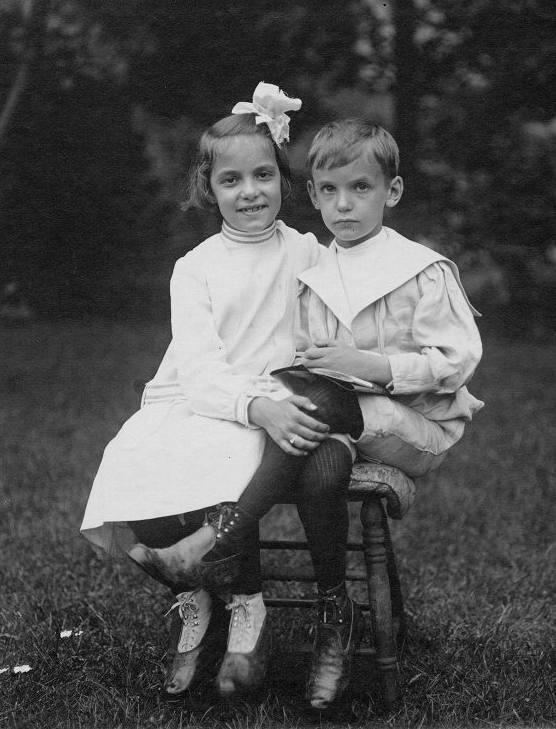
Figure 1.--Here we see a snapshot American twins in 1904. Note that both children are wearing rubbers over their high top shoes. Presumably in rained in the morning, although the grass does not look wet. But I doubt if they put on the rubbers just for show. These children are the Spencer twins from a prominent Pittsburgh family. Their nanes are Charles and Elizabeth and were about 9-years old.
|
|
Overshoes are protective footwear worn over the shoes to prevent them from being ruined by mud and rain. There have been different types of overshoes. Some looked rather like boots, especially galoshes. Wellies were even called boots. The key difference was that with overshoes you kept your shoes on while boots were footwear themselves and not worn with shoes. Boot like overshoes were called galoshes. Ones for shoes were called rubbers. Galoshes were commonly worn by boys. Rubbers were more common for men. Overshoes were not very popular with chidren--primarily because of the bother associated with oputting them on and taking them off.
Purpose
Overshoes are protective footwear worn over the shoes to from being ruined by mud and rain. This was very important before the 20th century when sidewalks and paved streets were not very common.
Types
There have been different types of overshoes. Some looked rather like boots, especially galoshes. Wellies were even called boots. The key difference was that with overshoes you kept your shoes on while boots were footwear themselves and not worn with shoes. Wellies were very popular iun Britain. American children were more likely to wear galoshes.
Galoshes
Galoshes are ancient in origin. The Romans had leather galoshes. Modern galoshes are rubberized canvas Some are plastic. Galoshes are made to look like boots and were called galoshes. Ones shaped more like shoes were called rubbers. Galoshes were commonly worn by boys. Mothers insisted children wear galoshes to school in rainy wearher. This was to make sure both that their feet did not get wet and also to protect the shoes. Often children were irritated by all the bother involved. Mom put them on before sending the kids off to school. At school it was a different matter. The kids had to restle them iff and even more irritaing, put them back on for coming back home.
Overshoes
Overshoes are almost as old as shoes themselves. Medevil cobblers created leather overshoes which protected shoes and feet. Leather shoes were quite expensive and often delicate. The protective overshoes were called a "pattens". They were commonly worn in the 14th and 15th centuries. They consisted of a block under the heel and additional one under the ball of the foot. These blocks raised the shoe above the ground and was fastened on with straps. Thus the expensive shoe was raised above the muddy streets. Designs of overshoes adopted to cghanging styles of shoes. Overshoes were not very popular with chidren--primarily because of the bother associated with oputting them on and taking them off.
Rubbers
Rubbers are of course rubberized overshoes. They were made to just cover the shoes, but not to oprovidedadded protection. are to ankle level. They are a type of galoshes. We are not sure just when rubbers first appeared. I must have been some time in the late-19th century. It is not well-covered in the photographic record because rubbers were generally removed before the portrait was taken. We begin to ee them as soon as snapshots were invented at the turn-of-the 20th century. Galoshes include rubberized rainwear rather like a boot to completely cover shoes in the rain. Rubbers are a smaller version. They slipped over the shoes like large galoshes, but only covered part of the shoe. If the shoe was low-cut oxfords, rubbers covered most of the shoe. If they were high-top shoes, they just covered the bottom part of the shoe. Of course this was the part most likely to get wet in the rain. The shape of the rubbers varied. There wee different suizes and shpes to accomodate the dufferent popular shoe shapes of the time. Rubbers were particularly important when shoes were almost all leather and expensive in relative terms. Rubbers unlike larger galoshes did not have any closing devives, they simply slipped on the shoe. I rember when I went to school in the late-1940s and early 50s, that mom always insisted on galoshes when it rained and I hated them. I think most of us kids had galoshes. Dad always wore rubbers when it rained. They were easier to put on and take off, but did not provide enough protection for boys prone to jump into puddles. That is probably why rubbers were less common for children. Rubbers have generally gone out of fashion and are today much less common than they were in the firt half of the 20th century.
HBC

Navigate the Historic Boys' Clothing Web Site:
[Return to the Main footwear page]
[Introduction]
[Activities]
[Biographies]
[Chronologies]
[Countries]
[Style Index]
[Bibliographies]
[Contributions]
[FAQs]
[Glossaries]
[Images]
[Links]
[Registration]
[Boys' Clothing Home]
Navigate the Historic Boys' Clothing Web chronological pages:
[The 1800s]
[The 1940s]
[The 1880s]
[The 1900s]
[The 1920s]
[The 1930s]
Navigate the Historic Boys' Clothing Web style pages:
[Skelton suits]
[Tunics]
[Eton suits]
[Kilts]
[Sailor suits]
[Knicker suits]
[Short pants suit]
[Long pants suits]
Created: July 15, 1998
Last updated: 9:24 PM 1/22/2012