
American Boys' Peaked Caps
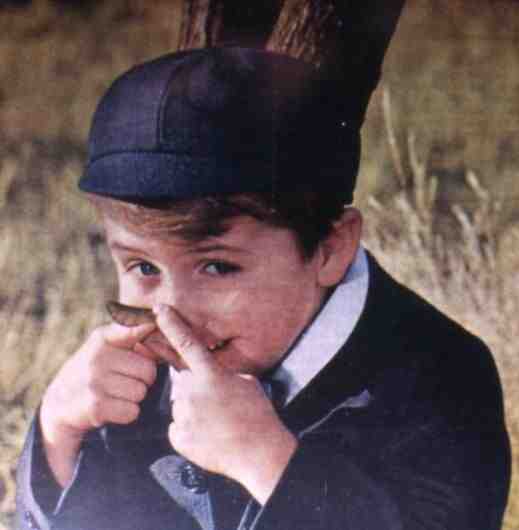
Figure 1.--A well dressed American boy in the 1940s and 50s usually wore a peaked cap with a suit, especially an Eton suit. This image comes from a 1970s magazine advertisement. Notice the seam down the front center. British peaked caps always had the seams offset so there was a pannel at fron where a school badgecould be placed.
|
|
Well dressed American boys wearing suits in the 1920s-30s, began wearung solid colored peaked caps. This was less common in Britain as boys were more likely to wear their school caps. Peaked caps were not extensively worn at American schools wear boys did not normally uniforms, but beginning in the 1920s as sailor caps declined in popularity, well dressed boys began to wear peaked caps in colors matching their suits. The peaked cap was worn in America before the 1920s. While it was a popular style, it was not a dominate style. The peaked cap was especially common with the Eton suit worn by younger boys in America. Many American mothers considered it a necessary finishing touch for the Eton suit. Even after graduating to more mature style suits, however, a well dressed American boy from an affluent family might continued to wear a peaked cap until 12 or even 13 years old. These caps were especially common as part of any formal outfit.
Well dressed American boys wearing suits in the 1920s-30s, began wearung solid colored peaked caps. Remember that headwear were very commonly worn in through the early 1950s. Any wide spread gathering would show men and boys wearing hats and caps. Hat were considered more appropriate for formal occasions in the early 1900s until after World War I (1914-18), but by the 1950s, hats were increasingly being seen as inappropriate for boys and this peaked cap was the most formal headwear worn by boys.
Trends in other countries differed from American trends. Peaked hat were less commonly worn in Britain other than as schoolwear. The style was very strongly associated with school wear. caps. The style was even less common on the Continent. Convnetions and the popularity of the peaked cap varied greatly from country to country. The peak cap first appeared in Britain and from the beginning was strongly associated with schoolwear. The major exception was Cuubbing. The peaked cp was chosen as the style for the Wolf Cub program. Many other countries subsequently used the peaked cap for their Cub program. We note them in America during the late 19th century. They were not as strongly associated with school wear in America and conventions varied over time. They were also worn in Europe, but the popularity varied widely from country. The association with Britain was probabky a fctor. They appear to have been especially popular in the Netherlands. The peaked cap was also widely worn in British Empire countries.
The peaked cap first appeared in Britain during the mid-19th century as a sport or games cap. We do not see them in America until the 1880s, although they could have crossed the Atlantic a little earlier. We do see boys wearing these caps with Fauntleroy suits and kilt suits in the 1880s. It waa one of many types of headwear wirn with these outfits. They were popular at the turn of the 20th century for boys of all social classes. Flat caps eclipsed the peaked cap in the 1910s. Peaked caps were not extensively worn at American schools. By the 1910s we mostly see flat caps. And American boys did not wear school uniforms. Beginning in the 1920s as sailor caps declined in popularity, well dressed American boys began to wear peaked caps in colors matching their suits. The peaked cap was worn in America before the 1920s. While it was a popular style, it was not a dominate style. Ny the 1940s, the peaked cap was the style for American boys to wear with a suit. This continued until the late 1950s when it became less common to wear caps and hats. Even so, an American boy wearing an Eton suit would commonly wear an Eton cap.
We see boys wearing peaked caps with a variety of outfits. It was a cap style commonly worn with suits. This was because it was so common to wear suits in the late-19th century. We see it being worn with different styles of suits, including styles not commonly associated with it. Younger boys might wear it with a Fauntleroy suit. An exception was the sailor suit, perhaps because their sailor headwear styles. Basically the peaked cap was worn with whatever suit style was popular at the time. It was a widely worn cap style at the turn-of-the 20th century. Gradually the peaked cap came to be seen as more of a upper-class style. We are not entirely sure of the nechanism at wiork here. We also note peaked cap that match the material and color of the suit. The peaked cap was especially common with the Eton suit worn by younger boys in America. Many American mothers considered it a necessary finishing touch for the Eton suit. Even after graduating to more mature style suits, however, a well dressed American boy from an affluent family might continued to wear a peaked cap until 12 or even 13 years old. These caps were especially common as part of any formal outfit. The peaked cap was especially common with short pants suits.
Colors
We note peaked caps were worn in colors and materials matching a boys suit or in colors which were used for suits. The most common colors were grey, blue, and black. Some white caps were also worn. We do not see bright colors except as school caps. This is a little difficult to follow because until the 1970s we are nostly dealing with black-and-white photography.
Style
The style of the peaked cap was fairly standard, but there were variations. The major variarion was the size of the peak which for formal suits could be quite small. Other variaions was the size o the crown and the possible addition of a fabric-covered button top.
Construction
Notice the seam down the front center. British peaked caps always had the seams offset so there was a pannel at fron where a school badgecould be placed.
These caps are called school caps in Britain because they were so widely wirn by school boys. This was not the case in Anmerica, but we do see them worn at school. We note both uniform and non-uniform school caps. The peaked cap was one of several cap styles boys wore at the turn-of- the-20th century century which meant that some boys wore them to school. They were generally replaced by flat caps with became rhe dominant cap style (1910s). The peaked cap was also worn as a uniform item at a number of private schools. These were a realtively small nummber of toney northeastern schools that emulated the British system, including the uniform. Many American private schools were founded in the mid- and late-19th century. They commonly adopted the uniforms worn at British public (private boarding) schools. One of the items adopted was the peaked cap. This was used both for the basic uniform and also as a games (sports) cap. The sports cap in particular was commonly dione in bright colors or circular patterns.
HBC

Navigate the Historic Boys' Clothing Web Headwear Pages:
[Return to the Main peaked cap country page]
[Return to the Main peaked cap page]
[Return to the Main headwear page]
[Caps]
[Hats]
[Berets]
[Hair]
Navigate the Historic Boys' Clothing Web chronological pages:
[The 1880s]
[The 1890s]
[The 1900s]
[The 1910s]
[The 1920s]
[The 1930s]
[The 1940s]
[The 1950s]
[The 1960s]
[The 1970s]
[The 1980s]
Navigate the Historic Boys' Clothing Web Site:
[Introduction]
[Activities]
[Biographies]
[Chronology]
[Cloth and textiles]
[Garments]
[Countries]
[Topics]
[Bibliographies]
[Contributions]
[FAQs]
[Glossaries]
[Images]
[Links]
[Registration]
[Tools]
[Boys' Clothing Home]
Created: March 20, 2000
Last updated: 9:04 PM 3/14/2013